
EdTech Books
Product by EdTech Books
Facts checked: Not yet checked
Our take (not a Learning Standard rating). This label applies to learning-science judgments throughout this overview.
Our take (not a Learning Standard rating)
EdTech Books serves as an open-access library rather than an interactive tutor, meaning its educational effectiveness depends entirely on how the texts are used. While it removes financial barriers to high-quality academic content, it lacks built-in retrieval practice, spaced repetition, or active learning mechanics to independently drive student mastery.
Pros
- Grants free access to peer-reviewed academic content across multiple disciplines.
- Allows educators to remix and adapt texts to align directly with specific curriculum goals.
- Supports offline reading capabilities to ensure equitable access without continuous internet reliance.
- Eliminates the cognitive overload often found in commercial textbooks by prioritizing clean reading interfaces.
Cons
- Lacks interactive retrieval practice or self-assessment tools to test comprehension.
- Does not adapt content difficulty to match individual reading levels or prior knowledge.
- Offers no built-in spaced repetition mechanics to help learners retain complex information over time.
- Provides zero feedback on student engagement or understanding, requiring educators to assess learning externally.
What Do We Know About EdTech Books?
EdTech Books is highly effective as a content delivery system but requires external instructional support to guarantee actual learning. Your child will not find interactive quizzes, adaptive learning algorithms, or gamified rewards here. Instead, this platform functions as a digital library of open educational resources. Because it relies heavily on passive reading, its success hinges on how well your child can self-regulate and apply active reading strategies. Learning science clearly shows that passive reading produces lower long-term retention compared to active recall. Therefore, educators and parents must supplement these texts with external retrieval practice, such as flashcards or structured discussion. The platform excels at removing financial barriers, offering high-level texts in early childhood education, humanities, and sciences completely free of charge. However, The Learning Standard has not yet rated this platform for specific pedagogical efficacy. If your child is in a classroom that uses EdTech Books, expect them to use it exactly as they would a traditional physical textbook. You will need to actively check their understanding through direct questioning, as the platform will not track their progress or flag areas of confusion.
How Does EdTech Books Work?
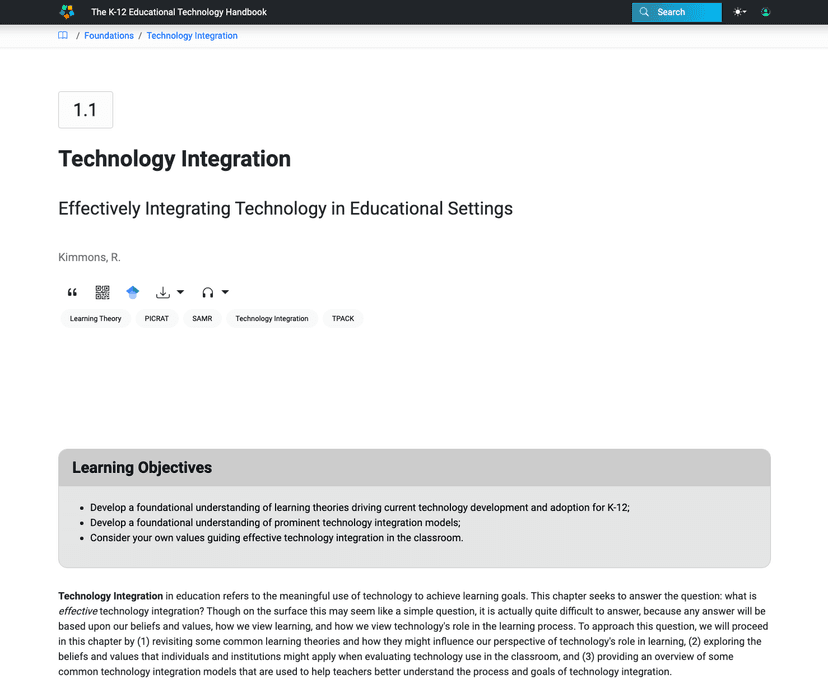
EdTech Books utilizes an open-source, passive-reading pedagogical approach where learners consume educator-curated texts at their own pace. The platform functions as a centralized repository where authors and educators publish, share, and remix digital textbooks. Users navigate through chapters of text, embedded images, and academic journals much like a standard website. Educators have the power to clone existing textbooks and edit them to remove extraneous cognitive load, tailoring the material precisely to their syllabus. Students then access these customized texts via direct links. There are no logins required to read, no progress bars, and no locked modules. The learning mechanics are entirely text-based and rely on the student's intrinsic motivation and prior knowledge to decode and process the information. Because there are no built-in knowledge checks, the burden of applying learning science principles falls on the instructor. Teachers must design their own assignments, discussion prompts, and formative assessments to ensure students are actually processing and retaining the material presented in the EdTech Books interface.
Strengths and tradeoffs of EdTech Books
The biggest strength of EdTech Books is its deeply customizable open-access library, while its biggest weakness is the complete absence of interactive learning mechanics like retrieval practice. Flexibility for Educators: The platform shines by allowing teachers to remix content. By editing texts to match their specific instructional sequences, educators can minimize cognitive overload and provide highly relevant worked examples. This customization ensures students only read what they strictly need to know. Accessibility: Because it is entirely free, it removes the friction of textbook costs, ensuring all students have day-one access to course materials. Lack of Active Processing: Learning science dictates that students remember what they actively recall, not what they passively review. EdTech Books offers no built-in quizzing, spaced repetition algorithms, or interactive simulations. Students simply read. No Adaptive Feedback: The platform cannot diagnose misconceptions. If a student misunderstands a concept in a science or humanities text, the platform will not course-correct them. The Learning Standard has not yet evaluated the platform, but its current architecture makes it a powerful tool for content distribution rather than a standalone educational engine.
Who Might Benefit From EdTech Books?
EdTech Books is best for self-directed high school or college students whose educators have specifically curated texts for their coursework. Because the platform spans highly academic subjects like applied science and early childhood education theory, the primary audience skews older. It is an excellent resource for school districts and universities looking to replace expensive commercial textbooks with customizable open educational resources. Younger learners or students who struggle with reading comprehension will find the platform difficult to use independently, as it lacks the scaffolding, multimedia engagement, and immediate feedback necessary to support novice learners through complex new topics.
Data Transparency
Does Not Meet Data Transparency Standard
EdTech Books does not meet our data transparency standard. Its privacy policy does not document basic protections, including a statement that it does not sell data, a commitment against targeted advertising and limits on sharing children's data.
1 of 35 checks passed
Evaluated September 2026
EdTech Books →Level 1 · Basic protections
Does not sell data or target ads at students, limits sharing, and lets parents see and delete their child's data.
Not documented: a statement that it does not sell data, a commitment against targeted advertising, limits on sharing children's data, contractual limits on service providers, a COPPA or FERPA commitment, parents' right to see their child's data, parents' right to delete their child's data, account deletion
Level 2 · Parent control (meets the standard)
Families can get their data out, know who processes it, and know how long it is kept.
Not documented: users' right to access their data, data export, a data retention timeline, named service providers, self-service deletion
Level 3 · Direct data access
Families or schools can pull their own data through an API, in a stated format.
Not documented: an API for retrieving their own data, a named export format
View all 35 checks
Parent Access0/8
Does the policy mention parents specifically?
The policy does not mention parents.
Can parents view their child's data?
The policy does not say whether parents can view their child's data.
Can parents modify their child's data?
The policy does not say whether parents can change their child's data.
Can parents delete their child's account?
The policy does not say whether parents can delete their child's data or account.
Is there a dedicated Children's Privacy section?
The policy has no section on children's privacy.
Does it reference COPPA compliance?
The policy does not mention COPPA.
Does it reference FERPA compliance?
The policy does not mention FERPA.
Is parental consent required for child accounts?
The policy does not mention parental consent; it only says that using the website counts as consent to the policy.
Data Portability0/5
Can users access their personal data?
The policy does not say whether users can access their personal data.
Can users download/export their data?
The policy does not say whether users can download or export their data.
Is there a self-service data access tool?
The policy does not describe a self-service data access tool.
Is a specific data format mentioned for export?
The policy does not name any export format.
Is there an API for data access?
The policy does not mention an API for data access.
Data Minimization1/6
Is data collection itemized?
“The information collected by log files include internet protocol (IP) addresses, browser type, Internet Service Provider (ISP), date and time stamp, referring/exit pages, and possibly the number of clicks.”
Can the app be used without a real name?
The policy does not say whether a real name is collected or needed.
Can the app be used without an email?
The policy does not say whether an email address is collected or needed.
Does it state collection is limited to what is necessary?
The policy does not say that collection is limited to what is necessary.
Is IP address anonymized or truncated?
The policy says IP addresses are logged and not linked to identifiable information, but it does not say they are anonymized or truncated.
Is location tracking explicitly excluded?
The policy does not rule out location tracking and says log data is used for tracking users' movement on the website and gathering demographic information.
Third-Party Protection0/7
Does it explicitly state no selling of data?
The policy does not say that data is not sold.
Are third-party providers named?
The policy refers to hosting companies in general but does not name any third-party provider.
Are providers contractually restricted?
The policy does not describe any contractual limits on providers.
No-targeted-advertising commitment?
The policy makes no commitment against targeted advertising.
Is AI/ML data sharing addressed?
The policy does not address sharing data for AI or machine learning.
Child-specific sharing restriction?
The policy has no sharing limits specific to children.
Cookies/tracking limited or opt-out?
The policy says cookies store preferences and pages visited but offers no limit on them or way to opt out.
Deletion & Retention0/5
Can users delete their account?
The policy does not say whether users can delete their account or data.
Self-service deletion mechanism?
The policy does not describe a self-service deletion tool.
Specific data retention timeline?
The policy gives no specific data retention timeline.
Auto-deletion of inactive accounts?
The policy does not mention automatically deleting inactive accounts.
Post-deletion handling described?
The policy does not describe what happens to data after deletion.
Advertising0/4
Advertising model explicitly disclosed?
The policy does not address advertising.
Free from third-party advertisements?
The policy does not address third-party advertising.
Children excluded from ad targeting?
The policy does not address ad targeting of children.
Ad-free option available?
The policy does not mention advertising or an ad-free option.
What This Means
The policy review did not meet our data transparency standard. The checks above show the documented findings and unknowns. A missing statement does not establish how the app handles data in practice.
About this evaluation: Based on automated analysis of EdTech Books against 35 policy-disclosure questions, including questions adapted from the Common Sense Privacy Program's published evaluation questions. TLS is not affiliated with Common Sense Media, and this is not a Common Sense rating. Quoted text is copied from the policy; unquoted notes are our summary. Results describe what the policy documents, not the company's actual practices. Privacy policies can change: this review reflects the version we analyzed and does not determine legal compliance.
Sources and review method
TLS combines product information and editorial analysis to explain how EdTech Books works, its tradeoffs, and the questions to ask before choosing it. Product features, an instructional rationale and evidence of learning outcomes are different kinds of information.
Formal Learning Standard assessment: not yet completed. Data Transparency findings are reported separately and do not establish learning effectiveness. Read our methodology.
Frequently Asked Questions About EdTech Books
Is EdTech Books free?
Yes, EdTech Books is completely free. It operates as an Open Educational Resource platform, meaning all textbooks, journals, and publications hosted on the site are free to read, share, and remix. There are no paywalls, hidden fees, or premium subscription tiers for students or educators. By eliminating the high costs typically associated with academic publishing, the platform ensures that all learners have immediate, equitable access to required reading materials from the first day of class.
Is EdTech Books good for elementary students?
No, EdTech Books is primarily designed for high school and higher education students. While the platform contains academic texts about early childhood education, these are typically journals and textbooks written for aspiring teachers, not interactive reading materials for young children. Elementary students require explicit phonics instruction, interactive scaffolding, and multimodal engagement to build foundational literacy skills. This platform strictly provides passive academic reading material, making it completely unsuitable as a direct learning tool for young children.
What does EdTech Books teach?
EdTech Books does not teach a single standardized curriculum but rather hosts user-generated textbooks across disciplines including Humanities, Social Science, Science, and Applied Science. The specific content depends entirely on which open-source textbook the student or educator selects from the library. Because it relies on open publishing, the quality and accuracy of the instruction vary significantly from book to book. Educators must independently vet the textbooks to ensure the material aligns with their specific academic standards and learning objectives.
How does EdTech Books vs Khan Academy compare?
EdTech Books is a passive digital library for academic textbooks, whereas Khan Academy is an active, interactive learning platform. Khan Academy uses mastery-based progression, step-by-step instructional videos, and immediate feedback to guide students toward comprehension. In contrast, EdTech Books strictly provides static reading material. It lacks adaptive learning algorithms and requires educators to build their own independent assessments. Choose EdTech Books for free textbook distribution, but rely on Khan Academy for structured, interactive skill building and retrieval practice.
Has The Learning Standard evaluated EdTech Books?
TLS has not yet completed a Learning Standard evaluation of how well EdTech Books teaches. Its privacy policy has been reviewed for Data Transparency and does not yet document the basic protections (Level 1).
Is EdTech Books COPPA compliant?
A COPPA reference was not found in the reviewed privacy policy. This does not determine whether the app complies with COPPA. Policy review note: The policy does not mention COPPA.
Is EdTech Books FERPA compliant?
A FERPA reference was not found in the reviewed privacy policy. This does not determine whether the app complies with FERPA. Policy review note: The policy does not mention FERPA.
Does EdTech Books have a children's privacy policy?
No dedicated children's privacy section was found in the reviewed policy. Policy review note: The policy has no section on children's privacy.
Does EdTech Books sell student data?
A statement ruling out data selling was not found in the reviewed policy. This does not establish that the app sells student data. Policy review note: The policy does not say that data is not sold.
Can you delete your data from EdTech Books?
Account deletion was not documented in the reviewed privacy policy. This does not establish whether deletion is available. Policy review note: The policy does not say whether users can delete their account or data.
Follow TLS Research
Subscribe to future TLS research updates: app reviews, findings, and what the evidence shows.
Screenshots
Take Action
For EdTech Books
If you represent EdTech Books and have a correction or new evidence, send the relevant source so we can review and update this page.
Submit a correctionDetails
- Pricing
- Free
- Platforms
- Web Browser, iOS (Apple mobile), iPadOS (Apple tablet), Android (Google mobile), Windows (Microsoft), macOS (Apple), Chrome OS (Google)
- Website
- Visit site