EdReady
Product by The NROC Project
Facts checked: Not yet checked
Our take (not a Learning Standard rating). This label applies to learning-science judgments throughout this overview.
Our take (not a Learning Standard rating)
EdReady utilizes mastery-based learning to identify and fill knowledge gaps, which aligns with cognitive science principles for building foundational skills. However, because The Learning Standard has not yet evaluated this platform, we cannot definitively confirm its instructional efficacy or the depth of its feedback mechanisms in real-world settings.
Pros
- Employs diagnostic assessments to identify specific knowledge gaps before instruction begins.
- Uses mastery-based progression to ensure students understand foundational concepts before advancing to complex topics.
- Allows educators to align target scores and curricula with specific institutional or standardized testing goals.
- Provides multimedia instructional resources to accommodate different information processing preferences.
Cons
- Efficacy data from a formal evaluation by The Learning Standard is currently unavailable.
- Institutional pricing models make it difficult for individual parents to purchase directly for home use.
- Heavy reliance on self-directed study requires high executive functioning and intrinsic motivation from the student.
- Feedback on incorrect answers may lack the interactive scaffolding required to correct deep-seated misconceptions.
What Do We Know About EdReady?
EdReady provides structured, mastery-based instruction that effectively targets specific academic gaps, though its heavy reliance on self-directed learning requires your child to possess strong executive functioning skills. The platform is designed primarily for institutional use, meaning your child will likely encounter it through their middle school, high school, or college rather than as a direct consumer download. EdReady begins by administering a diagnostic test to assess your child's current knowledge in math or English. Based on those results, it generates a personalized study path tailored to a specific goal, such as passing a state exam or placing into a college-level course. From a learning science perspective, this targeted approach is highly efficient because it prevents students from wasting time on concepts they have already mastered. Instead, your child focuses exclusively on their weak areas. The instruction relies on multimedia resources, including text and video, followed by practice questions. While this builds basic proficiency, parents should monitor whether their child is simply guessing through multiple-choice questions or actively engaging with the material. Because The Learning Standard has not yet officially evaluated EdReady, we cannot verify the quality of its immediate feedback or its long-term retention outcomes. You should treat it as a strong supplemental tool rather than a complete replacement for teacher-led instruction.
How Does EdReady Work?
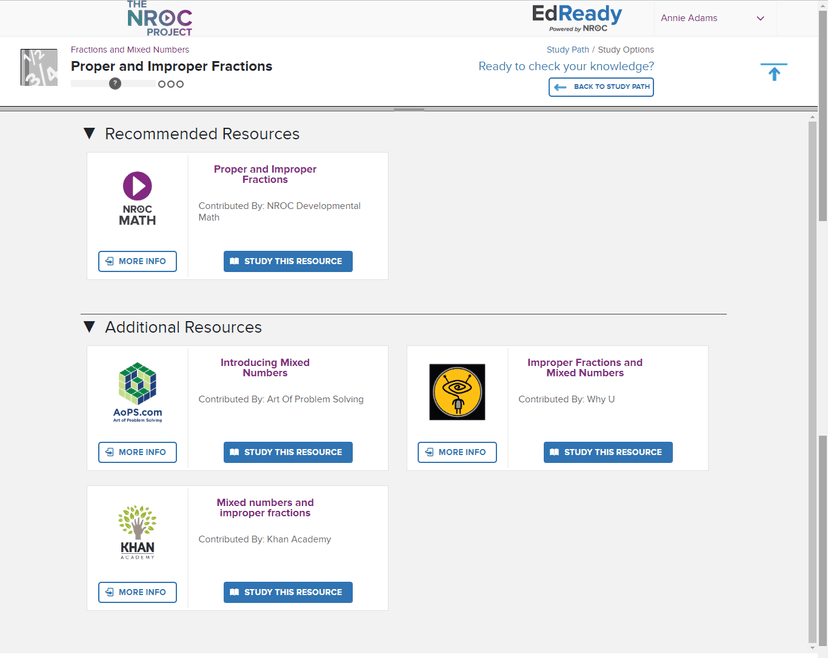
EdReady relies on a personalized, mastery-based progression model that uses diagnostic testing to build customized learning paths for each student. When your child logs into the platform, they first select a specific academic goal, such as preparing for a college placement exam or a grade-level transition. The system then administers an initial diagnostic assessment to measure their current competency against the requirements of that goal. EdReady uses this data to generate a target score and a visual readiness map showing exactly which concepts require study. Your child then works through the required modules, which present instructional content via text, audio, and video formats. After reviewing the material, students complete practice exercises to demonstrate mastery of the targeted concept. The platform continuously updates the student's readiness score as they pass these topic-level assessments. This structure leverages the learning science principle of targeted practice, ensuring cognitive load is focused strictly on unmastered material rather than redundant review. Once the student reaches their target score, they are considered academically prepared for their chosen objective.
Strengths and tradeoffs of EdReady
EdReady's biggest strength is its precise diagnostic capability that maps instruction directly to clear academic goals, while its biggest weakness is a lack of verified data regarding how it scaffolds instruction when a student repeatedly fails a concept. Goal-oriented personalization allows the platform to be highly efficient. By identifying exactly what your child already knows, EdReady bypasses redundant material and focuses cognitive resources entirely on knowledge gaps. This aligns well with the learning science concept of focused attention. Mastery-based progression is another significant asset, as it forces students to demonstrate competence before moving forward, preventing the accumulation of foundational deficits. On the downside, self-directed multimedia learning can be passive. Watching a video or reading a text explanation does not inherently trigger active retrieval practice unless the student is highly motivated to pause and test themselves. Furthermore, institutional barriers limit access, as the platform is built for schools rather than individual families. Because this app is pending evaluation by The Learning Standard, we cannot confirm if the system provides elaborative feedback. When a student gets an answer wrong, simply showing the correct answer is insufficient for deep learning; the system must explain the underlying misconception.
Who Might Benefit From EdReady?
EdReady is best for highly motivated students from sixth grade through college who need targeted intervention to pass specific placement exams or transition smoothly between grade levels. Because the platform relies heavily on independent study, your child must possess the self-regulation required to watch instructional videos and complete practice sets without constant adult supervision. It is particularly valuable for high school students preparing for college entrance exams or adult learners trying to earn technical credentials. Since access is primarily distributed through schools and institutional contracts, it serves best as an integrated component of a formal academic program rather than a standalone homeschooling curriculum.
Data Transparency
Does Not Meet Data Transparency Standard
EdReady does not meet our data transparency standard. Its privacy policy does not document basic protections, including a statement that it does not sell data, a commitment against targeted advertising and limits on sharing children's data.
11 of 35 checks passed
Evaluated September 2026
content.nroc.org →Level 1 · Basic protections
Does not sell data or target ads at students, limits sharing, and lets parents see and delete their child's data.
Not documented: a statement that it does not sell data, a commitment against targeted advertising, limits on sharing children's data, contractual limits on service providers, parents' right to see their child's data, parents' right to delete their child's data
Level 2 · Parent control (meets the standard)
Families can get their data out, know who processes it, and know how long it is kept.
Not documented: a data retention timeline, named service providers
Level 3 · Direct data access
Families or schools can pull their own data through an API, in a stated format.
Not documented: an API for retrieving their own data
View all 35 checks
Parent Access2/8
Does the policy mention parents specifically?
“If you are a parent or legal guardian of a minor (i.e., a person under the age of 18), you understand and acknowledge that use of these Sites by such minor is governed by and subject to the Terms.”
Can parents view their child's data?
The policy does not give parents a right to view their child's data.
Can parents modify their child's data?
The policy does not give parents a right to modify their child's data.
Can parents delete their child's account?
The policy does not give parents a right to delete their child's account or data.
Is there a dedicated Children's Privacy section?
The policy has no section dedicated to children's privacy or COPPA.
Does it reference COPPA compliance?
The policy does not mention COPPA.
Does it reference FERPA compliance?
“Those institutions are obligated to protect your privacy under the Family Educational Rights & Privacy Act of 1974 (FERPA), as amended and under the respective institution's policies concerning educational record privacy, and your data may only be used for legitimate educational and evaluation purposes.”
Is parental consent required for child accounts?
The policy does not require parental consent for child accounts.
Data Portability4/5
Can users access their personal data?
“NROC will store these data on your behalf as long as the account remains active. You may export your data (as a csv file) at any time.”
Can users download/export their data?
“NROC will store these data on your behalf as long as the account remains active. You may export your data (as a csv file) at any time.”
Is there a self-service data access tool?
“You may export your data (as a csv file) at any time.”
Is a specific data format mentioned for export?
“You may export your data (as a csv file) at any time.”
Is there an API for data access?
The policy does not mention an API for data access.
Data Minimization0/6
Is data collection itemized?
The policy lists fields only for instructor accounts on HippoCampus and does not list what data it collects from students on EdReady.
Can the app be used without a real name?
The policy says institutions may require personally identifiable information and that account holders provide personal information, so collection of real names is not ruled out.
Can the app be used without an email?
The policy says email addresses may be provided and collected.
Does it state collection is limited to what is necessary?
The policy does not say collection is limited to what is necessary.
Is IP address anonymized or truncated?
The policy does not address anonymizing or truncating IP addresses.
Is location tracking explicitly excluded?
The policy does not explicitly rule out location tracking.
Third-Party Protection1/7
Does it explicitly state no selling of data?
The policy says personally identifiable information is not made available outside NROC and its service providers, but it never explicitly says NROC does not sell data.
Are third-party providers named?
The policy does not name any third-party providers.
Are providers contractually restricted?
The policy says service providers use information only for authorized NROC purposes but does not say they are contractually restricted.
No-targeted-advertising commitment?
The policy says third-party ad companies may use visit information to show ads of interest to users.
Is AI/ML data sharing addressed?
The policy does not address sharing data for AI or machine learning.
Child-specific sharing restriction?
The policy has no sharing restriction specific to children.
Cookies/tracking limited or opt-out?
“However, cookies are not required for HippoCampus use. If your browser is configured not to accept cookies, you will still be able to access HippoCampus and its content.”
Deletion & Retention3/5
Can users delete their account?
“Barring any external factors beyond NROC's control, you have the right to close your account and delete your data from EdReady™ at any time.”
Self-service deletion mechanism?
“You may terminate your EdReadyTMaccount at any time by following the instructions on your account page.”
Specific data retention timeline?
The policy says data is kept as long as the account remains active and gives no specific retention period.
Auto-deletion of inactive accounts?
The policy does not address automatically deleting inactive accounts.
Post-deletion handling described?
“If you terminate your account, NROC will no longer store the data you provided directly in any identifiable form. However, NROC will retain aggregate and anonymized statistics gathered while you were using the site”
Advertising1/4
Advertising model explicitly disclosed?
“On occasion, we may use third-party advertising companies to serve ads when you visit the Sites.”
Free from third-party advertisements?
The policy says third-party advertising companies may serve ads on the Sites.
Children excluded from ad targeting?
The policy does not exclude children from ad targeting.
Ad-free option available?
The policy does not describe an ad-free option and says ads may be served on the Sites.
What This Means
The policy review did not meet our data transparency standard. The checks above show the documented findings and unknowns. A missing statement does not establish how the app handles data in practice.
About this evaluation: Based on automated analysis of content.nroc.org against 35 policy-disclosure questions, including questions adapted from the Common Sense Privacy Program's published evaluation questions. TLS is not affiliated with Common Sense Media, and this is not a Common Sense rating. Quoted text is copied from the policy; unquoted notes are our summary. Results describe what the policy documents, not the company's actual practices. Privacy policies can change: this review reflects the version we analyzed and does not determine legal compliance.
Sources and review method
TLS combines product information and editorial analysis to explain how EdReady works, its tradeoffs, and the questions to ask before choosing it. Product features, an instructional rationale and evidence of learning outcomes are different kinds of information.
Formal Learning Standard assessment: not yet completed. Data Transparency findings are reported separately and do not establish learning effectiveness. Read our methodology.
Frequently Asked Questions About EdReady
Is EdReady free?
EdReady is generally free for students, but only if their school or institution has purchased a license. The NROC Project charges institutions starting at roughly $14 per student per subject for customized versions of the platform. Individual parents cannot typically purchase a single, standalone subscription for home use. If your child's school uses EdReady, you will not have to pay out of pocket to access the assigned material.
Is EdReady good for high school students?
Yes, EdReady is highly effective for high school students who are preparing for college placement exams or standardized tests. Because high schoolers generally possess better executive functioning skills than younger children, they are better equipped to handle the self-directed, multimedia-heavy instruction the platform provides. The system's ability to map a student's current knowledge against specific college-readiness benchmarks makes it a highly practical tool for older teenagers focused on graduation and higher education.
What does EdReady teach?
EdReady primarily teaches mathematics and English language arts, with additional content available for humanities and career and technical education. The curriculum spans from sixth-grade foundational skills up through college-level readiness and adult education. Rather than teaching a broad, exploratory curriculum, the platform focuses strictly on the specific academic competencies required for a student to pass a targeted exam, enter a new grade level, or earn a professional credential.
How does EdReady compare to Khan Academy?
EdReady and Khan Academy both use mastery-based learning and video instruction, but EdReady is strictly goal-oriented and distributed through institutions. While Khan Academy is a free, open-ended platform that anyone can use for general tutoring, EdReady is designed specifically to help students hit a target score for a specific transition or exam. Khan Academy offers more flexibility for casual home use, whereas EdReady provides a more rigid, diagnostic-driven path tied to institutional benchmarks.
Has The Learning Standard evaluated EdReady?
TLS has not yet completed a Learning Standard evaluation of how well EdReady teaches. Its privacy policy has been reviewed for Data Transparency and does not yet document the basic protections (Level 1).
Is EdReady COPPA compliant?
A COPPA reference was not found in the reviewed privacy policy. This does not determine whether the app complies with COPPA. Policy review note: The policy does not mention COPPA.
Is EdReady FERPA compliant?
The reviewed privacy policy references FERPA. A policy reference alone does not establish FERPA compliance. Policy review note: The policy refers to FERPA obligations for data in institutional versions of EdReady.
Does EdReady have a children's privacy policy?
No dedicated children's privacy section was found in the reviewed policy. Policy review note: The policy has no section dedicated to children's privacy or COPPA.
Does EdReady sell student data?
A statement ruling out data selling was not found in the reviewed policy. This does not establish that the app sells student data. Policy review note: The policy says personally identifiable information is not made available outside NROC and its service providers, but it never explicitly says NROC does not sell data.
Can you delete your data from EdReady?
The reviewed privacy policy describes account deletion. We have not tested the deletion process. Policy review note: Users can close their account and delete their data.
Follow TLS Research
Subscribe to future TLS research updates: app reviews, findings, and what the evidence shows.
Screenshots

Take Action
For EdReady
If you represent The NROC Project and have a correction or new evidence, send the relevant source so we can review and update this page.
Submit a correctionDetails
- Pricing
- The NROC Project offers institutional licenses to customized EdReady instances starting at $14 per student per subject for unlimited access for the duration of the contract. Implementation and technical support, customization tools, and associated professional development are included. Minimum purchases and volume discounts may apply. Hosted or LMS-installable versions of NROC's multimedia courseware are also available, and other contractual terms for partnering institutions are considered.
- Platforms
- Web Browser, iOS (Apple mobile), iPadOS (Apple tablet), Android (Google mobile), Tizen (Samsung mobile), Windows (Microsoft), macOS (Apple), Chrome OS (Google)
- Grade Levels
- 6th Grade, 7th Grade, 8th Grade, 9th Grade, 10th Grade, 11th Grade, 12th Grade, Associate's degree, Bachelor's degree, Adult Education, Professional or Technical Credential
- Website
- Visit site