Edia AI Math
Product by Edia Learning, Inc
Facts checked: Not yet checked
Our take (not a Learning Standard rating). This label applies to learning-science judgments throughout this overview.
Our take (not a Learning Standard rating)
Edia AI Math provides immediate feedback and mastery-based progression, which supports knowledge acquisition. However, without independent evaluation, its claims of guaranteed state test improvements remain unverified. It excels at multilingual accessibility but relies heavily on student self-regulation during automated coaching sessions.
Pros
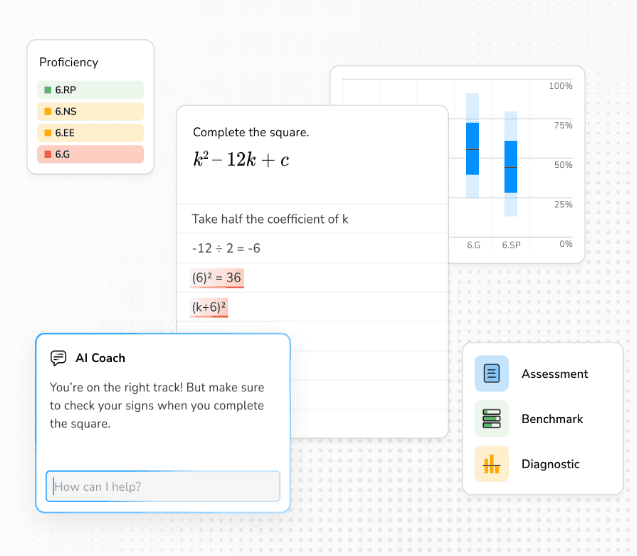
- Provides immediate, step-by-step feedback through an AI coach to correct misconceptions during problem-solving.
- Reduces cognitive load for non-native speakers by offering math instruction and read-aloud features in over 100 languages.
- Uses mastery-based progression to ensure students demonstrate foundational understanding before advancing to complex topics.
- Generates actionable data for educators to group students based on specific skill deficits.
Cons
- Relies on conversational AI which can sometimes generate convoluted explanations that confuse struggling learners.
- Lacks independent efficacy data to substantiate developer claims regarding guaranteed state test score improvements.
- Requires high student motivation and self-regulation to read and process text-heavy AI coaching responses.
What Do We Know About Edia AI Math?
Edia AI Math utilizes AI-driven feedback to teach math skills, but its true effectiveness remains pending independent evaluation. The platform functions as a digital tutor for your child, offering immediate responses when they struggle with a problem. This aligns with the learning science principle of timely feedback, which prevents students from practicing and internalizing mistakes. By offering instruction and read-aloud support in dozens of languages, it effectively removes reading comprehension barriers for English language learners tackling complex word problems. However, you should monitor how your child interacts with the AI coach. Automated tutors require significant self-regulation; your child must actually read and apply the feedback rather than simply guessing until the system provides the correct answer. While the developer promises improved state test scores, parents and educators should view this tool as supplemental practice rather than a replacement for direct human instruction. The program's strength lies in its ability to provide targeted, mastery-based repetitions, but it lacks the nuance a human teacher brings to identifying deep-seated conceptual misunderstandings.
How Does Edia AI Math Work?
Edia AI Math uses personalized, mastery-based learning pathways driven by an interactive AI chatbot. When a student logs in, they are presented with standard-aligned math problems suited to their grade level, ranging from third grade through high school. If the student answers incorrectly or requests help, the 1:1 AI coach initiates a dialogue. Instead of simply providing the correct answer, the system attempts to scaffold the learning process by breaking the problem down into smaller, manageable steps. This approach mirrors cognitive apprenticeship, guiding the learner through worked examples and prompting them to complete the next step. For educators, the platform operates in the background to analyze student inputs and error patterns. It then groups students with similar misunderstandings, allowing teachers to deliver targeted interventions exactly where they are needed. The inclusion of multi-language translation and text-to-speech functionality ensures that the cognitive focus remains on mathematical problem-solving rather than language decoding.
Strengths and tradeoffs of Edia AI Math
The biggest strength of Edia AI Math is its immediate, multilingual feedback loop, while its biggest weakness is the inherent unreliability of AI models in sustaining accurate, long-form mathematical reasoning. Strengths: The platform excels in applying the principle of immediate feedback. In learning science, correcting an error at the moment of misconception is highly effective for skill acquisition. Edia AI Math ensures students do not practice incorrect procedures. Furthermore, its multilingual accessibility reduces extraneous cognitive load. By allowing students to read and hear problems in their native language, the working memory is freed to focus entirely on math operations rather than translation. The system also utilizes mastery-based progression, requiring students to demonstrate competence before moving forward. Weaknesses: Despite its advanced features, the reliance on an AI chatbot introduces risks. Large language models can hallucinate or provide convoluted explanations that may frustrate a struggling learner. Additionally, the system demands high self-regulation. Students can often game AI tutors by clicking through hints without engaging in the necessary retrieval practice. Finally, the developer's claims of guaranteed test score improvements are currently unverified by independent research, making it difficult to assess long-term retention.
Who Might Benefit From Edia AI Math?
Edia AI Math is best for middle and high school students who need immediate, individualized feedback during independent math practice. Because the platform relies heavily on conversational AI, it requires a baseline level of reading comprehension and self-regulation, making it less ideal for younger elementary students despite its third-grade starting point. It is particularly valuable for English language learners who struggle with traditional math curriculum due to language barriers. For educators, it serves as an excellent diagnostic tool to identify skill gaps and organize small-group interventions in diverse classrooms.
Data Transparency
Does Not Meet Data Transparency Standard
Edia AI Math does not meet our data transparency standard. Its privacy policy does not document basic protections, including parents' right to see their child's data and parents' right to delete their child's data.
16 of 35 checks passed
Evaluated September 2026
edia.app →Level 1 · Basic protections
Does not sell data or target ads at students, limits sharing, and lets parents see and delete their child's data.
Not documented: parents' right to see their child's data, parents' right to delete their child's data
Level 2 · Parent control (meets the standard)
Families can get their data out, know who processes it, and know how long it is kept.
Not documented: a data retention timeline, self-service deletion
Level 3 · Direct data access
Families or schools can pull their own data through an API, in a stated format.
Not documented: an API for retrieving their own data, a named export format
View all 35 checks
Parent Access3/8
Does the policy mention parents specifically?
“Communicate and engage with parents and legal guardians.”
Can parents view their child's data?
The policy gives access rights to "you" but never says parents can view their child's data.
Can parents modify their child's data?
The policy does not say parents can modify their child's data.
Can parents delete their child's account?
The policy gives deletion rights to "you" but never says parents can delete their child's data or account.
Is there a dedicated Children's Privacy section?
The policy has no section dedicated to children's privacy or COPPA.
Does it reference COPPA compliance?
“All notifications are coordinated in accordance with applicable law, including FERPA, COPPA, and applicable state data breach notification requirements.”
Does it reference FERPA compliance?
“Name and email address: Required for account creation, user identification, login, password recovery, support requests, and FERPA compliance.”
Is parental consent required for child accounts?
The policy does not say parental consent is required for child accounts.
Data Portability2/5
Can users access their personal data?
“You may request access to your Personal Information by submitting a written request by email to support@edia.app for the following:”
Can users download/export their data?
“Upon receipt of a verifiable request from you, we will promptly take steps to deliver the requested information to you in a user-friendly readable and transferable format.”
Is there a self-service data access tool?
The policy offers access only through an email request, not a tool users operate themselves.
Is a specific data format mentioned for export?
The policy says only "readable and transferable format" and names no specific file format.
Is there an API for data access?
The policy does not describe an API that lets users or schools retrieve their own data.
Data Minimization2/6
Is data collection itemized?
“Assignment Data: Information regarding teacher-created assignment configurations (names, formats, options, lessons, due dates, durations) and student progress (answers submitted, attempted problems, timestamps).”
Can the app be used without a real name?
The policy says a name is required to create an account.
Can the app be used without an email?
The policy says an email address is required to create an account.
Does it state collection is limited to what is necessary?
“We collect and maintain only the Personal Information necessary for providing our Services.”
Is IP address anonymized or truncated?
The policy says it collects IP addresses and does not mention anonymizing or truncating them.
Is location tracking explicitly excluded?
The policy does not explicitly rule out location tracking.
Third-Party Protection6/7
Does it explicitly state no selling of data?
“We do not sell, trade, or rent your Personal Information.”
Are third-party providers named?
“Payment Details: Handled securely by Stripe, a third-party payment processor. We do not store payment details.”
Are providers contractually restricted?
“We will only provide the information they need to deliver our Services, and such third parties are prohibited from using your Personal Information for other purposes.”
No-targeted-advertising commitment?
“Targeted advertising is not permitted on the Site.”
Is AI/ML data sharing addressed?
“We will not share your Personal Information with third-parties for use with AI models, either in use or training. We will only share data derived from use of Edia, such as student work and answers to assignments, in an anonymized context.”
Child-specific sharing restriction?
“We will NOT share the names and actions of your students.”
Cookies/tracking limited or opt-out?
The policy describes necessary and Google tracking cookies but offers no opt-out or limit on tracking.
Deletion & Retention2/5
Can users delete their account?
“You may request that we delete any (or all) of your Personal Information that we collected.”
Self-service deletion mechanism?
The policy offers deletion only by request, not a tool users operate themselves.
Specific data retention timeline?
The policy gives no specific data retention timeline.
Auto-deletion of inactive accounts?
The policy does not address automatically deleting inactive accounts.
Post-deletion handling described?
“Upon receipt of a verifiable request from you, we will take steps to delete your Personal Information from our records and direct any service providers to delete your Personal Information from their records or notify you that your request for deletion cannot be honored.”
Advertising1/4
Advertising model explicitly disclosed?
The policy bans targeted advertising but does not otherwise disclose an advertising model or say there are no ads.
Free from third-party advertisements?
The policy bans targeted advertising but does not say the product is free of third-party ads.
Children excluded from ad targeting?
“Targeted advertising is not permitted on the Site.”
Ad-free option available?
The policy does not say the product has no ads or offer an ad-free option.
What This Means
The policy review did not meet our data transparency standard. The checks above show the documented findings and unknowns. A missing statement does not establish how the app handles data in practice.
About this evaluation: Based on automated analysis of edia.app against 35 policy-disclosure questions, including questions adapted from the Common Sense Privacy Program's published evaluation questions. TLS is not affiliated with Common Sense Media, and this is not a Common Sense rating. Quoted text is copied from the policy; unquoted notes are our summary. Results describe what the policy documents, not the company's actual practices. Privacy policies can change: this review reflects the version we analyzed and does not determine legal compliance.
Sources and review method
TLS combines product information and editorial analysis to explain how Edia AI Math works, its tradeoffs, and the questions to ask before choosing it. Product features, an instructional rationale and evidence of learning outcomes are different kinds of information.
Formal Learning Standard assessment: not yet completed. Data Transparency findings are reported separately and do not establish learning effectiveness. Read our methodology.
Frequently Asked Questions About Edia AI Math
Is Edia AI Math free?
Edia AI Math offers a free tier alongside paid School and District plans. The free version provides basic access, while institutional plans unlock advanced educator dashboards, automated grouping features, and comprehensive intervention tracking.
Is Edia AI Math good for elementary students?
It is functional for upper elementary grades 3 through 5, but younger students may struggle with the text-heavy AI coaching interface. It is highly effective for older students who possess the self-regulation required to interact thoughtfully with an automated tutor.
What does Edia AI Math teach?
Edia AI Math teaches mathematics and applied science concepts for grades 3 through 12. The curriculum covers foundational arithmetic, algebra, geometry, and advanced high school math, all mapped strictly to state educational standards.
Does Edia AI Math actually improve state test scores?
The developer claims guaranteed outcomes on state tests, but Edia AI Math has not yet been evaluated by The Learning Standard. We recommend reading our methodology to understand how independent efficacy is determined before trusting marketing claims.
Edia AI Math vs Khan Academy: Which is better?
Khan Academy relies heavily on instructional videos and structured practice sets, while Edia AI Math focuses on conversational, real-time AI intervention. Khan Academy has a proven track record supported by independent research, whereas Edia AI Math is newer and untested but offers superior multilingual support.
Has The Learning Standard evaluated Edia AI Math?
TLS has not yet completed a Learning Standard evaluation of how well Edia AI Math teaches. Its privacy policy has been reviewed for Data Transparency and does not yet document the basic protections (Level 1).
Is Edia AI Math COPPA compliant?
The reviewed privacy policy references COPPA. A policy reference alone does not establish COPPA compliance. Policy review note: The policy says breach notifications follow COPPA.
Is Edia AI Math FERPA compliant?
The reviewed privacy policy references FERPA. A policy reference alone does not establish FERPA compliance. Policy review note: The policy names FERPA compliance as a reason it collects data.
Does Edia AI Math have a children's privacy policy?
No dedicated children's privacy section was found in the reviewed policy. Policy review note: The policy has no section dedicated to children's privacy or COPPA.
Does Edia AI Math sell student data?
The reviewed policy states that the app does not sell data. This is a policy statement; actual data practices were not verified. Policy review note: The policy explicitly says Edia does not sell personal information.
Can you delete your data from Edia AI Math?
The reviewed privacy policy describes account deletion. We have not tested the deletion process. Policy review note: Users can ask to delete all of their data.
Follow TLS Research
Subscribe to future TLS research updates: app reviews, findings, and what the evidence shows.
Screenshots
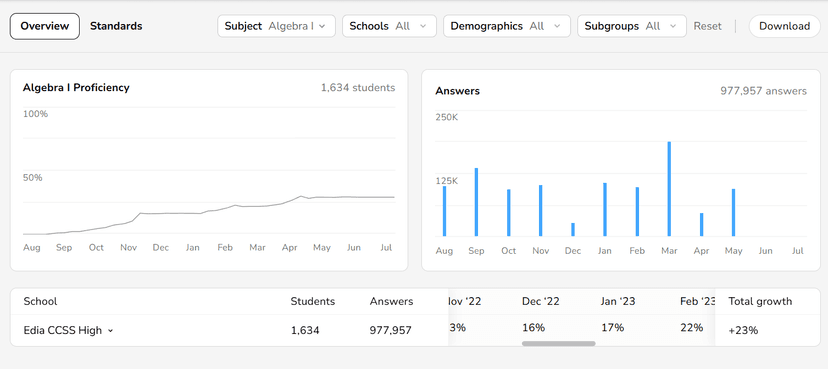
Take Action
For Edia AI Math
If you represent Edia Learning, Inc and have a correction or new evidence, send the relevant source so we can review and update this page.
Submit a correctionDetails
- Pricing
- Free and School/District Plans
- Platforms
- Web Browser, iOS (Apple mobile), iPadOS (Apple tablet), Windows (Microsoft), macOS (Apple), Chrome OS (Google)
- Grade Levels
- 3rd Grade, 4th Grade, 5th Grade, 6th Grade, 7th Grade, 8th Grade, 9th Grade, 10th Grade, 11th Grade, 12th Grade
- Website
- Visit site