
DoodleSpell
Product by Discovery Education, Inc.
Facts checked: Not yet checked
Our take (not a Learning Standard rating). This label applies to learning-science judgments throughout this overview.
Our take (not a Learning Standard rating)
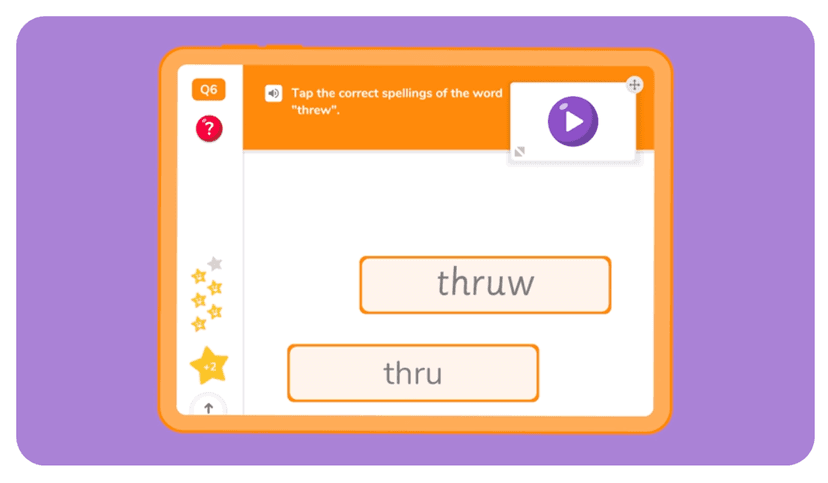
DoodleSpell effectively moves beyond rote memorization by teaching spelling words within the context of sentences and definitions, which aligns with cognitive science principles for vocabulary acquisition. However, because The Learning Standard has not yet evaluated this application, we cannot definitively confirm its long-term impact on spelling retention or independent writing skills.
Pros
- Presents spelling words within meaningful sentence contexts to support semantic understanding.
- Connects spelling practice to vocabulary acquisition rather than relying solely on rote memorization.
- Utilizes interactive exercises that require active retrieval of spelling patterns.
Cons
- Lacks independent efficacy data to confirm long-term spelling retention.
- May not provide enough explicit phonics instruction for struggling decoders.
- Has not yet undergone rigorous evaluation by The Learning Standard's rubric.
What Do We Know About DoodleSpell?
While The Learning Standard has not yet formally evaluated DoodleSpell, its approach of teaching spelling through context and meaning is grounded in sound vocabulary acquisition principles. Your child will not just memorize lists of isolated words, but will interact with words inside sentences to understand their usage. This method leverages contextual learning, which cognitive science shows is highly effective for building long-term retention. Rote memorization often leads to students passing a spelling test on Friday but forgetting the words by Monday. By tying spelling to semantic meaning, DoodleSpell helps anchor the words in your child's memory. However, parents should note that spelling applications often lack explicit, systematic phonics instruction required by students with dyslexia or severe decoding difficulties. The app is best viewed as a supplemental practice tool to reinforce classroom instruction rather than a complete spelling curriculum. Since it is pending evaluation, we recommend monitoring your child's progress to ensure the digital practice translates into accurate spelling in their everyday handwritten work.
How Does DoodleSpell Work?
DoodleSpell uses a contextualized practice approach that integrates spelling exercises with vocabulary and grammar mechanics. The application moves away from traditional drill-and-kill list memorization by presenting words alongside their definitions and requiring your child to use them correctly in sentences. This requires active retrieval practice, prompting the learner to recall the spelling while simultaneously processing the word's meaning. The interactive games and exercises are designed to adjust to the learner's age and curriculum level, covering standard primary school spelling rules. Your child completes daily micro-learning sessions, which helps prevent cognitive overload and takes advantage of spaced practice. By distributing the learning over multiple short sessions rather than cramming, the app aims to build a deeper, more permanent understanding of spelling patterns and word structures.
Strengths and tradeoffs of DoodleSpell
DoodleSpell's biggest strength is its integration of spelling with semantic meaning, while its biggest weakness is the lack of explicit phonics instruction for foundational decoders. Contextual learning is a major advantage here. When children learn words in isolation, they often struggle to transfer that spelling knowledge to their independent writing. By embedding words in sentences, DoodleSpell forces the brain to form multiple connections to the word, strengthening the memory trace. Furthermore, the use of short, frequent practice sessions aligns well with the spacing effect, a proven cognitive science principle that enhances long-term retention. On the downside, apps that focus heavily on contextual spelling sometimes assume a baseline level of phonetic awareness. If your child struggles with the fundamental sounds of language, they may need an intervention that provides explicit, systematic phonics rather than vocabulary-based spelling practice. Finally, because the app is currently pending a full review by The Learning Standard, we lack the empirical data to verify its adaptive algorithms and feedback mechanisms, which are critical for correcting persistent spelling misconceptions.
Who Might Benefit From DoodleSpell?
Best for elementary-aged students who have a basic grasp of phonics but need to transition from phonetic spelling to conventional spelling by understanding word meanings and context. Your child will benefit most from DoodleSpell if they already receive core reading instruction in school and need a daily, engaging supplement to reinforce spelling patterns. It is highly suitable for children aged 5 to 11 who struggle to apply their spelling words in actual writing, as the sentence-level practice bridges the gap between rote memorization and practical application. It is less suited for emergent readers needing foundational phonemic awareness.
Data Transparency
Does Not Meet Data Transparency Standard
DoodleSpell does not meet our data transparency standard. Its privacy policy does not document basic protections, including a commitment against targeted advertising and a COPPA or FERPA commitment.
19 of 35 checks passed
Level 1 · Basic protections
Does not sell data or target ads at students, limits sharing, and lets parents see and delete their child's data.
Not documented: a commitment against targeted advertising, a COPPA or FERPA commitment
Level 2 · Parent control (meets the standard)
Families can get their data out, know who processes it, and know how long it is kept.
Not documented: self-service deletion
Level 3 · Direct data access
Families or schools can pull their own data through an API, in a stated format.
Not documented: an API for retrieving their own data, a named export format
View all 35 checks
Parent Access5/8
Does the policy mention parents specifically?
“Parents can view, through the Parent Dashboard, information with respect to the Student users associated with their account”
Can parents view their child's data?
“Please contact Discovery Education at any time regarding privacy questions or concerns, or to request to review what personal information we have collected from a child.”
Can parents modify their child's data?
The policy lets parents review and delete a child's data but does not say parents can correct or modify it.
Can parents delete their child's account?
“Parents may also contact us at any time to request that we delete the personal information of a child or a parent and/or refuse to permit further collection or use of a child's information.”
Is there a dedicated Children's Privacy section?
“Children’s Personal Information Mystery Science does not permit students to create user accounts and does not collect personal information from students.”
Does it reference COPPA compliance?
The policy does not mention COPPA by name; it refers only to verified parental consent "as required by law".
Does it reference FERPA compliance?
The policy does not mention FERPA.
Is parental consent required for child accounts?
“Doodle Math and Pivot Interactives allows students and children twelve (12) years old and younger to create an account only if the student receives an invitation from the student’s teacher and parental consent has been obtained by the student’s school, or if the parent creates an account for their child.”
Data Portability3/5
Can users access their personal data?
“Right to access: For any of the processing described above, you have the right to ask us for copies of your personal data.”
Can users download/export their data?
“Right to data portability: You have the right to ask that we transfer the personal data you gave us from one organization to another or give it to you.”
Is there a self-service data access tool?
“If you have an online account with us, you have the ability to review and update your personal information online by logging into your account.”
Is a specific data format mentioned for export?
The policy only says data is provided in a "portable and readily usable format" and names no specific file format.
Is there an API for data access?
The policy does not mention an API for getting data.
Data Minimization1/6
Is data collection itemized?
“When you sign up for a Parent User account (either on the website or on the Learning App), we collect, from you, your _identifiers_ (name, email address) and your child’s _identifiers_ (first name, birth month, birth year), the rating of your child’s level in the relevant subject, _sensitive log-in information_ password (hashed), assigned user ID.”
Can the app be used without a real name?
The policy says the student's name is collected from whoever creates the account.
Can the app be used without an email?
The policy says a teacher may optionally provide the student's email address, so it can be collected.
Does it state collection is limited to what is necessary?
The policy does not say collection is limited to what is necessary; it limits only staff access to a need-to-know basis.
Is IP address anonymized or truncated?
The policy says IP addresses are collected and does not say they are anonymized or truncated.
Is location tracking explicitly excluded?
The policy says it collects location information determined from the IP address.
Third-Party Protection5/7
Does it explicitly state no selling of data?
“California residents have the right to opt-out of the sale of their personal information and the sharing of their personal information for purposes of cross-context behavioral advertising. We do not sell personal information.”
Are third-party providers named?
“We use Stripe as our third-party payment processor.”
Are providers contractually restricted?
“We may share such information with our authorized service providers who help us maintain our Websites and Services and provide other services to us. We seek to ensure that these service providers may not use the personal information for any other purpose. These service providers have agreed to maintain the confidentiality, security and integrity of the personal information.”
No-targeted-advertising commitment?
The policy says Google Ads and X Pixel serve ads based on visits to the Learning Apps and makes no commitment against targeted advertising.
Is AI/ML data sharing addressed?
The policy does not address AI or machine learning.
Child-specific sharing restriction?
“Except as provided in this Section, we do not share personal information collected from children under sixteen years old with any third parties.”
Cookies/tracking limited or opt-out?
“To opt in (or back out) of our use of non-essential cookies, please visit by clicking the Cookie Settings link in the footer of our homepage https://doodlelearning.com.”
Deletion & Retention4/5
Can users delete their account?
“If you are a user of the Services, you may request to have your personal information that you provided when you subscribed along with the information relating to your use of the Services removed from our databases by submitting a request to our contact information set forth at the end of this Policy”
Self-service deletion mechanism?
The policy says deletion is done by sending a request, not through a tool users operate themselves.
Specific data retention timeline?
“Thereafter, Doodle Math deletes information from parents and teachers after six months and information from students after twenty-four months.”
Auto-deletion of inactive accounts?
“we will delete (1) information associated with a Student account, which is linked to a Teacher/School or Parent account, when the account remains inactive for 24 months and does not have an active subscription;”
Post-deletion handling described?
“We will remove such information as soon as practicable for us, however, we may still retain certain information associated with your account for analytical purposes and record keeping integrity, as well as to prevent fraud, collect any fees owed, enforce our terms and conditions”
Advertising1/4
Advertising model explicitly disclosed?
“For marketing purposes, including helping us create and publish content most relevant and impactful to you; developing and displaying content and advertising tailored to your interests on our Websites and Services; measuring and improving the effectiveness of our advertising campaigns”
Free from third-party advertisements?
The policy does not say the product is free of ads and mentions sharing data with its advertisers.
Children excluded from ad targeting?
The policy does not say children are excluded from ad targeting; it says only that students are not contacted with marketing communications.
Ad-free option available?
The policy does not mention an ad-free option or say the product has no ads.
What This Means
The policy review did not meet our data transparency standard. The checks above show the documented findings and unknowns. A missing statement does not establish how the app handles data in practice.
About this evaluation: Based on automated analysis of Privacy policy and Privacy Policy against 35 policy-disclosure questions, including questions adapted from the Common Sense Privacy Program's published evaluation questions. TLS is not affiliated with Common Sense Media, and this is not a Common Sense rating. Quoted text is copied from the policy; unquoted notes are our summary. Results describe what the policy documents, not the company's actual practices. Privacy policies can change: this review reflects the version we analyzed and does not determine legal compliance.
Sources and review method
TLS combines product information and editorial analysis to explain how DoodleSpell works, its tradeoffs, and the questions to ask before choosing it. Product features, an instructional rationale and evidence of learning outcomes are different kinds of information.
Formal Learning Standard assessment: not yet completed. Data Transparency findings are reported separately and do not establish learning effectiveness. Read our methodology.
Frequently Asked Questions About DoodleSpell
Is DoodleSpell free?
No, DoodleSpell offers a free trial, but requires a paid subscription for full access. Parents should utilize the trial period to determine if the app's contextual approach matches their child's learning needs before committing to a purchase.
Is DoodleSpell good for elementary students?
Yes, the app is specifically aligned to KS1 and KS2 curricula, making it appropriate for children aged 5 to 11. It covers spelling rules and vocabulary expected in kindergarten through fifth grade, using interactive exercises to maintain engagement.
What does DoodleSpell teach?
DoodleSpell teaches conventional spelling, vocabulary, and grammar. Rather than focusing purely on isolated letter sequences, it teaches your child the meaning of words and how to correctly place them within the grammatical structure of a sentence.
DoodleSpell vs. traditional spelling lists: Which is better?
Research strongly supports DoodleSpell's contextual method over traditional isolated spelling lists. Learning words in sentences builds semantic connections, reducing the likelihood of your child forgetting the spelling immediately after a weekly test.
Has The Learning Standard evaluated DoodleSpell?
TLS has not yet completed a Learning Standard evaluation of how well DoodleSpell teaches. Its privacy policy has been reviewed for Data Transparency and does not yet document the basic protections (Level 1).
Is DoodleSpell COPPA compliant?
A COPPA reference was not found in the reviewed privacy policy. This does not determine whether the app complies with COPPA. Policy review note: The policy does not mention COPPA by name; it refers only to verified parental consent "as required by law".
Is DoodleSpell FERPA compliant?
A FERPA reference was not found in the reviewed privacy policy. This does not determine whether the app complies with FERPA. Policy review note: The policy does not mention FERPA.
Does DoodleSpell have a children's privacy policy?
The reviewed policy includes a dedicated children's privacy section. Policy review note: The policy has a section headed Children's Personal Information.
Does DoodleSpell sell student data?
The reviewed policy states that the app does not sell data. This is a policy statement; actual data practices were not verified. Policy review note: The policy states that the company does not sell personal information.
Can you delete your data from DoodleSpell?
The reviewed privacy policy describes account deletion. We have not tested the deletion process. Policy review note: Users can ask to have their data removed.
Follow TLS Research
Subscribe to future TLS research updates: app reviews, findings, and what the evidence shows.
Screenshots
Take Action
For DoodleSpell
If you represent Discovery Education, Inc. and have a correction or new evidence, send the relevant source so we can review and update this page.
Submit a correctionDetails
- Pricing
- Free Trial
- Grade Levels
- Kindergarten, 1st Grade, 2nd Grade, 3rd Grade, 4th Grade, 5th Grade, 6th Grade, 7th Grade, 8th Grade, 9th Grade
- Website
- Visit site