Djamgatech: AI Cert Master
Product by Djamgatech
Facts checked: Not yet checked
Our take (not a Learning Standard rating). This label applies to learning-science judgments throughout this overview.
Our take (not a Learning Standard rating)
Djamgatech provides strong retrieval practice for advanced certification exams through extensive quizzing, but its overall educational efficacy remains pending evaluation. It leverages elaborative feedback by explaining incorrect answers, which supports retention. However, it relies entirely on testing rather than primary instruction, meaning learners must already understand foundational concepts.
Pros
- Employs retrieval practice through extensive question banks to strengthen memory recall.
- Provides elaborative feedback on incorrect answers to help learners understand their mistakes.
- Uses adaptive testing algorithms to direct practice toward specific knowledge gaps.
- Allows offline access to maintain consistent study habits without internet dependency.
Cons
- Relies exclusively on assessment rather than providing primary instructional content.
- Lacks scaffolding for beginners who need foundational concept introductions.
- Requires users to self-regulate their study pacing without structured curriculum progression.
What Do We Know About Djamgatech: AI Cert Master?
This app serves as an effective supplementary assessment tool rather than a comprehensive instructional platform for your older child or student. Djamgatech focuses entirely on retrieval practice for professional and advanced technical certifications like AWS, PMP, and CISSP. The Learning Standard has not yet fully evaluated this application, but its mechanics align with established testing effects in cognitive science. Learners use the app to test their existing knowledge, uncover blind spots, and review detailed explanations for incorrect answers. It does not teach concepts from scratch. Instead, it assumes your student is already studying the material through other courses or textbooks. The inclusion of adaptive algorithms means the system identifies which subjects the user struggles with and serves more questions in those areas. This targeted practice reduces study time waste. However, because it lacks primary instruction, users who do not understand the underlying material will likely become frustrated. It is entirely free to use, which removes financial barriers, but users must possess strong self-regulation skills to build a consistent study schedule. You should view this strictly as a final preparation tool for high-stakes exams.
How Does Djamgatech: AI Cert Master Work?
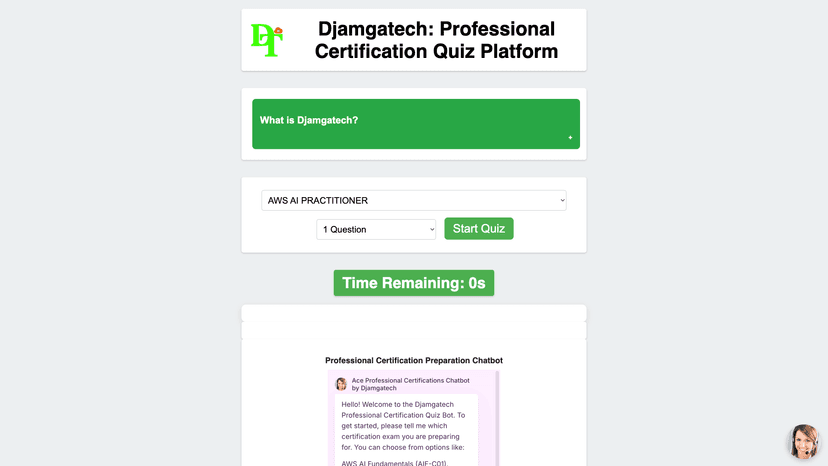
Djamgatech relies on adaptive retrieval practice by serving multiple-choice questions and adjusting difficulty based on user performance. Learners select a specific certification track, such as cloud computing or project management, and initiate practice exams. As the user answers questions, the application tracks success rates across different subtopics. The underlying algorithm then serves additional questions targeting the identified weak areas, a technique known as spaced and interleaved practice. When a user selects an incorrect answer, the app immediately provides elaborative feedback detailing why the choice is wrong and explaining the correct concept. This immediate correction prevents the reinforcement of false knowledge. Users can complete these quizzes offline, allowing for highly flexible study sessions. The entire ecosystem is built around high-frequency testing, forcing the brain to repeatedly retrieve information to strengthen long-term memory pathways prior to an exam.
Strengths and tradeoffs of Djamgatech: AI Cert Master
The biggest strength of Djamgatech is its use of immediate elaborative feedback, while its biggest weakness is the total lack of primary instructional scaffolding. By instantly explaining why an answer is incorrect, the app capitalizes on the testing effect, ensuring learners correct their mental models in real-time. This approach aligns with learning science principles showing that retrieval practice combined with high-quality feedback produces superior long-term retention compared to simply rereading notes. Furthermore, the adaptive algorithm efficiently directs learners toward their weakest domains, maximizing study efficiency. On the negative side, the app offers no foundational instruction. Users cannot watch a lesson or read a chapter before testing. If a learner does not already possess a baseline understanding of complex topics like cybersecurity or cloud architecture, the testing format will induce cognitive overload rather than facilitate learning. The interface also relies heavily on text-based multiple-choice questions, which may not adequately prepare learners for performance-based or practical exam scenarios. Ultimately, it excels as a targeted review mechanism but fails as a standalone educational curriculum.
Who Might Benefit From Djamgatech: AI Cert Master?
Best for advanced students and professionals who require high-volume retrieval practice to prepare for specific technical certifications. The content focuses entirely on career and technical education, making it unsuitable for young children or primary education students. It serves self-directed learners who have already studied the foundational material through external courses and now need to identify their knowledge gaps. Because it requires significant intrinsic motivation and reading comprehension, it is ideal for mature users who can independently manage their exam preparation timelines and tolerate rigorous, repetitive testing.
Data Transparency
Does Not Meet Data Transparency Standard
Djamgatech: AI Cert Master does not meet our data transparency standard. Its privacy policy does not document basic protections, including limits on sharing children's data, contractual limits on service providers and a COPPA or FERPA commitment.
14 of 35 checks passed
Evaluated September 2026
Privacy Policy →Level 1 · Basic protections
Does not sell data or target ads at students, limits sharing, and lets parents see and delete their child's data.
Not documented: limits on sharing children's data, contractual limits on service providers, a COPPA or FERPA commitment, parents' right to see their child's data, parents' right to delete their child's data
Level 2 · Parent control (meets the standard)
Families can get their data out, know who processes it, and know how long it is kept.
Not documented: a data retention timeline, self-service deletion
Level 3 · Direct data access
Families or schools can pull their own data through an API, in a stated format.
Not documented: an API for retrieving their own data, a named export format
View all 35 checks
Parent Access1/8
Does the policy mention parents specifically?
The policy never mentions parents; its children's section refers only to children and to anyone who believes a child has provided information.
Can parents view their child's data?
The policy gives parents no right to view a child's data.
Can parents modify their child's data?
The policy gives parents no right to modify a child's data.
Can parents delete their child's account?
The policy says it will delete information if anyone reports that a child provided it, but it gives parents no specific deletion right.
Is there a dedicated Children's Privacy section?
“11\. CHILDREN’S PRIVACY”
Does it reference COPPA compliance?
The policy does not reference COPPA.
Does it reference FERPA compliance?
The policy does not reference FERPA.
Is parental consent required for child accounts?
The policy says the services are not directed to children under 13 and does not mention parental consent.
Data Portability2/5
Can users access their personal data?
“Depending on where you live, you may have the right to access, correct, delete or port your personal information, to restrict or object to processing, and to withdraw consent.”
Can users download/export their data?
“Depending on where you live, you may have the right to access, correct, delete or port your personal information, to restrict or object to processing, and to withdraw consent.”
Is there a self-service data access tool?
The policy says rights are exercised by emailing the company and describes no self-service tool.
Is a specific data format mentioned for export?
The policy does not name a data export format.
Is there an API for data access?
The policy does not describe an API for users to retrieve their data.
Data Minimization3/6
Is data collection itemized?
“Our hosting provider records ordinary web request information, including IP address, browser type and the pages requested, for security and reliability.”
Can the app be used without a real name?
“The apps work without an account. We do not ask for your name, email address or a password in order to use them.”
Can the app be used without an email?
“The apps work without an account. We do not ask for your name, email address or a password in order to use them.”
Does it state collection is limited to what is necessary?
The policy calls the information it holds limited but never says collection is limited to what is necessary.
Is IP address anonymized or truncated?
The policy says IP addresses are recorded and does not say they are anonymized or truncated.
Is location tracking explicitly excluded?
The policy says analytics collects approximate region and does not rule out location tracking.
Third-Party Protection4/7
Does it explicitly state no selling of data?
“We do not sell your personal information, and we do not share it for advertising purposes.”
Are third-party providers named?
“to infrastructure and service providers acting on our behalf - Google Firebase Hosting, Google Analytics and Tag Manager, Stripe, and our email provider;”
Are providers contractually restricted?
The policy says providers act on the company's behalf but mentions no contractual restrictions.
No-targeted-advertising commitment?
“We do not use it to build advertising profiles.”
Is AI/ML data sharing addressed?
The policy does not address sharing data with AI or machine-learning systems.
Child-specific sharing restriction?
The policy has no sharing restriction specific to children's data.
Cookies/tracking limited or opt-out?
“You can refuse cookies in your browser settings; parts of the sites may then behave differently.”
Deletion & Retention1/5
Can users delete their account?
“Depending on where you live, you may have the right to access, correct, delete or port your personal information, to restrict or object to processing, and to withdraw consent.”
Self-service deletion mechanism?
Deletion requests are made by email; the policy describes no self-service deletion.
Specific data retention timeline?
The policy gives no data retention timeline.
Auto-deletion of inactive accounts?
The policy does not mention auto-deleting inactive accounts.
Post-deletion handling described?
The policy does not describe how data is handled after deletion beyond a note that removing public posts may not be complete.
Advertising3/4
Advertising model explicitly disclosed?
“**None of the applications listed in section 1 contains an advertising SDK.** There is no AdMob in them, and no advertising is served inside any of them.”
Free from third-party advertisements?
“**None of the applications listed in section 1 contains an advertising SDK.** There is no AdMob in them, and no advertising is served inside any of them.”
Children excluded from ad targeting?
The policy says the services are not directed to children under 13 but makes no statement about excluding children from ad targeting.
Ad-free option available?
“**None of the applications listed in section 1 contains an advertising SDK.** There is no AdMob in them, and no advertising is served inside any of them.”
What This Means
The policy review did not meet our data transparency standard. The checks above show the documented findings and unknowns. A missing statement does not establish how the app handles data in practice.
About this evaluation: Based on automated analysis of Privacy Policy against 35 policy-disclosure questions, including questions adapted from the Common Sense Privacy Program's published evaluation questions. TLS is not affiliated with Common Sense Media, and this is not a Common Sense rating. Quoted text is copied from the policy; unquoted notes are our summary. Results describe what the policy documents, not the company's actual practices. Privacy policies can change: this review reflects the version we analyzed and does not determine legal compliance.
Sources and review method
TLS combines product information and editorial analysis to explain how Djamgatech: AI Cert Master works, its tradeoffs, and the questions to ask before choosing it. Product features, an instructional rationale and evidence of learning outcomes are different kinds of information.
Formal Learning Standard assessment: not yet completed. Data Transparency findings are reported separately and do not establish learning effectiveness. Read our methodology.
Frequently Asked Questions About Djamgatech: AI Cert Master
Is Djamgatech: AI Cert Master free?
Yes. The application is completely free to use. The developer states there are no paywalls or advertisements within the platform, allowing uninterrupted study sessions.
Is Djamgatech: AI Cert Master good for elementary students?
No. The application focuses exclusively on advanced professional certifications such as AWS, CPA, and CISSP. The content and vocabulary are designed for adult learners and professionals, not young children.
What does Djamgatech: AI Cert Master teach?
It assesses knowledge in applied sciences, career, and technical education. Specifically, it offers practice tests for over 50 professional certifications, including cloud computing, project management, and cybersecurity, rather than teaching foundational concepts from scratch.
How does Djamgatech: AI Cert Master compare to traditional study guides?
Unlike static study guides, this app uses adaptive algorithms to dynamically alter question delivery based on your performance. This interactive retrieval practice is generally more effective for memory retention than passively reading a study guide.
Has The Learning Standard evaluated Djamgatech: AI Cert Master?
TLS has not yet completed a Learning Standard evaluation of how well Djamgatech: AI Cert Master teaches. Its privacy policy has been reviewed for Data Transparency and does not yet document the basic protections (Level 1).
Is Djamgatech: AI Cert Master COPPA compliant?
A COPPA reference was not found in the reviewed privacy policy. This does not determine whether the app complies with COPPA. Policy review note: The policy does not reference COPPA.
Is Djamgatech: AI Cert Master FERPA compliant?
A FERPA reference was not found in the reviewed privacy policy. This does not determine whether the app complies with FERPA. Policy review note: The policy does not reference FERPA.
Does Djamgatech: AI Cert Master have a children's privacy policy?
The reviewed policy includes a dedicated children's privacy section. Policy review note: Section 11 is a dedicated Children's Privacy section.
Does Djamgatech: AI Cert Master sell student data?
The reviewed policy states that the app does not sell data. This is a policy statement; actual data practices were not verified. Policy review note: The policy states the company does not sell personal information.
Can you delete your data from Djamgatech: AI Cert Master?
The reviewed privacy policy describes account deletion. We have not tested the deletion process. Policy review note: Users can ask for their personal information to be deleted.
Follow TLS Research
Subscribe to future TLS research updates: app reviews, findings, and what the evidence shows.
Screenshots

Take Action
For Djamgatech: AI Cert Master
If you represent Djamgatech and have a correction or new evidence, send the relevant source so we can review and update this page.
Submit a correctionDetails
- Pricing
- Free
- Platforms
- Web Browser
- Website
- Visit site