DataCamp Classrooms
Product by DataCamp
Facts checked: Not yet checked
Our take (not a Learning Standard rating). This label applies to learning-science judgments throughout this overview.
Our take (not a Learning Standard rating)
While DataCamp Classrooms offers extensive technical content, The Learning Standard has not yet evaluated its pedagogical efficacy. Its interactive coding environment uses immediate feedback and active practice to build procedural knowledge, though gamification elements may occasionally distract from deep conceptual mastery for advanced learners.
Pros
- Provides immediate, automated feedback on coding exercises to correct misconceptions instantly.
- Uses a browser-based coding environment that eliminates the friction of local software installation.
- Structures courses around mastery-based progression to ensure foundational skills are built before advancing.
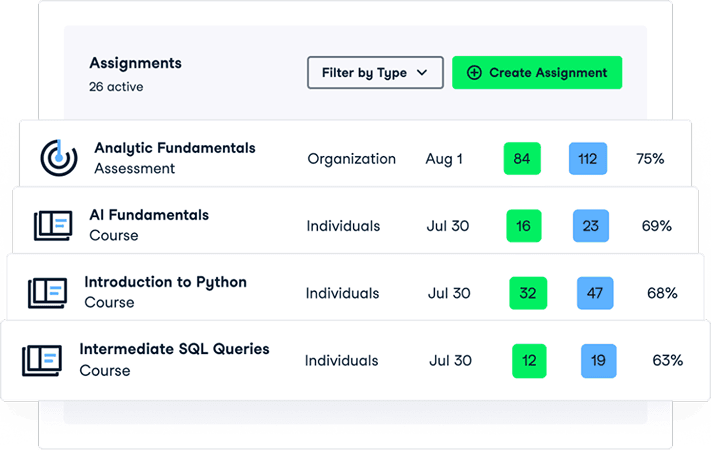
- Equips educators with an intuitive dashboard to monitor student progress and assignment completion.
Cons
- Relies heavily on fill-in-the-blank coding exercises that can limit the development of independent problem-solving skills.
- Uses gamification elements like XP and streaks that may incentivize speed over deep learning.
- Lacks robust formative assessments to test conceptual understanding outside of syntax execution.
- Requires teachers to apply for access rather than providing instant onboarding.
What Do We Know About DataCamp Classrooms?
DataCamp Classrooms provides effective, interactive instruction for older students building foundational technical skills in data science, AI, and programming, though its fill-in-the-blank approach limits independent coding practice.
Your teen will access a massive library of courses covering high-demand topics like Python, SQL, and machine learning directly through a web browser. Because the platform uses an in-browser coding environment, students do not need to install complex software to start learning. Instead, they write code alongside instructional videos and receive immediate, automated feedback when they make an error. This rapid feedback loop aligns well with cognitive science principles for acquiring procedural knowledge.
However, you should be aware that the learning mechanics often rely heavily on scaffolding. Students frequently complete partial scripts rather than building projects from scratch. While excellent for beginners, this approach can create a false sense of fluency. When your child attempts to write a program entirely on their own, they may struggle to recall syntax or structure without the platform's guardrails. Educators utilize built-in dashboards to track completion, making it highly transparent for classroom integration. Note that The Learning Standard has not yet formally evaluated this platform against our full rubric.
How Does DataCamp Classrooms Work?
DataCamp Classrooms uses a mastery-based progression model combining short instructional videos with immediate interactive coding practice.
Students begin a module by watching a concise, expert-led video that introduces a specific concept, such as a new Python function or SQL query. Immediately following the video, the platform prompts students to apply what they just learned in a browser-based coding terminal. This active practice requires them to type actual code to solve a localized problem.
The system evaluates the code upon submission. If correct, the student earns experience points (XP) and advances to the next step. If incorrect, the platform provides targeted hints to help the student correct their syntax or logic. This cycle of direct instruction followed by immediate retrieval practice helps cement basic coding mechanics. For educators, the platform provides an administrative dashboard to assign specific modules, set deadlines, and monitor metrics like completion rates and accuracy across an entire class roster.
Strengths and tradeoffs of DataCamp Classrooms
The platform's biggest strength is its frictionless, browser-based coding environment paired with immediate feedback, while its biggest weakness is an over-reliance on heavily scaffolded exercises that hinder unguided problem-solving.
Strengths: DataCamp Classrooms excels at reducing the cognitive load associated with learning to code. By providing an integrated development environment within the browser, students bypass the complex setup usually required for programming. The platform leverages immediate feedback loops, a proven learning science principle, to instantly correct syntax errors before they become ingrained habits. The short, focused video instruction respects working memory limits by breaking complex data science topics into digestible chunks.
Weaknesses: The platform leans heavily on scaffolded practice, often presenting code where students only need to fill in a few missing blanks. While useful for novices, this limits desirable difficulties: the cognitive struggle required for long-term retention and transfer of skills. Without adequate opportunities to build projects entirely from scratch, students may struggle to apply these skills in real-world environments. Additionally, the platform's gamification features, such as XP and leaderboards, focus more on extrinsic motivation, which can sometimes encourage learners to guess repeatedly rather than pause and reflect on their errors.
Who Might Benefit From DataCamp Classrooms?
Best for high school and higher education students who need a structured, frictionless introduction to coding and data science concepts alongside formal classroom instruction.
The platform is highly effective for complete beginners in the 11th grade through adult education who might feel intimidated by setting up complex programming environments. It serves as an excellent supplemental tool for computer science or career and technical education (CTE) teachers wanting to assign specific modules for foundational syntax drill and practice. Because of the heavy scaffolding, it is less suited for advanced computer science students seeking open-ended, project-based learning experiences.
Data Transparency
Does Not Meet Data Transparency Standard
DataCamp Classrooms does not meet our data transparency standard. Its privacy policy does not document basic protections, including a statement that it does not sell data, a commitment against targeted advertising and limits on sharing children's data.
13 of 35 checks passed
Evaluated September 2026
Privacy Policy →Level 1 · Basic protections
Does not sell data or target ads at students, limits sharing, and lets parents see and delete their child's data.
Not documented: a statement that it does not sell data, a commitment against targeted advertising, limits on sharing children's data, contractual limits on service providers, a COPPA or FERPA commitment, parents' right to see their child's data, parents' right to delete their child's data
Level 2 · Parent control (meets the standard)
Families can get their data out, know who processes it, and know how long it is kept.
Level 3 · Direct data access
Families or schools can pull their own data through an API, in a stated format.
Not documented: an API for retrieving their own data, a named export format
View all 35 checks
Parent Access2/8
Does the policy mention parents specifically?
“When we learn that a child under 13 has submitted their personal data to DataCamp, we will try to delete the information as soon as possible if we do not have consent from the guardian.”
Can parents view their child's data?
The policy gives parents no right to view their child's data.
Can parents modify their child's data?
The policy gives parents no right to modify their child's data.
Can parents delete their child's account?
The policy says DataCamp will try to delete data from children under 13 when it finds out, but gives parents no right to request deletion.
Is there a dedicated Children's Privacy section?
“Do we collect personal data from children? We do not intentionally gather personal data from visitors who are under the age of 13.”
Does it reference COPPA compliance?
The policy does not mention COPPA.
Does it reference FERPA compliance?
The policy does not mention FERPA.
Is parental consent required for child accounts?
The policy says it does not knowingly collect data from children under 13 and will try to delete it if there is no guardian consent, but it does not require parental consent for child accounts.
Data Portability2/5
Can users access their personal data?
“You have the right to ask us for a copy of your personal data, and for certain information about how we use it.”
Can users download/export their data?
“Currently, we do not support automatic download of your data. However, you have the right to ask us to retrieve all the personal data we have about you. You can submit a request via our **[privacy contact form](https://support.datacamp.com/hc/en-us/requests/new?ticket_form_id=360004155713#skip_wizard)** if you wish to download your data.”
Is there a self-service data access tool?
The policy says automatic download is not supported and access requests go through a contact form.
Is a specific data format mentioned for export?
The policy does not name an export format.
Is there an API for data access?
The policy does not mention an API for data access.
Data Minimization1/6
Is data collection itemized?
“- **Personal Information**: such as, your name (first and last names), email address and subscription type; and”
Can the app be used without a real name?
The policy says first and last name are required to register.
Can the app be used without an email?
The policy says an email address is required to register.
Does it state collection is limited to what is necessary?
The policy does not say that data collection in general is limited to what is necessary; it only says this about payment information.
Is IP address anonymized or truncated?
The policy says it collects IP addresses and does not say they are anonymized or truncated.
Is location tracking explicitly excluded?
The policy lists geolocation data, including precise GPS-derived location, among the data it may collect.
Third-Party Protection3/7
Does it explicitly state no selling of data?
The policy says DataCamp does not sell data 'in the conventional sense' but admits that sharing with advertising partners may count as a sale under the CCPA.
Are third-party providers named?
“Your time zone, email address, first and last name and mobile device ID will be stored in customer.io ( [privacy policy](https://customer.io/gdpr.html)), which is a third-party service we use to manage our communication channels with our learners.”
Are providers contractually restricted?
The policy mentions Standard Contractual Clauses only for international transfers and does not say providers are contractually limited in how they use data.
No-targeted-advertising commitment?
The policy says it uses tailored advertising, including in-app ads, based on user activity.
Is AI/ML data sharing addressed?
“To deliver AI-Native Features, certain personal data we already collect, such as your name, learning history, and past exercise submissions, may be transmitted to third-party large language model ("LLM") providers.”
Child-specific sharing restriction?
The policy has no sharing restrictions specific to children.
Cookies/tracking limited or opt-out?
“If you would like to disable profiling and tracking, please let us know using the **[privacy contact form](https://support.datacamp.com/hc/en-us/requests/new?ticket_form_id=360004155713#skip_wizard)**. Our support team will help you turn off profiling/tracking.”
Deletion & Retention4/5
Can users delete their account?
“At any time you can cancel your subscription and delete your data permanently in your [account settings](https://www.datacamp.com/profile/account_settings).”
Self-service deletion mechanism?
“At any time you can cancel your subscription and delete your data permanently in your [account settings](https://www.datacamp.com/profile/account_settings).”
Specific data retention timeline?
“This is with the exception of your payment details and your transaction history which we need to keep for 7 years from the date of the relevant transaction.”
Auto-deletion of inactive accounts?
The policy does not describe automatic deletion of inactive accounts.
Post-deletion handling described?
“Note that even if we honor your request to delete your information, we may retain certain information as required or permitted by law.”
Advertising1/4
Advertising model explicitly disclosed?
“We also use third-party advertising services like Facebook, Google, and other ad networks and ad servers to deliver advertising about our services on other websites and applications you may use.”
Free from third-party advertisements?
The policy says users may see tailored in-app ads and ads that appear on the Website and in the App.
Children excluded from ad targeting?
The policy does not exclude children from ad targeting.
Ad-free option available?
The policy says users will still see some advertising whatever they choose.
What This Means
The policy review did not meet our data transparency standard. The checks above show the documented findings and unknowns. A missing statement does not establish how the app handles data in practice.
About this evaluation: Based on automated analysis of Privacy Policy against 35 policy-disclosure questions, including questions adapted from the Common Sense Privacy Program's published evaluation questions. TLS is not affiliated with Common Sense Media, and this is not a Common Sense rating. Quoted text is copied from the policy; unquoted notes are our summary. Results describe what the policy documents, not the company's actual practices. Privacy policies can change: this review reflects the version we analyzed and does not determine legal compliance.
Sources and review method
TLS combines product information and editorial analysis to explain how DataCamp Classrooms works, its tradeoffs, and the questions to ask before choosing it. Product features, an instructional rationale and evidence of learning outcomes are different kinds of information.
Formal Learning Standard assessment: not yet completed. Data Transparency findings are reported separately and do not establish learning effectiveness. Read our methodology.
Frequently Asked Questions About DataCamp Classrooms
Is DataCamp Classrooms free?
Yes, it is entirely free for educators and their students. Teachers must submit a short application form to verify their status, after which they can invite their students to join the platform at no cost.
Is DataCamp Classrooms good for high school students?
Yes, the platform is specifically targeted at 11th and 12th graders, as well as higher education students. The content density and reading level are highly appropriate for older teenagers and adults developing career-ready technical skills.
What does DataCamp Classrooms teach?
It teaches applied computer science and data skills, including Python, SQL, R, machine learning, and AI literacy (such as using ChatGPT). The curriculum focuses heavily on data manipulation, analysis, and fundamental programming syntax.
DataCamp Classrooms vs. Codecademy: Which is better?
DataCamp focuses specifically on data science, analytics, and AI, making it superior for statistics or data-centric courses. Codecademy offers broader pathways in general web development and software engineering. Both rely heavily on in-browser, scaffolded exercises that require supplemental project work for true mastery.
Has The Learning Standard evaluated DataCamp Classrooms?
TLS has not yet completed a Learning Standard evaluation of how well DataCamp Classrooms teaches. Its privacy policy has been reviewed for Data Transparency and does not yet document the basic protections (Level 1).
Is DataCamp Classrooms COPPA compliant?
A COPPA reference was not found in the reviewed privacy policy. This does not determine whether the app complies with COPPA. Policy review note: The policy does not mention COPPA.
Is DataCamp Classrooms FERPA compliant?
A FERPA reference was not found in the reviewed privacy policy. This does not determine whether the app complies with FERPA. Policy review note: The policy does not mention FERPA.
Does DataCamp Classrooms have a children's privacy policy?
The reviewed policy includes a dedicated children's privacy section. Policy review note: The policy has a subsection with its own heading about children's data.
Does DataCamp Classrooms sell student data?
A statement ruling out data selling was not found in the reviewed policy. This does not establish that the app sells student data. Policy review note: The policy says DataCamp does not sell data 'in the conventional sense' but admits that sharing with advertising partners may count as a sale under the CCPA.
Can you delete your data from DataCamp Classrooms?
The reviewed privacy policy describes account deletion. We have not tested the deletion process. Policy review note: Users can delete their data.
Follow TLS Research
Subscribe to future TLS research updates: app reviews, findings, and what the evidence shows.
Screenshots

Take Action
For DataCamp Classrooms
If you represent DataCamp and have a correction or new evidence, send the relevant source so we can review and update this page.
Submit a correctionDetails
- Pricing
- Free
- Platforms
- Web Browser, iOS (Apple mobile), iPadOS (Apple tablet), Android (Google mobile), Tizen (Samsung mobile), Windows (Microsoft), macOS (Apple), Chrome OS (Google), Other
- Grade Levels
- 11th Grade, 12th Grade, Associate's degree, Bachelor's degree, Post-master's certificate, Doctoral Degree, Adult Education
- Website
- Visit site