
CollegeReadyMath - Algebra I Intervention
Product by CollegeReadyMath
Facts checked: Not yet checked
Our take (not a Learning Standard rating). This label applies to learning-science judgments throughout this overview.
Our take (not a Learning Standard rating)
While CollegeReadyMath - Algebra I Intervention has not yet been formally evaluated by The Learning Standard, its reliance on visual explanations aligns well with the dual-coding theory of learning. However, without confirmed adaptive retrieval practice or spaced repetition features, its effectiveness as a complete standalone intervention tool remains uncertain.
Pros
- Utilizes visual representations to reduce cognitive load when introducing complex algebraic concepts.
- Targets specific foundational gaps typical of students needing targeted intervention.
- Breaks down multi-step equations into observable, manageable components to build initial fluency.
Cons
- Lacks transparent data on whether it uses spaced repetition to ensure long-term retention of formulas.
- Offers limited information on how it adapts difficulty in real-time when a student struggles.
- Fails to provide clear evidence of scaffolding withdrawal to transition students from visual aids to abstract problem-solving.
What Do We Know About CollegeReadyMath - Algebra I Intervention?
CollegeReadyMath - Algebra I Intervention serves as a supplemental visual aid rather than a complete replacement for comprehensive algebra instruction. If your child struggles with the abstract nature of algebraic equations, this tool translates letters and numbers into visual models to help them grasp the underlying logic. The platform targets middle and high school students who have fallen behind, specifically focusing on the foundational concepts required to pass Algebra I. Learning science supports this visual approach, known as dual-coding, which combines verbal instruction with visual representations to strengthen memory pathways. However, because The Learning Standard has not yet evaluated this program, we cannot confirm if it actively forces your child to recall information from memory: a critical process known as retrieval practice. You should expect to use this program alongside traditional homework or tutoring to ensure your child actually practices solving equations without the visual crutches. It requires a school or district license, meaning you will likely access it through your child's educational institution rather than purchasing a direct consumer subscription. Monitor your child's progression to ensure they are translating these visual lessons into traditional mathematical notation on paper.
How Does CollegeReadyMath - Algebra I Intervention Work?
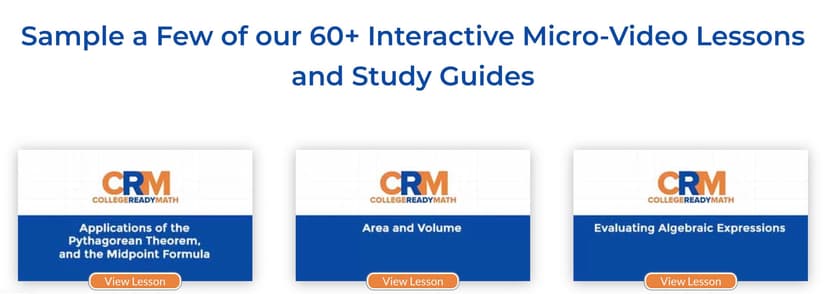
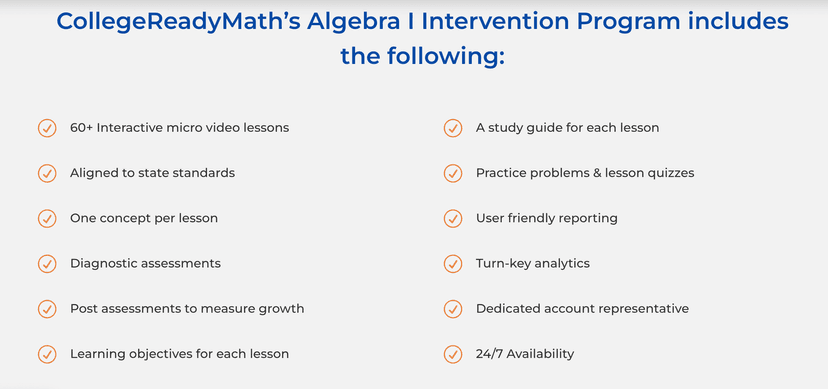
CollegeReadyMath - Algebra I Intervention uses direct visual instruction to target specific knowledge gaps in foundational algebra. The platform presents students with visual models that map abstract mathematical symbols to concrete representations. When your child logs in, they navigate through specific modules targeting essential Algebra I standards, such as linear equations, factoring, or graphing. The system explains the logic behind mathematical rules rather than just presenting rote memorization drills. By visually breaking down equations step-by-step, it acts as a digital worked example, reducing the working memory strain required to process new mathematical procedures. Once the concept is introduced visually, students work through practice sets designed to solidify that specific skill. However, without independent evaluation data, the exact mechanics of its feedback loop remain unclear. Effective intervention tools typically provide immediate, explanatory feedback when a student makes an error, guiding them back to the correct process. Users progress through the targeted modules, ideally building the prerequisite knowledge required to re-engage with grade-level classroom material.
Strengths and tradeoffs of CollegeReadyMath - Algebra I Intervention
The biggest strength of CollegeReadyMath - Algebra I Intervention is its emphasis on visual conceptualization, while its biggest weakness is the lack of proven adaptive retrieval practice. Learning science shows that novices benefit heavily from worked examples and visual models to manage cognitive load during initial learning phases. By stripping away abstract complexity and showing students exactly how variables interact visually, the app effectively builds early comprehension. This is especially vital for intervention students who have already failed to grasp the concepts through traditional abstract instruction. However, initial comprehension does not guarantee long-term mastery. The platform currently lacks transparent mechanisms for spaced repetition, meaning students may understand a concept on Tuesday but forget it by Friday's exam. Furthermore, true mathematical fluency requires transitioning from relying on visual aids to executing abstract procedures independently. Without verified evidence that the app effectively fades its scaffolding over time, there is a risk that students may become overly dependent on the visual models. Until The Learning Standard fully evaluates the platform, educators and parents should supplement these visual lessons with traditional, abstract retrieval practice to ensure deep, durable learning.
Who Might Benefit From CollegeReadyMath - Algebra I Intervention?
CollegeReadyMath - Algebra I Intervention is best for middle and high school students in grades 7 through 12 who lack foundational algebra skills and require visual remediation. It specifically serves teenagers who have struggled with standard, abstract classroom instruction and need core concepts broken down into concrete visual models. This tool functions best in a classroom intervention setting or a structured tutoring environment where teachers assign specific modules to address identified knowledge gaps. It is not designed for advanced students seeking enrichment or younger children learning basic arithmetic, but rather for older students actively at risk of failing Algebra I.
Data Transparency
Does Not Meet Data Transparency Standard
CollegeReadyMath - Algebra I Intervention does not meet our data transparency standard. Its privacy policy does not document basic protections, including a statement that it does not sell data, a commitment against targeted advertising and limits on sharing children's data.
4 of 35 checks passed
Evaluated September 2026
Privacy Policy →Level 1 · Basic protections
Does not sell data or target ads at students, limits sharing, and lets parents see and delete their child's data.
Not documented: a statement that it does not sell data, a commitment against targeted advertising, limits on sharing children's data, contractual limits on service providers, a COPPA or FERPA commitment, parents' right to see their child's data, parents' right to delete their child's data, account deletion
Level 2 · Parent control (meets the standard)
Families can get their data out, know who processes it, and know how long it is kept.
Not documented: users' right to access their data, data export, a data retention timeline, self-service deletion
Level 3 · Direct data access
Families or schools can pull their own data through an API, in a stated format.
Not documented: an API for retrieving their own data, a named export format
View all 35 checks
Parent Access0/8
Does the policy mention parents specifically?
The policy text never mentions parents; the only reference to parents is in the site footer describing who the company serves.
Can parents view their child's data?
The policy does not address parents viewing their child's data.
Can parents modify their child's data?
The policy does not address parents modifying their child's data.
Can parents delete their child's account?
The policy does not address parents deleting their child's data or account.
Is there a dedicated Children's Privacy section?
The policy has no section on children's privacy.
Does it reference COPPA compliance?
The policy does not mention COPPA.
Does it reference FERPA compliance?
The policy does not mention FERPA.
Is parental consent required for child accounts?
The policy only mentions consent of 'the individual concerned' and says nothing about parental consent for child accounts.
Data Portability0/5
Can users access their personal data?
The policy does not give users a right to access their personal data.
Can users download/export their data?
The policy does not address downloading or exporting data.
Is there a self-service data access tool?
The policy does not describe a self-service data access tool.
Is a specific data format mentioned for export?
The policy does not mention any export format.
Is there an API for data access?
The policy does not mention an API for data access.
Data Minimization1/6
Is data collection itemized?
The policy does not list the specific types of data it collects.
Can the app be used without a real name?
The policy does not say whether real names are collected.
Can the app be used without an email?
The policy does not say whether email addresses are collected.
Does it state collection is limited to what is necessary?
“We will collect and use of personal information solely with the objective of fulfilling those purposes specified by us and for other compatible purposes, unless we obtain the consent of the individual concerned or as required by law.”
Is IP address anonymized or truncated?
The policy does not address anonymizing or truncating IP addresses.
Is location tracking explicitly excluded?
The policy does not address location tracking.
Third-Party Protection2/7
Does it explicitly state no selling of data?
The policy does not state that the company does not sell data.
Are third-party providers named?
“Third-party vendors, such as Google, may display our ads on websites within their adsense display network.”
Are providers contractually restricted?
The policy does not describe any contractual restrictions on third-party providers.
No-targeted-advertising commitment?
The policy makes no commitment against targeted advertising and describes using remarketing cookies.
Is AI/ML data sharing addressed?
The policy does not address AI or machine learning.
Child-specific sharing restriction?
The policy has no sharing restrictions specific to children.
Cookies/tracking limited or opt-out?
“These third-party vendors use cookies in order to serve our ads to those who have visited our website. If you’d like to opt out of Google’s use of these cookies, please visit Google’s Ads Settings page.”
Deletion & Retention0/5
Can users delete their account?
The policy does not give users a way to delete their account or data.
Self-service deletion mechanism?
The policy does not describe a self-service deletion mechanism.
Specific data retention timeline?
The policy only says data is kept 'as long as necessary' and gives no specific timeline.
Auto-deletion of inactive accounts?
The policy does not address automatically deleting inactive accounts.
Post-deletion handling described?
The policy does not describe what happens to data after deletion.
Advertising1/4
Advertising model explicitly disclosed?
“We use remarketing to advertise our services online. Third-party vendors, such as Google, may display our ads on websites within their adsense display network.”
Free from third-party advertisements?
The policy does not say whether the product is free of third-party ads; it only describes the company's own remarketing ads on other sites.
Children excluded from ad targeting?
The policy does not exclude children from ad targeting.
Ad-free option available?
The policy does not mention an ad-free option or say the product has no advertising.
What This Means
The policy review did not meet our data transparency standard. The checks above show the documented findings and unknowns. A missing statement does not establish how the app handles data in practice.
About this evaluation: Based on automated analysis of Privacy Policy against 35 policy-disclosure questions, including questions adapted from the Common Sense Privacy Program's published evaluation questions. TLS is not affiliated with Common Sense Media, and this is not a Common Sense rating. Quoted text is copied from the policy; unquoted notes are our summary. Results describe what the policy documents, not the company's actual practices. Privacy policies can change: this review reflects the version we analyzed and does not determine legal compliance.
Sources and review method
TLS combines product information and editorial analysis to explain how CollegeReadyMath - Algebra I Intervention works, its tradeoffs, and the questions to ask before choosing it. Product features, an instructional rationale and evidence of learning outcomes are different kinds of information.
Formal Learning Standard assessment: not yet completed. Data Transparency findings are reported separately and do not establish learning effectiveness. Read our methodology.
Frequently Asked Questions About CollegeReadyMath - Algebra I Intervention
Is CollegeReadyMath - Algebra I Intervention free?
No, CollegeReadyMath - Algebra I Intervention is not a free application. It uses a tiered pricing model based on the number of active users. Because of this enterprise-style pricing structure, the program is primarily sold directly to schools, districts, or specialized tutoring centers rather than individual parents. You will generally need to access this platform through a district-provided license rather than purchasing a standalone consumer subscription for your home.
Is CollegeReadyMath - Algebra I Intervention good for middle schoolers?
Yes, CollegeReadyMath - Algebra I Intervention is suitable for 7th and 8th graders who are preparing for or currently struggling with Algebra I. The program translates abstract high school-level math concepts into accessible visual models. This approach specifically helps bridge the cognitive gap for younger middle school students who are transitioning out of basic foundational arithmetic and struggling to understand the logic behind variables, coefficients, and linear equations.
What does CollegeReadyMath - Algebra I Intervention teach?
CollegeReadyMath - Algebra I Intervention teaches the foundational and essential mathematical concepts required to successfully pass a standard high school Algebra I course. It focuses heavily on the underlying logic of algebraic rules rather than rote memorization. The curriculum visually explains challenging core topics like linear equations, variable isolation, polynomial functions, and graphing to students who have demonstrated significant knowledge gaps in their regular math classes.
How does CollegeReadyMath - Algebra I Intervention compare to Khan Academy?
Khan Academy offers a comprehensive, mastery-based curriculum for all math levels, whereas CollegeReadyMath - Algebra I Intervention acts as a targeted visual supplement specifically for struggling algebra students. While Khan Academy relies heavily on procedural video lectures followed by extensive practice sets, CollegeReadyMath focuses much more specifically on using concrete visual modeling to explain the underlying reasons behind the math for students needing intensive remediation.
Has The Learning Standard evaluated CollegeReadyMath - Algebra I Intervention?
TLS has not yet completed a Learning Standard evaluation of how well CollegeReadyMath - Algebra I Intervention teaches. Its privacy policy has been reviewed for Data Transparency and does not yet document the basic protections (Level 1).
Is CollegeReadyMath - Algebra I Intervention COPPA compliant?
A COPPA reference was not found in the reviewed privacy policy. This does not determine whether the app complies with COPPA. Policy review note: The policy does not mention COPPA.
Is CollegeReadyMath - Algebra I Intervention FERPA compliant?
A FERPA reference was not found in the reviewed privacy policy. This does not determine whether the app complies with FERPA. Policy review note: The policy does not mention FERPA.
Does CollegeReadyMath - Algebra I Intervention have a children's privacy policy?
No dedicated children's privacy section was found in the reviewed policy. Policy review note: The policy has no section on children's privacy.
Does CollegeReadyMath - Algebra I Intervention sell student data?
A statement ruling out data selling was not found in the reviewed policy. This does not establish that the app sells student data. Policy review note: The policy does not state that the company does not sell data.
Can you delete your data from CollegeReadyMath - Algebra I Intervention?
Account deletion was not documented in the reviewed privacy policy. This does not establish whether deletion is available. Policy review note: The policy does not give users a way to delete their account or data.
Follow TLS Research
Subscribe to future TLS research updates: app reviews, findings, and what the evidence shows.
Screenshots
Take Action
For CollegeReadyMath - Algebra I Intervention
If you represent CollegeReadyMath and have a correction or new evidence, send the relevant source so we can review and update this page.
Submit a correctionDetails
- Pricing
- Priced by number of users
- Platforms
- iOS (Apple mobile), iPadOS (Apple tablet), Android (Google mobile), Tizen (Samsung mobile), Windows (Microsoft), macOS (Apple), Chrome OS (Google)
- Grade Levels
- 7th Grade, 8th Grade, 9th Grade, 10th Grade, 11th Grade, 12th Grade
- Website
- Visit site