
Colleague AI
Product by Colleague AI
Facts checked: Not yet checked
Our take (not a Learning Standard rating). This label applies to learning-science judgments throughout this overview.
Our take (not a Learning Standard rating)
Colleague AI provides an open-ended conversational interface that can support personalized learning, but its effectiveness depends heavily on the user's prompting skills. Because the platform relies on generative AI rather than a structured curriculum, it lacks built-in spaced repetition or systematic mastery tracking necessary for foundational skill development.
Pros
- Offers personalized, on-demand scaffolding by answering student questions in real-time.
- Adapts explanations to different reading levels or prior knowledge states when explicitly prompted.
- Reduces administrative burden for educators by assisting with lesson planning and rubrics.
- Supports multiple subject areas through a single conversational interface.
Cons
- Lacks a predefined curriculum or learning progression to ensure systematic coverage of foundational skills.
- Requires strong user prompting skills to generate instructionally sound explanations.
- Omits built-in retrieval practice or spaced repetition schedules.
- Risks generating inaccurate information without mechanisms for expert verification.
What Do We Know About Colleague AI?
Colleague AI is only effective for learning if your child already possesses the self-directed learning skills required to query an AI assistant. Unlike traditional educational apps that guide students through a structured curriculum, this platform functions as an open-ended chat interface. It acts as a digital tutor, responding to user prompts across subjects ranging from math to social science. Because the app does not feature built-in assessments or mastery tracking, it cannot independently verify if your child has actually learned a concept. Learning science indicates that novices need explicit instruction and structured practice to build schema. Colleague AI relies entirely on the learner to drive the interaction. If your child struggles with a math concept, they must know how to ask the AI to break it down or provide worked examples. For educators and older students, the platform offers significant utility as an on-demand resource for brainstorming, generating study materials, or explaining complex topics. However, parents of younger learners should not expect this tool to replace systematic instruction, as it is a supplemental research tool rather than a comprehensive teaching program.
How Does Colleague AI Work?
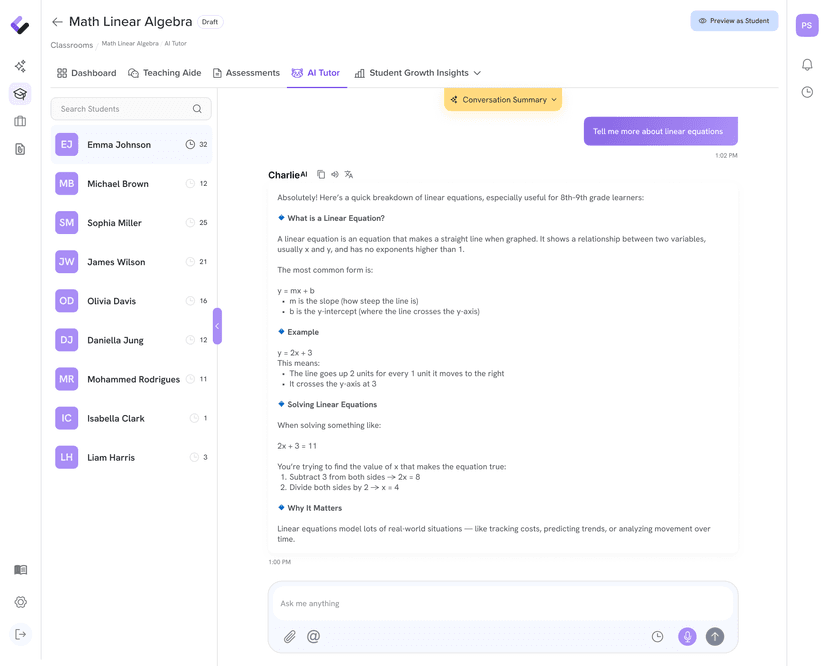
Colleague AI utilizes a conversational, generative AI model to deliver on-demand scaffolding and personalized explanations. Users interact with the platform by typing questions or requests into a chat interface, and the AI processes these prompts to generate tailored text-based responses. The platform operates in two distinct modes: a colleague for educators and a buddy for students. For educators, the AI generates lesson plans, rubrics, and professional development materials based on specific instructional goals. For students, the AI answers questions, explains concepts, and provides study assistance across all subject areas. The system does not follow a linear learning path but instead relies on inquiry-based learning mechanics where the user initiates all educational sequences. There are no built-in practice sets, quizzes, or progression trees. To apply learning science principles like retrieval practice or interleaved practice, users must explicitly instruct the AI to generate quizzes or mix practice problems on their own.
Strengths and tradeoffs of Colleague AI
The biggest strength of Colleague AI is its ability to provide immediate, highly customized explanations across any subject, while its biggest weakness is the complete lack of a structured learning progression. The platform excels at on-demand scaffolding. When a student is stuck on a specific problem, the AI can generate step-by-step worked examples, which cognitive load theory identifies as highly effective for novice learners. Furthermore, it can adjust its reading level and tone to match the user's needs, offering a highly personalized tutoring experience. However, the open-ended nature of generative AI presents significant instructional flaws. The platform completely lacks systematic mastery tracking. It does not monitor what a student knows or prompt them to review older material using spaced repetition. Additionally, the platform requires users to be proficient in prompt engineering. A student who asks a vague question will receive a vague answer, limiting the tool's effectiveness for younger learners or those lacking metacognitive skills. Without built-in retrieval practice or formal assessments, the burden of ensuring long-term retention falls entirely on the user.
Who Might Benefit From Colleague AI?
Colleague AI is best for high school students, college learners, and educators who possess the metacognitive skills necessary to self-direct their learning and prompt an AI effectively. Because it requires active inquiry rather than passive progression through a curriculum, it serves highly motivated learners looking for an on-demand digital tutor to explain complex concepts, generate study guides, or provide worked examples in advanced subjects. It is also a strong productivity tool for teachers needing assistance with administrative tasks and lesson differentiation. It is not suitable for early elementary students who require structured, systematic instruction.
Data Transparency
Meets Data Transparency Standard
Colleague AI meets our data transparency standard at Level 2 of 3 (Parent control). Level 3 needs the policy to document an API for retrieving their own data and a named export format.
20 of 35 checks passed
Evaluated September 2026
Privacy Policy →Level 1 · Basic protections
Does not sell data or target ads at students, limits sharing, and lets parents see and delete their child's data.
Level 2 · Parent control (meets the standard)
Families can get their data out, know who processes it, and know how long it is kept.
Level 3 · Direct data access
Families or schools can pull their own data through an API, in a stated format.
Not documented: an API for retrieving their own data, a named export format
View all 35 checks
Parent Access5/8
Does the policy mention parents specifically?
“Parents and eligible students can:”
Can parents view their child's data?
“Parents and eligible students can: - Review Student Data”
Can parents modify their child's data?
“Parents and eligible students can: - Review Student Data - Request corrections”
Can parents delete their child's account?
The policy lets parents review, correct and export student data but does not say parents can delete their child's data or account.
Is there a dedicated Children's Privacy section?
The policy has a general Student Data Protection section but no section headed on children's privacy or COPPA.
Does it reference COPPA compliance?
“We comply with: - FERPA requirements - COPPA regulations”
Does it reference FERPA compliance?
“We act as a “School Official” under FERPA”
Is parental consent required for child accounts?
The policy mentions only "obtaining appropriate consents" and does not require parental consent for child accounts.
Data Portability2/5
Can users access their personal data?
“- Access your personal data”
Can users download/export their data?
“- Export your data”
Is there a self-service data access tool?
The policy has users make access requests by email and does not describe a self-service data access tool.
Is a specific data format mentioned for export?
The policy says only that data comes in a "usable format" and names no specific format.
Is there an API for data access?
The policy does not describe an API for users or schools to get their data.
Data Minimization2/6
Is data collection itemized?
“- Browser type and version - Operating system - IP address (which may indicate your general location)”
Can the app be used without a real name?
The policy lists student name as required data.
Can the app be used without an email?
The policy collects email addresses and contact information.
Does it state collection is limited to what is necessary?
“We take steps to minimize the collection of personal data to only what is necessary to provide our Services.”
Is IP address anonymized or truncated?
The policy collects IP addresses and does not say they are anonymized or truncated.
Is location tracking explicitly excluded?
The policy collects location (state/province and country) and IP-based general location.
Third-Party Protection7/7
Does it explicitly state no selling of data?
“We explicitly prohibit: - Targeted advertising using Student Data - Sale of Student Data”
Are third-party providers named?
“We utilize Amazon AWS and Microsoft Azure for Generative AI functionalities”
Are providers contractually restricted?
“- All providers must comply with our privacy and security requirements”
No-targeted-advertising commitment?
“We explicitly prohibit: - Targeted advertising using Student Data”
Is AI/ML data sharing addressed?
“We have opted OUT of sharing data with AWS and Azure for model training”
Child-specific sharing restriction?
“- Sale of Student Data - Building non-educational student profiles - Unauthorized data sharing”
Cookies/tracking limited or opt-out?
“Manage cookies through: - Browser settings - Our cookie preferences tool - Third-party opt-out tools”
Deletion & Retention3/5
Can users delete their account?
“- Request data deletion”
Self-service deletion mechanism?
The policy handles deletion by request only and describes no self-service deletion tool.
Specific data retention timeline?
“- API data is retained for abuse monitoring for maximum 30 days”
Auto-deletion of inactive accounts?
“- Delete inactive accounts per policy”
Post-deletion handling described?
The policy mentions only "secure deletion methods" and does not explain what happens to data after deletion.
Advertising1/4
Advertising model explicitly disclosed?
The policy does not say whether the product shows advertising.
Free from third-party advertisements?
The policy does not say the product is free of third-party ads.
Children excluded from ad targeting?
“We explicitly prohibit: - Targeted advertising using Student Data”
Ad-free option available?
The policy does not mention an ad-free option or say the product has no ads.
Meets Data Transparency Standard
The reviewed policy met our data transparency standard. This result describes the policy disclosures we assessed. Actual practices and legal compliance were not verified.
About this evaluation: Based on automated analysis of Privacy Policy against 35 policy-disclosure questions, including questions adapted from the Common Sense Privacy Program's published evaluation questions. TLS is not affiliated with Common Sense Media, and this is not a Common Sense rating. Quoted text is copied from the policy; unquoted notes are our summary. Results describe what the policy documents, not the company's actual practices. Privacy policies can change: this review reflects the version we analyzed and does not determine legal compliance.
Sources and review method
TLS combines product information and editorial analysis to explain how Colleague AI works, its tradeoffs, and the questions to ask before choosing it. Product features, an instructional rationale and evidence of learning outcomes are different kinds of information.
Formal Learning Standard assessment: not yet completed. Data Transparency findings are reported separately and do not establish learning effectiveness. Read our methodology.
Frequently Asked Questions About Colleague AI
Is Colleague AI free?
Colleague AI offers a Free Basic Plan that provides all users with access to its core conversational features at no cost. For users requiring higher usage limits or advanced capabilities, Individual Plus Plans are available through monthly or annual subscriptions. Additionally, schools and districts can purchase Enterprise Licenses, which offer unlimited usage, secure data storage, and seamless integration with existing Single Sign-On and Learning Management Systems.
Is Colleague AI good for elementary students?
Colleague AI is not highly effective for early elementary students. Young children generally lack the reading comprehension, metacognitive awareness, and prompt-generation skills necessary to direct an open-ended artificial intelligence tool. Foundational learning in early grades requires explicit, systematic instruction and heavily structured practice sets. Parents of young children should look for applications that offer a defined curriculum and mastery tracking rather than an unstructured chat interface.
What does Colleague AI teach?
Because it relies on generative AI rather than a rigid curriculum, Colleague AI can generate explanations and study materials for virtually any academic discipline. The platform natively supports inquiries across Humanities, Social Science, Science, Math, Applied Science, and Career & Technical Education. However, it functions as an informational resource and tutor rather than a formal teaching course, relying entirely on the user to determine what topics to cover and when to study them.
How does Colleague AI compare to Khan Academy?
Colleague AI functions as a flexible, open-ended conversational assistant, while Khan Academy operates as a highly structured, mastery-based curriculum. Khan Academy provides sequential video instruction, standardized practice sets, and detailed progress tracking, making it superior for building foundational skills. Conversely, Colleague AI excels at generating customized explanations, modifying reading levels on the fly, and assisting educators with lesson planning and administrative tasks.
Has The Learning Standard evaluated Colleague AI?
TLS has not yet completed a Learning Standard evaluation of how well Colleague AI teaches. Its privacy policy has been reviewed for Data Transparency and reaches Level 2, Parent control.
Is Colleague AI COPPA compliant?
The reviewed privacy policy references COPPA. A policy reference alone does not establish COPPA compliance. Policy review note: The policy states it complies with COPPA.
Is Colleague AI FERPA compliant?
The reviewed privacy policy references FERPA. A policy reference alone does not establish FERPA compliance. Policy review note: The policy states it acts as a School Official under FERPA.
Does Colleague AI have a children's privacy policy?
No dedicated children's privacy section was found in the reviewed policy. Policy review note: The policy has a general Student Data Protection section but no section headed on children's privacy or COPPA.
Does Colleague AI sell student data?
The reviewed policy states that the app does not sell data. This is a policy statement; actual data practices were not verified. Policy review note: The company prohibits selling Student Data.
Can you delete your data from Colleague AI?
The reviewed privacy policy describes account deletion. We have not tested the deletion process. Policy review note: Users can ask for their data to be deleted.
Follow TLS Research
Subscribe to future TLS research updates: app reviews, findings, and what the evidence shows.
Screenshots

Latest News
All Colleague AI NewsTake Action
For Colleague AI
If you represent Colleague AI and have a correction or new evidence, send the relevant source so we can review and update this page.
Submit a correctionDetails
- Pricing
- Free Basic Plan gives all users access to core features at no cost. Individual Plus Plans offer usage-based monthly or annual subscriptions for personal use. Enterprise Licenses provide districts and schools with unlimited usage and storage for all educators and students, plus comprehensive implementation support including onboarding assistance, professional development, and seamless tech integrations with SSO, LMS, and SIS systems.
- Platforms
- Web Browser
- Website
- Visit site