ClassMate
Product by World Book Online
Facts checked: Not yet checked
Our take (not a Learning Standard rating). This label applies to learning-science judgments throughout this overview.
Our take (not a Learning Standard rating)
While The Learning Standard has not yet officially evaluated ClassMate, its design aligns with solid learning science principles by embedding explicit literacy instruction directly into cross-curricular content. It uses graphic organizers to reduce cognitive load, though its reliance on gamification requires careful monitoring to ensure engagement translates to actual comprehension.
Pros
- Integrates graphic organizers to help students structure information and reduce cognitive load during complex reading tasks.
- Provides just-in-time scaffolding that allows struggling readers to access grade-level texts across various subjects.
- Leverages cross-curricular reading materials to build domain-specific vocabulary and background knowledge.
- Employs targeted literacy strategies within science and math contexts to reinforce comprehension outside of traditional English classes.
Cons
- Relies on gamification elements that often distract students from deep processing and meaningful learning.
- Lacks transparent reporting on how the small-language model AI generates text scaffolds and whether it introduces factual errors.
- Requires heavy teacher oversight to ensure students are actively using the literacy strategies rather than passively clicking through texts.
- Pricing is restricted to school and district licenses, making it entirely inaccessible for individual parents or homeschoolers.
What Do We Know About ClassMate?
ClassMate presents a theoretically sound approach to adolescent literacy, though its actual effectiveness remains pending formal evaluation by The Learning Standard. If your child's school uses this platform, expect them to engage with fact-checked articles across subjects like science, math, and history. The tool embeds specific reading comprehension strategies directly into these assignments. Rather than practicing reading skills in isolation, your child will build background knowledge while tackling complex texts. This cross-curricular approach aligns well with cognitive science research showing that reading comprehension relies heavily on domain-specific knowledge. However, because the platform incorporates gamification, you should monitor whether your child is actually retaining the material or simply optimizing for points and rewards. The use of a small-language model AI aims to provide immediate help when your child struggles, adjusting the text complexity to keep them in their zone of proximal development. Parents should encourage their children to use the provided graphic organizers, as these tools actively reduce cognitive load and force students to physically map out relationships between concepts. While unavailable for individual home purchase, it serves as a strong supplementary tool within a structured classroom environment.
How Does ClassMate Work?
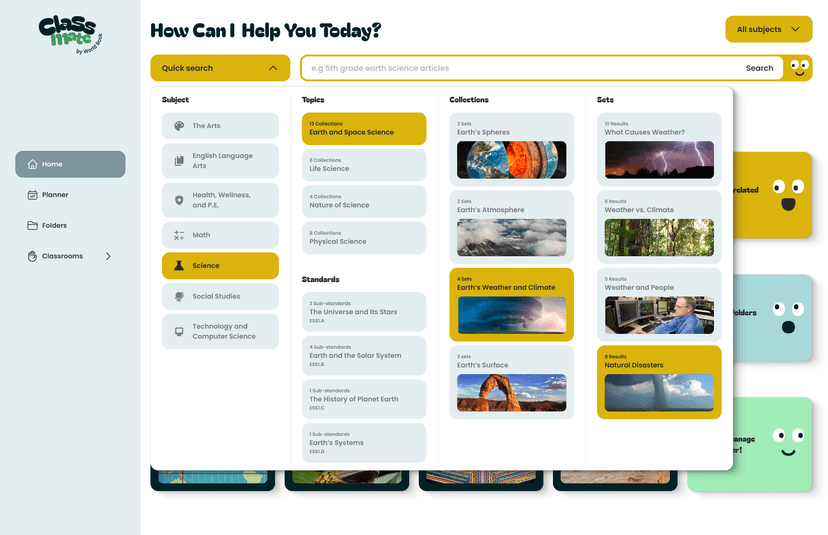
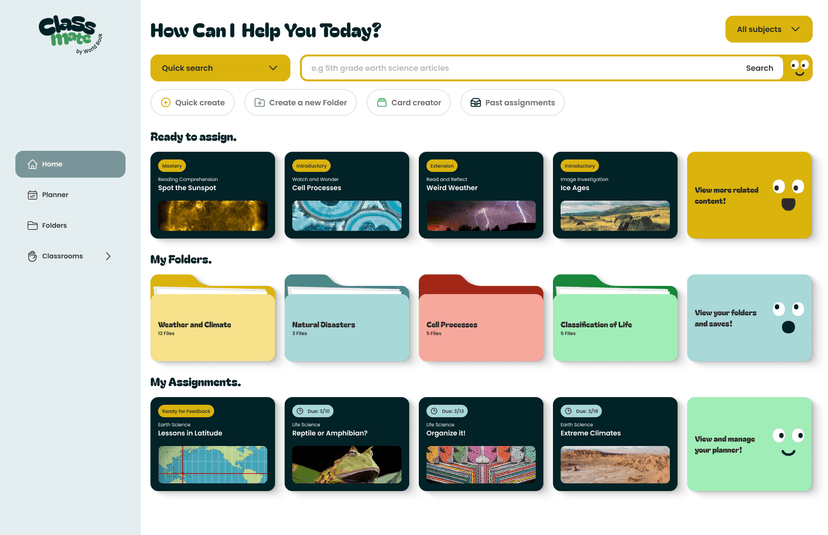
ClassMate uses a blended learning approach that embeds direct literacy instruction within cross-curricular content exploration. When students log in, they do not just read isolated passages; they interact with a massive library of fact-checked World Book articles covering humanities, STEM, and career education. The platform utilizes a small-language AI model to dynamically deploy nearly 50 different literacy strategies and graphic organizers based on the specific text and the student's current reading level. If a student struggles with a dense science article, the system provides just-in-time scaffolds, such as vocabulary definitions or simplified sentence structures, to make the grade-level content accessible. This immediate feedback loop prevents frustration and keeps students engaged. Furthermore, the integration of graphic organizers forces students into active reading, requiring them to extract key information and visually map connections. This aligns with the learning science principle of dual coding, combining verbal information with visual structures to strengthen memory retention. Teachers monitor progress through an educator dashboard, allowing them to differentiate instruction for varying reading levels within the same classroom setting.
Strengths and tradeoffs of ClassMate
The biggest strength of ClassMate is its integration of literacy instruction into content-area teaching, while its biggest weakness is a reliance on gamification that risks prioritizing engagement over deep cognitive processing. By demanding that students read across subjects like math and science, the platform builds vital background knowledge, which learning science identifies as a primary driver of reading comprehension. The inclusion of graphic organizers is another significant strength. These tools actively reduce cognitive load by giving students a visual framework to organize complex information, moving them from passive reading to active meaning-making. The system's use of just-in-time scaffolds acts as a form of guided practice, ensuring students are not left struggling with inaccessible texts. On the downside, the use of a small-language model AI introduces questions about the predictability and consistency of the scaffolds provided. Additionally, the platform employs gamification to motivate middle schoolers. Research warns that extrinsic rewards like badges or points can often short-circuit learning, encouraging students to skim material rather than engage in the retrieval practice necessary for long-term retention. Schools must ensure teachers are actively monitoring comprehension rather than just completion metrics.
Who Might Benefit From ClassMate?
ClassMate is best for middle school educators looking to integrate evidence-based literacy strategies directly into their science, math, and social studies curricula. Targeted specifically at 6th, 7th, and 8th graders, it serves classrooms that need robust, fact-checked reading materials paired with automated differentiation tools. It is highly effective for mixed-ability classrooms where teachers struggle to adapt single texts for diverse reading levels. Because it requires a school or district-wide license, it is not suitable for individual families or independent homeschoolers. Ultimately, it fits best in districts prioritizing cross-curricular literacy and blended learning models.
Data Transparency
Does Not Meet Data Transparency Standard
ClassMate does not meet our data transparency standard. Its privacy policy does not document basic protections, including a statement that it does not sell data and contractual limits on service providers.
19 of 35 checks passed
Evaluated September 2026
worldbookonline.com →Level 1 · Basic protections
Does not sell data or target ads at students, limits sharing, and lets parents see and delete their child's data.
Not documented: a statement that it does not sell data, contractual limits on service providers
Level 2 · Parent control (meets the standard)
Families can get their data out, know who processes it, and know how long it is kept.
Level 3 · Direct data access
Families or schools can pull their own data through an API, in a stated format.
Not documented: an API for retrieving their own data, a named export format
View all 35 checks
Parent Access6/8
Does the policy mention parents specifically?
“Only you, or an authorized agent that you authorize to act on your behalf, may make a request related to your personal information. You may also make a request on behalf of your minor child.”
Can parents view their child's data?
“Only you, or an authorized agent that you authorize to act on your behalf, may make a request related to your personal information. You may also make a request on behalf of your minor child.”
Can parents modify their child's data?
“Only you, or an authorized agent that you authorize to act on your behalf, may make a request related to your personal information. You may also make a request on behalf of your minor child.”
Can parents delete their child's account?
“Only you, or an authorized agent that you authorize to act on your behalf, may make a request related to your personal information. You may also make a request on behalf of your minor child.”
Is there a dedicated Children's Privacy section?
The policy has a student data section but no section headed for children's privacy or COPPA.
Does it reference COPPA compliance?
The policy does not mention COPPA.
Does it reference FERPA compliance?
“we do not knowingly collect or solicit any personal information from children, as defined under applicable law, without verified written parental consent or consent appropriately obtained pursuant to applicable educational privacy laws (including the Family Educational Rights and Privacy Act)”
Is parental consent required for child accounts?
“we do not knowingly collect or solicit any personal information from children, as defined under applicable law, without verified written parental consent or consent appropriately obtained pursuant to applicable educational privacy laws (including the Family Educational Rights and Privacy Act)”
Data Portability2/5
Can users access their personal data?
“_Access_ – The right to request access to and obtain a copy of any personal information we may have about you.”
Can users download/export their data?
“_Access_ – The right to request access to and obtain a copy of any personal information we may have about you.”
Is there a self-service data access tool?
The policy says rights are exercised by email or phone and describes no self-service access tool.
Is a specific data format mentioned for export?
The policy does not name a data export format.
Is there an API for data access?
The policy does not describe an API for users or schools to retrieve their data.
Data Minimization1/6
Is data collection itemized?
“The personal information we collect during account registration may depend on your account type but could include username, email address, photograph, biography, company, title, and other contact information you provide.”
Can the app be used without a real name?
The policy says student My Research accounts include a first name, and schools may provide student information.
Can the app be used without an email?
The policy says it collects email addresses at registration, and school administrators may see student profiles that include email addresses.
Does it state collection is limited to what is necessary?
The policy does not say collection is limited to what is necessary.
Is IP address anonymized or truncated?
The policy says it collects IP addresses and does not mention anonymizing or truncating them.
Is location tracking explicitly excluded?
The policy says it collects location data, for example via Wi-Fi or IP address.
Third-Party Protection4/7
Does it explicitly state no selling of data?
The policy says it does not sell personal information for money but admits sharing it in ways that may count as a sale under privacy laws, so it makes no unqualified no-selling commitment.
Are third-party providers named?
“We specifically use analytics services, like Google Analytics, to assist us with analyzing our Site and Service traffic and Site and Service usage to optimize, maintain, and secure our Site and Services and inform subsequent business decisions (including, _e.g_., advertising).”
Are providers contractually restricted?
The policy does not say service providers are contractually restricted in how they use data.
No-targeted-advertising commitment?
“**Advertising Limitations.** World Book does not collect, use, disclose, or sell student data to (a) inform, influence, or enable targeted advertising; or (b) develop a profile of a student, family member/guardian, or group, for any purpose other than providing the Services.”
Is AI/ML data sharing addressed?
The policy does not address AI or machine learning.
Child-specific sharing restriction?
“World Book does not collect, use, disclose, or sell student data to (a) inform, influence, or enable targeted advertising; or (b) develop a profile of a student, family member/guardian, or group, for any purpose other than providing the Services.”
Cookies/tracking limited or opt-out?
“Customize your browser settings to refuse all or some browser cookies, or to alert you when websites set or access cookies.”
Deletion & Retention4/5
Can users delete their account?
“_Deletion_ – The right to delete your personal information that we have collected or obtained, subject to certain exceptions.”
Self-service deletion mechanism?
“Student information may be removed from the system at any time by appropriate district personnel.”
Specific data retention timeline?
“Student “My Research” accounts allow students to save collections of articles and media from World Book’s digital database products, and are purged within 90 days of the end of the Service.”
Auto-deletion of inactive accounts?
The policy ties deletion to the end of the Service or year-end processing, not to account inactivity.
Post-deletion handling described?
“Student information may be removed from the system at any time by appropriate district personnel. In all cases, all backup information will be removed with a 30-day rotation cycle.”
Advertising2/4
Advertising model explicitly disclosed?
“For users of our Sites and Services, we may also use your information to serve you ads (including interest-based advertising) about our products or other products or services we (or our advertising partners, such as other third-party brands) think you might find interesting.”
Free from third-party advertisements?
The policy describes advertisements served on its Site and does not say the product is free of third-party ads.
Children excluded from ad targeting?
“We do not allow third-party advertising networks to collect information on our Services for targeted advertising purposes or to knowingly direct targeted advertising to individuals we know to be students.”
Ad-free option available?
The policy does not offer an ad-free option or say the product has no advertising.
What This Means
The policy review did not meet our data transparency standard. The checks above show the documented findings and unknowns. A missing statement does not establish how the app handles data in practice.
About this evaluation: Based on automated analysis of worldbookonline.com against 35 policy-disclosure questions, including questions adapted from the Common Sense Privacy Program's published evaluation questions. TLS is not affiliated with Common Sense Media, and this is not a Common Sense rating. Quoted text is copied from the policy; unquoted notes are our summary. Results describe what the policy documents, not the company's actual practices. Privacy policies can change: this review reflects the version we analyzed and does not determine legal compliance.
Sources and review method
TLS combines product information and editorial analysis to explain how ClassMate works, its tradeoffs, and the questions to ask before choosing it. Product features, an instructional rationale and evidence of learning outcomes are different kinds of information.
Formal Learning Standard assessment: not yet completed. Data Transparency findings are reported separately and do not establish learning effectiveness. Read our methodology.
Frequently Asked Questions About ClassMate
Is ClassMate free?
No, ClassMate is not free and cannot be purchased by individual consumers. It uses a B2B pricing model, requiring a per-building license for individual schools or a per-student license for district-wide implementations. Parents cannot buy a subscription for home use, so access depends entirely on whether your local school district has purchased a contract with World Book Online.
Is ClassMate good for middle schoolers?
Yes, the platform is specifically designed for 6th, 7th, and 8th-grade students. It targets adolescent literacy by combining mature, fact-checked content with necessary reading scaffolds. Middle school is a critical time when reading instruction shifts from learning to read to reading to learn. ClassMate supports this transition by helping students parse complex informational texts in subjects like STEM and social sciences without talking down to them.
What does ClassMate teach?
ClassMate teaches cross-curricular literacy and reading comprehension skills. Rather than focusing on fiction or standalone grammar exercises, it trains students to extract information from nearly a million pieces of subject-specific content, including science, humanities, and career education. It actively teaches students how to use over 50 literacy strategies and graphic organizers to map concepts, define domain-specific vocabulary, and understand complex informational texts.
Does The Learning Standard recommend ClassMate?
ClassMate is currently pending evaluation by our team, so we cannot issue an official recommendation at this time. Our methodology requires rigorous, independent testing against established learning science principles before issuing a final verdict. Once our analysts complete their review of how effectively the platform's AI scaffolding and graphic organizers drive actual comprehension, we will update this profile with a definitive rating.
ClassMate vs Newsela: Which is better?
Both platforms excel at bringing differentiated, cross-curricular texts into the classroom, but they serve slightly different needs. Newsela focuses heavily on daily news and current events, dynamically adjusting the Lexile level of journalism. ClassMate leverages the deep, encyclopedic archive of World Book Online and heavily emphasizes integrated graphic organizers and an AI-driven scaffolding model to explicitly teach reading strategies alongside the text.
Has The Learning Standard evaluated ClassMate?
TLS has not yet completed a Learning Standard evaluation of how well ClassMate teaches. Its privacy policy has been reviewed for Data Transparency and does not yet document the basic protections (Level 1).
Is ClassMate COPPA compliant?
A COPPA reference was not found in the reviewed privacy policy. This does not determine whether the app complies with COPPA. Policy review note: The policy does not mention COPPA.
Is ClassMate FERPA compliant?
The reviewed privacy policy references FERPA. A policy reference alone does not establish FERPA compliance. Policy review note: The policy names FERPA as governing how consent for children's data is obtained.
Does ClassMate have a children's privacy policy?
No dedicated children's privacy section was found in the reviewed policy. Policy review note: The policy has a student data section but no section headed for children's privacy or COPPA.
Does ClassMate sell student data?
A statement ruling out data selling was not found in the reviewed policy. This does not establish that the app sells student data. Policy review note: The policy says it does not sell personal information for money but admits sharing it in ways that may count as a sale under privacy laws, so it makes no unqualified no-selling commitment.
Can you delete your data from ClassMate?
The reviewed privacy policy describes account deletion. We have not tested the deletion process. Policy review note: Users may request deletion of their personal information.
Follow TLS Research
Subscribe to future TLS research updates: app reviews, findings, and what the evidence shows.
Screenshots


Take Action
For ClassMate
If you represent World Book Online and have a correction or new evidence, send the relevant source so we can review and update this page.
Submit a correctionDetails
- Pricing
- Priced per building for schools or per student for district-wide
- Platforms
- Web Browser, Windows (Microsoft), macOS (Apple), Chrome OS (Google)
- Grade Levels
- 6th Grade, 7th Grade, 8th Grade
- Website
- Visit site