
CK-12 Simulations
Product by CK-12 Foundation
Facts checked: Not yet checked
Our take (not a Learning Standard rating). This label applies to learning-science judgments throughout this overview.
Our take (not a Learning Standard rating)
CK-12 Simulations effectively teach abstract physics and chemistry concepts by allowing students to manipulate variables and immediately observe the outcomes. By visualizing invisible forces, the platform leverages dual coding theory, though it lacks built-in spaced retrieval practice to ensure long-term retention of the formulas driving these simulations.
Pros
- Allows students to isolate variables and observe direct physical consequences, supporting inquiry-based learning.
- Pairs visual models with study questions to prompt active cognitive processing.
- Provides walkthrough videos that function as worked examples to reduce initial cognitive load.
Cons
- Lacks automated spaced repetition to help students retain formulas and conceptual relationships over time.
- Offers limited feedback on incorrect responses to the study questions beyond showing the right answer.
- Requires significant self-regulation, making it easy for unguided students to click aimlessly without learning.
What Do We Know About CK-12 Simulations?
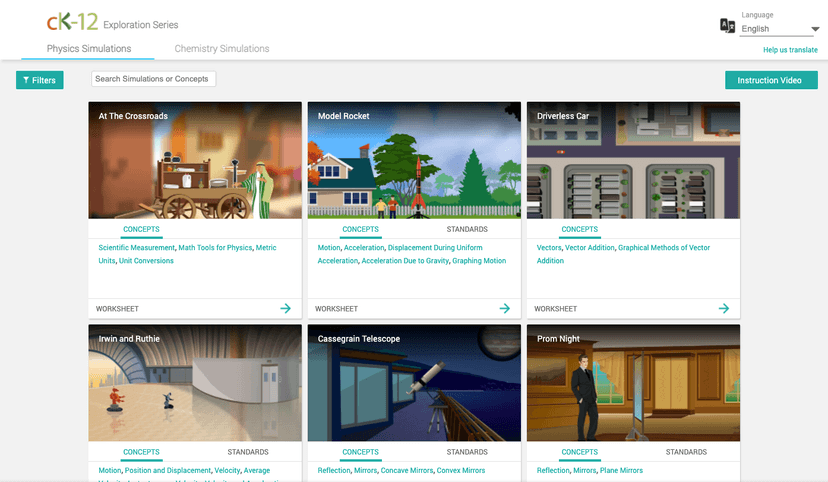
CK-12 Simulations is an effective tool for teaching your child abstract science concepts through interactive, variable-based modeling. Instead of simply reading about physics and chemistry, your child manipulates sliders and inputs to see how changing mass, velocity, or temperature alters a system in real time. This active engagement prevents passive consumption and forces learners to test hypotheses. The platform is completely free and covers a wide range of middle and high school science standards. While the visual demonstrations are excellent for building initial conceptual understanding, the app relies heavily on the user's motivation to watch the walkthrough videos and answer the accompanying study questions. Because there is no strict progression system locking your child out of advanced topics, you may need to guide them to ensure they are completing modules that align with their current classroom instruction rather than just playing with the graphics. The Learning Standard has not yet formally evaluated this app, but its design aligns well with inquiry-based learning principles.
How Does CK-12 Simulations Work?
CK-12 Simulations uses an inquiry-based learning approach where visual demonstrations and interactive variable manipulation precede direct instruction. Your child begins by selecting a real-world scenario, such as a roller coaster or a functioning battery. They are presented with a set of sliders representing variables like friction, gravity, or concentration. Adjusting these inputs immediately changes the visual animation and the corresponding data graphs, establishing a clear cause-and-effect relationship. This translates abstract mathematical formulas into tangible physical reactions. After experimenting with the model, students watch a short walkthrough video that explicitly connects their observations to formal scientific principles. Finally, the simulation provides a set of study questions designed to test their understanding of the concepts they just observed. This sequence ensures that learners build a mental model before tackling the complex mathematics underlying the scientific phenomena.
Strengths and tradeoffs of CK-12 Simulations
The biggest strength of CK-12 Simulations is its ability to reduce cognitive load through dynamic visualization, while its biggest weakness is the lack of guided feedback during the assessment phase. Interactive Modeling: By allowing students to manipulate one variable at a time while keeping others constant, the platform effectively mimics the scientific method. This grounds abstract concepts like kinematics or thermodynamics in observable reality, making it easier for learners to encode the information. Worked Examples: The inclusion of walkthrough videos provides essential scaffolding, showing students exactly how experts analyze the simulation. Weak Assessment Mechanics: While the visual learning tools are robust, the study questions act more as traditional quizzes rather than adaptive learning tools. If your child answers a question incorrectly, the platform does not provide targeted, step-by-step feedback to correct their specific misconception. No Retrieval Practice: The app functions as a collection of standalone modules rather than a comprehensive curriculum. It does not track long-term progress or utilize spaced repetition to periodically test your child on older concepts, meaning they may forget the material if it is not reinforced elsewhere.
Who Might Benefit From CK-12 Simulations?
Best for middle and high school students who struggle with abstract science concepts and need visual, interactive models to supplement their classroom learning. Because the simulations bridge the gap between complex mathematical formulas and real-world physical reactions, the platform is particularly useful for visual learners tackling introductory physics and chemistry. It serves as an excellent homework companion or laboratory substitute for students aiming to master core STEM competencies, provided they have the self-discipline to actively complete the accompanying study questions and review the walkthroughs.
Data Transparency
Does Not Meet Data Transparency Standard
CK-12 Simulations does not meet our data transparency standard. Its privacy policy does not document basic protections, including a statement that it does not sell data, a commitment against targeted advertising and a COPPA or FERPA commitment.
16 of 35 checks passed
Evaluated September 2026
Privacy Policy →Level 1 · Basic protections
Does not sell data or target ads at students, limits sharing, and lets parents see and delete their child's data.
Not documented: a statement that it does not sell data, a commitment against targeted advertising, a COPPA or FERPA commitment
Level 2 · Parent control (meets the standard)
Families can get their data out, know who processes it, and know how long it is kept.
Not documented: a data retention timeline, self-service deletion
Level 3 · Direct data access
Families or schools can pull their own data through an API, in a stated format.
Not documented: an API for retrieving their own data, a named export format
View all 35 checks
Parent Access5/8
Does the policy mention parents specifically?
“Children’s privacy is important to us. Younger visitors should always check with their parents or guardians before entering information online.”
Can parents view their child's data?
“Review the personal information we maintain about your child;”
Can parents modify their child's data?
The policy lets parents review, delete, or stop the use of their child's information, but gives them no right to correct it.
Can parents delete their child's account?
“Direct us to delete the personal information we maintain about your child; and”
Is there a dedicated Children's Privacy section?
“**2\. CHILDREN’S PRIVACY**”
Does it reference COPPA compliance?
The policy does not mention COPPA.
Does it reference FERPA compliance?
The policy mentions student records but does not name FERPA.
Is parental consent required for child accounts?
“If we become aware that a child user wants to access the Platform, we will take steps to obtain consent from their parent or guardian.”
Data Portability3/5
Can users access their personal data?
“If you are registered with us, you may log into your account to access and correct your account information.”
Can users download/export their data?
“You can ask us for a copy of your personal information and can ask for a copy of personal information to be provided in machine readable form.”
Is there a self-service data access tool?
“If you are registered with us, you may log into your account to access and correct your account information.”
Is a specific data format mentioned for export?
The policy says only "machine readable form" and names no specific file format.
Is there an API for data access?
The policy does not describe an API for getting data.
Data Minimization1/6
Is data collection itemized?
“If you are a student or teacher, we may collect information such as your name, telephone number, email address, mailing address, birth date, profile photo, demographic data, and account login information (i.e., username and password).”
Can the app be used without a real name?
The policy says it collects students' names.
Can the app be used without an email?
The policy says it collects students' email addresses.
Does it state collection is limited to what is necessary?
The policy does not say collection is limited to what is necessary, apart from limited parent data used for consent.
Is IP address anonymized or truncated?
The policy says it collects IP addresses and does not say they are anonymized or truncated.
Is location tracking explicitly excluded?
The policy says it collects the device's city and does not rule out location tracking.
Third-Party Protection5/7
Does it explicitly state no selling of data?
The policy does not say that CK-12 does not sell personal information.
Are third-party providers named?
“If you donate to us, we may collect from PayPal (our service provider) your name, contact information, and donation amount.”
Are providers contractually restricted?
“We take steps to prohibit our service providers from using your personal information for purposes outside of providing services to us.”
No-targeted-advertising commitment?
The policy makes no promise not to use data for targeted advertising.
Is AI/ML data sharing addressed?
“We may also aggregate or deidentify information about users of our Platform to train AI models, understand usage trends, and gather opinions, comments, and suggestions about our Platform.”
Child-specific sharing restriction?
“To protect the privacy of children (see the definition above), certain functionality associated with a child’s account will be disabled to ensure that the child’s profile information (including profile photo) will not be visible to others on our Platform.”
Cookies/tracking limited or opt-out?
“For more information about Google Analytics and how to opt out, please visit [https://tools.google.com/dlpage/gaoptout/](https://tools.google.com/dlpage/gaoptout/).”
Deletion & Retention2/5
Can users delete their account?
“You may request to cancel your membership and have your account removed from our Platform. Please make all cancellation requests via email to [support@ck12.org](mailto:support@ck12.org).”
Self-service deletion mechanism?
The policy says account deletion is requested by email, not through a self-service tool.
Specific data retention timeline?
The policy keeps data as long as an account exists or as needed, with no specific time limit.
Auto-deletion of inactive accounts?
The policy does not address automatic deletion of inactive accounts.
Post-deletion handling described?
“We may anonymize your personal information after you have deactivated or deleted your account so that we can use this anonymized information for our internal business purposes.”
Advertising0/4
Advertising model explicitly disclosed?
The policy mentions ads CK-12 places on third-party websites but does not say whether the product itself shows ads.
Free from third-party advertisements?
The policy does not say the product is free of third-party ads.
Children excluded from ad targeting?
The policy does not say children are excluded from ad targeting.
Ad-free option available?
The policy does not say whether the product has ads or an ad-free option.
What This Means
The policy review did not meet our data transparency standard. The checks above show the documented findings and unknowns. A missing statement does not establish how the app handles data in practice.
About this evaluation: Based on automated analysis of Privacy Policy against 35 policy-disclosure questions, including questions adapted from the Common Sense Privacy Program's published evaluation questions. TLS is not affiliated with Common Sense Media, and this is not a Common Sense rating. Quoted text is copied from the policy; unquoted notes are our summary. Results describe what the policy documents, not the company's actual practices. Privacy policies can change: this review reflects the version we analyzed and does not determine legal compliance.
Sources and review method
TLS combines product information and editorial analysis to explain how CK-12 Simulations works, its tradeoffs, and the questions to ask before choosing it. Product features, an instructional rationale and evidence of learning outcomes are different kinds of information.
Formal Learning Standard assessment: not yet completed. Data Transparency findings are reported separately and do not establish learning effectiveness. Read our methodology.
Frequently Asked Questions About CK-12 Simulations
Is CK-12 Simulations free?
Yes, CK-12 Simulations is entirely free for students, parents, and educators. The CK-12 Foundation operates as a non-profit organization and does not charge for access to its interactive modules or study materials.
Is CK-12 Simulations good for middle schoolers?
Yes, middle school students can heavily benefit from the platform's introductory physics and chemistry modules. The visual nature of the simulations helps 6th through 8th graders grasp foundational scientific principles before they are required to learn the complex mathematics behind them.
What does CK-12 Simulations teach?
CK-12 Simulations teaches core concepts in physics and chemistry, including mechanics, thermodynamics, electromagnetism, and atomic structure. It focuses on helping students understand the invisible forces and mathematical relationships that govern real-world physical phenomena.
How does CK-12 Simulations compare to PhET Interactive Simulations?
Both platforms offer high-quality, free science simulations, but PhET provides a wider variety of elementary and math modules, whereas CK-12 Simulations focuses heavily on middle and high school physics and chemistry with integrated walkthrough videos and structured study questions.
Has The Learning Standard evaluated CK-12 Simulations?
TLS has not yet completed a Learning Standard evaluation of how well CK-12 Simulations teaches. Its privacy policy has been reviewed for Data Transparency and does not yet document the basic protections (Level 1).
Is CK-12 Simulations COPPA compliant?
A COPPA reference was not found in the reviewed privacy policy. This does not determine whether the app complies with COPPA. Policy review note: The policy does not mention COPPA.
Is CK-12 Simulations FERPA compliant?
A FERPA reference was not found in the reviewed privacy policy. This does not determine whether the app complies with FERPA. Policy review note: The policy mentions student records but does not name FERPA.
Does CK-12 Simulations have a children's privacy policy?
The reviewed policy includes a dedicated children's privacy section. Policy review note: The policy has a dedicated Children's Privacy section.
Does CK-12 Simulations sell student data?
A statement ruling out data selling was not found in the reviewed policy. This does not establish that the app sells student data. Policy review note: The policy does not say that CK-12 does not sell personal information.
Can you delete your data from CK-12 Simulations?
The reviewed privacy policy describes account deletion. We have not tested the deletion process. Policy review note: Users can ask to have their account removed.
Follow TLS Research
Subscribe to future TLS research updates: app reviews, findings, and what the evidence shows.
Screenshots

Take Action
For CK-12 Simulations
If you represent CK-12 Foundation and have a correction or new evidence, send the relevant source so we can review and update this page.
Submit a correctionDetails
- Pricing
- Free for educational purposes
- Platforms
- Web Browser, iPadOS (Apple tablet), Windows (Microsoft), macOS (Apple), Chrome OS (Google), Other
- Grade Levels
- 6th Grade, 7th Grade, 8th Grade, 9th Grade, 10th Grade, 11th Grade, 12th Grade, Associate's degree, Adult Education
- Website
- Visit site