
Britannica LaunchPacks
Product by Encyclopedia Britannica Inc.
Facts checked: Not yet checked
Our take (not a Learning Standard rating). This label applies to learning-science judgments throughout this overview.
Our take (not a Learning Standard rating)
Britannica LaunchPacks delivers exceptional, trustworthy multimodal content but relies entirely on teacher implementation to drive actual learning. While its varied media supports dual coding theory by combining text and visuals, it lacks built-in retrieval practice or adaptive assessments to independently verify student mastery.
Pros
- Offers differentiated reading levels for the same text to support varying student reading capabilities.
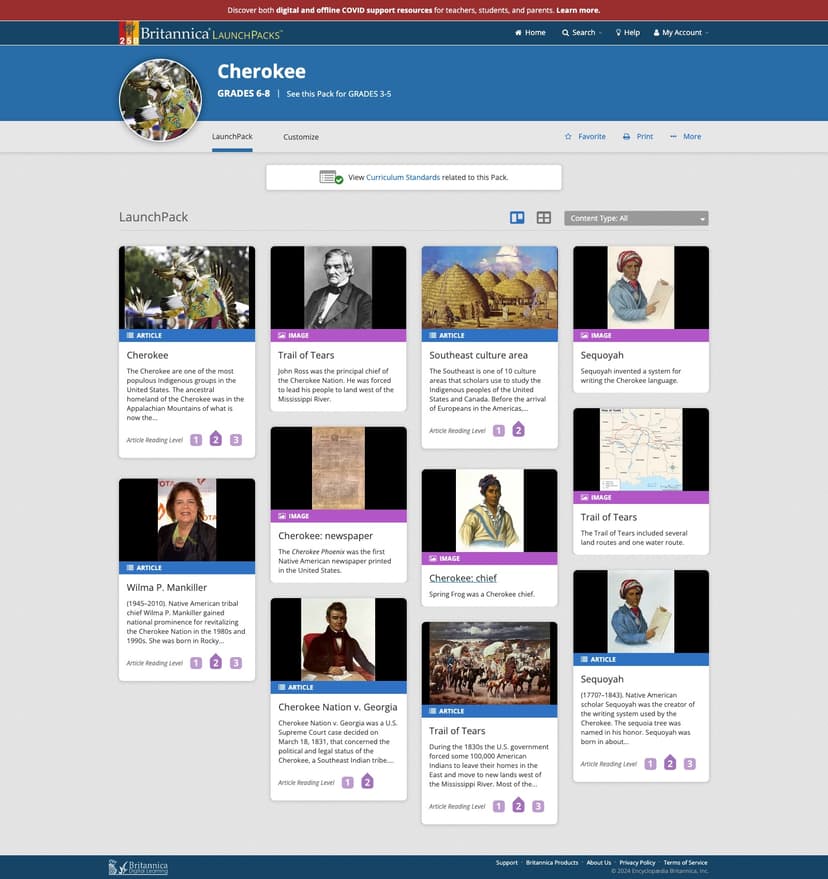
- Combines text, video, and primary sources to support dual coding theory and reduce cognitive overload.
- Provides highly accurate, vetted informational texts that eliminate the need for open web searching.
- Allows educators to annotate texts and customize resource packs to align with specific classroom objectives.
Cons
- Lacks built-in formative assessments or retrieval practice mechanisms to test student recall.
- Provides no adaptive learning pathways based on individual student performance or interaction.
- Requires significant teacher orchestration to translate curated resources into active learning experiences.
- Offers no automated feedback to students when they interact with the materials.
What Do We Know About Britannica LaunchPacks?
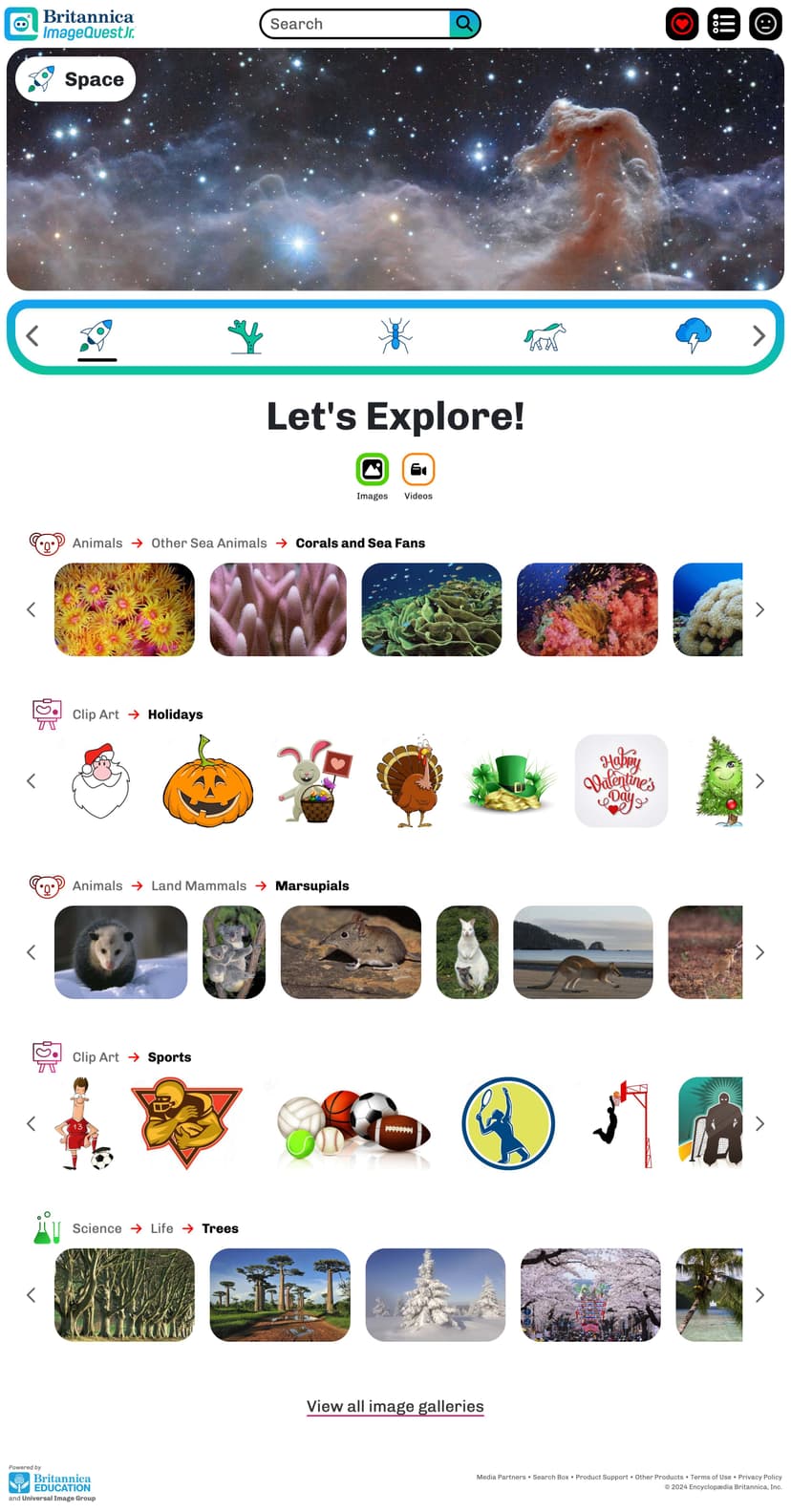
Britannica LaunchPacks is effective as a high-quality digital library but does not independently teach your child without an educator guiding the process. The platform provides carefully organized collections of articles, videos, and images designed around specific science and social studies topics. This approach ensures your child consumes vetted, accurate information rather than searching the open internet. By offering the same informational text at different reading levels, the app prevents reading comprehension deficits from blocking content knowledge acquisition. However, this is primarily an input tool. It does not test your child, utilize spaced repetition, or adapt to their learning pace. Your child will read, watch, and explore, but the actual cognitive work of synthesizing and remembering the material depends entirely on the assignments their teacher creates. Because The Learning Standard has not yet evaluated this platform, we cannot verify its independent efficacy, but its reliance on teacher-driven instruction means its success will vary heavily based on classroom implementation.
How Does Britannica LaunchPacks Work?
Britannica LaunchPacks uses inquiry-based resource curation to provide students with organized, multimodal information on specific academic topics. Rather than following a linear curriculum, students access content bundles that include encyclopedic articles, primary source documents, videos, and interactive maps. This design supports the cognitive theory of multimedia learning by presenting information through both visual and verbal channels simultaneously. When a student opens a pack, they can select their appropriate reading level for the core text, ensuring the vocabulary matches their current capability. Teachers assign these packs to students, often adding their own annotations, guiding questions, or instructions directly into the interface. Students then consume the media to complete external assignments, research projects, or class discussions. The platform functions as a sophisticated digital textbook rather than an automated tutor, meaning it delivers the content but leaves the pedagogical framing entirely to the classroom educator.
Strengths and tradeoffs of Britannica LaunchPacks
The biggest strength of Britannica LaunchPacks is its trustworthy, multimodal content differentiation, while its biggest weakness is the complete absence of built-in retrieval practice. Strengths: The platform excels at reducing cognitive load for struggling readers. By allowing students to toggle between reading levels on the exact same topic, it separates decoding skills from content acquisition. Furthermore, its integration of historical photos, videos, and text leverages dual coding theory, helping students build stronger mental models of complex science and social studies concepts. Weaknesses: Despite these strong inputs, the platform fails to complete the learning loop. Learning science dictates that active recall is necessary for long-term retention, yet LaunchPacks offers no quizzes, spaced repetition algorithms, or interactive knowledge checks. Students consume information passively unless a teacher actively intervenes with external assessments. Additionally, the lack of automated feedback means a student has no way of knowing if they have actually understood the material they just read. Until The Learning Standard officially evaluates the platform, educators should be aware that LaunchPacks is a powerful content repository, not a standalone instructional tool.
Who Might Benefit From Britannica LaunchPacks?
Best for middle and high school teachers who need reliable, differentiated resources to support project-based or inquiry-based classroom instruction. It is highly effective for students in third through twelfth grade who require adjusted reading levels to access grade-level science and social studies content. Parents will find it far less useful as a standalone home-learning tool, as it strictly requires an educator to structure the assignments, provide corrective feedback, and facilitate the active recall necessary for long-term retention.
Data Transparency
Does Not Meet Data Transparency Standard
Britannica LaunchPacks does not meet our data transparency standard. Its privacy policy does not document basic protections, including a statement that it does not sell data, parents' right to see their child's data and parents' right to delete their child's data.
20 of 35 checks passed
Evaluated September 2026
Encyclopædia Britannica, Inc. Corporate Site →Level 1 · Basic protections
Does not sell data or target ads at students, limits sharing, and lets parents see and delete their child's data.
Not documented: a statement that it does not sell data, parents' right to see their child's data, parents' right to delete their child's data
Level 2 · Parent control (meets the standard)
Families can get their data out, know who processes it, and know how long it is kept.
Not documented: data export, self-service deletion
Level 3 · Direct data access
Families or schools can pull their own data through an API, in a stated format.
Not documented: an API for retrieving their own data, a named export format
View all 35 checks
Parent Access5/8
Does the policy mention parents specifically?
“If you are under the age of 16, please get permission from your parent/legal guardian or school before using the Services.”
Can parents view their child's data?
The policy does not give parents a right to view their child's data.
Can parents modify their child's data?
The policy does not give parents a right to change their child's data.
Can parents delete their child's account?
The policy lets anyone report data held about a child under 16, and lets the user or school district order deletion, but it does not give parents a right to delete their child's data or account.
Is there a dedicated Children's Privacy section?
“Children's Privacy & Student Data”
Does it reference COPPA compliance?
“your student service data is processed in a way that is COPPA- and FERPA-compliant.”
Does it reference FERPA compliance?
“your student service data is processed in a way that is COPPA- and FERPA-compliant.”
Is parental consent required for child accounts?
“If you are under the age of 16, please get permission from your parent/legal guardian or school before using the Services. If we discover that we have collected any personal information from a child under the age of 16 without the proper consent required by law, we will suspend the associated account”
Data Portability1/5
Can users access their personal data?
“If you wish to confirm that Britannica is processing your personal data, or to have access to the personal data Britannica may have about you, please contact us at edsupport@eb.com.”
Can users download/export their data?
The policy only tells users to contact the data protection officer for more information about portability and does not describe any way to download or export data.
Is there a self-service data access tool?
The policy handles access requests only by email, not through a tool users run themselves.
Is a specific data format mentioned for export?
The policy does not name any export format.
Is there an API for data access?
The policy does not mention an API for accessing data.
Data Minimization2/6
Is data collection itemized?
“Categories of information we collect include: (1) identity data, which includes your name, email address or other similar identifiers; (2) contact data, which includes postal or physical address, email address or telephone number; and (3) financial data, which includes credit card and other payment information.”
Can the app be used without a real name?
The policy says it collects identity data, including name.
Can the app be used without an email?
The policy says it collects email addresses.
Does it state collection is limited to what is necessary?
“We only collect such personal information or student data that is necessary to provide the subscribed-to Services to our institutional customers and their authorized users.”
Is IP address anonymized or truncated?
The policy says it collects IP addresses and does not say they are anonymized or truncated.
Is location tracking explicitly excluded?
The policy says it collects both general and precise location information.
Third-Party Protection5/7
Does it explicitly state no selling of data?
The policy never says that Britannica does not sell personal data.
Are third-party providers named?
“Britannica uses third-party vendors to help us provide the Services. For example, Amazon Web Services provides our cloud hosting facilities.”
Are providers contractually restricted?
“These vendors can only use your personal information or student data to provide the contracted services, not for their own commercial purposes, and are subject to written security, confidentiality and non-disclosure obligations.”
No-targeted-advertising commitment?
“The Services do not contain any third-party advertising or targeted advertising.”
Is AI/ML data sharing addressed?
The policy does not address AI or machine learning.
Child-specific sharing restriction?
“We will only disclose student data to authorized employees or representatives of the school institution and will not knowingly disclose the student data to any third person without express written authorization.”
Cookies/tracking limited or opt-out?
“You can opt out of this Google Analytics Advertiser feature using the Ads Settings located at https://www.google.com/settings/ads. In addition, you can use the Google Analytics Opt-Out Browser Add-on to disable tracking by Google Analytics.”
Deletion & Retention3/5
Can users delete their account?
“If you no longer wish to have a registered account, you may terminate your account by sending an email to edsupport@eb.com.”
Self-service deletion mechanism?
The policy handles account deletion only through email requests, not a self-service tool.
Specific data retention timeline?
“Because of the way we maintain the Britannica Services, such deletion may not be immediate, and residual copies of your profile information or posts may remain on backup media for up to ninety (90) days.”
Auto-deletion of inactive accounts?
The policy does not say inactive accounts are deleted automatically.
Post-deletion handling described?
“Because of the way we maintain the Britannica Services, such deletion may not be immediate, and residual copies of your profile information or posts may remain on backup media for up to ninety (90) days.”
Advertising4/4
Advertising model explicitly disclosed?
“The Services do not contain any third-party advertising or targeted advertising.”
Free from third-party advertisements?
“The Services do not contain any third-party advertising or targeted advertising.”
Children excluded from ad targeting?
“The Services do not contain any third-party advertising or targeted advertising.”
Ad-free option available?
“The Services do not contain any third-party advertising or targeted advertising.”
What This Means
The policy review did not meet our data transparency standard. The checks above show the documented findings and unknowns. A missing statement does not establish how the app handles data in practice.
About this evaluation: Based on automated analysis of Encyclopædia Britannica, Inc. Corporate Site against 35 policy-disclosure questions, including questions adapted from the Common Sense Privacy Program's published evaluation questions. TLS is not affiliated with Common Sense Media, and this is not a Common Sense rating. Quoted text is copied from the policy; unquoted notes are our summary. Results describe what the policy documents, not the company's actual practices. Privacy policies can change: this review reflects the version we analyzed and does not determine legal compliance.
Sources and review method
TLS combines product information and editorial analysis to explain how Britannica LaunchPacks works, its tradeoffs, and the questions to ask before choosing it. Product features, an instructional rationale and evidence of learning outcomes are different kinds of information.
Formal Learning Standard assessment: not yet completed. Data Transparency findings are reported separately and do not establish learning effectiveness. Read our methodology.
Frequently Asked Questions About Britannica LaunchPacks
Is Britannica LaunchPacks free?
No, Britannica LaunchPacks is not free. It is an enterprise-level platform sold directly to schools and school districts. Parents cannot typically purchase individual subscriptions for home use, and pricing varies based on the size of the school or district.
Is Britannica LaunchPacks good for elementary students?
Yes, it is effective for students in 3rd grade and up. The platform allows texts to be scaled down to lower reading levels, making complex historical and scientific concepts accessible to younger readers without overwhelming them with advanced vocabulary.
What does Britannica LaunchPacks teach?
Britannica LaunchPacks provides content for Humanities, Social Sciences, and Science. It does not teach math or reading mechanics; instead, it provides the informational texts and media necessary for students to build background knowledge in specific historical eras, civic structures, and scientific phenomena.
Does Britannica LaunchPacks use adaptive learning?
No, the platform does not use algorithmic adaptive learning. While students or teachers can manually change the reading level of an article, the software does not automatically adjust difficulty based on student performance or provide personalized learning pathways.
Britannica LaunchPacks vs. Newsela: Which is better?
Newsela focuses heavily on daily news and current events with embedded quizzes for reading comprehension, making it stronger for ELA instruction. Britannica LaunchPacks is better for deep, topical research in history and science using encyclopedic content and multimedia, though it lacks Newsela's built-in assessment tools.
Has The Learning Standard evaluated Britannica LaunchPacks?
TLS has not yet completed a Learning Standard evaluation of how well Britannica LaunchPacks teaches. Its privacy policy has been reviewed for Data Transparency and does not yet document the basic protections (Level 1).
Is Britannica LaunchPacks COPPA compliant?
The reviewed privacy policy references COPPA. A policy reference alone does not establish COPPA compliance. Policy review note: The policy says student data is handled in line with COPPA.
Is Britannica LaunchPacks FERPA compliant?
The reviewed privacy policy references FERPA. A policy reference alone does not establish FERPA compliance. Policy review note: The policy says student data is handled in line with FERPA.
Does Britannica LaunchPacks have a children's privacy policy?
The reviewed policy includes a dedicated children's privacy section. Policy review note: The policy has its own section headed "Children's Privacy & Student Data".
Does Britannica LaunchPacks sell student data?
A statement ruling out data selling was not found in the reviewed policy. This does not establish that the app sells student data. Policy review note: The policy never says that Britannica does not sell personal data.
Can you delete your data from Britannica LaunchPacks?
The reviewed privacy policy describes account deletion. We have not tested the deletion process. Policy review note: Users can ask by email to delete their account.
Follow TLS Research
Subscribe to future TLS research updates: app reviews, findings, and what the evidence shows.
Screenshots

Take Action
For Britannica LaunchPacks
If you represent Encyclopedia Britannica Inc. and have a correction or new evidence, send the relevant source so we can review and update this page.
Submit a correctionDetails
- Pricing
- Contact vendor for pricing.
- Platforms
- Web Browser
- Grade Levels
- 3rd Grade, 4th Grade, 5th Grade, 6th Grade, 7th Grade, 8th Grade, 9th Grade, 10th Grade, 11th Grade, 12th Grade
- Website
- Visit site