
Awakening
Product by Legends of Learning
Facts checked: Not yet checked
Our take (not a Learning Standard rating). This label applies to learning-science judgments throughout this overview.
Our take (not a Learning Standard rating)
While Awakening provides an immersive game-based environment that boosts student engagement in math and science, its true pedagogical impact remains unverified. The heavy reliance on gamification can sometimes overshadow the core academic content, requiring careful supervision to ensure your child is actually engaging in meaningful retrieval practice rather than just playing.
Pros
- Integrates standards-aligned math and science questions directly into exploration-based gameplay.
- Provides educator dashboards that track objective student performance data and flag learning gaps.
- Uses variable reward schedules to sustain student engagement over extended learning sessions.
- Requires active recall of facts to resolve in-game obstacles and progress the narrative.
Cons
- Extrinsic rewards can distract from intrinsic motivation to master the underlying math and science concepts.
- Navigating the 3D game mechanics often consumes more time than actual academic retrieval practice.
- Lacks detailed scaffolding or worked examples when a student struggles with a new concept.
- Relies heavily on multiple-choice questions which limits the development of deeper conceptual understanding.
What Do We Know About Awakening?
Awakening offers a highly engaging gamified environment, but its effectiveness depends heavily on whether your child balances gameplay with actual academic effort. It drops your child into a vibrant 3D world where they must solve math and science problems to progress, battle, and unlock items. While this approach is excellent for capturing attention, learning science shows that extrinsic motivation like earning virtual coins or upgrading an avatar can sometimes undermine the deeper processing required for long-term retention. You will need to monitor their playtime to ensure they are actively thinking through the curriculum-aligned questions rather than just guessing to return to the game. Because The Learning Standard has not yet fully evaluated this platform, we recommend using the educator or parent dashboards closely to verify that time spent on the app translates to actual skill acquisition. The game-based learning approach here is best utilized as supplementary practice for concepts already taught in the classroom, rather than a primary tool for introducing new, complex topics.
How Does Awakening Work?
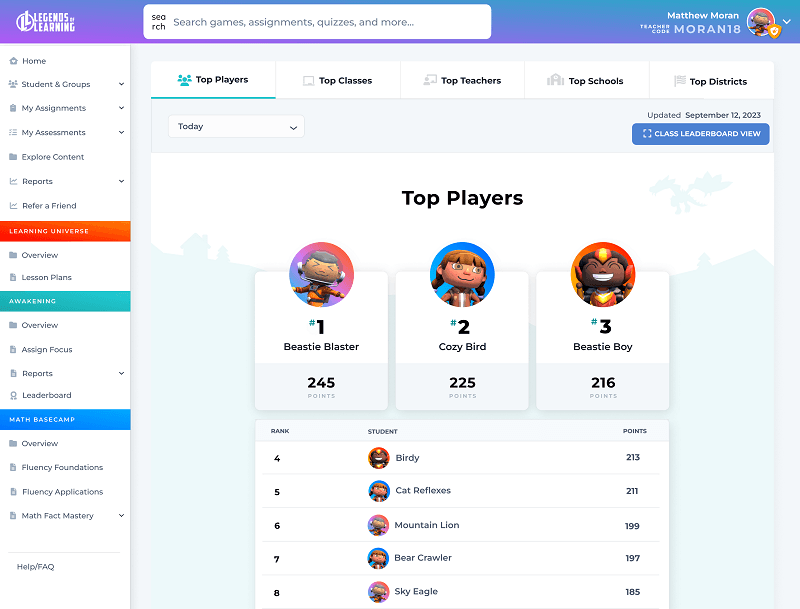
Awakening uses an immersive game-based learning model that embeds discrete math and science assessments into an open-world exploration framework. Students navigate a 3D environment, interacting with elements that trigger academic challenges. To advance, they must complete curriculum-aligned tasks, typically structured as multiple-choice questions or simple interactions. Correct answers reward the student with in-game currency or items, leveraging gamification mechanics to reinforce task completion. When your child encounters a wild creature or obstacle, the battle is resolved by correctly retrieving math or science facts. This applies the concept of retrieval practice, pulling information from memory to strengthen neural pathways. Educators and parents can assign specific standard-aligned playlists, steering the encounters toward targeted learning objectives. The platform continuously collects performance data behind the scenes, populating a dashboard that highlights proficiencies and flags areas requiring further instruction.
Strengths and tradeoffs of Awakening
Awakening's biggest strength is its ability to sustain student engagement through game-based learning, while its biggest weakness is the potential for cognitive overload where game mechanics overshadow the academic content. The platform excels at masking rote practice behind appealing visuals and interactive tasks. This leverages the benefits of gamification, increasing time-on-task for students who typically resist traditional worksheets. When your child engages in battles or quests, they are prompted to recall facts, utilizing retrieval practice to strengthen memory consolidation. However, the rich graphical environment introduces extraneous cognitive load. Learning science indicates that if a task requires too much working memory to navigate the game itself, fewer cognitive resources are available for processing the actual math or science concepts. Furthermore, the feedback mechanisms are often limited to simply marking an answer right or wrong. Without immediate worked examples or scaffolded feedback upon failure, students may resort to guessing rather than genuinely correcting their misconceptions.
Who Might Benefit From Awakening?
Awakening is best for K-8 students who struggle with motivation and need a highly interactive, game-like environment to practice math and science. It serves as an effective supplementary tool for children who resist traditional homework but will happily spend time in digital worlds. Because the platform relies heavily on testing existing knowledge rather than providing direct instruction, it is most useful for reinforcing concepts that educators or parents have already introduced. It is an ideal fit for classrooms or homes looking to gamify review sessions and drill foundational skills within an engaging, low-stakes environment.
Data Transparency
Does Not Meet Data Transparency Standard
Awakening reaches Level 1 of 3 (Basic protections), below our data transparency standard. Reaching Level 2 needs the policy to document data export and self-service deletion.
24 of 35 checks passed
Evaluated September 2026
Legends of Learning Privacy Policy →Level 1 · Basic protections
Does not sell data or target ads at students, limits sharing, and lets parents see and delete their child's data.
Level 2 · Parent control (meets the standard)
Families can get their data out, know who processes it, and know how long it is kept.
Not documented: data export, self-service deletion
Level 3 · Direct data access
Families or schools can pull their own data through an API, in a stated format.
Not documented: an API for retrieving their own data, a named export format
View all 35 checks
Parent Access6/8
Does the policy mention parents specifically?
“Parents and Teacher or Administrative Users, through the Educational Institution, have the right at any time to: (1) review the specific pieces of personal information we have collected from their Student User;”
Can parents view their child's data?
“Parents and Teacher or Administrative Users, through the Educational Institution, have the right at any time to: (1) review the specific pieces of personal information we have collected from their Student User;”
Can parents modify their child's data?
The policy gives parents the right to review data, have it deleted, and refuse further collection, but not to change it.
Can parents delete their child's account?
“Parents and Teacher or Administrative Users, through the Educational Institution, have the right at any time to: (1) review the specific pieces of personal information we have collected from their Student User; (2) direct us to delete that Student User’s personal information from our records;”
Is there a dedicated Children's Privacy section?
“Children’s Privacy”
Does it reference COPPA compliance?
“Legends of Learning is also fully COPPA and FERPA compliant.”
Does it reference FERPA compliance?
“Legends of Learning is also fully COPPA and FERPA compliant.”
Is parental consent required for child accounts?
The policy relies on the school giving consent on the parent's behalf rather than requiring consent from parents.
Data Portability2/5
Can users access their personal data?
“Teacher or Administrative Users can review or change the information they provided when registering for the Services by accessing the teacher or administrator dashboard or by contacting us as described in the Section titled “Contact Us” below”
Can users download/export their data?
The policy does not address downloading or exporting data.
Is there a self-service data access tool?
“Teacher or Administrative Users can review or change the information they provided when registering for the Services by accessing the teacher or administrator dashboard”
Is a specific data format mentioned for export?
The policy does not name any export format.
Is there an API for data access?
The policy does not mention an API for data access.
Data Minimization2/6
Is data collection itemized?
“When registering for any Teacher Account: users will be requested to provide their first and last name and email address, subjects and grades they teach, district name, school name, and the school’s state.”
Can the app be used without a real name?
The policy says students are asked for their first and last name or a nickname, so real names may be collected.
Can the app be used without an email?
The policy does not explicitly say that student email addresses are never collected.
Does it state collection is limited to what is necessary?
“Our collection and use of data from any user is strictly limited to the minimum requirements needed for operation of the Services.”
Is IP address anonymized or truncated?
The policy says IP addresses are collected but does not say they are anonymized or truncated.
Is location tracking explicitly excluded?
The policy does not explicitly rule out location tracking.
Third-Party Protection6/7
Does it explicitly state no selling of data?
“We do not under any circumstance sell or rent data to third parties.”
Are third-party providers named?
“Operators that may process Student User personal information: our cloud hosting provider (Amazon Web Services, Inc.), our authentication/single sign-on providers (Google LLC, ClassLink, Inc., Instructure, Inc., and Clever, Inc.), and our customer support platform (Intercom, Inc.), each solely to operate and secure the Services.”
Are providers contractually restricted?
“provided that the service providers we use agree to keep the information confidential and to use it only for purposes that are permitted by this Privacy Policy. These third-parties do not share your information with any other third-parties.”
No-targeted-advertising commitment?
“Information collected about Student Users will not be used for marketing or advertising purposes.”
Is AI/ML data sharing addressed?
The policy does not address AI or machine learning.
Child-specific sharing restriction?
“We allow third-party advertising networks to use tracking technologies like cookies and web beacons, described above, to collect information about users, other than Student Users.”
Cookies/tracking limited or opt-out?
“You can reset your web browser to refuse all cookies or to indicate when a cookie is being sent.”
Deletion & Retention4/5
Can users delete their account?
“At any time, Teacher Users, with the exception of those that fall under School Accounts, may cancel their Teacher Account by emailing us at support@legendsoflearning.com or by contacting us as described in the Section titled “Contact Us” below.”
Self-service deletion mechanism?
The policy says deletion happens by emailing or contacting the company, not through a tool users operate themselves.
Specific data retention timeline?
“we will remove all personally identifiable information associated with the Teacher Account (“ **Account Information**”) from our live databases within seventy-two (72) hours after the cancellation.”
Auto-deletion of inactive accounts?
“If a Teacher Account is not canceled, we will remove all Account Information from our active databases twenty-four (24) months after the last activity on the Teacher Account.”
Post-deletion handling described?
“Even if you request to close your account, keep in mind that deletion by third parties to whom the information had been provided may not be immediate, and the deleted information may persist in backup copies for a reasonable period of time (but will not be available to others).”
Advertising4/4
Advertising model explicitly disclosed?
“The Platform and our Services are backed by our Student Safe guarantee. This means that a child using our Platform in a school setting will never be subject to any form of advertisements in the Platform.”
Free from third-party advertisements?
“The Platform and our Services are backed by our Student Safe guarantee. This means that a child using our Platform in a school setting will never be subject to any form of advertisements in the Platform.”
Children excluded from ad targeting?
“Information collected about Student Users will not be used for marketing or advertising purposes.”
Ad-free option available?
“The Platform and our Services are backed by our Student Safe guarantee. This means that a child using our Platform in a school setting will never be subject to any form of advertisements in the Platform.”
What This Means
The policy review did not meet our data transparency standard. The checks above show the documented findings and unknowns. A missing statement does not establish how the app handles data in practice.
About this evaluation: Based on automated analysis of Legends of Learning Privacy Policy against 35 policy-disclosure questions, including questions adapted from the Common Sense Privacy Program's published evaluation questions. TLS is not affiliated with Common Sense Media, and this is not a Common Sense rating. Quoted text is copied from the policy; unquoted notes are our summary. Results describe what the policy documents, not the company's actual practices. Privacy policies can change: this review reflects the version we analyzed and does not determine legal compliance.
Sources and review method
TLS combines product information and editorial analysis to explain how Awakening works, its tradeoffs, and the questions to ask before choosing it. Product features, an instructional rationale and evidence of learning outcomes are different kinds of information.
Formal Learning Standard assessment: not yet completed. Data Transparency findings are reported separately and do not establish learning effectiveness. Read our methodology.
Frequently Asked Questions About Awakening
Is Awakening free?
No, Awakening is not entirely free. While Legends of Learning offers limited trial access for students and parents to explore the environment, full access requires a paid subscription. Pricing is primarily structured around school and district licenses, which scale based on the number of student users. Parents should check with their child's school to see if access is already provided before seeking individual purchasing options.
Is Awakening good for elementary and middle schoolers?
Yes, Awakening is specifically designed for students in Kindergarten through 8th grade. The gameplay mechanics, featuring avatars, creature battles, and exploration, are highly tailored to capture the attention of this demographic. However, the complexity of the academic content scales with the grade level, ensuring that an 8th grader is facing rigorous, standard-aligned math and science questions even while engaging with the same core game loop as a younger student.
What does Awakening teach?
Awakening primarily teaches curriculum-aligned math and science. The content spans from early childhood foundational skills to middle school applied science, social science, and career and technical education concepts. Instead of teaching topics from scratch through direct instruction, the app focuses on providing practice and assessment. Students answer questions related to specific learning standards to progress through the game, making it a tool for reinforcing knowledge rather than acquiring it initially.
How does Awakening compare vs. Prodigy Math?
Awakening and Prodigy Math both use RPG-style gaming to mask academic practice, but Awakening covers both math and science, whereas Prodigy focuses solely on math and English. Prodigy is characterized by a more established consumer model with a heavier in-game push for parental subscriptions. Awakening leans more heavily into school-based deployments and offers a wider breadth of STEM subjects, though its overall pedagogical depth remains pending evaluation according to our methodology.
Has The Learning Standard evaluated Awakening?
TLS has not yet completed a Learning Standard evaluation of how well Awakening teaches. Its privacy policy has been reviewed for Data Transparency and reaches Level 1, Basic protections.
Is Awakening COPPA compliant?
The reviewed privacy policy references COPPA. A policy reference alone does not establish COPPA compliance. Policy review note: The policy states it complies with COPPA.
Is Awakening FERPA compliant?
The reviewed privacy policy references FERPA. A policy reference alone does not establish FERPA compliance. Policy review note: The policy states it complies with FERPA.
Does Awakening have a children's privacy policy?
The reviewed policy includes a dedicated children's privacy section. Policy review note: The policy has its own section headed Children's Privacy.
Does Awakening sell student data?
The reviewed policy states that the app does not sell data. This is a policy statement; actual data practices were not verified. Policy review note: The policy states the company does not sell data.
Can you delete your data from Awakening?
The reviewed privacy policy describes account deletion. We have not tested the deletion process. Policy review note: Users can ask to have their accounts cancelled and deleted.
Follow TLS Research
Subscribe to future TLS research updates: app reviews, findings, and what the evidence shows.
Screenshots

Take Action
For Awakening
If you represent Legends of Learning and have a correction or new evidence, send the relevant source so we can review and update this page.
Submit a correctionDetails
- Pricing
- Trials are available as well as school and district pricing based on amount of student users.
- Platforms
- Web Browser, iOS (Apple mobile), iPadOS (Apple tablet), Android (Google mobile), Windows (Microsoft), macOS (Apple), Chrome OS (Google)
- Grade Levels
- Kindergarten, 1st Grade, 2nd Grade, 3rd Grade, 4th Grade, 5th Grade, 6th Grade, 7th Grade, 8th Grade
- Website
- Visit site