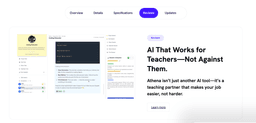
Athena AI
Product by Athena AI
Facts checked: Not yet checked
Our take (not a Learning Standard rating). This label applies to learning-science judgments throughout this overview.
Our take (not a Learning Standard rating)
While Athena AI utilizes promising learning science principles like mastery-based progression and real-time personalized feedback, The Learning Standard has not yet formally evaluated its effectiveness. The platform acts as an AI co-teacher for older students, adapting difficulty dynamically, but requires independent verification to confirm true learning gains.
Pros
- Dynamically adjusts question difficulty based on student performance to maintain an optimal cognitive load.
- Employs personalized learning pathways that allow students to progress only after demonstrating mastery.
- Covers a massive breadth of advanced subjects from high school through professional credentialing.
- Offers a free tier that makes adaptive artificial intelligence tools accessible for individual learners.
Cons
- Effectiveness claims have not yet been independently verified by The Learning Standard.
- Heavy reliance on generative AI means educators must carefully monitor content for potential hallucinations or inaccuracies.
- The broad focus across dozens of subjects results in less depth compared to domain-specific math or science tools.
- Requires high student self-regulation, making it unsuitable for learners who need human accountability.
What Do We Know About Athena AI?
Athena AI shows strong potential for high school and college students through its use of adaptive artificial intelligence, though its ultimate effectiveness remains pending formal evaluation by The Learning Standard. Your child will interact with an AI co-teacher that attempts to tailor humanities, math, and science content to their specific mastery level. Because it employs competency-based progression, students cannot simply click through lessons; they must demonstrate understanding before moving forward. This approach aligns well with established learning science, specifically the benefits of personalized pacing and active retrieval. However, because the system relies on generative AI to create and adjust lessons in real-time, you must ensure your child understands how to critically evaluate AI-generated text. The app functions best as a supplemental tutor rather than a complete replacement for human instruction. Educators and parents should monitor progress closely. Until our formal efficacy review is complete, treat Athena AI as a promising, highly adaptable study aid that requires a mature, self-directed learner to unlock its full value.
How Does Athena AI Work?
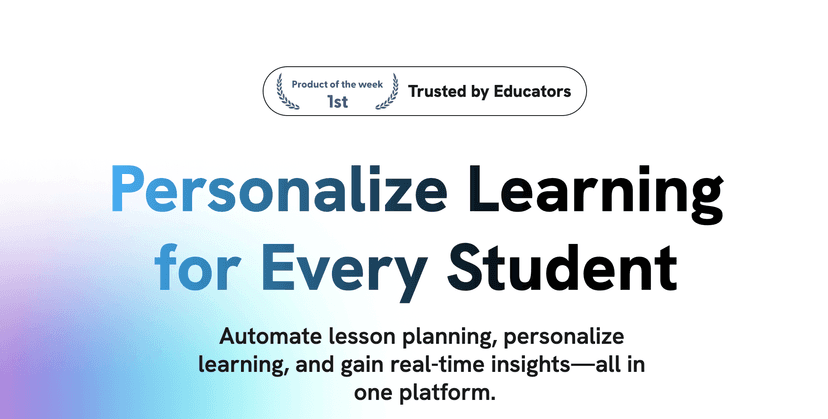
Athena AI utilizes a competency-based, personalized learning approach where an AI engine dynamically adjusts instructional content and practice problems based on real-time student inputs. As your child engages with a lesson, the platform monitors their answers to assess comprehension. If a student struggles with a specific math or science concept, the AI generates immediate, targeted interventions, providing worked examples and alternative explanations. Conversely, if a student demonstrates quick mastery, the system accelerates the pacing to prevent boredom. This constant adjustment helps maintain the student in their zone of proximal development. The platform also integrates problem-based learning scenarios, asking students to apply theoretical knowledge to complex, multi-step challenges. Rather than feeding students static video lectures, Athena AI forces active engagement through continuous prompting and assessment. Teachers can use the backend dashboard to track these micro-interactions, allowing them to step in when the AI indicates a student is persistently stuck.
Strengths and tradeoffs of Athena AI
The biggest strength of Athena AI is its ability to provide immediate, individualized feedback through real-time adaptation, while its biggest weakness is the inherent risk of AI hallucinations and the lack of independent efficacy data. From a learning science perspective, immediate feedback is crucial for correcting misconceptions before they encode into long-term memory. Athena AI handles this well by interjecting with explanations the moment a student makes an error. Furthermore, its reliance on mastery-based progression ensures that foundational gaps are addressed before introducing complex topics. However, the system's broad application across highly varied subjects means the quality of worked examples may fluctuate depending on the domain. Generative AI occasionally struggles with rigid logic in advanced mathematics, which could frustrate learners if the AI co-teacher provides inaccurate steps. Additionally, because the platform demands high cognitive engagement and self-direction, it lacks the interpersonal accountability that human teachers provide. Until formally evaluated, its theoretical strengths in spacing and retrieval practice must be weighed against the practical limitations of current AI models.
Who Might Benefit From Athena AI?
Athena AI is best for self-directed high school students, college undergraduates, and adult learners who need adaptive, on-demand tutoring across complex subjects. Because the platform relies heavily on text-based AI interactions and requires substantial self-regulation, it is not suitable for early elementary students. It works exceptionally well for individuals pursuing professional or technical credentials who need to study outside of standard classroom hours. Educators teaching large classes may also find it highly useful as a supplementary tool to provide personalized problem sets, freeing up class time for deeper, human-led discussions and targeted interventions.
Data Transparency
Does Not Meet Data Transparency Standard
Athena AI does not meet our data transparency standard. Its privacy policy does not document basic protections, including a statement that it does not sell data, a commitment against targeted advertising and limits on sharing children's data.
8 of 35 checks passed
Evaluated September 2026
Athena →Level 1 · Basic protections
Does not sell data or target ads at students, limits sharing, and lets parents see and delete their child's data.
Not documented: a statement that it does not sell data, a commitment against targeted advertising, limits on sharing children's data, contractual limits on service providers, parents' right to see their child's data, parents' right to delete their child's data, account deletion
Level 2 · Parent control (meets the standard)
Families can get their data out, know who processes it, and know how long it is kept.
Not documented: users' right to access their data, data export, a data retention timeline, self-service deletion
Level 3 · Direct data access
Families or schools can pull their own data through an API, in a stated format.
Not documented: an API for retrieving their own data, a named export format
View all 35 checks
Parent Access4/8
Does the policy mention parents specifically?
“If a child under the age of sixteen wishes to register for our Services and provides us with their parent's or guardian's first name, last name and email address, we will only use the parent's name and email address to obtain consent to process the child's information”
Can parents view their child's data?
The policy does not give parents a right to view their child's data.
Can parents modify their child's data?
The policy does not give parents a right to modify their child's data.
Can parents delete their child's account?
The policy does not give parents a right to delete their child's data or account.
Is there a dedicated Children's Privacy section?
The policy has a paragraph on children's privacy with no heading of its own, and it refers to a separate COPPA Privacy Notice that was not provided.
Does it reference COPPA compliance?
“Our collection and use of personal information and educational records are governed by our contracts with schools, our Privacy Notice including our COPPA Privacy Notice (applicable to data of children under 13), and by applicable privacy laws including the Family Educational Rights and Privacy Act (FERPA).”
Does it reference FERPA compliance?
“We seek to protect personal information and records of students as required by FERPA.”
Is parental consent required for child accounts?
“we take additional steps to obtain verifiable parental consent before collecting any personal information from a child under the age of sixteen in the limited instances our Services are available to such children.”
Data Portability0/5
Can users access their personal data?
The policy does not describe a right for users to access their personal data.
Can users download/export their data?
The policy does not address downloading or exporting data.
Is there a self-service data access tool?
The policy does not describe a self-service data access tool.
Is a specific data format mentioned for export?
The policy does not name any export format.
Is there an API for data access?
The policy does not mention an API for data access.
Data Minimization1/6
Is data collection itemized?
“The personal information (as defined pursuant to FERPA) that we hold includes each student's first and last name, IP address from which they access the Services, their email address, their age or school year, the name of their school, their software development skill level, and audio and video files containing their voice, image and likeness.”
Can the app be used without a real name?
The policy says it holds each student's first and last name.
Can the app be used without an email?
The policy says it holds each student's email address.
Does it state collection is limited to what is necessary?
The policy does not say collection is limited to what is necessary.
Is IP address anonymized or truncated?
The policy says it collects IP addresses and does not say they are anonymized or truncated.
Is location tracking explicitly excluded?
The policy says it collects location information, including approximate location derived from IP address.
Third-Party Protection2/7
Does it explicitly state no selling of data?
The policy says only that it does not currently sell data as defined under Nevada law, while it also shares data with advertising partners and allows data to be sold in business transactions.
Are third-party providers named?
“Our hosting providers, including Amazon Web Services (provided by Amazon.com, Inc.) will hold all data processed by our platform on their servers”
Are providers contractually restricted?
The policy does not say service providers are contractually restricted in how they use data.
No-targeted-advertising commitment?
The policy says it may use personal information for interest-based or personalized advertising, including through cross-device tracking.
Is AI/ML data sharing addressed?
The policy does not address sharing data for AI or machine learning.
Child-specific sharing restriction?
The policy restricts only how the parent's contact details are used and points to a COPPA notice that was not provided; it states no restriction on sharing children's data.
Cookies/tracking limited or opt-out?
“Cookies and Interest-Based Advertising: You may stop or restrict the placement of Technologies on your device or remove them by adjusting your preferences as your browser or device permits.”
Deletion & Retention0/5
Can users delete their account?
The policy does not describe a way for users to delete their account or data.
Self-service deletion mechanism?
The policy does not describe a self-service deletion mechanism.
Specific data retention timeline?
The policy gives no specific retention timeline.
Auto-deletion of inactive accounts?
The policy does not address automatic deletion of inactive accounts.
Post-deletion handling described?
The policy does not describe how data is handled after deletion.
Advertising1/4
Advertising model explicitly disclosed?
“Some of the ways we may market to you include email campaigns, text messages, phone calls, custom audiences advertising, and "interest-based" or "personalized advertising," including through cross-device tracking.”
Free from third-party advertisements?
The policy says third-party advertising partners may place tracking on the Services and deliver personalized ads.
Children excluded from ad targeting?
The policy does not exclude children from ad targeting.
Ad-free option available?
The policy does not offer an ad-free option; it offers only opt-outs from targeted ads.
What This Means
The policy review did not meet our data transparency standard. The checks above show the documented findings and unknowns. A missing statement does not establish how the app handles data in practice.
About this evaluation: Based on automated analysis of Athena against 35 policy-disclosure questions, including questions adapted from the Common Sense Privacy Program's published evaluation questions. TLS is not affiliated with Common Sense Media, and this is not a Common Sense rating. Quoted text is copied from the policy; unquoted notes are our summary. Results describe what the policy documents, not the company's actual practices. Privacy policies can change: this review reflects the version we analyzed and does not determine legal compliance.
Sources and review method
TLS combines product information and editorial analysis to explain how Athena AI works, its tradeoffs, and the questions to ask before choosing it. Product features, an instructional rationale and evidence of learning outcomes are different kinds of information.
Formal Learning Standard assessment: not yet completed. Data Transparency findings are reported separately and do not establish learning effectiveness. Read our methodology.
Frequently Asked Questions About Athena AI
Is Athena AI free?
Yes, Athena AI offers a free version for individual learners. For schools and districts looking to deploy the platform at scale, the company requires administrators to reach out directly for custom, discounted pricing structures.
Is Athena AI good for high school students?
Athena AI is highly appropriate for students in 9th through 12th grade. The platform targets older learners capable of self-directed study and critical thinking, offering advanced coursework support across humanities, math, and science.
What does Athena AI teach?
Athena AI covers a massive breadth of academic domains including Humanities, Social Science, Science, Math, Applied Science, and Career and Technical Education. It acts as a generalist tutor rather than a single-subject specialist.
How does Athena AI compare to traditional tutoring?
Athena AI provides immediate, 24/7 personalized feedback at a fraction of the cost of a human tutor. However, it lacks the emotional intelligence and strict accountability that a live human provides to keep unmotivated students on track.
Has The Learning Standard evaluated Athena AI?
TLS has not yet completed a Learning Standard evaluation of how well Athena AI teaches. Its privacy policy has been reviewed for Data Transparency and does not yet document the basic protections (Level 1).
Is Athena AI COPPA compliant?
The reviewed privacy policy references COPPA. A policy reference alone does not establish COPPA compliance. Policy review note: The policy references its COPPA Privacy Notice for children's data.
Is Athena AI FERPA compliant?
The reviewed privacy policy references FERPA. A policy reference alone does not establish FERPA compliance. Policy review note: The policy's FERPA statement references FERPA compliance.
Does Athena AI have a children's privacy policy?
No dedicated children's privacy section was found in the reviewed policy. Policy review note: The policy has a paragraph on children's privacy with no heading of its own, and it refers to a separate COPPA Privacy Notice that was not provided.
Does Athena AI sell student data?
A statement ruling out data selling was not found in the reviewed policy. This does not establish that the app sells student data. Policy review note: The policy says only that it does not currently sell data as defined under Nevada law, while it also shares data with advertising partners and allows data to be sold in business transactions.
Can you delete your data from Athena AI?
Account deletion was not documented in the reviewed privacy policy. This does not establish whether deletion is available. Policy review note: The policy does not describe a way for users to delete their account or data.
Follow TLS Research
Subscribe to future TLS research updates: app reviews, findings, and what the evidence shows.
Screenshots

Take Action
For Athena AI
If you represent Athena AI and have a correction or new evidence, send the relevant source so we can review and update this page.
Submit a correctionDetails
- Pricing
- Free. For schools and districts, reach out to us for custom discounted pricing.
- Platforms
- Web Browser, iPadOS (Apple tablet), Windows (Microsoft), macOS (Apple), Chrome OS (Google)
- Grade Levels
- 9th Grade, 10th Grade, 11th Grade, 12th Grade, Bachelor's degree, Professional or Technical Credential
- Website
- Visit site