
Arduino Student Kit
Product by Arduino Education
Facts checked: Not yet checked
Our take (not a Learning Standard rating). This label applies to learning-science judgments throughout this overview.
Our take (not a Learning Standard rating)
The Arduino Student Kit provides excellent hands-on project-based learning for electronics and coding, but its effectiveness depends heavily on learner self-regulation. While it utilizes physical manipulatives to build concrete understanding of abstract circuitry concepts, the lack of automated feedback means struggling students may hit frustrating roadblocks without adult guidance.
Pros
- Engages tactile learning by combining physical hardware manipulation with digital coding.
- Uses project-based learning to connect abstract programming concepts to real-world outcomes.
- Provides step-by-step worked examples to reduce cognitive load during initial circuit setup.
- Encourages experiential learning and critical thinking through trial-and-error circuit building.
Cons
- Lacks automated real-time feedback for coding syntax errors or misplaced physical wiring.
- Demands high learner self-regulation to persist through troubleshooting failures.
- Offers limited built-in scaffolding for learners who deviate from the provided instructions.
- Does not include adaptive progression to adjust difficulty based on student performance.
What Do We Know About Arduino Student Kit?
The Arduino Student Kit is an effective tool for teaching foundational coding and electronics if your child has the patience for self-directed troubleshooting. This kit bridges the gap between digital software and physical hardware, applying project-based learning principles to make abstract STEM concepts tangible. Your child will write code on a computer and immediately see the results in physical components like LEDs and motors. This immediate physical feedback strengthens the connection between cause and effect. However, parents must understand that this is not an adaptive learning software that corrects mistakes automatically. When a circuit fails to light up, your child must rely on systematic debugging to find the error in their code or wiring. This builds critical problem-solving skills but can also cause high frustration for learners who lack self-regulation. While the step-by-step worked examples effectively manage cognitive load for beginners, you should expect to provide occasional guidance when your child encounters complex errors. Because The Learning Standard has not yet fully evaluated this specific kit, its long-term retention metrics remain unverified, but the underlying pedagogical approach of experiential, hands-on STEM education is strongly supported by learning science.
How Does Arduino Student Kit Work?
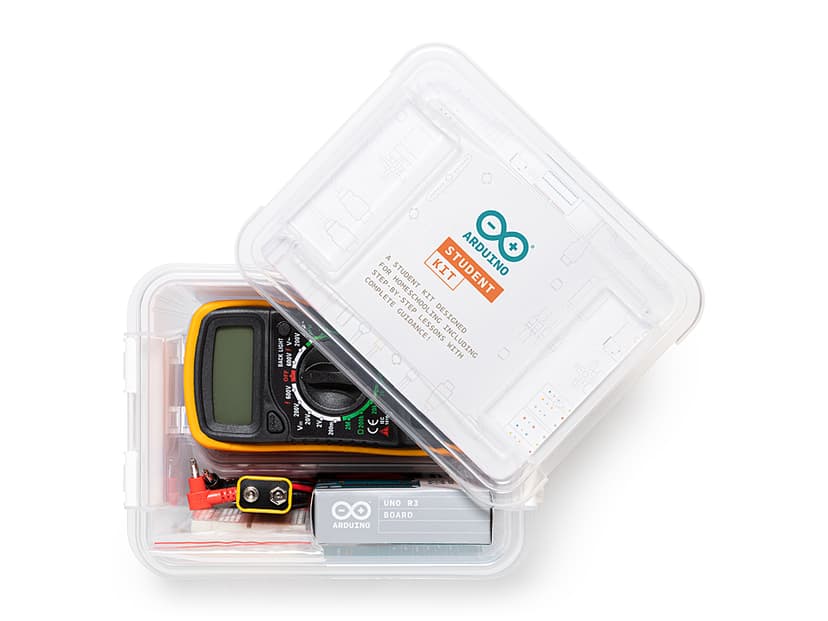
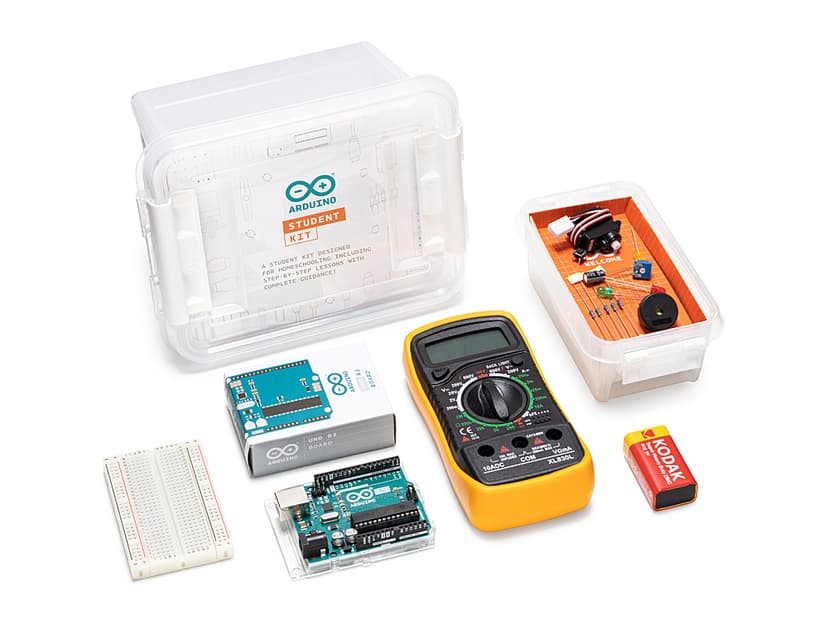
The Arduino Student Kit utilizes project-based experiential learning combined with direct instruction via step-by-step digital guides. Your child starts by accessing online lessons that introduce a specific electronics concept, such as voltage or loops in programming. They then follow worked examples to assemble physical hardware components, plugging wires, resistors, and sensors into a breadboard. Next, your child writes C++ based code in the Arduino IDE software and uploads it to the physical micro-controller. The learning mechanics rely heavily on the experiential cycle of building, testing, and debugging. If the project works, the student observes the physical output, reinforcing the concept. If it fails, they must engage in active troubleshooting. The kit progresses linearly from simple single-component circuits to complex multi-sensor projects, gradually removing instructional scaffolding to encourage independent application of learned skills.
Strengths and tradeoffs of Arduino Student Kit
The biggest strength of the Arduino Student Kit is its use of physical manipulatives to ground abstract programming concepts, while its biggest weakness is the absence of real-time, targeted feedback for student errors. Tangible Learning: By forcing learners to manipulate physical wires and sensors alongside writing code, the kit engages multiple cognitive pathways. This physical interaction helps students build robust mental models of invisible forces like electrical current. Worked Examples: The initial lessons rely heavily on worked examples, a proven strategy for reducing extraneous cognitive load when students encounter highly complex new information. Debugging and Frustration: Conversely, learning science dictates that immediate, specific feedback is crucial for novice learners. Because the Arduino environment cannot easily tell a student if a physical wire is plugged into the wrong pin, the feedback loop is entirely dependent on the student's ability to self-evaluate. Self-Regulation Demands: This lack of automated scaffolding means that while successful debugging builds high-level critical thinking, it also risks overwhelming working memory. Students without strong self-regulation strategies may experience cognitive overload.
Who Might Benefit From Arduino Student Kit?
The Arduino Student Kit is best for middle and high school students who possess strong self-direction and an active interest in hands-on STEM projects. While marketed for all ages, the fine motor skills required for breadboarding and the logic required for C++ coding are most appropriate for learners aged eleven and older. It serves as an excellent foundational tool for homeschoolers needing a structured applied science curriculum or hobbyists transitioning from block-based coding to text-based programming. Children who thrive on tactile engagement will gain the most from this kit.
Data Transparency
Meets Data Transparency Standard
Arduino Student Kit meets our data transparency standard at Level 2 of 3 (Parent control). Level 3 needs the policy to document an API for retrieving their own data and a named export format.
22 of 35 checks passed
Evaluated September 2026
Arduino Privacy Policy →Level 1 · Basic protections
Does not sell data or target ads at students, limits sharing, and lets parents see and delete their child's data.
Level 2 · Parent control (meets the standard)
Families can get their data out, know who processes it, and know how long it is kept.
Level 3 · Direct data access
Families or schools can pull their own data through an API, in a stated format.
Not documented: an API for retrieving their own data, a named export format
View all 35 checks
Parent Access7/8
Does the policy mention parents specifically?
“For more information on how we process the personal data of minors and their parents or legal guardians, please see Section 3, "Minors' Data" below.”
Can parents view their child's data?
“Parents may also have the right under applicable law to review or prevent further collection or use of personal data from the parent, legal guardian or the minor. To make a request, please email us at”
Can parents modify their child's data?
“Parents and legal guardians of minors under the age of 14 can request that Arduino make changes to their minor's account or delete it by logging into their account.”
Can parents delete their child's account?
“Parents and legal guardians of minors under the age of 14 can request that Arduino make changes to their minor's account or delete it by logging into their account.”
Is there a dedicated Children's Privacy section?
“Please read the following information regarding the processing of personal data of minors under 18 years of age (a " **minor**" or " **minors**").”
Does it reference COPPA compliance?
“The personal data collected within the Junior Account may be considered personal information (or similar term) in certain jurisdictions, including the United States under the Children's Online Privacy Protection Act (" **COPPA**"):”
Does it reference FERPA compliance?
The policy does not mention FERPA.
Is parental consent required for child accounts?
“Minors (including students) under the age of 18 may create an account by selecting unique access credentials and getting parental or legal guardian consent.”
Data Portability2/5
Can users access their personal data?
“You have the right to confirm processing and know/access the personal information we have collected about you”
Can users download/export their data?
“Where it is technically feasible or required, you may receive this information in a portable format.”
Is there a self-service data access tool?
The policy says rights are exercised by emailing Arduino or submitting a web form, and it does not describe a self-service tool for accessing data.
Is a specific data format mentioned for export?
The policy only says "structured, common, and machine-readable format" and does not name a specific file format.
Is there an API for data access?
The policy does not mention an API for accessing data.
Data Minimization2/6
Is data collection itemized?
“The table below identifies the purposes for which we process personal data, the corresponding categories of personal data processed for each purpose, our legal basis (and special condition) for processing and how long we retain your personal data.”
Can the app be used without a real name?
The policy gives Junior Accounts random usernames, but Restricted Accounts may have additional data collected, including first and last names, so it never says real names are not collected.
Can the app be used without an email?
The policy says it processes email addresses for Restricted Account and Junior Account users.
Does it state collection is limited to what is necessary?
The policy has no general statement that collection is limited to what is necessary; it only limits the use of sensitive data and collects parent data needed to activate a minor's account.
Is IP address anonymized or truncated?
“We use third party tools to mask your IP address and analyze use of our Website at the country (and not individual) level.”
Is location tracking explicitly excluded?
The policy says Arduino collects geographical location data.
Third-Party Protection5/7
Does it explicitly state no selling of data?
“We do not knowingly sell or share the personal information of minors under the age of 18.”
Are third-party providers named?
“In Arduino's application Science Kit Physics Lab, we embed videos from YouTube and the App is tagged for child-directed treatment with Google so that according to Google/YouTube's system design, no personal data is sent to YouTube.”
Are providers contractually restricted?
“We will take steps to ensure that your information receives appropriate safeguards in the jurisdictions in which we or our service providers process it, for example, by entering into appropriate safeguards to protect the personal information, which will include entering into approved standard contractual clauses with the recipient (where required under applicable law).”
No-targeted-advertising commitment?
The policy says it uses data for targeted and cross-context behavioral advertising, and its no-ads-targeting commitment covers only minors.
Is AI/ML data sharing addressed?
The policy does not address AI or machine learning.
Child-specific sharing restriction?
“On areas of the services available to users under the age of 14, we use a subset of our service providers, and we do not permit service providers to use minors' data for behavioral advertising. We do not disclose minors' personal data to other third-party operators.”
Cookies/tracking limited or opt-out?
“We honor opt-out preference signals. An opt-out preference signal is a signal that is sent by a platform, technology, or mechanism on your behalf that communicates your choice to opt-out of sharing personal information for targeted advertisements or the sale of your personal information.”
Deletion & Retention4/5
Can users delete their account?
“If you cancel your account or we terminate it, we delete your account but retain information relating to your account as explained in this Privacy Policy.”
Self-service deletion mechanism?
The policy says deletion is requested by email or web form and does not describe a self-service deletion tool.
Specific data retention timeline?
“The data retention period is 24 months after your last interaction with us by accessing our Website, by your consent to the use of cookies, or by interaction with our newsletter.”
Auto-deletion of inactive accounts?
“The retention period of personal data will be equal to the period of activity on the Junior Account. If the Junior Account is not accessed for 24 months, we will deactivate it.”
Post-deletion handling described?
“After your account is cancelled or terminated we delete your account and de-identify your username within the Forum and Project Hub (if you have posted/commented within them). Posts remain in Forum and Project Hub for 5 years”
Advertising2/4
Advertising model explicitly disclosed?
“This category of personal information may be sold or shared for analytics, marketing, advertising and cross-context behavioral advertising.”
Free from third-party advertisements?
The policy does not say the product is free of third-party ads, and it describes sharing data with advertising providers.
Children excluded from ad targeting?
“we do not permit service providers to use minors' data for behavioral advertising”
Ad-free option available?
The policy does not describe an ad-free option or say the product has no ads.
Meets Data Transparency Standard
The reviewed policy met our data transparency standard. This result describes the policy disclosures we assessed. Actual practices and legal compliance were not verified.
About this evaluation: Based on automated analysis of Arduino Privacy Policy against 35 policy-disclosure questions, including questions adapted from the Common Sense Privacy Program's published evaluation questions. TLS is not affiliated with Common Sense Media, and this is not a Common Sense rating. Quoted text is copied from the policy; unquoted notes are our summary. Results describe what the policy documents, not the company's actual practices. Privacy policies can change: this review reflects the version we analyzed and does not determine legal compliance.
Sources and review method
TLS combines product information and editorial analysis to explain how Arduino Student Kit works, its tradeoffs, and the questions to ask before choosing it. Product features, an instructional rationale and evidence of learning outcomes are different kinds of information.
Formal Learning Standard assessment: not yet completed. Data Transparency findings are reported separately and do not establish learning effectiveness. Read our methodology.
Frequently Asked Questions About Arduino Student Kit
Is the Arduino Student Kit free?
No, the Arduino Student Kit requires a one-time physical hardware purchase of $76 per kit. Once you own the physical components, all accompanying online lessons, step-by-step guides, and the Arduino IDE programming software are included at no additional cost. There are no recurring monthly subscription fees required to access the core educational materials or to use the hardware.
Is the Arduino Student Kit good for elementary school students?
While the manufacturer lists it as suitable for all ages, the cognitive demands of text-based coding and complex circuit troubleshooting are generally too high for early elementary students. It is far more effective for middle schoolers and high school students who have developed the necessary logical reasoning skills, reading comprehension levels, and fine motor skills required to manipulate small wires and breadboards.
What does the Arduino Student Kit teach?
The Arduino Student Kit teaches fundamental electronics, electrical circuitry, and text-based computer programming. Your child will learn foundational applied physics concepts such as electrical resistance, voltage, and digital versus analog signals. Simultaneously, they will learn basic C++ coding logic, including how to write loops, declare variables, and use conditional statements to control the physical hardware they assemble.
How does the Arduino Student Kit compare to block-coding apps like Scratch?
Unlike Scratch, which uses visual digital drag-and-drop blocks to teach basic logic on a screen, the Arduino Student Kit requires learners to type actual C++ syntax and manipulate physical hardware. This makes Arduino a much more advanced, real-world application of computer programming. The learning curve is significantly steeper, but it bridges the gap between digital software and physical engineering.
Has The Learning Standard evaluated Arduino Student Kit?
TLS has not yet completed a Learning Standard evaluation of how well Arduino Student Kit teaches. Its privacy policy has been reviewed for Data Transparency and reaches Level 2, Parent control.
Is Arduino Student Kit COPPA compliant?
The reviewed privacy policy references COPPA. A policy reference alone does not establish COPPA compliance. Policy review note: The policy names COPPA as covering Junior Account data.
Is Arduino Student Kit FERPA compliant?
A FERPA reference was not found in the reviewed privacy policy. This does not determine whether the app complies with FERPA. Policy review note: The policy does not mention FERPA.
Does Arduino Student Kit have a children's privacy policy?
The reviewed policy includes a dedicated children's privacy section. Policy review note: Section 3, "Minors' Data," is a section with its own heading about children's data.
Does Arduino Student Kit sell student data?
The reviewed policy states that the app does not sell data. This is a policy statement; actual data practices were not verified. Policy review note: The vendor commits not to sell minors' data, which covers K-12 students. It does sell some adults' data.
Can you delete your data from Arduino Student Kit?
The reviewed privacy policy describes account deletion. We have not tested the deletion process. Policy review note: Accounts are deleted when the user cancels them.
Follow TLS Research
Subscribe to future TLS research updates: app reviews, findings, and what the evidence shows.
Screenshots
Take Action
For Arduino Student Kit
If you represent Arduino Education and have a correction or new evidence, send the relevant source so we can review and update this page.
Submit a correctionDetails
- Pricing
- Price per kit: $76
- Platforms
- Windows (Microsoft), macOS (Apple), Chrome OS (Google), Other
- Website
- Visit site