Arckit
Product by Arckit
Facts checked: Not yet checked
Our take (not a Learning Standard rating). This label applies to learning-science judgments throughout this overview.
Our take (not a Learning Standard rating)
Arckit provides an excellent tactile foundation for project-based learning in spatial reasoning and architecture, but its effectiveness depends entirely on the teacher guiding the provided lesson plans. Because The Learning Standard has not yet fully evaluated this tool, we cannot definitively rate its standalone educational impact.
Pros
- Translates abstract geometric concepts into tangible physical models to reduce cognitive load.
- Encourages cooperative learning through group-based building tasks that require active peer communication.
- Provides natural, immediate feedback on structural integrity through the physical constraints of the building materials.
Cons
- Relies entirely on external teacher facilitation rather than providing built-in instructional scaffolding.
- Carries a prohibitive price point that limits accessibility for individual families and underfunded classrooms.
- Lacks embedded assessment tools to measure individual student mastery within a cooperative group setting.
What Do We Know About Arckit ?
Arckit is highly effective for hands-on, project-based learning in spatial reasoning, provided your child has a knowledgeable educator guiding the experience. Because this product is primarily a set of advanced architectural building blocks paired with a teacher curriculum, it does not teach concepts independently like a digital app would. Instead, it relies on problem-based learning where your child applies math, engineering, and design principles to construct physical models. Your child will benefit from the tactile engagement, which research shows improves memory retention for spatial and geometric concepts. However, without the structured lesson plans and an adult to facilitate, it functions more as an expensive creative toy than an educational curriculum. For parents considering this for home use, you must be prepared to act as the teacher and actively guide your child through the design challenges. The high cost means this is best viewed as a serious investment for deeply engaged homeschoolers or school districts rather than a casual supplementary learning tool. Note that The Learning Standard has not yet formally evaluated Arckit in a controlled setting.
How Does Arckit Work?
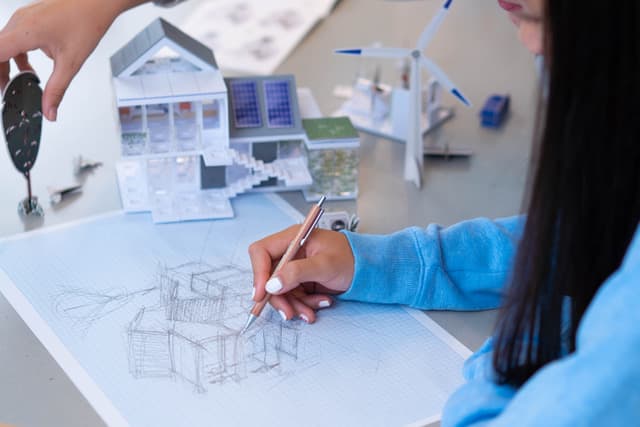
Arckit uses project-based and cooperative learning by pairing physical architectural modeling components with structured classroom lesson plans. Students work in small groups to solve specific design challenges outlined in the curriculum, moving from initial concept to physical construction. This process demands active problem-solving and peer communication, which strengthens understanding through social learning. The lesson plans align with Next Generation Science Standards, guiding teachers to integrate topics like sustainability, structural engineering, and civic planning into the building process. As students manipulate the physical blocks, they engage in spatial mapping and geometric reasoning. The physical constraints of the building materials provide immediate, experiential feedback. If a student attempts to build a structure that lacks foundational support, it will fail, forcing the student to iterate and redesign based on real-world physics rather than passive memorization.
Strengths and tradeoffs of Arckit
Arckit's biggest strength is its ability to make abstract spatial concepts tangible, while its biggest weakness is its complete reliance on adult facilitation for educational value. Hands-on spatial reasoning is deeply supported here. Physically manipulating architectural blocks lowers the cognitive load required to understand complex geometric relationships compared to viewing them on a flat screen. Project-based engagement is another major strength, as the curriculum encourages students to solve open-ended architectural problems, fostering critical thinking and collaborative skills. However, these strengths are offset by the lack of independent scaffolding. Because the physical blocks cannot provide targeted instructional feedback, a student who misunderstands a structural concept requires a teacher to intervene and correct the misconception. Cost and accessibility remain significant weaknesses, as the high price per student limits widespread adoption. Finally, while the curriculum claims alignment with various state standards, the lack of built-in assessment tools makes it difficult for educators to accurately measure individual student retrieval and mastery within a cooperative group setting.
Who Might Benefit From Arckit ?
Arckit is best for middle and high school classrooms or dedicated homeschool environments where an educator can actively facilitate project-based engineering lessons. The tool excels for students who thrive on tactile, hands-on learning and struggle with purely theoretical math or science instruction. It is also ideal for collaborative group work, making it a strong fit for STEM camps, architectural clubs, or specialized career and technical education programs. Because of the high cost and requirement for adult guidance, it is not recommended for parents seeking an independent learning activity.
Sources and review method
TLS combines product information and editorial analysis to explain how Arckit works, its tradeoffs, and the questions to ask before choosing it. Product features, an instructional rationale and evidence of learning outcomes are different kinds of information.
Formal Learning Standard assessment: not yet completed. Data Transparency findings are reported separately and do not establish learning effectiveness. Read our methodology.
Frequently Asked Questions About Arckit
Is Arckit free?
No, Arckit is a highly specialized physical product and curriculum system. A standard educational kit designed for four students starts at approximately $500, making it a significant investment primarily targeted at schools and well-funded educational programs.
Is Arckit good for elementary students?
Arckit can be used by younger students, but its complexity makes it better suited for middle school ages and above. Younger children may lack the fine motor skills and spatial reasoning required to fully benefit from the advanced architectural challenges without heavy adult assistance.
What does Arckit teach?
Arckit teaches architectural design, spatial reasoning, structural engineering, and sustainability. Through its curriculum, it also targets broader skills like collaborative problem-solving, critical thinking, and applied mathematics by forcing students to physically construct their ideas.
Arckit vs LEGO Education: which is better?
While LEGO Education focuses heavily on robotics, coding, and basic mechanics, Arckit provides a much more realistic, specialized approach to architecture and civic design. LEGO is generally more versatile for early STEM, whereas Arckit is superior for dedicated structural engineering modules.
Has The Learning Standard evaluated Arckit?
TLS has not yet completed a Learning Standard evaluation of how well Arckit teaches. TLS has not published a Data Transparency result for its privacy policy.
Follow TLS Research
Subscribe to future TLS research updates: app reviews, findings, and what the evidence shows.
Screenshots


Take Action
For Arckit
If you represent Arckit and have a correction or new evidence, send the relevant source so we can review and update this page.
Submit a correctionDetails
- Pricing
- The amount of kits any schools orders will determine the price. 1 x Arckit Edu kit and Lesson Plans for 4 students will start at $500.
- Platforms
- iOS (Apple mobile), iPadOS (Apple tablet), Android (Google mobile), macOS (Apple), Chrome OS (Google)
- Website
- Visit site