Andraly Stories
Product by Andraly
Facts checked: Not yet checked
Our take (not a Learning Standard rating). This label applies to learning-science judgments throughout this overview.
Our take (not a Learning Standard rating)
Andraly Stories engages early readers through interactive choice, but its effectiveness relies heavily on how well its guided reading levels adapt to the user. Giving children agency over story elements fosters motivation, while integrated phonics support aids decoding. Its long-term impact remains pending formal evaluation.
Pros
- Incorporates read-along tracking and phonics support to assist with real-time word decoding.
- Leverages student agency by allowing kids to manipulate characters and settings to increase intrinsic motivation.
- Aligns story text complexity with standard guided reading levels to provide an appropriate cognitive load.
- Enables story saving and retelling to promote narrative comprehension and vocabulary consolidation.
- Provides immediate corrective feedback during the decoding process to prevent reading frustration.
Cons
- Lacks explicit instruction on grammar or syntax outside of the generated reading experience.
- Does not provide detailed diagnostic reports to parents or teachers on a child's specific decoding errors.
- Interactive game-based elements may distract some children from actual text comprehension through the seductive detail effect.
- The Learning Standard has not yet formally evaluated the efficacy of its adaptive leveling mechanisms.
What Do We Know About Andraly Stories?
Andraly Stories provides effective supplemental reading practice, though its overall teaching efficacy remains pending formal evaluation by The Learning Standard. Your child will practice reading by building their own digital books. By choosing characters, settings, and items, they shape the narrative directly. This interactive model leverages student agency, which learning science shows strongly correlates with sustained engagement and intrinsic motivation. The app includes read-along features and phonics support. These tools act as scaffolds, helping your child decode unfamiliar words in context rather than in isolation. When your child encounters a difficult word, the immediate phonetic feedback prevents reading frustration and maintains momentum. Furthermore, the stories align with established guided reading levels. This ensures the text matches your child's current reading ability, managing cognitive load so they are challenged but not overwhelmed. Parents must monitor usage to ensure children are actually reading the generated text and not just playing with the story-building mechanics. While creating narratives builds comprehension and sequencing skills, it does not replace explicit phonics instruction. Use this app as a supplemental practice tool to reinforce classroom learning rather than a primary foundational reading curriculum.
How Does Andraly Stories Work?
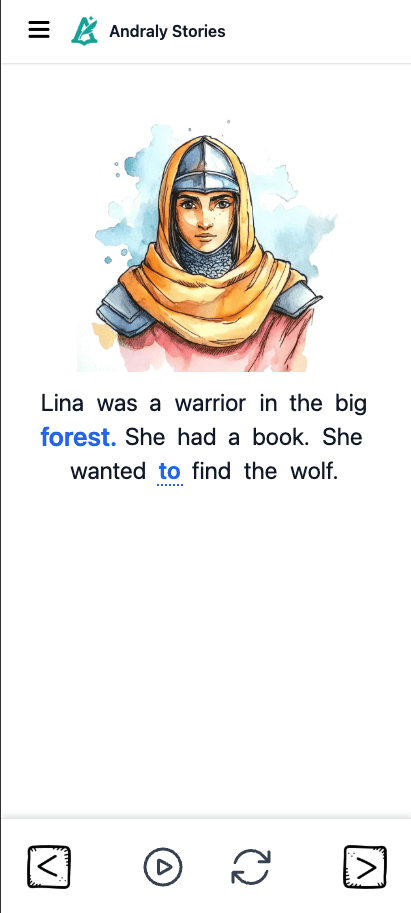
Andraly Stories uses a game-based, constructivist approach where students actively build narratives to practice leveled reading. Children begin by selecting different story components, such as a main character, a specific setting, and key items. The app then generates a cohesive story incorporating these specific choices. As your child reads the generated text, the app provides structural scaffolding. If they struggle with decoding, they can access phonics cues and read-along audio to help sound out words. This provides immediate, corrective feedback during the active reading process. The text complexity automatically targets specific guided reading levels, ensuring the vocabulary and sentence structures are appropriate for the user's developmental stage. Once a story is complete, children can save and retell it. Retelling serves as a highly effective retrieval practice technique that strengthens narrative comprehension and working memory. Educators using the platform can integrate these student-created stories into blended learning environments, allowing for independent practice alongside direct classroom literacy instruction.
Strengths and tradeoffs of Andraly Stories
The biggest strength of Andraly Stories is its ability to foster intrinsic motivation through creative choice, while its biggest weakness is the potential for interactive elements to distract from actual reading practice. Strengths in Motivation and Scaffolding: Giving children agency over the story context increases direct engagement. When a child chooses the hero and the setting, they are immediately more invested in the text. The app supports this interest with multimodal scaffolding. By offering read-along audio and phonics support, it helps children decode words in real time without breaking the narrative flow. Additionally, matching text to established guided reading levels ensures the material provides an appropriate cognitive load for early readers. Weaknesses in Focus and Assessment: Game-based reading apps often struggle with the seductive detail effect. Children may spend too much time interacting with characters and settings, actively avoiding the cognitive effort of reading the text itself. Furthermore, the app lacks robust diagnostic feedback. While it supports reading in the moment, it does not currently provide parents or teachers with granular data on which specific phonemes or sight words a child misses. Because the app is pending evaluation by The Learning Standard, its long-term impact on literacy retention remains unverified.
Who Might Benefit From Andraly Stories?
Andraly Stories is best for preschool through fourth-grade students who need engaging, supplementary reading practice to build fluency and comprehension. It works particularly well for reluctant readers who respond positively to gamified elements and creative control over their assignments. Parents can use it at home to make daily reading time less of a chore, while teachers and homeschoolers can utilize it as an independent literacy station in a blended learning model. Because it relies on story generation rather than explicit phonics drills, it serves best alongside a structured foundational reading curriculum.
Data Transparency
Meets Data Transparency Standard
Andraly Stories meets our data transparency standard at Level 2 of 3 (Parent control). Level 3 needs the policy to document an API for retrieving their own data.
25 of 35 checks passed
Evaluated September 2026
Privacy Policy →Level 1 · Basic protections
Does not sell data or target ads at students, limits sharing, and lets parents see and delete their child's data.
Level 2 · Parent control (meets the standard)
Families can get their data out, know who processes it, and know how long it is kept.
Level 3 · Direct data access
Families or schools can pull their own data through an API, in a stated format.
Not documented: an API for retrieving their own data
View all 35 checks
Parent Access7/8
Does the policy mention parents specifically?
“Andraly Stories is a service for parents and legal guardians of children.”
Can parents view their child's data?
“Review, edit, or delete any child profile inside the app (Profile tab → select profile → Edit / Delete).”
Can parents modify their child's data?
“Review, edit, or delete any child profile inside the app (Profile tab → select profile → Edit / Delete).”
Can parents delete their child's account?
“Delete your entire account and all child profiles and stories (Profile tab → Delete account).”
Is there a dedicated Children's Privacy section?
“## Information about children (COPPA)”
Does it reference COPPA compliance?
“## Information about children (COPPA) Because Andraly Stories is intended to be operated by parents on behalf of their children, we collect the information above that may relate to a child only when you, the parent, provide it inside your account.”
Does it reference FERPA compliance?
The policy does not mention FERPA.
Is parental consent required for child accounts?
“By creating an account, you confirm that you are at least 18 years old and that you are creating the account as the parent or legal guardian of the child or children who will use it.”
Data Portability4/5
Can users access their personal data?
“Contact us at [hello@andraly.com](mailto:hello@andraly.com) to request a copy of the information associated with your account.”
Can users download/export their data?
“**Exporting stories.** You can export a story as a text file or copy it to the clipboard from the story menu.”
Is there a self-service data access tool?
“Review, edit, or delete any child profile inside the app (Profile tab → select profile → Edit / Delete).”
Is a specific data format mentioned for export?
“You can export a story as a text file or copy it to the clipboard from the story menu.”
Is there an API for data access?
The policy does not describe an API for data access.
Data Minimization3/6
Is data collection itemized?
“- The child's first name (used to personalize stories) - The child's reading age range (used to tune story difficulty)”
Can the app be used without a real name?
The policy says the child's first name is collected to personalize stories.
Can the app be used without an email?
“We do **not** collect: the child's email, phone number, contact information, geolocation, behavioral advertising identifiers, or persistent identifiers tied to the child.”
Does it state collection is limited to what is necessary?
The policy says each service provider gets only what it needs, but it does not say collection itself is limited to what is necessary.
Is IP address anonymized or truncated?
The policy does not address IP address anonymization.
Is location tracking explicitly excluded?
“We do **not** collect: the child's email, phone number, contact information, geolocation, behavioral advertising identifiers, or persistent identifiers tied to the child.”
Third-Party Protection6/7
Does it explicitly state no selling of data?
“We do not sell your personal information, and we do not use any data for advertising or cross-app tracking.”
Are third-party providers named?
“- **Auth0 (Okta)** — authentication (parent email + password).”
Are providers contractually restricted?
The policy says each provider receives only what it needs but does not mention contractual restrictions.
No-targeted-advertising commitment?
“We do not sell your personal information, and we do not use any data for advertising or cross-app tracking.”
Is AI/ML data sharing addressed?
“**OpenAI** — generates story text from the prompts you provide, and reads photos you scan of sight-word lists in order to extract the words on the page. Beyond the child's first name (sent only when “include child in story” is enabled) and the contents of a page you choose to scan, no personal information is sent.”
Child-specific sharing restriction?
“Generated story content is stored under your account and is not shared with third parties for advertising or analytics purposes.”
Cookies/tracking limited or opt-out?
“We do not sell your personal information, and we do not use any data for advertising or cross-app tracking.”
Deletion & Retention4/5
Can users delete their account?
“Delete your entire account and all child profiles and stories (Profile tab → Delete account).”
Self-service deletion mechanism?
“Delete your entire account and all child profiles and stories (Profile tab → Delete account).”
Specific data retention timeline?
“Account deletion is immediate and permanent. Generated stories, images, and audio are removed from our servers, and your authentication identity record is deleted as part of the same operation.”
Auto-deletion of inactive accounts?
The policy does not address deleting inactive accounts.
Post-deletion handling described?
“Account deletion is immediate and permanent. Generated stories, images, and audio are removed from our servers, and your authentication identity record is deleted as part of the same operation.”
Advertising1/4
Advertising model explicitly disclosed?
The policy says no data is used for advertising but does not explicitly say the app has no ads.
Free from third-party advertisements?
The policy says no data is used for advertising but does not explicitly say the app has no third-party ads.
Children excluded from ad targeting?
“We do **not** collect: the child's email, phone number, contact information, geolocation, behavioral advertising identifiers, or persistent identifiers tied to the child.”
Ad-free option available?
The policy does not explicitly say the app has no ads or offer an ad-free option.
Meets Data Transparency Standard
The reviewed policy met our data transparency standard. This result describes the policy disclosures we assessed. Actual practices and legal compliance were not verified.
About this evaluation: Based on automated analysis of Privacy Policy against 35 policy-disclosure questions, including questions adapted from the Common Sense Privacy Program's published evaluation questions. TLS is not affiliated with Common Sense Media, and this is not a Common Sense rating. Quoted text is copied from the policy; unquoted notes are our summary. Results describe what the policy documents, not the company's actual practices. Privacy policies can change: this review reflects the version we analyzed and does not determine legal compliance.
Sources and review method
TLS combines product information and editorial analysis to explain how Andraly Stories works, its tradeoffs, and the questions to ask before choosing it. Product features, an instructional rationale and evidence of learning outcomes are different kinds of information.
Formal Learning Standard assessment: not yet completed. Data Transparency findings are reported separately and do not establish learning effectiveness. Read our methodology.
Frequently Asked Questions About Andraly Stories
Is Andraly Stories free?
No, Andraly Stories is not free; it requires a paid subscription to access its interactive reading features. The platform operates on a tiered pricing model designed for individual families. For schools, teachers, and school districts, the developer offers a monthly usage-based invoice system to accommodate larger-scale implementations. While you may find promotional trial periods, parents and educators should expect an ongoing financial commitment to use the app for sustained reading practice.
What does Andraly Stories teach?
Andraly Stories primarily teaches reading fluency, decoding, and narrative comprehension. By allowing children to select characters and settings, it introduces the foundational elements of story structure and sequencing. As your child reads, the integrated phonics support and read-along audio help them practice decoding unfamiliar words within the context of full sentences. This contextual practice helps bridge the gap between isolated phonics drills and functional reading fluency.
Is Andraly Stories good for kindergarteners?
Yes, Andraly Stories is highly appropriate for kindergarteners and early elementary students. At this developmental stage, children rely heavily on visual cues and auditory scaffolding to decode text. The app provides immediate phonics support and read-along audio, preventing frustration when a child encounters a difficult word. Because it aligns text with guided reading levels, the cognitive load remains manageable, though it should always supplement direct phonics instruction rather than replace it entirely.
How does Andraly Stories compare to Epic!?
While both Andraly Stories and Epic! target early literacy, they use fundamentally different pedagogical approaches. Epic! functions as a massive digital library of traditional published books, emphasizing volume reading and exposure to diverse topics. In contrast, Andraly Stories is a constructivist platform where children actively build the narrative elements themselves before reading. Epic! is superior for independent, sustained reading, whereas Andraly Stories is better for motivating reluctant readers through creative engagement and gamified choice.
Has The Learning Standard evaluated Andraly Stories?
TLS has not yet completed a Learning Standard evaluation of how well Andraly Stories teaches. Its privacy policy has been reviewed for Data Transparency and reaches Level 2, Parent control.
Is Andraly Stories COPPA compliant?
The reviewed privacy policy references COPPA. A policy reference alone does not establish COPPA compliance. Policy review note: The policy names COPPA in its children's section heading.
Is Andraly Stories FERPA compliant?
A FERPA reference was not found in the reviewed privacy policy. This does not determine whether the app complies with FERPA. Policy review note: The policy does not mention FERPA.
Does Andraly Stories have a children's privacy policy?
The reviewed policy includes a dedicated children's privacy section. Policy review note: The policy has a section with its own heading about children's information.
Does Andraly Stories sell student data?
The reviewed policy states that the app does not sell data. This is a policy statement; actual data practices were not verified. Policy review note: The vendor states it does not sell personal information.
Can you delete your data from Andraly Stories?
The reviewed privacy policy describes account deletion. We have not tested the deletion process. Policy review note: Users can delete their account.
Follow TLS Research
Subscribe to future TLS research updates: app reviews, findings, and what the evidence shows.
Screenshots

Take Action
For Andraly Stories
If you represent Andraly and have a correction or new evidence, send the relevant source so we can review and update this page.
Submit a correctionDetails
- Pricing
- Andraly has a tiered subscription pricing model. For educators we can offer a monthly usage based invoice model.
- Platforms
- Web Browser, iOS (Apple mobile), iPadOS (Apple tablet), Android (Google mobile), macOS (Apple), Chrome OS (Google)
- Grade Levels
- Preschool, Prekindergarten, Transitional Kindergarten, Kindergarten, 1st Grade, 2nd Grade, 3rd Grade, 4th Grade
- Website
- Visit site