
Anatomy.app
Product by Anatomy Next Inc.
Facts checked: Not yet checked
Our take (not a Learning Standard rating). This label applies to learning-science judgments throughout this overview.
Our take (not a Learning Standard rating)
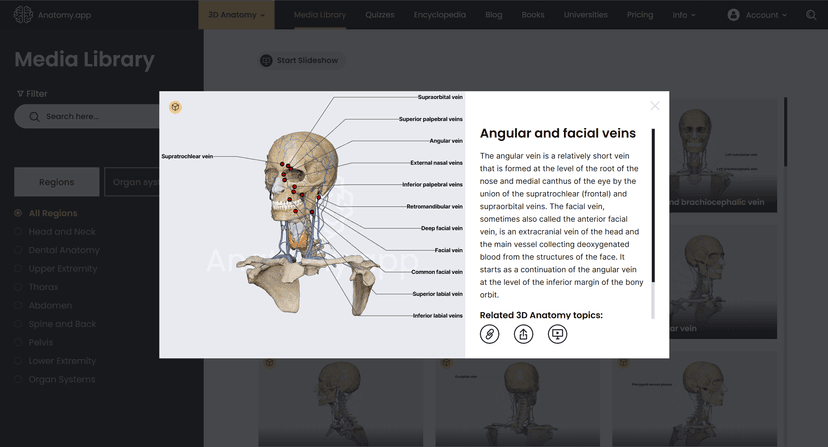
Anatomy.app provides highly detailed 3D models that support spatial understanding of human anatomy, an essential component of medical education. However, because The Learning Standard has not yet formally evaluated the app, we cannot definitively confirm its mastery-based progression efficacy. It successfully pairs visual immersion with retrieval practice through integrated quizzes.
Pros
- Integrates retrieval practice through immediate quizzing after article comprehension.
- Utilizes 3D interactive models to reduce cognitive load when visualizing complex spatial relationships in the human body.
- Aligns visual and textual information to support dual coding theory for medical students.
Cons
- Lacks transparent data on how its personalized learning algorithms adapt to repeated student errors.
- Requires high baseline anatomical vocabulary, making it unsuitable for introductory learners.
- Offers limited explanatory feedback during quizzes beyond identifying correct and incorrect anatomical structures.
What Do We Know About Anatomy.app?
Anatomy.app is an effective supplementary tool for higher-education learners needing spatial reinforcement of human anatomy, though its complete pedagogical efficacy remains pending evaluation by The Learning Standard. Your child will use this application to bridge the gap between flat textbook illustrations and actual human physiology. By manipulating 3D models of bones, muscles, and organs, learners engage spatial reasoning skills critical for medical and applied science fields. The application effectively pairs these interactive visual models with targeted reading materials and quizzes. This combination leverages dual coding, presenting the same anatomical concepts through both visual and verbal channels to strengthen memory encoding. Parents and educators should note that this is a rigorous, college-level tool designed for Bachelor's, Master's, and Doctoral degree candidates. It is not designed for casual learners or younger children. Because it utilizes a mastery-based approach, your child must actively engage with the quizzes rather than passively rotating models to see actual knowledge retention. While the monthly cost is reasonable for medical resources, institutions should closely monitor if the personalized learning pathways genuinely adapt to student knowledge gaps or simply randomize quiz questions.
How Does Anatomy.app Work?
Anatomy.app uses immersive learning and competency-based progression by pairing interactive 3D spatial models with direct text instruction and retrieval practice sets. Users begin by selecting a specific bodily system or anatomical region to study. They are presented with a high-fidelity 3D model that they can rotate, dissect, and examine from multiple angles. This active manipulation helps build accurate mental models of complex spatial relationships. Alongside the visual interface, learners read detailed articles explaining the physiological functions and structural names. After reviewing the material, users must complete integrated quizzes to test their knowledge. These quizzes act as retrieval practice, forcing the learner to recall anatomical names and locations from memory, which learning science identifies as one of the most robust methods for long-term retention. As a competency-based platform, it encourages users to repeat these modules until they achieve a high accuracy rate, though the exact mechanics of its personalized difficulty scaling remain untested by our evaluators.
Strengths and tradeoffs of Anatomy.app
The biggest strength of Anatomy.app is its application of dual coding theory through interactive 3D modeling, while its biggest weakness is the lack of detailed explanatory feedback during incorrect quiz attempts. Visualizing spatial relationships is notoriously difficult in traditional medical education. By allowing students to manipulate 3D structures, the app significantly reduces the intrinsic cognitive load associated with mentally translating flat textbook images into 3D realities. Retrieval practice is appropriately integrated via end-of-module quizzes, ensuring that learners actively pull information from memory rather than passively reviewing notes. However, the application falls short in formative feedback. When a student incorrectly identifies a muscle or bone, the system generally points to the correct structure but lacks deep, contextual explanations of why the error was made or how to distinguish between similarly named structures. Additionally, while the developer claims to use personalized learning pathways, independent data verifying how dynamically the software adapts to individual knowledge gaps is currently pending evaluation. For advanced learners who already possess strong metacognitive skills, this lack of scaffolding is manageable, but it remains a missing piece in an otherwise robust anatomical reference tool.
Who Might Benefit From Anatomy.app?
Anatomy.app is best for university-level medical, nursing, and physical therapy students who need rigorous spatial visualization tools alongside their standard curriculum. Because the content targets advanced degree levels, it expects a high degree of foundational scientific literacy. The ideal use case involves a student reviewing the 3D models after a classroom lecture or lab dissection to solidify their mental map of the human body. It serves as an excellent study companion for those preparing for complex anatomical exams, but its clinical depth makes it entirely inappropriate for high school biology students or casual science enthusiasts looking for basic overviews.
Data Transparency
Does Not Meet Data Transparency Standard
Anatomy.app does not meet our data transparency standard. Its privacy policy does not document basic protections, including a statement that it does not sell data, a commitment against targeted advertising and limits on sharing children's data.
11 of 35 checks passed
Evaluated October 2026
Privacy Policy →Level 1 · Basic protections
Does not sell data or target ads at students, limits sharing, and lets parents see and delete their child's data.
Not documented: a statement that it does not sell data, a commitment against targeted advertising, limits on sharing children's data, a COPPA or FERPA commitment, parents' right to see their child's data, parents' right to delete their child's data
Level 2 · Parent control (meets the standard)
Families can get their data out, know who processes it, and know how long it is kept.
Not documented: a data retention timeline
Level 3 · Direct data access
Families or schools can pull their own data through an API, in a stated format.
Not documented: an API for retrieving their own data, a named export format
View all 35 checks
Parent Access0/8
Does the policy mention parents specifically?
The policy does not mention parents.
Can parents view their child's data?
The policy does not give parents any right to view their child's data.
Can parents modify their child's data?
The policy does not give parents any right to change their child's data.
Can parents delete their child's account?
The policy does not give parents any right to delete their child's data or account.
Is there a dedicated Children's Privacy section?
The policy has no section about children's privacy.
Does it reference COPPA compliance?
The policy does not mention COPPA.
Does it reference FERPA compliance?
The policy does not mention FERPA.
Is parental consent required for child accounts?
The policy does not say parental consent is required for child accounts.
Data Portability3/5
Can users access their personal data?
“These may include the right (i) to request access and obtain a copy of your personal information, (ii) to request rectification or erasure;”
Can users download/export their data?
“**Right to obtain a copy** of the personal data you previously shared with us”
Is there a self-service data access tool?
“If you would at any time like to review or change the information in your account or terminate your account, you can: - Log in to your account settings and update your user account.”
Is a specific data format mentioned for export?
The policy does not name a file format for exported data.
Is there an API for data access?
The policy mentions only Google APIs and offers no API for users to get their own data.
Data Minimization1/6
Is data collection itemized?
“The personal information we collect may include the following: - names - email addresses - passwords - billing addresses - debit/credit card numbers - job titles”
Can the app be used without a real name?
The policy says it collects names.
Can the app be used without an email?
The policy says it collects email addresses.
Does it state collection is limited to what is necessary?
The policy limits how long data is kept and when it is processed, but does not say collection is limited to what is necessary.
Is IP address anonymized or truncated?
The policy says it collects IP addresses and does not say they are anonymized or truncated.
Is location tracking explicitly excluded?
The policy says it automatically collects location and country information.
Third-Party Protection3/7
Does it explicitly state no selling of data?
The policy only says no data was sold in the past twelve months, offers a 'sale/sharing' opt-out for ad tracking, and does not commit to never selling data.
Are third-party providers named?
“All payment data is handled and stored byStripe.”
Are providers contractually restricted?
“We have contracts in place with our third parties, which are designed to help safeguard your personal information. This means that they cannot do anything with your personal information unless we have instructed them to do it.”
No-targeted-advertising commitment?
The policy allows third parties to show advertisements tailored to users' interests.
Is AI/ML data sharing addressed?
The policy does not address sharing data with AI/ML systems.
Child-specific sharing restriction?
The policy has no sharing restrictions specific to children.
Cookies/tracking limited or opt-out?
“To opt out of being tracked by Google Analytics across the Services, visit [https://tools.google.com/dlpage/gaoptout](https://tools.google.com/dlpage/gaoptout).”
Deletion & Retention3/5
Can users delete their account?
“Upon your request to terminate your account, we will deactivate or delete your account and information from our active databases.”
Self-service deletion mechanism?
“If you would at any time like to review or change the information in your account or terminate your account, you can: - Log in to your account settings and update your user account.”
Specific data retention timeline?
The policy keeps data as long as needed or as long as the user has an account, with no specific time period.
Auto-deletion of inactive accounts?
The policy does not mention automatically deleting inactive accounts.
Post-deletion handling described?
“Upon your request to terminate your account, we will deactivate or delete your account and information from our active databases. However, we may retain some information in our files to prevent fraud, troubleshoot problems, assist with any investigations, enforce our legal terms and/or comply with applicable legal requirements.”
Advertising1/4
Advertising model explicitly disclosed?
“We also permit third parties and service providers to use online tracking technologies on our Services for analytics and advertising, including to help manage and display advertisements, to tailor advertisements to your interests, or to send abandoned shopping cart reminders (depending on your communication preferences).”
Free from third-party advertisements?
The policy says third-party tailored ads may appear on the Services.
Children excluded from ad targeting?
The policy does not exclude children from ad targeting.
Ad-free option available?
The policy does not describe an ad-free option.
What This Means
The policy review did not meet our data transparency standard. The checks above show the documented findings and unknowns. A missing statement does not establish how the app handles data in practice.
About this evaluation: Based on automated analysis of Privacy Policy against 35 policy-disclosure questions, including questions adapted from the Common Sense Privacy Program's published evaluation questions. TLS is not affiliated with Common Sense Media, and this is not a Common Sense rating. Quoted text is copied from the policy; unquoted notes are our summary. Results describe what the policy documents, not the company's actual practices. Privacy policies can change: this review reflects the version we analyzed and does not determine legal compliance.
Sources and review method
TLS combines product information and editorial analysis to explain how Anatomy.app works, its tradeoffs, and the questions to ask before choosing it. Product features, an instructional rationale and evidence of learning outcomes are different kinds of information.
Formal Learning Standard assessment: not yet completed. Data Transparency findings are reported separately and do not establish learning effectiveness. Read our methodology.
Frequently Asked Questions About Anatomy.app
Is Anatomy.app free?
No, Anatomy.app requires a paid subscription for access. Students and educators can choose between a monthly plan for $8.99, a yearly plan for $79.99, or a lifetime license for $225. Institutional pricing for universities requires a custom quote from the developer. Given the cost, we highly recommend that students check with their university library or academic department before purchasing an individual license, as many medical programs secure institutional access for their enrolled cohorts to lower out-of-pocket expenses.
Is Anatomy.app good for university students?
Yes, Anatomy.app is explicitly designed for higher education degree candidates. Its rigorous anatomical vocabulary and complex 3D models align directly with the needs of Bachelor's, Master's, and Doctoral students in medical, healthcare, and applied science programs. The pedagogical design assumes a high level of background knowledge and strong independent study habits. Because the app expects users to manage their own retrieval practice sessions, it is an excellent fit for mature learners who require advanced clinical reference tools rather than basic introductory science lessons.
What does Anatomy.app teach?
Anatomy.app teaches human anatomy, focusing on the accurate identification and spatial relationship of muscles, bones, and internal organs. It pairs visual identification with physiological functions, requiring learners to master complex medical terminology and anatomical structures through repeated quizzing and 3D exploration. Rather than simply showing static images, the application teaches students how interconnected bodily systems operate in three-dimensional space, which is a critical competency for future surgeons, physical therapists, and medical researchers who need to visualize anatomy beneath the skin.
How does Anatomy.app compare to Complete Anatomy?
Both applications offer high-fidelity 3D anatomical models, but Anatomy.app places a stronger emphasis on integrated article reading and competency-based quizzing modules. While Complete Anatomy is widely known for its exhaustive clinical tools and deep layering capabilities, Anatomy.app streamlines the learning process by directly tying reading comprehension to immediate retrieval practice. Students who need a massive, highly customizable digital cadaver might prefer Complete Anatomy, whereas those looking for a structured, textbook-like progression with built-in testing features may benefit more from Anatomy.app.
Has The Learning Standard evaluated Anatomy.app?
TLS has not yet completed a Learning Standard evaluation of how well Anatomy.app teaches. Its privacy policy has been reviewed for Data Transparency and does not yet document the basic protections (Level 1).
Is Anatomy.app COPPA compliant?
A COPPA reference was not found in the reviewed privacy policy. This does not determine whether the app complies with COPPA. Policy review note: The policy does not mention COPPA.
Is Anatomy.app FERPA compliant?
A FERPA reference was not found in the reviewed privacy policy. This does not determine whether the app complies with FERPA. Policy review note: The policy does not mention FERPA.
Does Anatomy.app have a children's privacy policy?
No dedicated children's privacy section was found in the reviewed policy. Policy review note: The policy has no section about children's privacy.
Does Anatomy.app sell student data?
A statement ruling out data selling was not found in the reviewed policy. This does not establish that the app sells student data. Policy review note: The policy only says no data was sold in the past twelve months, offers a 'sale/sharing' opt-out for ad tracking, and does not commit to never selling data.
Can you delete your data from Anatomy.app?
The reviewed privacy policy describes account deletion. We have not tested the deletion process. Policy review note: Users can ask to have their account deleted.
Follow TLS Research
Subscribe to future TLS research updates: app reviews, findings, and what the evidence shows.
Screenshots
Take Action
For Anatomy.app
If you represent Anatomy Next Inc. and have a correction or new evidence, send the relevant source so we can review and update this page.
Submit a correctionDetails
- Pricing
- Students and lecturers can purchase: a monthly subscription for $8.99, a yearly subscription for $79.99, a lifetime subscription for $225. For institutions and large-scale integrations, pricing is agreed on a case-by-case basis.
- Platforms
- Web Browser
- Grade Levels
- Bachelor's degree, Master's Degree, Doctoral Degree
- Website
- Visit site