
Ambient Weather WS-2000 Weather Station
Product by Ambient Weather
Facts checked: Not yet checked
Our take (not a Learning Standard rating). This label applies to learning-science judgments throughout this overview.
Our take (not a Learning Standard rating)
The Ambient Weather WS-2000 functions as a powerful data-gathering tool rather than a standalone instructional program. It provides real-world, localized meteorological data that supports project-based learning and statistical analysis, but it lacks built-in pedagogical scaffolding, requiring an educator or parent to design the actual lessons.
Pros
- Captures real-time, localized data to ground abstract meteorological concepts in concrete reality.
- Enables authentic project-based learning through long-term data tracking and graphing.
- Supports cross-curricular skill building in mathematical data analysis and scientific inquiry.
Cons
- Lacks built-in curriculum, worked examples, or direct instruction on weather concepts.
- Requires significant adult facilitation to translate raw dashboard data into meaningful learning outcomes.
- Offers no feedback mechanisms or assessments to check student comprehension.
What Do We Know About Ambient Weather WS-2000 Weather Station?
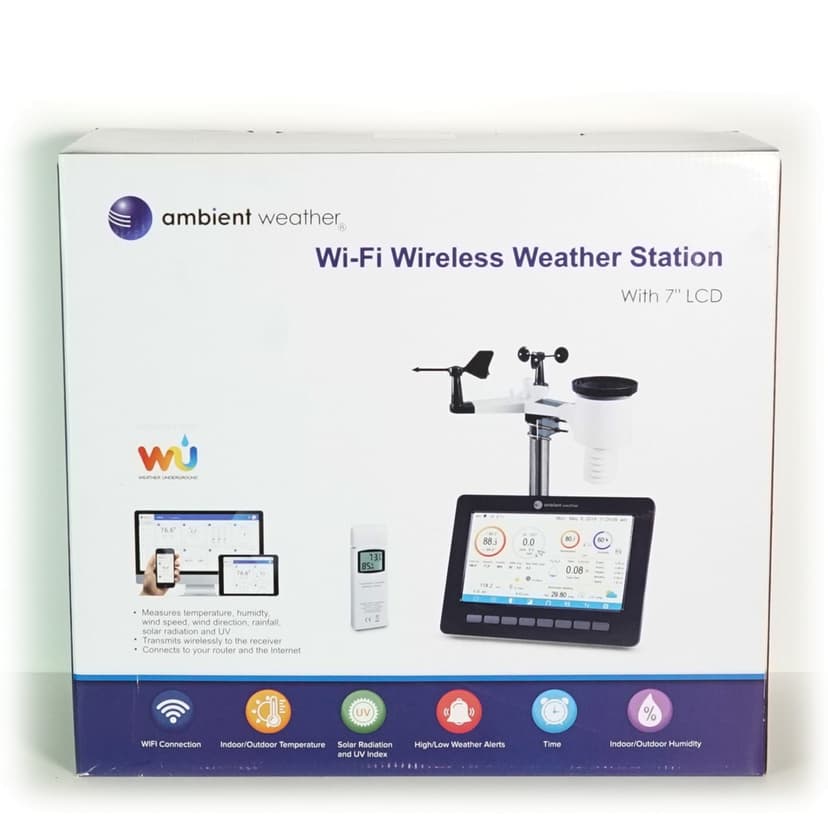
The Ambient Weather WS-2000 is highly effective for hands-on data collection but relies entirely on you or your child's teacher to provide the actual instruction. Instead of a software app that guides your child through sequenced lessons, this is a professional-grade hardware and software pairing that records hyper-local environmental data. Your child can monitor temperature, humidity, wind speed, and barometric pressure in real-time, which builds data literacy and scientific observation skills. Because the system transmits data to the Ambient Weather Network, your child can compare their backyard statistics with stations globally. However, parents should understand that this platform does not explain what barometric pressure is or why wind speeds change. It requires active adult involvement to create inquiry-based projects, such as graphing temperature changes over a month or predicting local storms. If you are looking for an independent learning app that teaches science concepts through tutorials and quizzes, this product will not meet your needs. If you want a robust tool to anchor a comprehensive, project-based science curriculum at home or in the classroom, it provides excellent raw materials for learning.
How Does Ambient Weather WS-2000 Weather Station Work?
The Ambient Weather WS-2000 utilizes a project-based learning approach where students interact with live, authentic environmental data rather than simulated scenarios. You set up a physical sensor array outdoors that wirelessly transmits meteorological metrics to an indoor color display and an online dashboard. Students log into the Ambient Weather Network to monitor real-time statistics, view historical trends, and interact with map layers showing global weather patterns. The learning mechanics center on observation, data collection, and statistical analysis. Rather than progressing through mastery-based levels, your child uses the platform to pull raw data for external assignments. They might export a month of rainfall data to a spreadsheet to practice graphing, or compare their local air quality index with a station in another country. The system acts as a persistent, real-world laboratory, requiring students to apply scientific inquiry methods to interpret the fluctuating data presented on their dashboard.
Strengths and tradeoffs of Ambient Weather WS-2000 Weather Station
The biggest strength of the WS-2000 is its provision of authentic, real-time data for project-based learning, while its biggest weakness is the complete absence of built-in instructional scaffolding. By connecting students with live environmental metrics from their exact location, the platform grounds abstract scientific concepts in tangible reality. This immediate relevance leverages the cognitive science principle of situated learning, making mathematical graphing and meteorological concepts more meaningful. When students track their own local weather, they are more engaged in the data analysis process. Furthermore, the historical data access allows for longitudinal studies, helping your child practice pattern recognition and statistical modeling. However, the platform fails to provide any direct instruction or retrieval practice. If a student misinterprets a drop in barometric pressure, the system will not correct them. There are no worked examples demonstrating how to read a wind rose, nor are there spaced repetition quizzes to cement new vocabulary. Consequently, the cognitive load of turning raw data into structured learning falls entirely on the educator or parent, making it a powerful scientific tool but an incomplete educational solution on its own.
Who Might Benefit From Ambient Weather WS-2000 Weather Station?
Best for middle school and high school students who are engaging in long-term, project-based science and math curricula under adult guidance. It is ideal for classrooms or homeschool environments where educators want a reliable, localized data source to teach statistical analysis, graphing, and environmental science. While younger children in lower elementary grades can enjoy reading the basic temperature display, the complex data analytics and higher-order thinking required to fully utilize the online dashboard are best suited for learners in grades six through nine who are developing advanced data literacy skills.
Data Transparency
Does Not Meet Data Transparency Standard
Ambient Weather WS-2000 Weather Station does not meet our data transparency standard. Its privacy policy does not document basic protections, including a commitment against targeted advertising and a COPPA or FERPA commitment.
18 of 35 checks passed
Evaluated September 2026
Privacy Policy →Level 1 · Basic protections
Does not sell data or target ads at students, limits sharing, and lets parents see and delete their child's data.
Not documented: a commitment against targeted advertising, a COPPA or FERPA commitment
Level 2 · Parent control (meets the standard)
Families can get their data out, know who processes it, and know how long it is kept.
Not documented: a data retention timeline, self-service deletion
Level 3 · Direct data access
Families or schools can pull their own data through an API, in a stated format.
Not documented: an API for retrieving their own data, a named export format
View all 35 checks
Parent Access5/8
Does the policy mention parents specifically?
“If we learn that we have collected Personal Information from a child under age 13 without verification of parental consent, we will delete that information as quickly as possible.”
Can parents view their child's data?
“You may submit a Verifiable Request for the information listed above, or exercise any of your rights enumerated under this Notice by completing the [request form available here](https://privacy.nkhome.com/privacy-request) or by calling 1-800-784-4221 toll-free in North America or 1-610-447-1555. You may also submit a Verifiable Request on behalf of your minor child.”
Can parents modify their child's data?
“You may submit a Verifiable Request for the information listed above, or exercise any of your rights enumerated under this Notice by completing the [request form available here](https://privacy.nkhome.com/privacy-request) or by calling 1-800-784-4221 toll-free in North America or 1-610-447-1555. You may also submit a Verifiable Request on behalf of your minor child.”
Can parents delete their child's account?
“You may submit a Verifiable Request for the information listed above, or exercise any of your rights enumerated under this Notice by completing the [request form available here](https://privacy.nkhome.com/privacy-request) or by calling 1-800-784-4221 toll-free in North America or 1-610-447-1555. You may also submit a Verifiable Request on behalf of your minor child.”
Is there a dedicated Children's Privacy section?
“Protecting the privacy of young children is especially important. For that reason, we do not knowingly collect or solicit Personal Information from anyone under the age of 13 or knowingly allow such persons to register for the Site accounts.”
Does it reference COPPA compliance?
The policy does not reference COPPA.
Does it reference FERPA compliance?
The policy does not reference FERPA.
Is parental consent required for child accounts?
The policy says it does not allow children under 13 to register at all; it does not set out a parental consent process for child accounts.
Data Portability2/5
Can users access their personal data?
“Right of access: You have the right to access your Personal Information.”
Can users download/export their data?
“You have a right to receive a copy of your personal data in a portable and readily usable format that allows you to transmit your data to another controller.”
Is there a self-service data access tool?
The policy only describes requests through a form, email, or phone, not a self-service access tool.
Is a specific data format mentioned for export?
The policy only says "portable and readily usable format" and does not name a specific format.
Is there an API for data access?
The policy mentions APIs only as a way public activity content may be distributed, not as a way for users to retrieve their own data.
Data Minimization1/6
Is data collection itemized?
“Personal Identifiers, including name, email address, postal address, telephone number, and online Identifiers”
Can the app be used without a real name?
The policy says it collects names as personal identifiers.
Can the app be used without an email?
The policy says it collects email addresses.
Does it state collection is limited to what is necessary?
The policy limits how long data is kept to what is necessary but does not say collection is limited to what is necessary.
Is IP address anonymized or truncated?
The policy says it collects IP addresses and does not say they are anonymized or truncated.
Is location tracking explicitly excluded?
The policy says it collects general location and precise geolocation.
Third-Party Protection6/7
Does it explicitly state no selling of data?
“We do not sell your personal data, as defined by the CPA.”
Are third-party providers named?
“- Amazon Advertising - Apple Pay - Google Ads - Google Pay - Meta Ads - Microsoft Ads - Open AI”
Are providers contractually restricted?
“When we disclose Personal Information for a business purpose, we enter into an agreement with the receiving party that describes the purpose for sharing the Personal Information, and that requires the receiving party to keep that Personal Information confidential.”
No-targeted-advertising commitment?
The policy says it processes personal data for targeted advertising and shares it with ad networks.
Is AI/ML data sharing addressed?
“We may disclose your personal information to the following third party controllers for business purposes: Open AI.”
Child-specific sharing restriction?
“We do not knowingly sell or share (for cross-context behavioral advertising) the personal information of consumers under 16 years of age.”
Cookies/tracking limited or opt-out?
“This site uses Google Analytics to analyze your interactions and experiences with our Services. You can find out how Google Analytics uses data [here](https://support.google.com/analytics/answer/6004245) and how to opt out of Google Analytics [here](https://tools.google.com/dlpage/gaoptout).”
Deletion & Retention2/5
Can users delete their account?
“You have the right to request that we delete any personal data we have obtained about you.”
Self-service deletion mechanism?
The policy only describes deletion by request, not a self-service deletion tool.
Specific data retention timeline?
The policy says it is not possible to predict how long data will be kept and gives only criteria, not a timeline.
Auto-deletion of inactive accounts?
The policy does not address automatic deletion of inactive accounts.
Post-deletion handling described?
“We will permanently delete any such personal data from our records and direct our processors to do the same. However, we may retain your personal data if it is necessary for certain purposes, as allowed by law.”
Advertising2/4
Advertising model explicitly disclosed?
“We “share” certain personal information with third party ad networks for purposes of behavioral advertising, including: Personal Identifiers, Internet Activity, and Commercial Information. This allows us to show you ads that are more relevant to you.”
Free from third-party advertisements?
The policy says it works with third-party ad networks and shows ads.
Children excluded from ad targeting?
“We do not knowingly sell or share (for cross-context behavioral advertising) the personal information of consumers under 16 years of age.”
Ad-free option available?
The policy lets users opt out of targeted advertising but does not describe an ad-free option.
What This Means
The policy review did not meet our data transparency standard. The checks above show the documented findings and unknowns. A missing statement does not establish how the app handles data in practice.
About this evaluation: Based on automated analysis of Privacy Policy against 35 policy-disclosure questions, including questions adapted from the Common Sense Privacy Program's published evaluation questions. TLS is not affiliated with Common Sense Media, and this is not a Common Sense rating. Quoted text is copied from the policy; unquoted notes are our summary. Results describe what the policy documents, not the company's actual practices. Privacy policies can change: this review reflects the version we analyzed and does not determine legal compliance.
Sources and review method
TLS combines product information and editorial analysis to explain how Ambient Weather WS-2000 Weather Station works, its tradeoffs, and the questions to ask before choosing it. Product features, an instructional rationale and evidence of learning outcomes are different kinds of information.
Formal Learning Standard assessment: not yet completed. Data Transparency findings are reported separately and do not establish learning effectiveness. Read our methodology.
Frequently Asked Questions About Ambient Weather WS-2000 Weather Station
Is the Ambient Weather WS-2000 free?
No, the base hardware requires an upfront investment of $299, which includes the essential outdoor sensor array and the indoor digital display. However, access to the online dashboard, known as the Ambient Weather Network, is completely free once you own the hardware. Educators and parents should note that specialized additional sensors, such as those for tracking soil moisture, air quality, or lightning strikes, require extra purchases to expand the system's capabilities.
Is the Ambient Weather WS-2000 good for elementary students?
It is partially effective for elementary students when supported by strong adult guidance. While first through fifth graders can easily learn basic meteorological concepts like reading a digital thermometer or identifying wind direction, the platform's core strengths lie elsewhere. The more complex data sets, historical graphing capabilities, and mapping layers found on the online dashboard are much better aligned with the analytical math and science standards expected of middle school students.
What does the Ambient Weather WS-2000 teach?
The platform provides the raw, authentic data necessary to teach meteorology, data literacy, statistical graphing, and scientific inquiry. It does not teach these subjects directly through automated lessons or video tutorials. Instead, it supplies the necessary real-time environmental metrics for your child to analyze long-term trends, calculate weekly averages, and fundamentally understand local weather patterns through hands-on, project-based assignments designed by an educator.
How does the Ambient Weather WS-2000 compare to free consumer weather apps?
Unlike free consumer weather apps that provide generalized regional forecasts based on distant airport data, the WS-2000 provides hyper-local, real-time data from your specific backyard or schoolyard. This immediate relevance makes it a much more accurate and engaging tool for scientific data collection and situated learning, though it requires a significant financial investment upfront compared to downloading a free mobile application.
Has The Learning Standard evaluated Ambient Weather WS-2000 Weather Station?
TLS has not yet completed a Learning Standard evaluation of how well Ambient Weather WS-2000 Weather Station teaches. Its privacy policy has been reviewed for Data Transparency and does not yet document the basic protections (Level 1).
Is Ambient Weather WS-2000 Weather Station COPPA compliant?
A COPPA reference was not found in the reviewed privacy policy. This does not determine whether the app complies with COPPA. Policy review note: The policy does not reference COPPA.
Is Ambient Weather WS-2000 Weather Station FERPA compliant?
A FERPA reference was not found in the reviewed privacy policy. This does not determine whether the app complies with FERPA. Policy review note: The policy does not reference FERPA.
Does Ambient Weather WS-2000 Weather Station have a children's privacy policy?
The reviewed policy includes a dedicated children's privacy section. Policy review note: The policy has a dedicated "Children's Privacy" section.
Does Ambient Weather WS-2000 Weather Station sell student data?
The reviewed policy states that the app does not sell data. This is a policy statement; actual data practices were not verified. Policy review note: The policy states that NK does not sell personal data.
Can you delete your data from Ambient Weather WS-2000 Weather Station?
The reviewed privacy policy describes account deletion. We have not tested the deletion process. Policy review note: Users can ask for all of their personal data to be deleted.
Follow TLS Research
Subscribe to future TLS research updates: app reviews, findings, and what the evidence shows.
Screenshots


Take Action
For Ambient Weather WS-2000 Weather Station
If you represent Ambient Weather and have a correction or new evidence, send the relevant source so we can review and update this page.
Submit a correctionDetails
- Pricing
- The product is $299. This includes the weather station, color display, and an Indoor Temperature and Humidity Sensor. We also offer a variety of indoor and outdoor sensors, such as lightning, soil moisture, and air quality, that are an added cost. Simply choose additional sensor options in the drop-down on the product page.
- Platforms
- Web Browser, iOS (Apple mobile), iPadOS (Apple tablet), Android (Google mobile), Windows (Microsoft), macOS (Apple), Chrome OS (Google)
- Grade Levels
- 1st Grade, 2nd Grade, 3rd Grade, 4th Grade, 5th Grade, 6th Grade, 7th Grade, 8th Grade, 9th Grade
- Website
- Visit site