
Ambient Weather WS-1965 Weather Station
Product by Ambient Weather
Facts checked: Not yet checked
Our take (not a Learning Standard rating). This label applies to learning-science judgments throughout this overview.
Our take (not a Learning Standard rating)
The Ambient Weather WS-1965 Weather Station provides excellent raw data for project-based learning but lacks built-in pedagogical instruction. It effectively supports data literacy and inquiry-based science when paired with active teaching. However, without external curriculum, your child will merely observe numbers rather than engage in active sense-making or retrieval practice.
Pros
- Enables authentic project-based learning by providing real-time local environmental data for classroom analysis.
- Supports data literacy development through interactive maps and historical trend charting.
- Connects abstract atmospheric science concepts to tangible, observable conditions in the student's immediate environment.
- Encourages inquiry-based learning when educators prompt students to predict weather patterns using the provided map layers.
Cons
- Provides no built-in assessments or retrieval practice to verify concept mastery.
- Requires significant adult facilitation to translate raw data into structured learning outcomes.
- Lacks direct instruction or worked examples on foundational meteorological concepts like barometric pressure or humidity.
What Do We Know About Ambient Weather WS-1965 Weather Station?
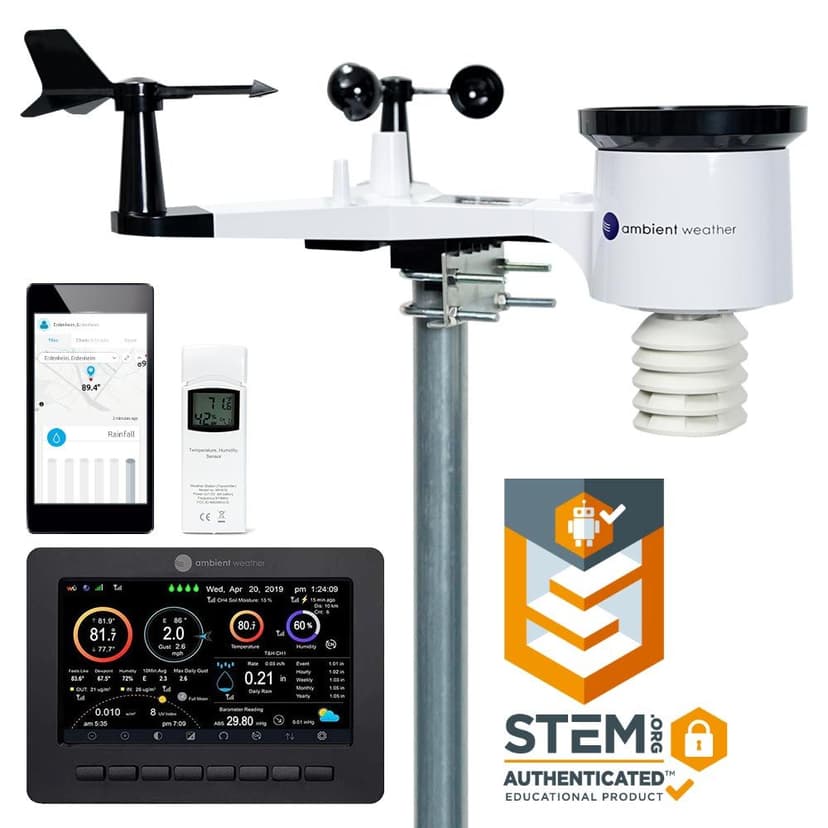
This hardware and software combination is highly effective for learning only when paired with a dedicated adult guide or structured curriculum. The Ambient Weather WS-1965 Weather Station is not an independent educational app that teaches your child directly. Instead, it is a scientific tool that feeds real-time environmental data into an online dashboard. Your child will see live temperature, humidity, and atmospheric trends, which provides an excellent foundation for project-based learning. The Learning Standard's research shows that open-ended inquiry tools require significant adult facilitation to be effective. Because the platform relies on inquiry-based learning principles, it excels at helping students draw connections between abstract science concepts and the physical world. However, parents and educators must understand that the Ambient Weather Network does not include lessons, quizzes, or spaced repetition to cement knowledge. You will need to ask guiding questions, prompt your child to analyze historical data, and help them form hypotheses about upcoming weather changes. If you are willing to build lessons around the data, this station is a powerful tool for developing math and science literacy. If you expect a standalone teaching application, you will be disappointed.
How Does Ambient Weather WS-1965 Weather Station Work?
The Ambient Weather WS-1965 relies on an inquiry-based learning approach where students analyze raw environmental data to uncover scientific principles. The physical weather station collects local data and pushes it wirelessly to the Ambient Weather Network dashboard. Your child logs into this dashboard to view interactive maps, graphical data layers, and historical trends. The learning mechanics center entirely on observation and data interpretation. Students interact with the map to compare their local station's readings with other stations across the globe, facilitating comparative analysis. By reviewing historical data charts, students practice identifying patterns and anomalies over time. There are no structured learning pathways, mastery checks, or guided tutorials. The cognitive work happens when the user takes the initiative to correlate a drop in barometric pressure with the arrival of a rainstorm. The platform serves as a visualization tool that transforms abstract atmospheric metrics into observable graphs, requiring the student or educator to supply the analytical rigor.
Strengths and tradeoffs of Ambient Weather WS-1965 Weather Station
The biggest strength of the Ambient Weather WS-1965 is its capacity to anchor abstract science in authentic, real-world data, while its biggest weakness is the complete absence of built-in pedagogical scaffolding. Grounding learning in a child's immediate environment leverages situated cognition, making concepts like temperature fluctuations and humidity highly relevant and easier to grasp. The historical data tracking allows for pattern recognition and active sense-making, which are critical skills in STEM education. When students use the platform's interactive maps to compare different geographical areas, they engage in meaningful comparative analysis. However, from a learning science perspective, the system lacks active retrieval practice or worked examples to guide novices. Without explicit instruction, novice learners often experience cognitive overload when faced with complex data dashboards. There is no feedback loop to correct misconceptions if your child misinterprets a weather graph. The tool provides excellent raw material for project-based learning, but it entirely outsources the instructional design to the parent or teacher.
Who Might Benefit From Ambient Weather WS-1965 Weather Station?
This tool is best for middle school educators and homeschooling parents who want to integrate authentic environmental data into their existing science and math curriculum. It effectively targets students in 3rd through 9th grade who are practicing data literacy, graphing, and atmospheric science. Because it requires active facilitation, it is ideal for project-based learning environments where students are expected to monitor trends over time, formulate hypotheses, and present findings. It is not suitable for young children or independent learners who need guided, step-by-step instruction to understand basic scientific concepts.
Data Transparency
Does Not Meet Data Transparency Standard
Ambient Weather WS-1965 Weather Station does not meet our data transparency standard. Its privacy policy does not document basic protections, including a commitment against targeted advertising and a COPPA or FERPA commitment.
18 of 35 checks passed
Evaluated September 2026
Privacy Policy →Level 1 · Basic protections
Does not sell data or target ads at students, limits sharing, and lets parents see and delete their child's data.
Not documented: a commitment against targeted advertising, a COPPA or FERPA commitment
Level 2 · Parent control (meets the standard)
Families can get their data out, know who processes it, and know how long it is kept.
Not documented: a data retention timeline, self-service deletion
Level 3 · Direct data access
Families or schools can pull their own data through an API, in a stated format.
Not documented: an API for retrieving their own data, a named export format
View all 35 checks
Parent Access5/8
Does the policy mention parents specifically?
“If we learn that we have collected Personal Information from a child under age 13 without verification of parental consent, we will delete that information as quickly as possible.”
Can parents view their child's data?
“You may also submit a Verifiable Request on behalf of your minor child who is under 13 years of age.”
Can parents modify their child's data?
“You may also submit a Verifiable Request on behalf of your minor child who is under 13 years of age.”
Can parents delete their child's account?
“You may also submit a Verifiable Request on behalf of your minor child who is under 13 years of age.”
Is there a dedicated Children's Privacy section?
“Protecting the privacy of young children is especially important. For that reason, we do not knowingly collect or solicit Personal Information from anyone under the age of 13 or knowingly allow such persons to register for the Site accounts.”
Does it reference COPPA compliance?
The policy does not mention COPPA.
Does it reference FERPA compliance?
The policy does not mention FERPA.
Is parental consent required for child accounts?
The policy bars users under 13 from registering at all rather than offering child accounts that require parental consent.
Data Portability2/5
Can users access their personal data?
“Right of access: You have the right to access your Personal Information.”
Can users download/export their data?
“You have a right to receive a copy of your personal data in a portable and readily usable format that allows you to transmit your data to another controller.”
Is there a self-service data access tool?
The policy offers access only through a request form, email or phone, not a tool users operate themselves.
Is a specific data format mentioned for export?
The policy promises only a "portable and readily usable format" and names no specific file format.
Is there an API for data access?
The policy mentions APIs only as a way public-activity content may be distributed, not as a way for users to retrieve their own data.
Data Minimization1/6
Is data collection itemized?
“Personal Identifiers, including name, email address, postal address, telephone number, and online Identifiers”
Can the app be used without a real name?
The policy says it collects users' names.
Can the app be used without an email?
The policy says it collects users' email addresses.
Does it state collection is limited to what is necessary?
The policy limits how long data is kept to what is necessary but does not say collection is limited to what is necessary.
Is IP address anonymized or truncated?
The policy says it collects IP addresses and does not say they are anonymized or truncated.
Is location tracking explicitly excluded?
The policy says it collects precise geolocation and GPS data.
Third-Party Protection6/7
Does it explicitly state no selling of data?
“We do not sell your personal data, as defined by the CPA.”
Are third-party providers named?
“We may disclose your personal information to the following third party controllers for business purposes: Open AI.”
Are providers contractually restricted?
“When we disclose Personal Information for a business purpose, we enter into an agreement with the receiving party that describes the purpose for sharing the Personal Information, and that requires the receiving party to keep that Personal Information confidential.”
No-targeted-advertising commitment?
The policy says it uses personal data for targeted and behavioral advertising.
Is AI/ML data sharing addressed?
“We may disclose your personal information to the following third party controllers for business purposes: Open AI.”
Child-specific sharing restriction?
“We do not knowingly sell or share (for cross-context behavioral advertising) the personal information of consumers under 16 years of age.”
Cookies/tracking limited or opt-out?
“Your browser settings may allow you to automatically transmit an opt-out preference signal, such as the Global Privacy Control (GPC) signal, to online services you visit. When we detect such signal, we place a U.S. Privacy String setting in your browser so that any third party who respects that signal will not track your activity on our website.”
Deletion & Retention2/5
Can users delete their account?
“You also have the right to request that we delete any of your Personal Information that we collect or maintain by”
Self-service deletion mechanism?
The policy offers deletion only by request, not through a tool users operate themselves.
Specific data retention timeline?
The policy says it is not possible to predict how long data will be kept and gives only criteria, not a timeline.
Auto-deletion of inactive accounts?
The policy does not address automatic deletion of inactive accounts.
Post-deletion handling described?
“We will permanently delete any such personal data from our records and direct our processors to do the same. However, we may retain your personal data if it is necessary for certain purposes, as allowed by law. Any personal data retained for these purposes will not be processed for other purposes.”
Advertising2/4
Advertising model explicitly disclosed?
“We “share” certain personal information with third party ad networks for purposes of behavioral advertising, including: Personal Identifiers, Internet Activity, and Commercial Information.”
Free from third-party advertisements?
The policy says it works with third-party ad networks to show users ads.
Children excluded from ad targeting?
“We do not knowingly sell or share (for cross-context behavioral advertising) the personal information of consumers under 16 years of age.”
Ad-free option available?
The policy offers an opt-out from targeted advertising but no ad-free option.
What This Means
The policy review did not meet our data transparency standard. The checks above show the documented findings and unknowns. A missing statement does not establish how the app handles data in practice.
About this evaluation: Based on automated analysis of Privacy Policy against 35 policy-disclosure questions, including questions adapted from the Common Sense Privacy Program's published evaluation questions. TLS is not affiliated with Common Sense Media, and this is not a Common Sense rating. Quoted text is copied from the policy; unquoted notes are our summary. Results describe what the policy documents, not the company's actual practices. Privacy policies can change: this review reflects the version we analyzed and does not determine legal compliance.
Sources and review method
TLS combines product information and editorial analysis to explain how Ambient Weather WS-1965 Weather Station works, its tradeoffs, and the questions to ask before choosing it. Product features, an instructional rationale and evidence of learning outcomes are different kinds of information.
Formal Learning Standard assessment: not yet completed. Data Transparency findings are reported separately and do not establish learning effectiveness. Read our methodology.
Frequently Asked Questions About Ambient Weather WS-1965 Weather Station
Is Ambient Weather WS-1965 free?
No, the Ambient Weather WS-1965 system is not free and requires a hardware purchase. The product costs $139, which includes the physical weather station, a color display console, and an indoor sensor. However, access to the companion Ambient Weather Network software and its educational map features is included at no additional monthly subscription cost. Once the hardware is set up, educators and students have unrestricted access to the online platform to track historical data, analyze map layers, and integrate the metrics into their daily science curriculum without ongoing fees.
Is Ambient Weather WS-1965 good for middle school students?
Yes, the tool is highly appropriate for students in 6th through 8th grade. Middle school science standards heavily emphasize data analysis, earth systems, and weather patterns. The interactive dashboard allows students of this age to practice reading complex graphs and tracking historical trends. Because middle schoolers are developing advanced cognitive skills, they are better equipped to handle the raw data presentation. However, they will still need adult guidance and targeted assignments to fully contextualize the atmospheric data they are viewing and turn simple observations into deeper scientific understanding.
What does Ambient Weather WS-1965 teach?
The platform teaches data literacy, applied mathematics, and earth science. Specifically, your child will learn how to read complex charts, track historical weather trends, and understand meteorological metrics like barometric pressure, humidity, and temperature gradients. It does not teach these concepts through explicit video lessons or reading assignments, but rather by providing the raw, real-time data necessary for students to conduct their own scientific investigations. Students learn by actively comparing different geographical areas and formulating hypotheses about how local climate factors impact daily weather changes.
Has The Learning Standard evaluated Ambient Weather WS-1965 Weather Station?
TLS has not yet completed a Learning Standard evaluation of how well Ambient Weather WS-1965 Weather Station teaches. Its privacy policy has been reviewed for Data Transparency and does not yet document the basic protections (Level 1).
Is Ambient Weather WS-1965 Weather Station COPPA compliant?
A COPPA reference was not found in the reviewed privacy policy. This does not determine whether the app complies with COPPA. Policy review note: The policy does not mention COPPA.
Is Ambient Weather WS-1965 Weather Station FERPA compliant?
A FERPA reference was not found in the reviewed privacy policy. This does not determine whether the app complies with FERPA. Policy review note: The policy does not mention FERPA.
Does Ambient Weather WS-1965 Weather Station have a children's privacy policy?
The reviewed policy includes a dedicated children's privacy section. Policy review note: The policy has a dedicated "Children's Privacy" section.
Does Ambient Weather WS-1965 Weather Station sell student data?
The reviewed policy states that the app does not sell data. This is a policy statement; actual data practices were not verified. Policy review note: The policy states NK does not sell personal data.
Can you delete your data from Ambient Weather WS-1965 Weather Station?
The reviewed privacy policy describes account deletion. We have not tested the deletion process. Policy review note: Users can ask for all of their personal information to be deleted.
Follow TLS Research
Subscribe to future TLS research updates: app reviews, findings, and what the evidence shows.
Screenshots

Take Action
For Ambient Weather WS-1965 Weather Station
If you represent Ambient Weather and have a correction or new evidence, send the relevant source so we can review and update this page.
Submit a correctionDetails
- Pricing
- The product is $139, which includes the weather station, a color display, and an indoor Temperature and Humidity Sensor
- Platforms
- Web Browser, iOS (Apple mobile), iPadOS (Apple tablet), Android (Google mobile), Windows (Microsoft), macOS (Apple), Chrome OS (Google)
- Grade Levels
- 3rd Grade, 4th Grade, 5th Grade, 6th Grade, 7th Grade, 8th Grade, 9th Grade
- Website
- Visit site