Alps Adaptive Learning Platform for Schools
Product by 2Sigma School
Facts checked: Not yet checked
Our take (not a Learning Standard rating). This label applies to learning-science judgments throughout this overview.
Our take (not a Learning Standard rating)
While Alps has not yet been formally evaluated by The Learning Standard, its mastery-based approach and automated scaffolding align with established learning science principles. It relies heavily on artificial intelligence to grade open-response questions and generate content, requiring strong teacher oversight to ensure the generated materials remain accurate and effective.
Pros
- Implements mastery-based learning by scaffolding computer science concepts based on real-time student performance.
- Automates rubric-based grading for open-response questions to provide immediate corrective feedback.
- Customizes difficulty and content generation to differentiate instruction for varying student skill levels.
- Delivers actionable progress insights to help educators identify specific classroom knowledge gaps instantly.
Cons
- Relies heavily on artificial intelligence for grading, which can misinterpret complex or highly creative student code.
- Requires significant teacher oversight to verify the technical accuracy of AI-generated curriculum materials.
- Lacks transparency on exactly how the proprietary adaptive algorithm selects the next instructional steps for students.
- Not yet evaluated by The Learning Standard for long-term knowledge retention or empirical efficacy.
What Do We Know About Alps Adaptive Learning Platform for Schools?
Alps shows strong potential for teaching computer science and STEM concepts effectively, though formal evaluation by The Learning Standard is still pending. This platform acts as a digital teaching assistant that personalizes your child's learning experience in real time. Instead of moving the whole class at the same speed, Alps uses competency-based progression to ensure your child masters one concept before advancing to the next. The system actively tracks performance and scaffolds difficult problems, breaking them down into more manageable steps when your child struggles. Because it uses artificial intelligence to grade open-ended questions, your child receives immediate feedback on their coding or math assignments. Immediate feedback is a proven driver of skill acquisition, as it corrects misconceptions before they encode into long-term memory. However, AI grading is not flawless. Educators must actively monitor the platform to ensure it accurately evaluates creative problem-solving rather than just looking for expected syntax. While primarily a tool designed for classrooms rather than independent home use, Alps provides teachers with the detailed data they need to support your child directly. The focus on mastery and personalized differentiation strongly aligns with effective educational practices.
How Does Alps Adaptive Learning Platform for Schools Work?
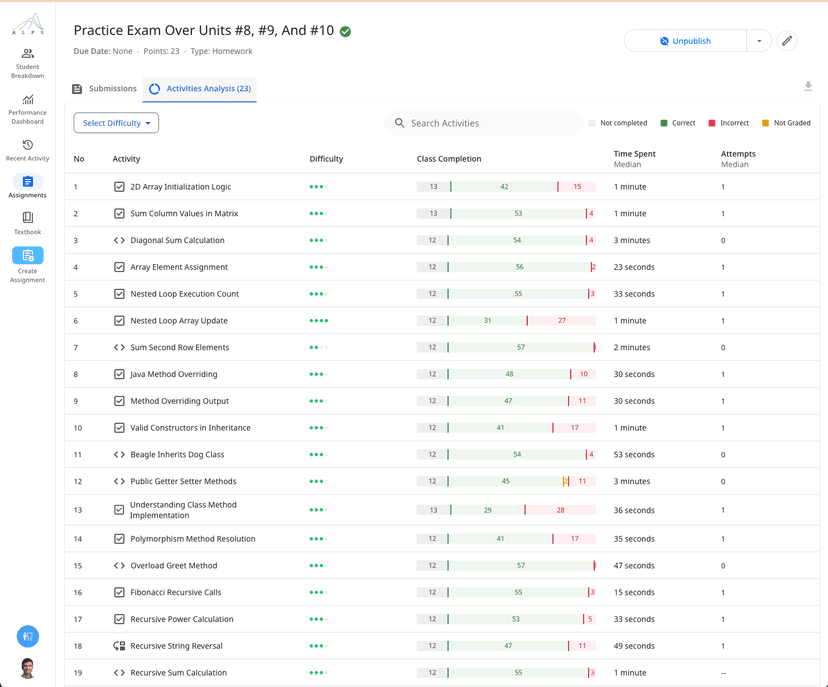
Alps utilizes personalized, mastery-based progression to deliver adaptive instruction in computer science and STEM fields. The platform integrates directly into the classroom workflow to automate content delivery and assessment. Teachers input their curriculum parameters, and the artificial intelligence engine generates aligned instructional materials and practice questions. As students work through the assignments, the platform monitors their inputs in real time. When a student submits an open-response answer or code snippet, the system applies a teacher-defined rubric to instantly grade the work and provide feedback. If a student struggles, the platform employs automated scaffolding to reduce the cognitive load, offering targeted hints or breaking the problem into smaller components. This continuous cycle of assessment and adaptation allows students to progress strictly at their own pace. Teachers simultaneously receive dashboard insights highlighting class-wide trends and individual bottlenecks, enabling them to intervene with targeted human instruction exactly where the software indicates a critical need.
Strengths and tradeoffs of Alps Adaptive Learning Platform for Schools
The biggest strength of Alps is its immediate, automated feedback on complex open-response questions, while its biggest weakness is the inherent unreliability of AI-generated grading without rigorous human oversight. Immediate feedback is highly effective for correcting misconceptions before they encode into a student's long-term memory. By automating rubric-based grading, Alps gives students the instant correction they need to adjust their mental models, particularly in subjects like computer science and math where errors compound quickly. Additionally, the platform excels at cognitive scaffolding. When the system detects failure, it differentiates the instruction by lowering the difficulty or breaking down the task, which effectively prevents cognitive overload. However, the heavy reliance on AI to generate curricula and grade open-ended answers introduces significant risks. Automated systems routinely struggle to assess novel or highly creative solutions that deviate from their training data. Teacher intervention remains critical to catch false negatives or positives in the automated grading. Until The Learning Standard can perform a formal evaluation, schools must carefully weigh the efficiency of AI automation against the absolute necessity for human validation.
Who Might Benefit From Alps Adaptive Learning Platform for Schools?
Alps is best for middle school through college educators who need to differentiate instruction in computer science, math, and STEM classrooms. It is highly optimized for teachers managing large class sizes who lack the time to manually grade complex, open-response coding or math assignments. Serving grades 7 through the bachelor's degree level, it functions as a blended learning tool rather than a standalone curriculum. It fits perfectly into competency-based schools where students must demonstrate mastery of specific technical skills before progressing. Parents will not purchase this directly, as it is strictly an enterprise platform designed to empower classroom teachers.
Data Transparency
Does Not Meet Data Transparency Standard
Alps Adaptive Learning Platform for Schools does not meet our data transparency standard. Its privacy policy does not document basic protections, including contractual limits on service providers and account deletion.
20 of 35 checks passed
Evaluated September 2026
1 new message →Level 1 · Basic protections
Does not sell data or target ads at students, limits sharing, and lets parents see and delete their child's data.
Not documented: contractual limits on service providers, account deletion
Level 2 · Parent control (meets the standard)
Families can get their data out, know who processes it, and know how long it is kept.
Not documented: data export, a data retention timeline, self-service deletion
Level 3 · Direct data access
Families or schools can pull their own data through an API, in a stated format.
Not documented: an API for retrieving their own data, a named export format
View all 35 checks
Parent Access7/8
Does the policy mention parents specifically?
“Where we offer direct registration, a learner aged 13 or older may register themselves, and a child under 13 may be registered only by a parent or legal guardian”
Can parents view their child's data?
“Where instead we collect a Child’s Personal Data directly on your consent, you can review or have deleted your Child’s personal information, and refuse further collection or use of it, by emailing us at privacy@2sigma.school.”
Can parents modify their child's data?
The policy lets parents see or delete their child's information and refuse further collection, but it does not give parents a right to correct or change it.
Can parents delete their child's account?
“Start there: ask the school to see or delete your Child’s information, or to stop further collection or use, and we will act on the school’s instruction.”
Is there a dedicated Children's Privacy section?
“This section explains our information collection, disclosure, parental consent practices and parental choice procedures with respect to information provided by children under the age of 13 (“Child” or “Children”).”
Does it reference COPPA compliance?
“This policy is in accordance with the U.S. Children's Online Privacy Protection Act (“COPPA”), and outlines our practices in the United States regarding Children's personal information.”
Does it reference FERPA compliance?
“This is student work, and much of it is an education record under the Family Educational Rights and Privacy Act (“FERPA”).”
Is parental consent required for child accounts?
“a child under 13 may be registered only by a parent or legal guardian — in which case we obtain consent from that parent or guardian, in the manner applicable law requires, before collecting personal information from the child.”
Data Portability1/5
Can users access their personal data?
“If your school, district or institution manages your account, contact that institution to review or request changes to your account information.”
Can users download/export their data?
The policy does not describe any way to download or export data.
Is there a self-service data access tool?
The policy handles access through requests to the school or by email, not through a tool users operate themselves.
Is a specific data format mentioned for export?
The policy does not name any export format.
Is there an API for data access?
The policy mentions LMS integrations but no API that users or schools can use to retrieve their own data.
Data Minimization2/6
Is data collection itemized?
“For Students:”
Can the app be used without a real name?
The policy says it collects student names.
Can the app be used without an email?
The policy says it collects student email addresses.
Does it state collection is limited to what is necessary?
The policy lists what it collects and what it does not request, and says service providers access only what they need, but it never says its own collection is limited to what is necessary.
Is IP address anonymized or truncated?
The policy says IP addresses reach Mixpanel, Sentry and other providers, and does not say they are anonymized or truncated.
Is location tracking explicitly excluded?
“We do not request home addresses, telephone numbers, geolocation, photographs, biometric identifiers, health, disability, discipline, or meal-status data, and we do not request them from a roster integration.”
Third-Party Protection6/7
Does it explicitly state no selling of data?
“We do not sell Personal Data, and we never sell student data.”
Are third-party providers named?
“Two service providers run in it on every page. **Mixpanel** gives us product analytics — which parts of the platform get used, and where people get stuck.”
Are providers contractually restricted?
The policy says providers access only the information they need, but it does not say they are bound by contract; written agreements are mentioned only for recipients of de-identified data.
No-targeted-advertising commitment?
“we do not use student data for targeted or behavioral advertising or to build an advertising profile”
Is AI/ML data sharing addressed?
“we do not use identifiable student data to train, fine-tune, or evaluate AI models, nor do we permit any third-party model provider to train on it.”
Child-specific sharing restriction?
“We do not sell it, do not use it for advertising or to build an advertising profile, and do not use it in identifiable form to train AI models.”
Cookies/tracking limited or opt-out?
“You can disable cookies, limit the types of cookies you allow, or set your browser to notify you when cookies are used.”
Deletion & Retention0/5
Can users delete their account?
The policy lets school-managed users request only 'changes' to account information and gives a deletion right only to parents of children under 13, not a general right for users to delete their account or all their data.
Self-service deletion mechanism?
The policy handles deletion through requests to the school or by email, not through a self-service tool.
Specific data retention timeline?
The policy keeps data only "as long as necessary" and gives no specific time limit.
Auto-deletion of inactive accounts?
The policy does not mention deleting inactive accounts automatically.
Post-deletion handling described?
The policy warns that deletion may end the account and that content removal may not be complete, but it does not describe how data is handled after deletion.
Advertising4/4
Advertising model explicitly disclosed?
“the learning platform carries no advertising, integrates no ad network, loads no tag manager or marketing tags, and runs no session recording.”
Free from third-party advertisements?
“We do not serve advertising through the Services, do not share Personal Data with advertisers or advertising networks, and do not track your activity across other sites or services for advertising purposes.”
Children excluded from ad targeting?
“We do not sell it, do not use it for advertising or to build an advertising profile, and do not use it in identifiable form to train AI models.”
Ad-free option available?
“the learning platform carries no advertising, integrates no ad network, loads no tag manager or marketing tags, and runs no session recording.”
What This Means
The policy review did not meet our data transparency standard. The checks above show the documented findings and unknowns. A missing statement does not establish how the app handles data in practice.
About this evaluation: Based on automated analysis of 1 new message against 35 policy-disclosure questions, including questions adapted from the Common Sense Privacy Program's published evaluation questions. TLS is not affiliated with Common Sense Media, and this is not a Common Sense rating. Quoted text is copied from the policy; unquoted notes are our summary. Results describe what the policy documents, not the company's actual practices. Privacy policies can change: this review reflects the version we analyzed and does not determine legal compliance.
Sources and review method
TLS combines product information and editorial analysis to explain how Alps Adaptive Learning Platform for Schools works, its tradeoffs, and the questions to ask before choosing it. Product features, an instructional rationale and evidence of learning outcomes are different kinds of information.
Formal Learning Standard assessment: not yet completed. Data Transparency findings are reported separately and do not establish learning effectiveness. Read our methodology.
Frequently Asked Questions About Alps Adaptive Learning Platform for Schools
Is Alps Adaptive Learning Platform for Schools free?
Yes, but only temporarily. The developer is currently offering limited beta trials for free through June 2025. After this initial beta period concludes, it will likely transition to a paid enterprise or subscription licensing model for schools and districts. Parents do not pay for this application out of pocket, as it operates exclusively as a classroom infrastructure tool purchased directly by educational institutions and managed by school administrators.
Is Alps Adaptive Learning Platform for Schools good for middle schoolers?
Yes, the platform is designed to support students starting in the 7th and 8th grades. It works exceptionally well for middle schoolers because it provides immediate feedback and heavily scaffolds difficult problems, preventing younger students from becoming frustrated by complex STEM and computer science topics. Middle school teachers can use the real-time generated insights to provide targeted, face-to-face support exactly where early adolescents struggle the most.
What does Alps Adaptive Learning Platform for Schools teach?
Alps primarily facilitates instruction in computer science, mathematics, applied sciences, and career and technical education. It is not a rigid, standalone curriculum itself, but rather an adaptive platform that generates and delivers practice content aligned with the teacher's specific curriculum goals. It rigorously focuses on competency-based mastery, ensuring your child fully understands foundational technical skills before the software allows them to move forward to more advanced concepts.
Has The Learning Standard evaluated Alps Adaptive Learning Platform for Schools?
TLS has not yet completed a Learning Standard evaluation of how well Alps Adaptive Learning Platform for Schools teaches. Its privacy policy has been reviewed for Data Transparency and does not yet document the basic protections (Level 1).
Is Alps Adaptive Learning Platform for Schools COPPA compliant?
The reviewed privacy policy references COPPA. A policy reference alone does not establish COPPA compliance. Policy review note: The policy says it follows COPPA.
Is Alps Adaptive Learning Platform for Schools FERPA compliant?
The reviewed privacy policy references FERPA. A policy reference alone does not establish FERPA compliance. Policy review note: Explicit reference to FERPA and education records.
Does Alps Adaptive Learning Platform for Schools have a children's privacy policy?
The reviewed policy includes a dedicated children's privacy section. Policy review note: The policy has its own section headed CHILDREN.
Does Alps Adaptive Learning Platform for Schools sell student data?
The reviewed policy states that the app does not sell data. This is a policy statement; actual data practices were not verified. Policy review note: The policy explicitly says the company does not sell data.
Can you delete your data from Alps Adaptive Learning Platform for Schools?
Account deletion was not documented in the reviewed privacy policy. This does not establish whether deletion is available. Policy review note: The policy lets school-managed users request only 'changes' to account information and gives a deletion right only to parents of children under 13, not a general right for users to delete their account or all their data.
Follow TLS Research
Subscribe to future TLS research updates: app reviews, findings, and what the evidence shows.
Screenshots

Take Action
For Alps Adaptive Learning Platform for Schools
If you represent 2Sigma School and have a correction or new evidence, send the relevant source so we can review and update this page.
Submit a correctionDetails
- Pricing
- We are offering limited beta trials for free through June 2025.
- Platforms
- Web Browser, iPadOS (Apple tablet), Windows (Microsoft), macOS (Apple), Chrome OS (Google)
- Grade Levels
- 7th Grade, 8th Grade, 9th Grade, 10th Grade, 11th Grade, 12th Grade, Associate's degree, Bachelor's degree
- Website
- Visit site