WaterWays
Product by Killer Snails
Facts checked: Not yet checked
Our take (not a Learning Standard rating). This label applies to learning-science judgments throughout this overview.
Our take (not a Learning Standard rating)
WaterWays offers an engaging, inquiry-based approach to environmental science, but its efficacy relies heavily on supplemental classroom discussion. It effectively uses immersive scenarios to teach plastic pollution and water quality. However, without built-in spaced repetition or robust knowledge retrieval checks, independent long-term retention remains uncertain pending our formal evaluation.
Pros
- Uses situated cognition by placing students in realistic environmental scenarios to solve community health problems.
- Requires active decision-making rather than passive video consumption to progress through ecological challenges.
- Integrates interdisciplinary concepts across science and civic responsibility to deepen contextual understanding.
Cons
- Lacks spaced retrieval practice to ensure long-term retention of complex environmental vocabulary.
- Does not provide granular adaptive scaffolding if a student struggles with a specific scientific concept.
- Requires external educator guidance to fully contextualize the interactive gameplay into mastery.
What Do We Know About WaterWays?
WaterWays is an effective supplementary tool for introducing 3rd through 5th graders to environmental science, provided it is paired with active adult guidance. Your child will not passively consume facts about the Urban Heat Island effect or marine biodiversity. Instead, the app forces them to investigate simulated local ecosystems and identify actionable solutions to pollution and water quality issues. This experiential learning model excels at building situational awareness and empathy for community health. However, you should not rely on this app as a standalone science curriculum. Because the app lacks robust, built-in retrieval practice and spaced repetition, your child might forget the technical vocabulary shortly after completing the five-lesson unit. To maximize the learning benefits, you must ask targeted questions about their in-game investigations to force knowledge retrieval. The app functions best when you treat it as an interactive lab experiment rather than a comprehensive textbook. The Learning Standard has not yet formally evaluated WaterWays, but its design aligns well with inquiry-based learning principles.
How Does WaterWays Work?
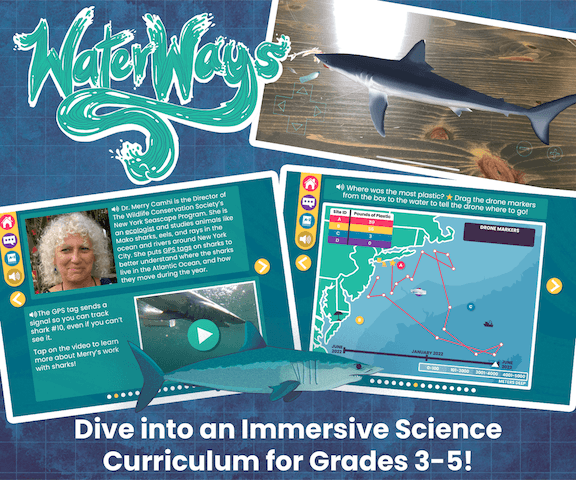
WaterWays relies on immersive, inquiry-based learning where students act as environmental investigators solving localized ecological problems. The app organizes content into distinct case studies covering topics like plastic pollution, air quality, and marine biodiversity. Your child enters a simulated environment and must interact with digital objects, collect data, and observe environmental indicators to deduce the root cause of a community issue. After gathering evidence, the student applies this information to select mitigation strategies. This game-based structure utilizes active learning, forcing the user to manipulate variables rather than simply reading text. Progression requires the completion of specific diagnostic tasks, mirroring the scientific method. The unit consists of five discrete lessons designed to take one class period each. There are no traditional quizzes or flashcards; assessment is entirely performance-based within the simulation.
Strengths and tradeoffs of WaterWays
The biggest strength of WaterWays is its use of situated cognition to make abstract ecological concepts concrete, while its biggest weakness is the absence of spaced repetition to cement long-term vocabulary retention. Contextualized Problem Solving: The app excels by embedding learning in realistic scenarios. When students investigate an Urban Heat Island, they process information through active engagement. This aligns with learning science principles showing that contextualized knowledge is easier to apply to real-world situations. Lack of Retrieval Practice: The app treats lessons as episodic events. Once a student finishes the lesson on marine biodiversity, the software does not systematically prompt them to retrieve that information days or weeks later. Without this spaced retrieval, the forgetting curve dictates that much of the specific terminology will be lost. Scaffolding Limitations: WaterWays provides a rich immersive environment but lacks dynamic adaptive feedback. If a student misinterprets data regarding water quality, the app does not break the concept down into smaller, worked examples to correct the misconception. It relies on the presence of a teacher or parent to bridge these instructional gaps.
Who Might Benefit From WaterWays?
Best for 3rd to 5th-grade educators and parents seeking interactive, project-based science supplements to anchor broader environmental lesson plans. WaterWays is ideal for classroom environments where teachers can facilitate pre- and post-gameplay discussions to reinforce the core concepts of water stewardship and pollution. It is not designed for self-directed learners looking for a primary science curriculum. The structured five-lesson unit works perfectly for a week-long focus on local ecology or Earth Month activities, serving as a digital lab replacement rather than a standalone tutor.
Data Transparency
Does Not Meet Data Transparency Standard
WaterWays does not meet our data transparency standard. Its privacy policy does not document basic protections, including contractual limits on service providers and parents' right to see their child's data.
16 of 35 checks passed
Evaluated September 2026
WaterWays: Privacy Policy →Level 1 · Basic protections
Does not sell data or target ads at students, limits sharing, and lets parents see and delete their child's data.
Not documented: contractual limits on service providers, parents' right to see their child's data
Level 2 · Parent control (meets the standard)
Families can get their data out, know who processes it, and know how long it is kept.
Not documented: data export, self-service deletion
Level 3 · Direct data access
Families or schools can pull their own data through an API, in a stated format.
Not documented: an API for retrieving their own data, a named export format
View all 35 checks
Parent Access5/8
Does the policy mention parents specifically?
“If there are any questions regarding this privacy policy or if a parent wishes for their student's data to be deleted, you may contact us using the information below.”
Can parents view their child's data?
The policy does not give parents a right to view their child's data.
Can parents modify their child's data?
The policy lets account holders change their own personal information but gives parents no right to modify their child's data.
Can parents delete their child's account?
“If there are any questions regarding this privacy policy or if a parent wishes for their student's data to be deleted, you may contact us using the information below.”
Is there a dedicated Children's Privacy section?
“**COPPA (Children Online Privacy Protection Act)**”
Does it reference COPPA compliance?
“When it comes to the collection of personal information from children under the age of 13 years old, the Children's Online Privacy Protection Act (COPPA) puts parents in control.”
Does it reference FERPA compliance?
“Following FERPA guidelines, once the subscription ends, all data will be deleted within 45 days of the contract ending.”
Is parental consent required for child accounts?
The policy does not say parental consent is required for child accounts.
Data Portability2/5
Can users access their personal data?
“You can change your personal information by logging in to your account on [https://accounts.killersnails.com](https://accounts.killersnails.com/)”
Can users download/export their data?
The policy does not address downloading or exporting data.
Is there a self-service data access tool?
“You can change your personal information by logging in to your account on [https://accounts.killersnails.com](https://accounts.killersnails.com/)”
Is a specific data format mentioned for export?
The policy does not name any export format.
Is there an API for data access?
The policy mentions only Google APIs for login and roster integration, not an API for retrieving user data.
Data Minimization1/6
Is data collection itemized?
“- Educator registration data: First and last name, email address, school association, and user name/password. - Student roster data: First and last names, email address or unique logon id.”
Can the app be used without a real name?
The policy says student roster data includes first and last names.
Can the app be used without an email?
The policy says student roster data may include email addresses.
Does it state collection is limited to what is necessary?
The policy does not say collection is limited to what is necessary.
Is IP address anonymized or truncated?
The policy says IP addresses are collected and does not mention anonymizing them.
Is location tracking explicitly excluded?
The policy does not rule out location tracking.
Third-Party Protection5/7
Does it explicitly state no selling of data?
“We do not sell, trade, or otherwise transfer to outside parties your Personally Identifiable Information.”
Are third-party providers named?
“Killer Snails uses Google’s Application Programming Interface (API) Services to enable users to log in to Killer Snails, import classes and rosters from Google Classroom, and create assignments in Google Classroom.”
Are providers contractually restricted?
The policy does not describe contractual limits on service providers.
No-targeted-advertising commitment?
“Killer Snails will never use Student Data for targeted advertising.”
Is AI/ML data sharing addressed?
The policy does not address AI or machine-learning data sharing.
Child-specific sharing restriction?
“We do not let third-parties collect PII from children.”
Cookies/tracking limited or opt-out?
“We honor Do Not Track signals and Do Not Track when a Do Not Track (DNT) browser mechanism is in place.”
Deletion & Retention2/5
Can users delete their account?
“If there are any questions regarding this privacy policy or if a parent wishes for their student's data to be deleted, you may contact us using the information below.”
Self-service deletion mechanism?
The policy offers deletion only by contacting the company, with no self-service tool.
Specific data retention timeline?
“Following FERPA guidelines, once the subscription ends, all data will be deleted within 45 days of the contract ending.”
Auto-deletion of inactive accounts?
The policy ties deletion to the contract ending, not to account inactivity.
Post-deletion handling described?
The policy does not describe what happens to data after deletion, such as backups.
Advertising1/4
Advertising model explicitly disclosed?
The policy rules out targeted ads that use student data but never states whether the product has advertising.
Free from third-party advertisements?
The policy restricts ad networks from targeting but does not state the product has no third-party ads.
Children excluded from ad targeting?
“Killer Snails does not permit third party advertising networks to collect information from or about students using Killer Snails Educational Products for the purpose of serving targeted advertising across websites and over time and Killer Snails will never use Student Data for targeted advertising.”
Ad-free option available?
The policy does not state the product has no ads and does not offer an ad-free option.
What This Means
The policy review did not meet our data transparency standard. The checks above show the documented findings and unknowns. A missing statement does not establish how the app handles data in practice.
About this evaluation: Based on automated analysis of WaterWays: Privacy Policy against 35 policy-disclosure questions, including questions adapted from the Common Sense Privacy Program's published evaluation questions. TLS is not affiliated with Common Sense Media, and this is not a Common Sense rating. Quoted text is copied from the policy; unquoted notes are our summary. Results describe what the policy documents, not the company's actual practices. Privacy policies can change: this review reflects the version we analyzed and does not determine legal compliance.
Sources and review method
TLS combines product information and editorial analysis to explain how WaterWays works, its tradeoffs, and the questions to ask before choosing it. Product features, an instructional rationale and evidence of learning outcomes are different kinds of information.
Formal Learning Standard assessment: not yet completed. Data Transparency findings are reported separately and do not establish learning effectiveness. Read our methodology.
Frequently Asked Questions About WaterWays
Is WaterWays free?
No. Individual lessons can be purchased for $3.99, and the complete five-lesson unit is available for $14.99. Discounts are offered for larger classroom or district purchases.
Is WaterWays good for 3rd graders?
Yes. The interactive mechanics and reading levels are appropriately targeted for 3rd through 5th-grade cognitive milestones. However, 3rd graders will benefit most when an adult facilitates the experience to help define complex scientific terms.
What does WaterWays teach?
WaterWays teaches environmental science, applied science, and career and technical education concepts. It focuses specifically on real-world ecological issues like water quality, plastic pollution, marine biodiversity, and the Urban Heat Island effect.
Does WaterWays use adaptive learning?
No. The app uses a linear, experiential progression model. It does not dynamically adjust the difficulty of scientific concepts based on the user's prior performance or mistakes.
Has The Learning Standard evaluated WaterWays?
TLS has not yet completed a Learning Standard evaluation of how well WaterWays teaches. Its privacy policy has been reviewed for Data Transparency and does not yet document the basic protections (Level 1).
Is WaterWays COPPA compliant?
The reviewed privacy policy references COPPA. A policy reference alone does not establish COPPA compliance. Policy review note: COPPA is referenced in a dedicated section that sets out the company's practices.
Is WaterWays FERPA compliant?
The reviewed privacy policy references FERPA. A policy reference alone does not establish FERPA compliance. Policy review note: The policy says it follows FERPA guidelines.
Does WaterWays have a children's privacy policy?
The reviewed policy includes a dedicated children's privacy section. Policy review note: There is a section with its own COPPA heading.
Does WaterWays sell student data?
The reviewed policy states that the app does not sell data. This is a policy statement; actual data practices were not verified. Policy review note: The company states it does not sell personal information.
Can you delete your data from WaterWays?
The reviewed privacy policy describes account deletion. We have not tested the deletion process. Policy review note: Deletion of a student's data can be requested.
Follow TLS Research
Subscribe to future TLS research updates: app reviews, findings, and what the evidence shows.
Screenshots
Take Action
For WaterWays
If you represent Killer Snails and have a correction or new evidence, send the relevant source so we can review and update this page.
Submit a correctionDetails
- Pricing
- An individual lesson (one class period) can be purchased for $3.99 and the unit (5 lessons over 5 class periods) can be purchased for $14.99. Discounts are offered for larger purchases.
- Platforms
- Web Browser, Chrome OS (Google)
- Grade Levels
- 3rd Grade, 4th Grade, 5th Grade
- Website
- Visit site