NextWaveSTEM “We Teach” STEM Programs
Product by NextWaveSTEM
Facts checked: Not yet checked
Our take (not a Learning Standard rating). This label applies to learning-science judgments throughout this overview.
Our take (not a Learning Standard rating)
While NextWaveSTEM "We Teach" STEM Programs is pending formal evaluation by The Learning Standard, its experiential learning model aligns with established science on active engagement. By forcing students to physically manipulate robotics and drones, it bridges abstract coding logic with concrete, observable outcomes, though efficacy relies heavily on the specific live instructor.
Pros
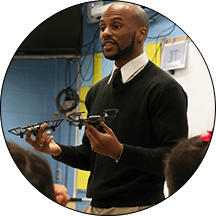
- Utilizes experiential learning by requiring students to physically program drones and build robots.
- Employs a mastery-based progression system that ensures core concepts are understood before advancing.
- Provides hands-on manipulation of 3D printing and Arduino hardware to strengthen spatial reasoning and applied logic.
- Uses immediate physical feedback from hardware to help students quickly identify and debug coding errors.
Cons
- Lacks transparent pricing, making it difficult for educators to evaluate cost-benefit ratios before inquiry.
- Requires significant hardware investments for drones and 3D printers alongside the instructional program.
- Relies entirely on live human instructors, which introduces variability in the consistency of pacing and worked examples.
- Diminishes the tactile, experiential benefits of hardware manipulation during remote learning scenarios.
What Do We Know About NextWaveSTEM “We Teach” STEM Programs?
NextWaveSTEM "We Teach" STEM Programs delivers potentially highly effective hands-on technical education, though formal efficacy data remains pending evaluation by The Learning Standard. Your child will not be interacting with a standalone software application, but rather participating in instructor-led courses focused on hardware like 3D printers, drones, and Arduino boards. Because the program utilizes a mastery-based approach, your child must demonstrate understanding of foundational coding or engineering concepts before moving to more complex tasks. This prevents knowledge gaps from compounding over time. The reliance on experiential learning means your child actively applies abstract math and science concepts to real-world problems, such as calculating flight paths or troubleshooting circuitry. However, parents and educators should note that the quality of instruction will vary based on the assigned certified STEM instructor. Furthermore, if your child participates remotely, the tactile benefits of handling physical hardware may be significantly reduced compared to the in-person experience.
How Does NextWaveSTEM “We Teach” STEM Programs Work?
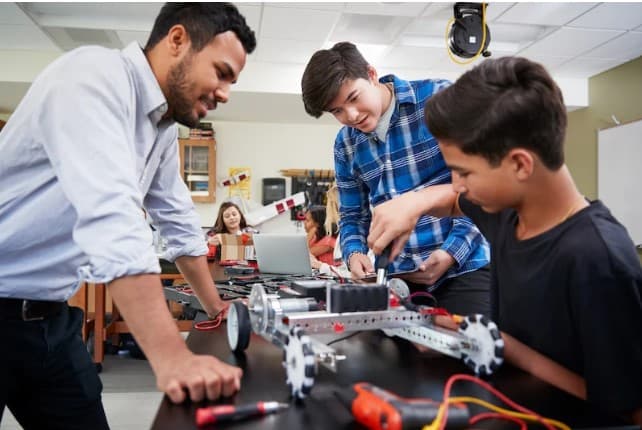
NextWaveSTEM uses an experiential, mastery-based progression model facilitated by live instructors through project-based technical modules. Rather than clicking through a gamified app, students participate in synchronous workshops or after-school programs led by certified teachers. The curriculum focuses heavily on hardware integration, requiring students to write code and immediately test it on physical devices like drones, robots, or Arduino microcontrollers. This immediate testing loop provides inherent, instant feedback: if the code is flawed, the drone does not fly correctly. Instructors provide scaffolded support, stepping in to help students debug errors and refine their logical reasoning. Because the program scales from kindergarten through 12th grade, the mechanics shift from basic foundational logic in early years to advanced, career-technical programming in high school. The delivery relies entirely on coordinating physical equipment alongside live instruction, meaning schools or parents must manage hardware logistics to fully realize the pedagogical benefits.
Strengths and tradeoffs of NextWaveSTEM “We Teach” STEM Programs
The biggest strength of NextWaveSTEM "We Teach" STEM Programs is its integration of tactile, experiential learning with emerging technology, while its biggest weakness is the logistical complexity and hardware dependency required for remote implementation. Experiential learning is a highly effective pedagogical approach for STEM, as it forces students to move beyond passive consumption and actively apply concepts. By using drones and 3D printers, the program gives students immediate visual and physical feedback on their work, which strongly reinforces cause-and-effect reasoning. The mastery-based progression ensures that foundational skills are cemented before introducing complex variables. However, the program's reliance on physical hardware creates a significant barrier. In remote learning scenarios, the absence of direct hands-on manipulation can dilute the experiential benefits, turning a hardware course into a standard screen-based coding lecture. Additionally, because the program relies on live human instructors rather than an adaptive algorithm, the consistency of worked examples and real-time pacing is entirely dependent on the individual teacher's skill level, which makes uniform quality control challenging.
Who Might Benefit From NextWaveSTEM “We Teach” STEM Programs?
Best for K-12 schools and dedicated after-school programs that want to integrate advanced hardware instruction but lack the internal staff to teach emerging tech. It serves kindergarten through 12th-grade students by offering a wide, adaptable curriculum. The program is ideal for kinesthetic learners who struggle with purely screen-based coding applications and need physical, real-world consequences to grasp abstract programming logic. It is less suited for individual parents seeking an inexpensive, plug-and-play app for casual weekend enrichment, as it requires scheduled instruction and specific hardware setups.
Sources and review method
TLS combines product information and editorial analysis to explain how NextWaveSTEM “We Teach” STEM Programs works, its tradeoffs, and the questions to ask before choosing it. Product features, an instructional rationale and evidence of learning outcomes are different kinds of information.
Formal Learning Standard assessment: not yet completed. Data Transparency findings are reported separately and do not establish learning effectiveness. Read our methodology.
Frequently Asked Questions About NextWaveSTEM “We Teach” STEM Programs
Is NextWaveSTEM "We Teach" STEM Programs free?
No. NextWaveSTEM "We Teach" STEM Programs requires paid licensing. Pricing is highly customized based on instructional hours, the type of equipment needed, and whether the delivery is in-person or remote. Schools and parents must contact the company directly for a specific quote.
Is NextWaveSTEM "We Teach" STEM Programs good for elementary students?
Yes. The program is specifically designed to scale down to the kindergarten level. Instructors use age-appropriate introductory robotics and simplified coding logic to teach foundational STEM concepts before moving to complex Arduino or drone programming in later grades.
What does NextWaveSTEM "We Teach" STEM Programs teach?
NextWaveSTEM "We Teach" STEM Programs teaches applied science, math, and career technical education. Specific subjects include 3D printing, robotics, drone technology, and Arduino coding. The curriculum focuses on teaching abstract programming logic through physical hardware manipulation.
Has The Learning Standard evaluated NextWaveSTEM “We Teach” STEM Programs?
TLS has not yet completed a Learning Standard evaluation of how well NextWaveSTEM “We Teach” STEM Programs teaches. TLS has not published a Data Transparency result for its privacy policy.
Follow TLS Research
Subscribe to future TLS research updates: app reviews, findings, and what the evidence shows.
Screenshots
Take Action
For NextWaveSTEM “We Teach” STEM Programs
If you represent NextWaveSTEM and have a correction or new evidence, send the relevant source so we can review and update this page.
Submit a correctionDetails
- Pricing
- Courses are delivered by our certified STEM instructors for both during school time and out-of-school time instruction. Instruction can be delivered in both in-person and remote scenarios. Since instructional hours, equipment, and scheduling are all customizable to customer needs pricing will depend on these factors, in addition to the number of hours purchased. Write to us at Hello@NextWaveSTEM.com or call at (312) 600-8239 for more information.
- Platforms
- Web Browser, iOS (Apple mobile), iPadOS (Apple tablet), Android (Google mobile), Windows (Microsoft), macOS (Apple), Chrome OS (Google)
- Grade Levels
- Kindergarten, 1st Grade, 2nd Grade, 3rd Grade, 4th Grade, 5th Grade, 6th Grade, 7th Grade, 8th Grade, 9th Grade, 10th Grade, 11th Grade, 12th Grade
- Website
- Visit site