
Goosechase
Product by Goosechase
Facts checked: Not yet checked
Our take (not a Learning Standard rating). This label applies to learning-science judgments throughout this overview.
Our take (not a Learning Standard rating)
Goosechase facilitates active learning and collaboration, but it is an engagement tool rather than a direct instruction platform. While pending formal evaluation by The Learning Standard, its scavenger hunt format effectively prompts physical movement and retrieval practice, though learning outcomes depend entirely on the teacher's prompt design.
Pros
- Leverages active learning by requiring physical movement and environmental interaction to complete tasks.
- Forces collaborative problem-solving and communication through its mandatory team-based structure.
- Allows educators to design custom prompts that assess learning through multimodal submissions like photos or videos.
- Provides real-time activity feeds that let teachers monitor student understanding during the activity.
Cons
- Lacks built-in instructional content, requiring teachers to create or heavily adapt all learning materials.
- Does not provide automated feedback or error correction on student submissions.
- Gamification elements like points and leaderboards can distract from deep cognitive processing.
- Requires significant setup time and active device management to run effectively in a classroom setting.
What Do We Know About Goosechase?
Goosechase is an effective engagement tool for collaborative practice, but it does not directly teach new academic concepts to your child. Instead of delivering instruction, this app relies on teachers to create scavenger hunt challenges that test what your child already knows. Your child will use a device to take photos, record videos, or enter text to complete these challenges. From a learning science perspective, this relies heavily on active learning and retrieval practice, asking your child to recall information and apply it in their physical environment. Because the app does not contain built-in curriculum or adaptive learning paths, its educational value depends entirely on how well the teacher designs the tasks. While The Learning Standard has not yet formally evaluated Goosechase, its design is better suited for team building, project-based learning, and review activities rather than independent study. Your child will not learn new math or reading skills just by logging in. However, when used as part of a well-designed lesson, the physical movement and collaborative problem-solving required can significantly boost your child's engagement and help consolidate prior learning.
How Does Goosechase Work?
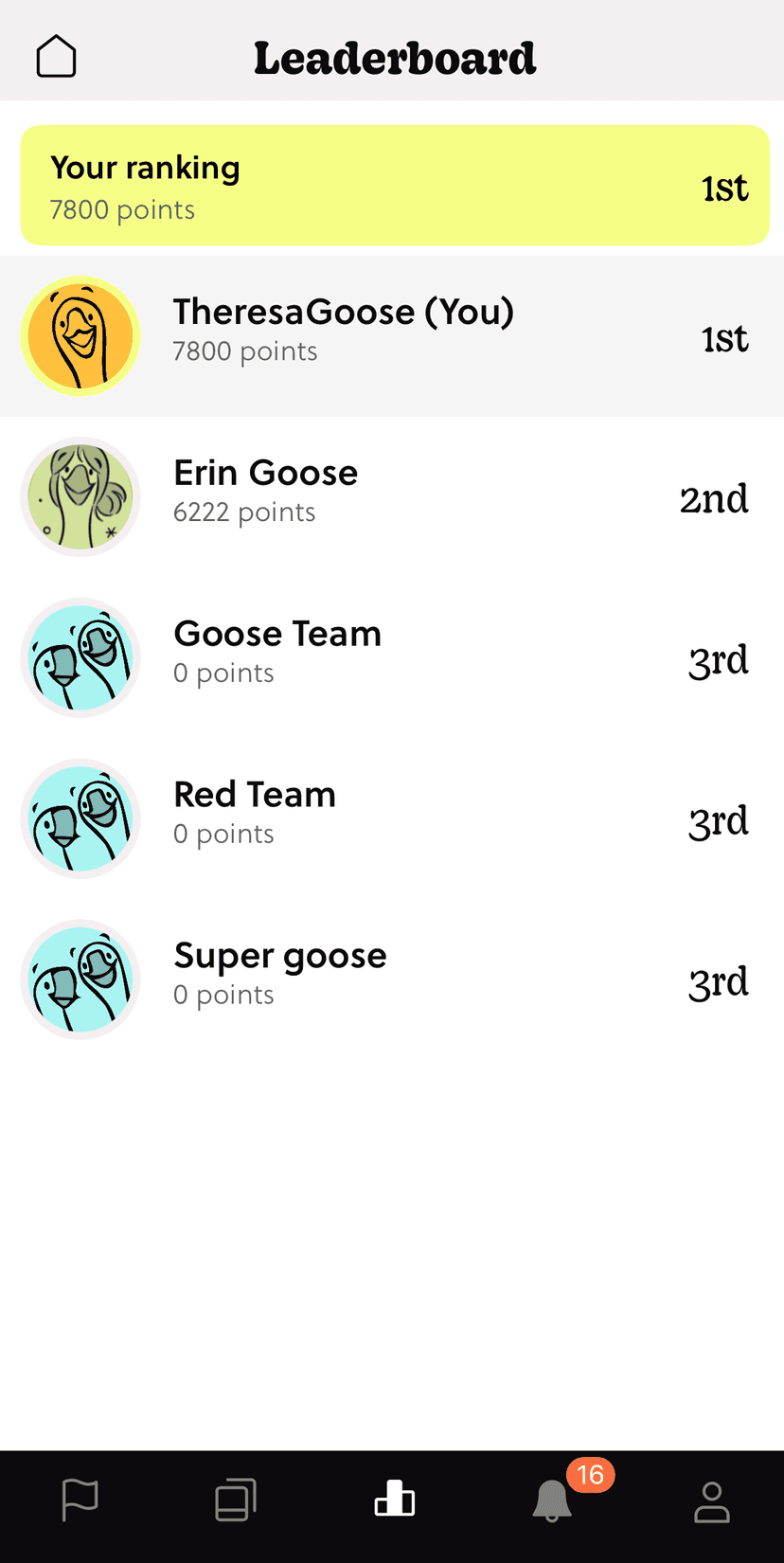
Goosechase uses game-based experiential learning where students complete custom, teacher-designed challenges in a scavenger hunt format. The platform is divided into an educator dashboard and a student-facing mobile interface. Teachers create an experience by writing specific tasks, called missions, that require students to find objects, answer questions, or perform physical actions. Students work in teams using a shared device to submit evidence of their completed missions via photo, video, text, or GPS location. As teams submit their evidence, they earn points and move up a real-time leaderboard. The teacher monitors the live activity feed to ensure students are staying on task and demonstrating accurate understanding of the material. The app does not grade submissions for accuracy automatically; instead, it relies on the teacher to review the multimodal evidence and award or deduct points manually. This mechanic forces students to actively search for answers and negotiate with peers, applying their knowledge in unstructured physical spaces.
Strengths and tradeoffs of Goosechase
Goosechase's biggest strength is its ability to drive active, multimodal learning, while its biggest weakness is the complete lack of built-in instructional content or automated feedback. From a learning science perspective, the platform excels at embodied cognition, which is the concept that physical movement and environmental interaction can significantly strengthen memory encoding. By forcing students to get up, collaborate, and capture tangible evidence of their learning, Goosechase moves beyond passive screen time. It is an excellent vehicle for retrieval practice, provided the teacher writes challenging prompts that require deep thinking. However, the app relies entirely on external instruction. There are no worked examples, no spaced repetition algorithms, and no direct teaching of concepts. If a student misunderstands a prompt and submits an incorrect photo, the app does not provide immediate corrective feedback to resolve the misconception. Furthermore, the reliance on extrinsic motivation through countdowns and leaderboards can sometimes cause students to rush through tasks for points rather than engaging deeply with the material. Ultimately, Goosechase is a highly flexible blank canvas that amplifies a teacher's lesson plan, but it cannot stand alone as a primary instructional tool.
Who Might Benefit From Goosechase?
Goosechase is best for classroom teachers and school administrators who want to gamify review sessions, field trips, or project-based learning. It is highly effective for students from upper elementary through higher education who are capable of working independently in small collaborative groups. Because it requires shared devices and physical navigation, it is less suited for independent homework or remote learning. It serves as an excellent supplementary tool for educators aiming to boost teamwork and apply concepts in physical spaces, provided they have the time to design the scavenger hunts.
Data Transparency
Meets Data Transparency Standard
Goosechase meets our data transparency standard at Level 2 of 3 (Parent control). Level 3 needs the policy to document an API for retrieving their own data and a named export format.
26 of 35 checks passed
Level 1 · Basic protections
Does not sell data or target ads at students, limits sharing, and lets parents see and delete their child's data.
Level 2 · Parent control (meets the standard)
Families can get their data out, know who processes it, and know how long it is kept.
Level 3 · Direct data access
Families or schools can pull their own data through an API, in a stated format.
Not documented: an API for retrieving their own data, a named export format
View all 35 checks
Parent Access8/8
Does the policy mention parents specifically?
“Deletion requests on behalf of an individual under the Designated Age can be made by a parent, guardian, or educational institution using any of the three methods above.”
Can parents view their child's data?
“Parents, legal guardians, and eligible pupils may review PII in pupil records and correct erroneous information in accordance with the LEA's published procedures.”
Can parents modify their child's data?
“Parents, legal guardians, and eligible pupils may review PII in pupil records and correct erroneous information in accordance with the LEA's published procedures.”
Can parents delete their child's account?
“Deletion requests on behalf of an individual under the Designated Age can be made by a parent, guardian, or educational institution using any of the three methods above.”
Is there a dedicated Children's Privacy section?
“We are committed to protecting the privacy of children online. We adhere to strict guidelines regarding the collection of Personal Information from individuals under the age of 13, or any other applicable "Designated Age" as defined above.”
Does it reference COPPA compliance?
“our platform should not be used by individuals under the age of 13 unless and/or until the relevant institution has acquired consent and authorization for an individual under the age of 13 to use our product, and for Goosechase to collect information from such individual in a manner compliant with this Privacy Policy and permitted by COPPA.”
Does it reference FERPA compliance?
“Users below the specified "Designated Age" are restricted from providing any Personal Information to us or through our Service unless explicit consent is obtained from a parent, guardian, or teacher, in compliance with FERPA regulations.”
Is parental consent required for child accounts?
“We do not knowingly collect any information from individuals under 13 years of age unless we have obtained proper consent and authorization from a parent, guardian, or educational institution.”
Data Portability2/5
Can users access their personal data?
“You have the right to access the Personal Information We hold about you in order to verify the Personal Information We have collected in respect of you and to have a general account of our uses of that Personal Information.”
Can users download/export their data?
“Request the transfer of your Personal Information to you or to a third party. We will provide to you, or a third party you have chosen, your Personal Information in a structured, commonly used, machine-readable format.”
Is there a self-service data access tool?
The policy provides data access only by request (email or the Mine form) and describes no self-service access tool.
Is a specific data format mentioned for export?
The policy refers only to a generic "structured, commonly used, machine-readable format" and names no specific format.
Is there an API for data access?
The policy does not describe an API for users or schools to retrieve their data.
Data Minimization2/6
Is data collection itemized?
“"Identity Data" includes first name, last name, username or similar identifier, and photos you may upload to your account.”
Can the app be used without a real name?
The policy offers a Guest mode, but the Identity Data collected at registration includes first and last name.
Can the app be used without an email?
The policy says student email addresses may be collected with consent from a parent, guardian or school.
Does it state collection is limited to what is necessary?
“Where consent and authorization are acquired, we would only collect data that is necessary to provide and improve our experiences.”
Is IP address anonymized or truncated?
The policy says IP addresses are collected and does not mention anonymizing or truncating them.
Is location tracking explicitly excluded?
The policy says real-time device location and location check-ins are collected, though users may decline location collection.
Third-Party Protection7/7
Does it explicitly state no selling of data?
“At Goosechase, we maintain a strong commitment to refrain from selling any personal information or user data.”
Are third-party providers named?
“AI alt text generation is processed under the AWS Service Terms (which prohibit use of customer content to train AWS's models).”
Are providers contractually restricted?
“Goosechase may provide Personal Information collected from you, to its service providers as necessary to enable the service provider to perform its obligations to us. They will be subject to contractual restrictions prohibiting them from using or disclosing any Personal Information for any other purpose.”
No-targeted-advertising commitment?
“We do not use student data for targeted advertising purposes, and we only use de-identified and aggregated data to enhance our services.”
Is AI/ML data sharing addressed?
“We do not use your personal information, your User Content, or any data we collect through the Service to train, fine-tune, or evaluate any generative AI or machine-learning model without your separate, explicit, opt-in consent.”
Child-specific sharing restriction?
“Any student data transferred to third parties is strictly non-identifying and is solely utilized for app functionality purposes. This data is never sold.”
Cookies/tracking limited or opt-out?
“Goosechase honors Global Privacy Control (GPC) signals as a valid opt-out request under California Civil Code §1798.135(b)(3).”
Deletion & Retention3/5
Can users delete their account?
“You have the right to request that we delete any of your personal information that we collected from you and retained, subject to certain exceptions.”
Self-service deletion mechanism?
“Account holders can delete their account and all associated data from the web Studio (click your icon in the upper-right → Account → Delete Account → type "DELETE ACCOUNT" to confirm) or from within the mobile app.”
Specific data retention timeline?
The policy keeps data as long as necessary or required by law; its only specific timelines are for handling deletion requests.
Auto-deletion of inactive accounts?
The policy does not describe automatic deletion of inactive accounts.
Post-deletion handling described?
“Deletion is permanent: all Experiences, missions, submissions, and points associated with the account are deleted and cannot be recovered.”
Advertising4/4
Advertising model explicitly disclosed?
“Students and minors are not part of any audience we advertise to. The participant App, as well as the Web App, are not configured to load third-party advertising or ad-targeting scripts; advertising cookies are set only on Goosechase marketing pages directed at adult buyers.”
Free from third-party advertisements?
“Students and minors are not part of any audience we advertise to. The participant App, as well as the Web App, are not configured to load third-party advertising or ad-targeting scripts; advertising cookies are set only on Goosechase marketing pages directed at adult buyers.”
Children excluded from ad targeting?
“We are committed to never targeting advertising or utilizing information for marketing purposes towards students, those under the age of 13, or individuals falling under any other designated age as specified by law.”
Ad-free option available?
“Students and minors are not part of any audience we advertise to. The participant App, as well as the Web App, are not configured to load third-party advertising or ad-targeting scripts; advertising cookies are set only on Goosechase marketing pages directed at adult buyers.”
Meets Data Transparency Standard
The reviewed policy met our data transparency standard. This result describes the policy disclosures we assessed. Actual practices and legal compliance were not verified.
About this evaluation: Based on automated analysis of Privacy Policy and Student Privacy Policy against 35 policy-disclosure questions, including questions adapted from the Common Sense Privacy Program's published evaluation questions. TLS is not affiliated with Common Sense Media, and this is not a Common Sense rating. Quoted text is copied from the policy; unquoted notes are our summary. Results describe what the policy documents, not the company's actual practices. Privacy policies can change: this review reflects the version we analyzed and does not determine legal compliance.
Sources and review method
TLS combines product information and editorial analysis to explain how Goosechase works, its tradeoffs, and the questions to ask before choosing it. Product features, an instructional rationale and evidence of learning outcomes are different kinds of information.
Formal Learning Standard assessment: not yet completed. Data Transparency findings are reported separately and do not establish learning effectiveness. Read our methodology.
Frequently Asked Questions About Goosechase
Is Goosechase free?
Goosechase offers a free Educator Basic tier, but its limitations make it difficult for standard classroom use. The free version only allows up to 5 teams, a maximum of 5 devices per team, and limits the teacher to running 1 live experience at a time. For a typical classroom of 25-30 students, educators will likely need the Educator Plus tier, which costs $99. District-wide implementation requires custom pricing.
Is Goosechase good for elementary students?
Goosechase can be highly effective for upper elementary students in grades 3 through 5 when they are placed in structured, collaborative groups. However, it is not recommended for independent use by early elementary students. Because the app requires strong reading comprehension to parse the mission prompts and basic digital literacy to capture and upload media, younger students in Kindergarten through 2nd grade will require heavy adult facilitation to participate effectively.
What does Goosechase teach?
Goosechase does not teach any specific academic subject directly. It functions entirely as a content-agnostic framework. Teachers must input their own curriculum into the platform to build challenges for subjects ranging from math to social studies. From a learning perspective, it teaches soft skills like collaborative problem-solving and communication, while serving as a tool for teachers to assess a student's ability to recall and apply prior knowledge.
How does Goosechase compare to Kahoot!?
While both platforms rely on gamification to engage students, they serve entirely different instructional purposes. Kahoot! focuses on rapid, screen-based retrieval practice, requiring students to answer multiple-choice questions quickly. Goosechase focuses on experiential, active learning where students must leave their desks to capture real-world evidence of a concept. Kahoot! is the better tool for quick formative assessment, while Goosechase excels at extended, project-based application and classroom team building.
Has The Learning Standard evaluated Goosechase?
TLS has not yet completed a Learning Standard evaluation of how well Goosechase teaches. Its privacy policy has been reviewed for Data Transparency and reaches Level 2, Parent control.
Is Goosechase COPPA compliant?
The reviewed privacy policy references COPPA. A policy reference alone does not establish COPPA compliance. Policy review note: The policy references COPPA compliance.
Is Goosechase FERPA compliant?
The reviewed privacy policy references FERPA. A policy reference alone does not establish FERPA compliance. Policy review note: The policy references FERPA compliance.
Does Goosechase have a children's privacy policy?
The reviewed policy includes a dedicated children's privacy section. Policy review note: This text is from section 1.3 "Children", which has its own heading; there is also a COPPA section (10.2).
Does Goosechase sell student data?
The reviewed policy states that the app does not sell data. This is a policy statement; actual data practices were not verified. Policy review note: The policy states Goosechase does not sell data.
Can you delete your data from Goosechase?
The reviewed privacy policy describes account deletion. We have not tested the deletion process. Policy review note: Users can request deletion of their data.
Follow TLS Research
Subscribe to future TLS research updates: app reviews, findings, and what the evidence shows.
Screenshots

Take Action
For Goosechase
If you represent Goosechase and have a correction or new evidence, send the relevant source so we can review and update this page.
Submit a correctionDetails
- Pricing
- Educator Basic (Free): Great for small one-off activities! - Team mode only - Up to 5 teams per Experience - Up to 5 mobile devices per team - Unlimited Experiences - Run 1 live Experience at a time - Access to 250+ pre-built Experience templates - Compatible with tablets like Chromebooks and iPads - Participant login without personal email - Real-time activity feed - Support from the customer success team Educator Plus ($99): Great for Single Classrooms! - Up to 10 teams or 40 individual students per Experience - Up to 4 mobile devices per team - Unlimited live Experiences - Access to 250+ pre-built Experience templates - Compatible with tablets like Chromebooks and iPads - Participant login without personal email - Real-time activity feed - Support from the customer success team School 500 ($749): For schools with up to 500 students - Up to 100 teams or 500 individual students per Experience - Up to 5 mobile devices per team - Unlimited live Experiences - Up to 30 creator accounts - Access to 250+ pre-built Experience templates - Compatible with tablets like Chromebooks and iPads - Participant login without personal email - Real-time activity feed - Support from a dedicated Account Manager District & School-wide (Contact for Pricing): For districts, and schools with 500+ students - Unlimited teams and students - Unlimited live Experiences - Unlimited creator accounts - Access to 250+ pre-built Experience templates - Compatible with tablets like Chromebooks and iPads - Participant login without personal email - Real-time activity feed - Support from a dedicated Account Manager
- Platforms
- Web Browser, iOS (Apple mobile), iPadOS (Apple tablet), Android (Google mobile), macOS (Apple), Chrome OS (Google)
- Grade Levels
- Kindergarten, 1st Grade, 2nd Grade, 3rd Grade, 4th Grade, 5th Grade, 6th Grade, 7th Grade, 8th Grade, 9th Grade, 10th Grade, 11th Grade, 12th Grade, Associate's degree, Bachelor's degree
- Website
- Visit site