
Financial Life Simulator
Product by Simulation Education Tools
Facts checked: Not yet checked
Our take (not a Learning Standard rating). This label applies to learning-science judgments throughout this overview.
Our take (not a Learning Standard rating)
While Financial Life Simulator uses experiential learning to demonstrate the consequences of personal finance choices, The Learning Standard has not yet evaluated its long-term effectiveness. The simulation model strongly supports situated cognition, but lacks proven data on whether students transfer these simulated skills to real-world financial behaviors.
Pros
- Uses experiential learning to map abstract financial concepts to concrete, simulated outcomes.
- Employs immediate feedback loops when students make spending or loan choices.
- Provides situated cognition by placing financial decisions within a realistic life narrative.
- Forces active decision-making rather than passive consumption of financial literacy content.
Cons
- Lacks explicit worked examples to guide students before they make complex financial choices.
- Does not utilize spaced repetition for core financial vocabulary and mathematical formulas.
- Risks cognitive overload by introducing multiple variables like loans and investments simultaneously.
- Does not provide targeted scaffolding for students who lack foundational math skills.
What Do We Know About Financial Life Simulator?
Financial Life Simulator offers a practical, active approach to financial literacy, though its true impact on your child's real-world financial behavior remains pending evaluation. Your child will navigate a simulated adult life, making critical choices about student loans, careers, daily spending, and investments. This experiential learning framework forces students to face the immediate consequences of debt and savings decisions, which is generally more effective than passively reading textbooks. However, without direct instruction or worked examples demonstrating how to calculate interest or build a budget, your child might guess rather than apply mathematical concepts. The simulation visually demonstrates cause and effect, which builds mental models for personal finance. Because it lacks built-in spaced retrieval practice for specific terms like compound interest or amortization, educators and parents should pair this software with explicit vocabulary instruction. The Learning Standard has not yet rated this tool, but the underlying mechanics align well with problem-based learning strategies.
How Does Financial Life Simulator Work?
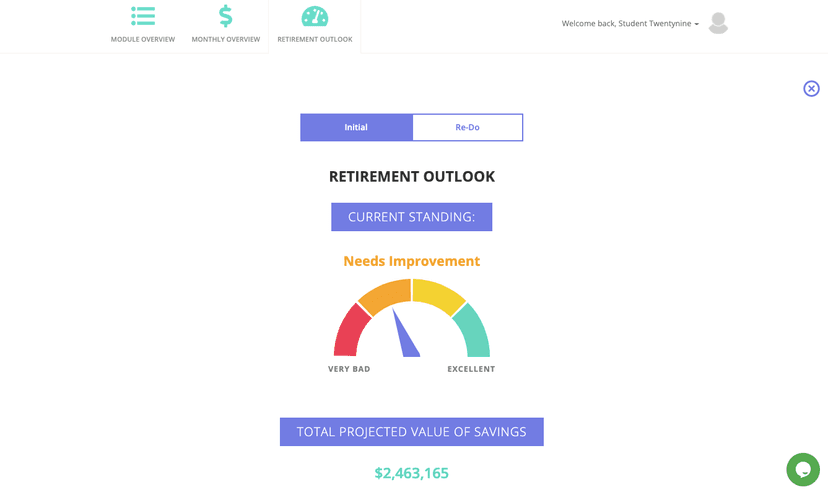
Financial Life Simulator uses game-based experiential learning to teach personal finance through an interactive life environment. Students log into the platform and are immediately tasked with making baseline life choices regarding college, career paths, and student loans. As the simulation progresses, the system presents scenarios requiring decisions on credit card usage, monthly budgeting, and investment allocations. The platform relies on intrinsic feedback, meaning students see the results of their choices through their virtual bank balance and credit score rather than receiving a traditional grade. This continuous loop of decision and consequence helps build mental models of financial wellness. Students must balance short-term desires with long-term goals, applying mathematical reasoning to their simulated income.
Strengths and tradeoffs of Financial Life Simulator
The biggest strength of Financial Life Simulator is its use of situated cognition, while its primary weakness is the absence of worked examples for complex financial calculations. Situated cognition is highly effective because it places learning in the exact context where it will ultimately be used. By forcing students to manage a virtual budget, they experience the friction of paying bills and managing debt, making abstract concepts concrete. Feedback loops are immediate; if a student overspends, their virtual financial health declines instantly. However, the application relies heavily on trial and error. Without worked examples showing the step-by-step mathematical impact of compound interest or loan amortization, novices may struggle to understand why their balance dropped so quickly. Furthermore, the platform does not feature spaced repetition or retrieval practice to ensure students memorize foundational financial terminology. This means students might miss out on building strong foundational knowledge if the simulation is used as a standalone tool rather than a supplementary practice environment.
Who Might Benefit From Financial Life Simulator?
Financial Life Simulator is best for middle school, high school, and early college students who already possess basic math skills but need context for personal finance. It works exceptionally well in blended learning environments where a teacher provides direct instruction on financial formulas, allowing students to apply those concepts within the game. The app is ideal for career and technical education classes or at-home learning when parents want to introduce their teenagers to the realities of adult financial responsibilities before they take on actual debt.
Sources and review method
TLS combines product information and editorial analysis to explain how Financial Life Simulator works, its tradeoffs, and the questions to ask before choosing it. Product features, an instructional rationale and evidence of learning outcomes are different kinds of information.
Formal Learning Standard assessment: not yet completed. Data Transparency findings are reported separately and do not establish learning effectiveness. Read our methodology.
Frequently Asked Questions About Financial Life Simulator
Is Financial Life Simulator free?
No, Financial Life Simulator is not free. It operates on a paid student license subscription model. This is typically purchased in bulk by schools or educational districts for integrated classroom use. Parents looking for a completely free alternative for at-home learning might need to explore other resources, as this platform relies on paid access to maintain its complex simulation engine and ongoing educational updates.
Is Financial Life Simulator good for high schoolers?
Yes, Financial Life Simulator is highly appropriate for high school students. The simulation covers highly relevant, impending life choices such as taking out student loans, selecting a career, and managing early credit card usage. These scenarios align perfectly with the developmental stage and upcoming adult responsibilities of teenagers, providing a safe environment to fail and learn before real money is on the line.
What does Financial Life Simulator teach?
Financial Life Simulator teaches applied personal finance and economic decision-making through experiential learning. Your child will learn about daily budgeting, the long-term mathematical impact of student loans, career earning potential versus cost of living, credit card mechanics, and the foundational basics of investing. By using a simulation rather than traditional textbook reading, students learn how these discrete financial concepts interact with each other.
How does Financial Life Simulator vs Dave Ramsey's Foundations compare?
Financial Life Simulator focuses heavily on digital, experiential learning through an interactive computer simulation, allowing students to learn by doing. In contrast, Dave Ramsey's Foundations in Personal Finance is a more traditional, video-led curriculum focused on direct instruction and rigid behavioral rules for money management. The simulator provides active decision-making practice, whereas Foundations provides passive consumption of specific financial philosophies.
Has The Learning Standard evaluated Financial Life Simulator?
TLS has not yet completed a Learning Standard evaluation of how well Financial Life Simulator teaches. TLS has not published a Data Transparency result for its privacy policy.
Follow TLS Research
Subscribe to future TLS research updates: app reviews, findings, and what the evidence shows.
Screenshots

Take Action
For Financial Life Simulator
If you represent Simulation Education Tools and have a correction or new evidence, send the relevant source so we can review and update this page.
Submit a correctionDetails
- Pricing
- Student license subscription
- Platforms
- Web Browser
- Grade Levels
- 7th Grade, 8th Grade, 9th Grade, 10th Grade, 11th Grade, 12th Grade, Associate's degree, Bachelor's degree
- Website
- Visit site