
Coding and Computational Thinking with Virtual SPIKE Prime
Product by Carnegie Mellon Robotics Academy
Facts checked: Not yet checked
Our take (not a Learning Standard rating). This label applies to learning-science judgments throughout this overview.
Our take (not a Learning Standard rating)
While The Learning Standard has not yet formally evaluated this program, its design strongly supports experiential learning. It uses virtual robotics to provide immediate visual feedback on code execution, effectively building mental models of algorithmic thinking. However, it lacks built-in spaced repetition and requires high self-regulation to push through complex problem-solving without direct human intervention.
Pros
- Provides immediate visual feedback on coding logic through a simulated robotics environment.
- Uses step-by-step worked examples to reduce cognitive load before introducing complex programming challenges.
- Embeds block-based coding practice directly within a structured curriculum rather than an open-ended sandbox.
Cons
- Lacks built-in spaced repetition to reinforce foundational syntax rules over time.
- Relies heavily on reading comprehension and lengthy videos, creating barriers for struggling readers.
- Does not provide individualized, adaptive learning pathways based on specific student error patterns.
What Do We Know About Coding and Computational Thinking with Virtual SPIKE Prime?
This curriculum provides an effective, highly structured introduction to coding logic for motivated students, though it has not yet been formally evaluated by The Learning Standard. Your child will use a virtual LEGO SPIKE Prime robot to solve programming challenges directly in their web browser. This eliminates the need for expensive physical hardware while still teaching core computational thinking skills like sequencing, loops, and conditional logic. The platform uses worked examples to show your child exactly how to solve a smaller problem before asking them to tackle a larger, novel one. This approach effectively manages cognitive load and prevents frustration. However, because the instruction relies heavily on direct video and text lessons, your child will need strong self-regulation and reading skills to succeed independently. The system does not adapt to your child's specific skill level in real-time, meaning an adult may need to intervene if they get stuck on a difficult logic puzzle. For parents looking for a rigorous, curriculum-aligned coding program rather than a game-based sandbox, this is a highly functional option that mirrors actual computer science education.
How Does Coding and Computational Thinking with Virtual SPIKE Prime Work?
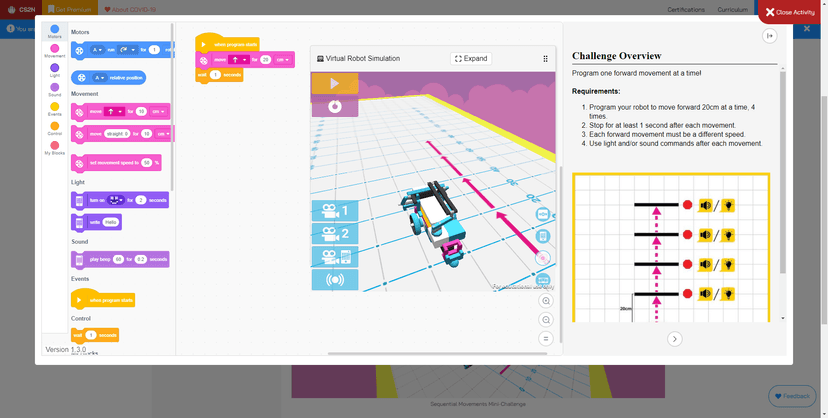
Coding and Computational Thinking with Virtual SPIKE Prime uses project-based learning combined with direct instruction to teach programming logic. Students watch instructional videos and read text animations explaining a specific coding concept, then immediately apply that concept to move a virtual robot on screen. The interface splits the screen between a block-based coding environment and a simulated 3D physical space. By executing code, students receive immediate visual feedback on whether their logical sequence succeeded or failed. This rapid trial-and-error loop is critical for building mental models of algorithmic thinking. The curriculum groups lessons into progressive units that introduce increasingly complex structures, such as moving from basic forward and backward sequences to sensor-based conditional statements. Each unit culminates in a capstone challenge that requires students to combine previously learned skills to solve a novel problem. This capstone design heavily utilizes retrieval practice, forcing students to recall and apply older concepts to succeed in the new environment.
Strengths and tradeoffs of Coding and Computational Thinking with Virtual SPIKE Prime
The biggest strength of this program is its use of immediate visual feedback to reinforce programming concepts, while its biggest weakness is the lack of adaptive scaffolding for struggling students. Immediate Feedback: Immediate visual feedback is a cornerstone of effective learning science. When students run their block code, they instantly see the virtual SPIKE Prime robot succeed or fail at its task, allowing them to rapidly debug their mental models. Furthermore, the curriculum heavily utilizes Worked Examples. It steps students through the exact logic needed before asking them to generalize that knowledge to new challenges, effectively minimizing cognitive overload during initial skill acquisition. Conversely, the platform is strictly linear and lacks Adaptive Sequencing. If a student fails to grasp the concept of a while loop, the software does not automatically generate prerequisite practice to bridge the gap. It relies entirely on the student to re-watch the direct instruction materials or seek a teacher's help. Additionally, there is no formalized Spaced Repetition system to ensure students retain early vocabulary and syntax rules later in the course, assuming permanent mastery once a module is simply completed.
Who Might Benefit From Coding and Computational Thinking with Virtual SPIKE Prime?
Best for upper elementary and middle school students who need a structured, curriculum-based approach to learning programming logic. Because it relies heavily on reading comprehension and sequential problem-solving, it is ideal for 3rd through 7th graders who can sustain focus on multi-step academic projects. It is an excellent fit for classrooms or homeschool environments wanting the rigor of robotics education without the high cost of physical LEGO kits. Students looking for a fast-paced gaming experience may find the academic pacing too slow, as it prioritizes methodical, step-by-step instruction over high-stimulation entertainment.
Data Transparency
Does Not Meet Data Transparency Standard
Coding and Computational Thinking with Virtual SPIKE Prime does not meet our data transparency standard. Its privacy policy does not document basic protections, including a commitment against targeted advertising, limits on sharing children's data and contractual limits on service providers.
9 of 35 checks passed
Evaluated September 2026
CS-STEM Network →Level 1 · Basic protections
Does not sell data or target ads at students, limits sharing, and lets parents see and delete their child's data.
Not documented: a commitment against targeted advertising, limits on sharing children's data, contractual limits on service providers, a COPPA or FERPA commitment, parents' right to see their child's data, parents' right to delete their child's data
Level 2 · Parent control (meets the standard)
Families can get their data out, know who processes it, and know how long it is kept.
Not documented: data export, a data retention timeline, self-service deletion
Level 3 · Direct data access
Families or schools can pull their own data through an API, in a stated format.
Not documented: an API for retrieving their own data, a named export format
View all 35 checks
Parent Access3/8
Does the policy mention parents specifically?
“Users under age 13 may only disclose personal information through CS2N with the consent or authorization required by applicable law, including consent obtained by a parent, guardian, school, district, or teacher when permitted by law.”
Can parents view their child's data?
The policy lets users ask what information is held about them, but it gives parents no specific right to view their child's data.
Can parents modify their child's data?
The policy lets users request corrections, but it gives parents no specific right to change their child's data.
Can parents delete their child's account?
The policy says CS2N will remove a child's information it learns was provided without consent, and that people with concerns can contact support, but it gives parents no right to request deletion.
Is there a dedicated Children's Privacy section?
“## **Children's Personal Information**”
Does it reference COPPA compliance?
The policy refers to applicable law but never mentions COPPA.
Does it reference FERPA compliance?
The policy does not mention FERPA.
Is parental consent required for child accounts?
“Users under age 13 may only disclose personal information through CS2N with the consent or authorization required by applicable law, including consent obtained by a parent, guardian, school, district, or teacher when permitted by law.”
Data Portability1/5
Can users access their personal data?
“You may [contact us](https://www.cs2n.org/support/contact) to ask what information we have about you, request corrections, request deletion where applicable, or express concerns about our use of your information.”
Can users download/export their data?
The policy does not offer a way to download or export data.
Is there a self-service data access tool?
The policy only offers data access by contacting CS2N, not through a self-service tool.
Is a specific data format mentioned for export?
The policy does not name any export format.
Is there an API for data access?
The policy describes no API that lets users get their own data.
Data Minimization1/6
Is data collection itemized?
“Depending on how you use CS2N, this may include your name, email address, username, account settings, course activity, group membership, and other information needed to provide CS2N features.”
Can the app be used without a real name?
The policy says CS2N collects users' names, including first and last names from Google or the user's organization.
Can the app be used without an email?
The policy says CS2N collects email addresses, including from Google or the user's organization.
Does it state collection is limited to what is necessary?
The policy describes what it collects but never says collection is limited to what is necessary.
Is IP address anonymized or truncated?
The policy does not address anonymizing IP addresses.
Is location tracking explicitly excluded?
The policy does not address location tracking.
Third-Party Protection3/7
Does it explicitly state no selling of data?
“We do not sell or rent your personal information.”
Are third-party providers named?
“With your permission, CS2N also uses Google Analytics through Google Tag Manager to understand how the site is used and to improve CS2N.”
Are providers contractually restricted?
The policy limits when data is shared but does not say providers are bound by contract.
No-targeted-advertising commitment?
The policy does not address targeted advertising.
Is AI/ML data sharing addressed?
The policy does not address AI or machine learning.
Child-specific sharing restriction?
The policy has no sharing restriction specific to children's data.
Cookies/tracking limited or opt-out?
“Analytics is not loaded until you choose to accept analytics. You may decline analytics and continue using CS2N.”
Deletion & Retention1/5
Can users delete their account?
“You may [contact us](https://www.cs2n.org/support/contact) to ask what information we have about you, request corrections, request deletion where applicable, or express concerns about our use of your information.”
Self-service deletion mechanism?
The policy only offers deletion by contacting CS2N, not through a self-service tool.
Specific data retention timeline?
The policy gives no data retention timeline.
Auto-deletion of inactive accounts?
The policy does not address deleting inactive accounts.
Post-deletion handling described?
The policy does not describe what happens to data after deletion.
Advertising0/4
Advertising model explicitly disclosed?
The policy does not address advertising.
Free from third-party advertisements?
The policy does not address third-party advertising.
Children excluded from ad targeting?
The policy does not address ad targeting of children.
Ad-free option available?
The policy does not address advertising or an ad-free option.
What This Means
The policy review did not meet our data transparency standard. The checks above show the documented findings and unknowns. A missing statement does not establish how the app handles data in practice.
About this evaluation: Based on automated analysis of CS-STEM Network against 35 policy-disclosure questions, including questions adapted from the Common Sense Privacy Program's published evaluation questions. TLS is not affiliated with Common Sense Media, and this is not a Common Sense rating. Quoted text is copied from the policy; unquoted notes are our summary. Results describe what the policy documents, not the company's actual practices. Privacy policies can change: this review reflects the version we analyzed and does not determine legal compliance.
Sources and review method
TLS combines product information and editorial analysis to explain how Coding and Computational Thinking with Virtual SPIKE Prime works, its tradeoffs, and the questions to ask before choosing it. Product features, an instructional rationale and evidence of learning outcomes are different kinds of information.
Formal Learning Standard assessment: not yet completed. Data Transparency findings are reported separately and do not establish learning effectiveness. Read our methodology.
Frequently Asked Questions About Coding and Computational Thinking with Virtual SPIKE Prime
Is Coding and Computational Thinking with Virtual SPIKE Prime free?
No, the curriculum is not free; it costs $9 per student. This subscription grants full access to the comprehensive instructional materials, the embedded block-based coding interface, and the virtual robotics simulator for a defined licensing period. While there is no free tier available for casual home users, this pricing model eliminates disruptive advertisements and in-app purchases. Bulk purchasing options and site licenses may be available for schools and larger educational organizations looking to implement the curriculum across multiple classrooms.
Is Coding and Computational Thinking with Virtual SPIKE Prime good for 3rd graders?
Yes, but it requires strong reading comprehension and academic self-regulation. While 3rd graders fall well within the target age range for the core computational concepts, the heavy reliance on text-based instruction and lengthy video lectures can be overwhelming. Younger students or struggling readers will likely require active adult guidance to successfully progress through the modular lessons. Parents should be prepared to sit alongside their 3rd grader to help decode complex instructions and manage the cognitive load of multi-step problem solving.
What does Coding and Computational Thinking with Virtual SPIKE Prime teach?
It teaches fundamental computational thinking, algorithmic design, and programming logic. Your child will learn how to build precise algorithms, sequence commands correctly, utilize repetitive loops, and apply conditional logic using a block-based coding interface. Beyond just writing code, the curriculum also teaches critical problem-solving skills, spatial reasoning, and basic physics concepts through the virtual movement of the SPIKE Prime robot. Students must continuously calculate distances, angles, and timing to ensure their virtual hardware successfully navigates the onscreen challenges.
How does Coding and Computational Thinking with Virtual SPIKE Prime compare to Code.org?
Code.org offers a free, highly gamified approach to early computer science, relying on familiar pop culture characters and short, high-stimulation puzzle levels. In stark contrast, Coding and Computational Thinking with Virtual SPIKE Prime is a paid, rigorous academic curriculum that uses a realistic, physics-based robotics simulator. It feels much more like a traditional classroom science lab than a consumer video game. Students who want entertainment might prefer Code.org, while those needing deep, methodical engineering instruction will benefit more from Virtual SPIKE Prime.
Has The Learning Standard evaluated Coding and Computational Thinking with Virtual SPIKE Prime?
TLS has not yet completed a Learning Standard evaluation of how well Coding and Computational Thinking with Virtual SPIKE Prime teaches. Its privacy policy has been reviewed for Data Transparency and does not yet document the basic protections (Level 1).
Is Coding and Computational Thinking with Virtual SPIKE Prime COPPA compliant?
A COPPA reference was not found in the reviewed privacy policy. This does not determine whether the app complies with COPPA. Policy review note: The policy refers to applicable law but never mentions COPPA.
Is Coding and Computational Thinking with Virtual SPIKE Prime FERPA compliant?
A FERPA reference was not found in the reviewed privacy policy. This does not determine whether the app complies with FERPA. Policy review note: The policy does not mention FERPA.
Does Coding and Computational Thinking with Virtual SPIKE Prime have a children's privacy policy?
The reviewed policy includes a dedicated children's privacy section. Policy review note: The policy has a section headed for children's personal information.
Does Coding and Computational Thinking with Virtual SPIKE Prime sell student data?
The reviewed policy states that the app does not sell data. This is a policy statement; actual data practices were not verified. Policy review note: The policy says CS2N does not sell personal information.
Can you delete your data from Coding and Computational Thinking with Virtual SPIKE Prime?
The reviewed privacy policy describes account deletion. We have not tested the deletion process. Policy review note: Users can ask CS2N to delete their information.
Follow TLS Research
Subscribe to future TLS research updates: app reviews, findings, and what the evidence shows.
Screenshots
Take Action
For Coding and Computational Thinking with Virtual SPIKE Prime
If you represent Carnegie Mellon Robotics Academy and have a correction or new evidence, send the relevant source so we can review and update this page.
Submit a correctionDetails
- Pricing
- $9 per student
- Platforms
- Web Browser, Windows (Microsoft), macOS (Apple), Chrome OS (Google)
- Grade Levels
- 3rd Grade, 4th Grade, 5th Grade, 6th Grade, 7th Grade
- Website
- Visit site