AI Educators
Product by AI Educators
Facts checked: Not yet checked
Our take (not a Learning Standard rating). This label applies to learning-science judgments throughout this overview.
Our take (not a Learning Standard rating)
Because The Learning Standard has not yet evaluated AI Educators, we cannot definitively confirm its instructional efficacy. However, its reliance on scenario-based learning and worked examples aligns with evidence-based practices for professional development. It effectively targets AI literacy through direct instruction but lacks independent data on long-term retention.
Pros
- Utilizes scenario-based learning to provide concrete context for abstract artificial intelligence concepts.
- Incorporates worked examples to model appropriate AI implementation in classroom settings, reducing cognitive load.
- Features administrative tracking tools that allow districts to monitor completion and compliance metrics.
- Offers tiered cohort models that can facilitate collaborative problem-solving and social learning among peer educators.
Cons
- Relies heavily on direct instruction, which may limit opportunities for generative retrieval practice.
- Does not explicitly mandate spaced repetition protocols to ensure long-term retention of policy frameworks.
- Lacks independent empirical evaluation to verify its claims of increased teacher confidence and effective implementation.
- Pricing complexity may create a barrier to entry for independent educators seeking standalone professional development.
What Do We Know About AI Educators?
AI Educators appears effective for establishing foundational AI literacy among teaching staff, though it remains pending evaluation by The Learning Standard. This platform delivers professional development focused on the safe, legal, and practical implementation of artificial intelligence in educational environments. Rather than passive lectures, the courses utilize scenario-based design. This means your teachers interact with realistic classroom challenges and policy dilemmas, bridging the gap between theoretical knowledge and practical application.\n\nThe curriculum leans heavily on direct instruction paired with real-world case studies. This approach provides strong worked examples, a proven cognitive science strategy that reduces cognitive load when adults are learning complex new frameworks. Administrators gain access to backend tracking to monitor which staff members have completed certification modules.\n\nWhile the structured framework protects district compliance, the platform does not currently publicize the use of spaced retrieval practice. Educators complete the modules, but without interleaved follow-up assessments, long-term retention of nuanced legal guidelines may degrade over time. If your school implements this tool, consider pairing it with ongoing professional learning communities to actively recall and practice the material throughout the school year.
How Does AI Educators Work?
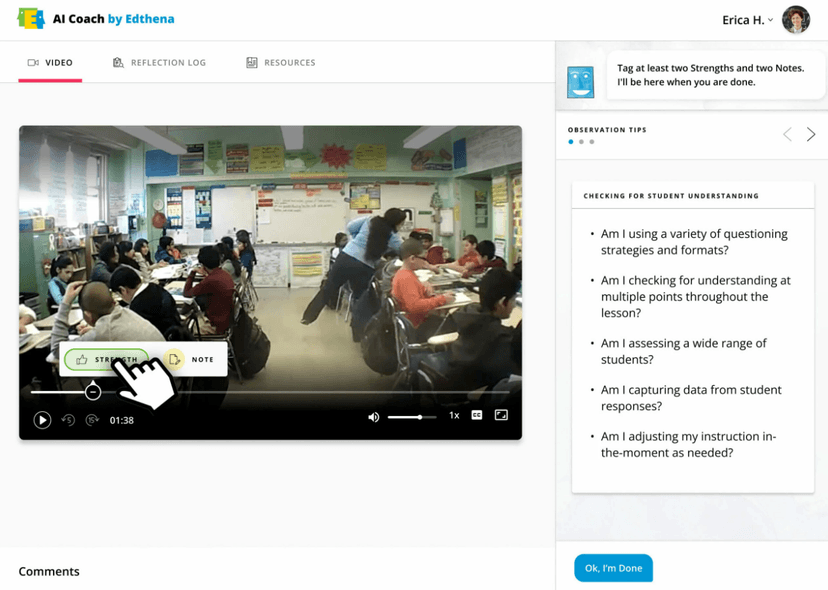
AI Educators uses scenario-based direct instruction combined with practical case studies to train adult learners. The platform guides educators through a structured progression of digital modules covering artificial intelligence basics, legal considerations, and pedagogical applications.\n\nUsers navigate through specific situational prompts that mimic real classroom environments. For example, a module presents a scenario involving academic dishonesty or data privacy, requiring the educator to apply the platform's proprietary frameworks to solve the problem. This reliance on situated learning helps adults transfer skills directly to their daily workflow. The courses provide explicit guidelines and worked examples, demonstrating exactly how a teacher should construct a prompt or evaluate an AI-generated student essay.\n\nFor institutional users, the experience includes an administrative dashboard. District leaders track module completion rates and certification status to ensure compliance with local AI mandates. Optional live coaching supplements the asynchronous modules, allowing cohorts to engage in synchronous discussion and collaborative troubleshooting.
Strengths and tradeoffs of AI Educators
The biggest strength of AI Educators is its use of realistic worked examples, while its biggest weakness is the apparent lack of spaced retrieval practice to ensure long-term retention.\n\nAdults learn complex procedures best when abstract concepts are anchored in concrete realities. AI Educators leverages situated learning by presenting teachers with authentic classroom scenarios and legal dilemmas. Providing detailed case studies effectively reduces cognitive load, allowing educators to absorb new policy frameworks without becoming overwhelmed by the technical mechanics of artificial intelligence. The platform's direct instruction approach ensures that foundational definitions and district compliance rules are delivered uniformly.\n\nHowever, the current course structure mimics traditional professional development, which frequently suffers from the forgetting curve. Because the program does not mandate spaced repetition, requiring users to recall information days or weeks after initial exposure, retention of specific privacy laws or prompt engineering techniques may fade quickly. Furthermore, while the platform includes admin tracking for completion, mere completion does not guarantee mastery. Without built-in interleaved practice, educators may struggle to flexibly apply the frameworks when faced with novel AI challenges outside the specific scenarios modeled in the course.
Who Might Benefit From AI Educators?
AI Educators is best for school districts and higher education institutions that need to quickly establish baseline AI literacy and legal compliance across their teaching staff. The platform is specifically designed for adult learners, including K-12 teachers, college professors, and professional trainers. It is an ideal solution for administrators seeking a centralized, trackable professional development system that moves beyond theoretical tech jargon and provides immediate, practical classroom strategies. Because of the tiered pricing and cohort options, it works well for large-scale institutional rollouts.
Data Transparency
Does Not Meet Data Transparency Standard
AI Educators does not meet our data transparency standard. Its privacy policy does not document basic protections, including a commitment against targeted advertising, limits on sharing children's data and a COPPA or FERPA commitment.
8 of 35 checks passed
Evaluated September 2026
Privacy →Level 1 · Basic protections
Does not sell data or target ads at students, limits sharing, and lets parents see and delete their child's data.
Not documented: a commitment against targeted advertising, limits on sharing children's data, a COPPA or FERPA commitment, parents' right to see their child's data, parents' right to delete their child's data, account deletion
Level 2 · Parent control (meets the standard)
Families can get their data out, know who processes it, and know how long it is kept.
Not documented: a data retention timeline, named service providers, self-service deletion
Level 3 · Direct data access
Families or schools can pull their own data through an API, in a stated format.
Not documented: an API for retrieving their own data, a named export format
View all 35 checks
Parent Access0/8
Does the policy mention parents specifically?
The policy does not mention parents.
Can parents view their child's data?
The policy does not give parents any right to view their child's data.
Can parents modify their child's data?
The policy does not give parents any right to modify their child's data.
Can parents delete their child's account?
The policy does not give parents any right to delete their child's data or account.
Is there a dedicated Children's Privacy section?
The policy has no section on children's privacy.
Does it reference COPPA compliance?
The policy does not mention COPPA.
Does it reference FERPA compliance?
The policy does not mention FERPA.
Is parental consent required for child accounts?
The policy does not address parental consent.
Data Portability3/5
Can users access their personal data?
“You may access your Account at any time to view or amend the Data.”
Can users download/export their data?
“You have the right to ask for a copy of your personal Data on payment of a small fee.”
Is there a self-service data access tool?
“You may access your Account at any time to view or amend the Data. You may need to modify or update your Data if your circumstances change.”
Is a specific data format mentioned for export?
The policy does not name a file format for data copies.
Is there an API for data access?
The policy does not mention an API for getting data.
Data Minimization1/6
Is data collection itemized?
“Without limitation, any of the following Data may be collected:”
Can the app be used without a real name?
The policy says it collects users' names.
Can the app be used without an email?
The policy says it collects contact information such as email addresses.
Does it state collection is limited to what is necessary?
The policy says data is collected "without limitation" and does not limit collection to what is necessary.
Is IP address anonymized or truncated?
The policy says IP addresses are collected automatically and does not mention anonymizing them.
Is location tracking explicitly excluded?
The policy does not rule out location tracking and collects post codes.
Third-Party Protection3/7
Does it explicitly state no selling of data?
“We respect your privacy. We do not sell your data or use your data in any way without your permission.”
Are third-party providers named?
The policy lists types of third-party services but does not name any provider.
Are providers contractually restricted?
“Any Data used by such parties is used only to the extent required by them to perform the services that **AI Educators** requests. Any use for other purposes is strictly prohibited.”
No-targeted-advertising commitment?
The policy describes marketing cookies that deliver targeted advertising and makes no commitment against targeted ads.
Is AI/ML data sharing addressed?
The policy does not address sharing data with AI or machine learning systems.
Child-specific sharing restriction?
The policy has no sharing restrictions specific to children.
Cookies/tracking limited or opt-out?
“You may restrict your internet browser’s use of Cookies.”
Deletion & Retention0/5
Can users delete their account?
The policy offers data deletion only when a business division is transferred and gives no general right to delete an account.
Self-service deletion mechanism?
The policy does not describe any self-service deletion tool.
Specific data retention timeline?
The policy says data is kept for as long as the user uses the services, with no specific timeline.
Auto-deletion of inactive accounts?
The policy does not address automatic deletion of inactive accounts.
Post-deletion handling described?
The policy does not describe what happens to data after deletion.
Advertising1/4
Advertising model explicitly disclosed?
“Marketing cookies are used to deliver advertising material relevant to you and your interests. They are also used to limit the number of times you see an advertisement, resulting to more targeted advertising, as well as help us measure the effectiveness of our campaigns.”
Free from third-party advertisements?
The policy says advertising networks place marketing cookies and does not say the product is free of third-party ads.
Children excluded from ad targeting?
The policy does not exclude children from ad targeting.
Ad-free option available?
The policy does not offer an ad-free option or say the product has no ads.
What This Means
The policy review did not meet our data transparency standard. The checks above show the documented findings and unknowns. A missing statement does not establish how the app handles data in practice.
About this evaluation: Based on automated analysis of Privacy against 35 policy-disclosure questions, including questions adapted from the Common Sense Privacy Program's published evaluation questions. TLS is not affiliated with Common Sense Media, and this is not a Common Sense rating. Quoted text is copied from the policy; unquoted notes are our summary. Results describe what the policy documents, not the company's actual practices. Privacy policies can change: this review reflects the version we analyzed and does not determine legal compliance.
Sources and review method
TLS combines product information and editorial analysis to explain how AI Educators works, its tradeoffs, and the questions to ask before choosing it. Product features, an instructional rationale and evidence of learning outcomes are different kinds of information.
Formal Learning Standard assessment: not yet completed. Data Transparency findings are reported separately and do not establish learning effectiveness. Read our methodology.
Frequently Asked Questions About AI Educators
Is AI Educators free?
No, AI Educators is not free. The platform operates on a tiered pricing model that charges a flat fee for individual lifetime access, with scaled volume discounts and custom pricing available for schools, districts, and enterprise implementations.
Is AI Educators good for K-12 students?
No, this platform is not designed for students. AI Educators is specifically built for adult learners, higher education faculty, and K-12 teaching staff. It provides professional development and certification to help educators understand and implement artificial intelligence safely.
What does AI Educators teach?
AI Educators teaches artificial intelligence literacy, policy compliance, and practical classroom integration. The curriculum focuses on legal frameworks, real-world case studies, data privacy, and strategies for using AI tools effectively in humanities, sciences, and career education courses.
Does AI Educators actually improve teacher performance?
The Learning Standard has not yet evaluated AI Educators to confirm its long-term impact on teacher performance. While its scenario-based design aligns with adult learning principles, independent efficacy data is currently pending. Please refer to our methodology for details on how we rate educational tools.
How does AI Educators compare to generic AI training?
AI Educators provides education-specific context rather than general technology overviews. By utilizing worked examples tailored to classroom scenarios, it reduces the cognitive load required to translate broad artificial intelligence capabilities into daily teaching practices and administrative policies.
Has The Learning Standard evaluated AI Educators?
TLS has not yet completed a Learning Standard evaluation of how well AI Educators teaches. Its privacy policy has been reviewed for Data Transparency and does not yet document the basic protections (Level 1).
Is AI Educators COPPA compliant?
A COPPA reference was not found in the reviewed privacy policy. This does not determine whether the app complies with COPPA. Policy review note: The policy does not mention COPPA.
Is AI Educators FERPA compliant?
A FERPA reference was not found in the reviewed privacy policy. This does not determine whether the app complies with FERPA. Policy review note: The policy does not mention FERPA.
Does AI Educators have a children's privacy policy?
No dedicated children's privacy section was found in the reviewed policy. Policy review note: The policy has no section on children's privacy.
Does AI Educators sell student data?
The reviewed policy states that the app does not sell data. This is a policy statement; actual data practices were not verified. Policy review note: The policy states that the company does not sell user data.
Can you delete your data from AI Educators?
Account deletion was not documented in the reviewed privacy policy. This does not establish whether deletion is available. Policy review note: The policy offers data deletion only when a business division is transferred and gives no general right to delete an account.
Follow TLS Research
Subscribe to future TLS research updates: app reviews, findings, and what the evidence shows.
Screenshots
Take Action
For AI Educators
If you represent AI Educators and have a correction or new evidence, send the relevant source so we can review and update this page.
Submit a correctionDetails
- Pricing
- Our courses follow a tiered pricing model to accommodate various learning environments, institutional needs, and scalability considerations. Pricing is structured to be flexible, ensuring accessibility for individual educators, schools, and districts. 1. Pricing Tiers Individual Enrollment (Self-Paced Access) Flat fee per course, providing lifetime access to course materials. School or District Licenses (Cohort-Based Implementation) Bulk Pricing Discounts: Schools purchasing multiple licenses receive volume-based discounts. Customized Implementation Support: Includes professional development facilitation, coaching sessions, or train-the-trainer models. Enterprise & Custom Packages (Higher Ed, EdTech, Large-Scale PD Programs) Tailored pricing for organizations seeking co-branded, customized versions of the courses. May include integration into existing LMS, data tracking, and specialized AI tool evaluations. Additionally, we offer live coaching and cohort support on a subscription basis.
- Platforms
- Web Browser, iOS (Apple mobile), iPadOS (Apple tablet), Android (Google mobile), Tizen (Samsung mobile), Windows (Microsoft), macOS (Apple), Chrome OS (Google)
- Grade Levels
- Associate's degree, Bachelor's degree, Post-baccalaureate certificate, Master's Degree, Post-master's certificate, Doctoral Degree, Post-doctoral certificate, Adult Education, Professional or Technical Credential
- Website
- Visit site