
Zearn Math
Product by Zearn
Facts checked: Not yet checked
Our take (not a Learning Standard rating). This label applies to learning-science judgments throughout this overview.
Our take (not a Learning Standard rating)
Zearn Math effectively builds foundational math skills through a Concrete-Pictorial-Abstract progression. The platform grounds instruction in cognitive science by requiring mastery-based progression and providing real-time scaffolding. While The Learning Standard has not yet formally evaluated its long-term efficacy, its design firmly aligns with evidence-based learning principles.
Keep the Zearn Math decision brief
Keep the Boost-versus-alert explanation, exact questions and a teacher message ready to share when another caregiver is helping with the same difficult lesson. Subscribe to future TLS research updates and download the one-page PDF here immediately.
Pros
- Utilizes a Concrete-Pictorial-Abstract progression to build deep conceptual understanding before introducing standard algorithms.
- Enforces mastery-based learning by requiring a perfect score on lesson quizzes before allowing progression.
- Employs immediate, targeted scaffolding during guided practice to address misconceptions in real-time.
- Provides interleaved practice to build procedural fluency alongside new concept acquisition.
Cons
- The strict 100% mastery requirement can cause frustration for students who make minor calculation errors.
- Heavy reliance on video-based instruction may reduce active engagement for students with attention difficulties.
- Independent pacing without direct teacher oversight can lead to isolated struggle on difficult concepts.
What Do We Know About Zearn Math?
Zearn Math is a highly effective tool for teaching K-8 math because it forces students to master concepts before moving forward. Your child cannot simply guess their way through lessons. The program requires active participation through interactive video instruction and practice sets. If your child struggles with a concept, the app pauses and provides personalized scaffolding to correct the misunderstanding immediately. This prevents the cementing of incorrect mathematical procedures. Cognitive Science Application: The platform relies heavily on the Concrete-Pictorial-Abstract method. Your child will first manipulate digital blocks, then move to drawings, and finally solve standard equations. This builds deep mathematical schemas rather than rote memorization. Potential Pitfalls: However, you should monitor your child's frustration levels. Because the app requires a perfect score to advance, minor typing or calculation errors can trigger repeated lessons. While The Learning Standard has not formally evaluated Zearn Math yet, its architecture aligns closely with proven cognitive science principles like spaced retrieval practice and mastery progression. It works best when you or a teacher contextualize the digital lessons with offline discussions.
How Does Zearn Math Work?
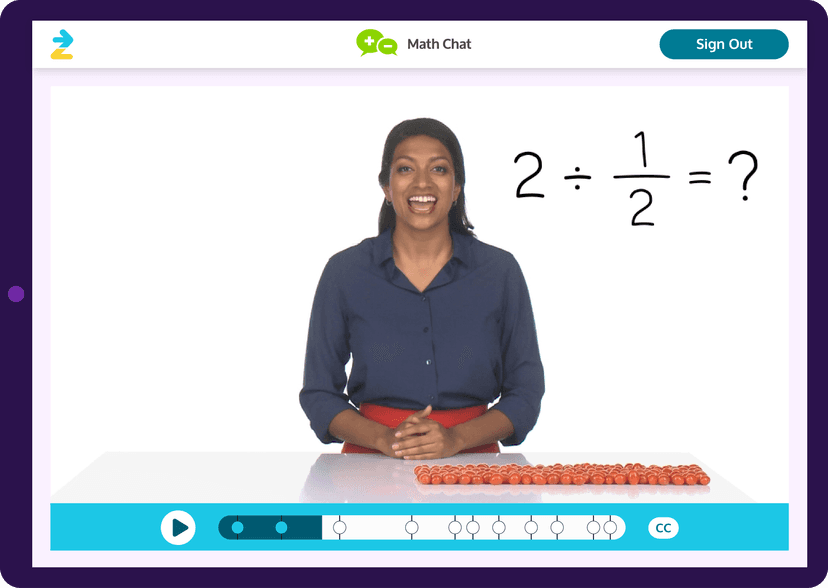
Zearn Math uses a mastery-based progression model with guided video instruction followed by structured practice sets. Your child begins each session with a fluency warmup designed to activate prior knowledge through retrieval practice. Next, they enter a guided lesson where a teacher explains a new concept via video. The video pauses frequently, requiring your child to solve interactive problems before the instruction continues. This forces active processing and prevents passive watching. Instructional Sequence: The platform utilizes a Concrete-Pictorial-Abstract sequence. Students manipulate digital objects to represent math physically, transition to visual models like number bonds, and finally use abstract numbers and symbols. When your child makes an error, the system provides immediate, corrective feedback and adjusts the difficulty of the next question. To finish a lesson, your child takes an independent quiz. They must score 100% to unlock the next topic. If they fail, they receive additional scaffolding and must try again.
Strengths and tradeoffs of Zearn Math
Zearn Math's biggest strength is its rigorous adherence to mastery learning, while its biggest weakness is the potential for student frustration due to its strict advancement requirements. Mastery-Based Progression: The platform excels at ensuring foundational understanding. By requiring perfect scores on exit tickets, it prevents students from advancing with dangerous knowledge gaps. Concrete-Pictorial-Abstract Instruction: The use of visual and digital manipulatives deeply aligns with cognitive load theory. By moving from physical representation to abstract symbols, the app helps build robust mental models of complex math concepts. Immediate Feedback: Real-time scaffolding during practice sets acts as a digital tutor. It interrupts incorrect procedures immediately, which learning science shows is critical for preventing the automation of errors. Lack of Flexibility: The strict advancement gates can be overly rigid. A student who understands a concept but makes a minor arithmetic or data-entry error must repeat the evaluation. Video Reliance: While interactive, the heavy use of video instruction demands sustained attention that may challenge younger learners or those with specific cognitive needs.
Who Might Benefit From Zearn Math?
Zearn Math is best for K-8 students who need highly structured, step-by-step instruction to build conceptual math understanding alongside standard classroom teaching. The platform serves as an excellent intervention tool for children who have developed gaps in their mathematical knowledge. Because of its mastery requirements, it forces students to slow down and prove their competence. It is highly effective for classrooms utilizing a blended learning model, allowing teachers to work with small groups while others progress independently. However, students who suffer from high math anxiety may need additional adult support to navigate the strict advancement gates.
Data Transparency
Meets Data Transparency Standard
Zearn Math meets our data transparency standard at Level 2 of 3 (Parent control). Level 3 needs the policy to document an API for retrieving their own data and a named export format.
26 of 35 checks passed
Evaluated September 2026
Privacy →Level 1 · Basic protections
Does not sell data or target ads at students, limits sharing, and lets parents see and delete their child's data.
Level 2 · Parent control (meets the standard)
Families can get their data out, know who processes it, and know how long it is kept.
Level 3 · Direct data access
Families or schools can pull their own data through an API, in a stated format.
Not documented: an API for retrieving their own data, a named export format
View all 35 checks
Parent Access7/8
Does the policy mention parents specifically?
“If you are a parent or legal guardian of a child under 13, you have the right to (1) review the personal information we have collected from your child, (2) request deletion of that information, and (3) refuse further collection or use of your child’s information.”
Can parents view their child's data?
“If you are a parent or legal guardian of a child under 13, you have the right to (1) review the personal information we have collected from your child, (2) request deletion of that information, and (3) refuse further collection or use of your child’s information.”
Can parents modify their child's data?
“You remain in control of the personal information you provide to us about yourself and your students. This means that you can review, revise, or delete your personal information or that of your students as described below.”
Can parents delete their child's account?
“Accounts are created and managed by adults: authorized educators or parents and guardians, who can also deactivate accounts and request deletion of student account data.”
Is there a dedicated Children's Privacy section?
“Zearn is designed to be used by students in grades K-8, and we take the privacy of children seriously. This section describes how we collect, use, and protect information from students, including children under 13.”
Does it reference COPPA compliance?
“As a nonprofit organization, Zearn does not sell student information and complies with all applicable federal and state student privacy laws, including FERPA and COPPA.”
Does it reference FERPA compliance?
“As a nonprofit organization, Zearn does not sell student information and complies with all applicable federal and state student privacy laws, including FERPA and COPPA.”
Is parental consent required for child accounts?
The policy says children under 13 cannot register themselves and that accounts are created by parents or educators, but it does not state that parental consent is required for child accounts.
Data Portability2/5
Can users access their personal data?
“You may review or change the information you have provided about yourself within your account settings.”
Can users download/export their data?
The policy does not address downloading or exporting data.
Is there a self-service data access tool?
“If you are an educator who has provided us with personal information about your students, you may review or revise that information at any time by logging into your account and accessing your classroom portal.”
Is a specific data format mentioned for export?
The policy does not mention any export format.
Is there an API for data access?
The policy does not mention an API for data access.
Data Minimization1/6
Is data collection itemized?
“When a student is registered for Zearn, we may collect the following information: first and last name, a unique student identifier, log-in information including username and password, and non-personal information such as current grade level.”
Can the app be used without a real name?
The policy says it collects students' first and last names.
Can the app be used without an email?
The policy allows students to be registered with school-authorized Google email accounts, so student emails may be collected.
Does it state collection is limited to what is necessary?
The policy limits how student data is used but does not state that collection is limited to what is necessary.
Is IP address anonymized or truncated?
The policy says it collects IP addresses and does not mention anonymizing or truncating them.
Is location tracking explicitly excluded?
The policy does not explicitly exclude location tracking.
Third-Party Protection7/7
Does it explicitly state no selling of data?
“We do not ever sell or rent your information.”
Are third-party providers named?
“Zearn.org rests on a cloud-based web server hosted by our third-party service provider, Heroku Enterprise (Heroku), a subsidiary of Salesforce.”
Are providers contractually restricted?
“Our third parties are legally obligated to keep your personal information confidential and use it only for our specific purpose. Our third-party providers are required to maintain reasonable security practices, to use the information only for the purpose of helping us deliver the Services to you, and to prevent disclosure of the information to unauthorized parties.”
No-targeted-advertising commitment?
“We do not display third-party advertising, contextual advertising, behavioral advertising, or targeted advertising to students. We also do not use student information for advertising or marketing purposes.”
Is AI/ML data sharing addressed?
“Some of our third parties utilize Artificial Intelligence (“AI”) features to assist with these functions. We will not share student personally identifiable information with these AI features.”
Child-specific sharing restriction?
“We do not sell or rent student information. We may share student information with third-party service providers that perform functions on our behalf, such as hosting services and maintaining databases.”
Cookies/tracking limited or opt-out?
“Zearn does not track its users across third-party websites and does not respond to Do Not Track (DNT) signals. Zearn also does not permit third-party websites to collect personally identifiable information about your activity on Zearn.org for advertising, marketing, independent profiling, or independent commercial purposes.”
Deletion & Retention5/5
Can users delete their account?
“You may request deletion of your account data earlier by contacting us at privacy@zearn.org.”
Self-service deletion mechanism?
“You may deactivate your account at any time through the product account dashboard. Following deactivation, we will retain deactivated account data for a period of 180 days so that you may easily reactivate your account within that limited period.”
Specific data retention timeline?
“If you do not reactivate your account during that 180-day period, we will delete or anonymize your information.”
Auto-deletion of inactive accounts?
“On January 15 of each year, we will anonymize student accounts with no log-in activity over the prior 18 months.”
Post-deletion handling described?
“If you do not reactivate the account during that 180-day period, we will anonymize the student’s information by removing all personal identifiers, including first and last name, student ID number, and date of birth. We do not re-identify data once it is anonymized.”
Advertising4/4
Advertising model explicitly disclosed?
“Student information is not used for advertising or marketing. Zearn Math does not display third-party advertising.”
Free from third-party advertisements?
“Student information is not used for advertising or marketing. Zearn Math does not display third-party advertising.”
Children excluded from ad targeting?
“We do not email students directly at any time. We do not use student information to engage in targeted advertising.”
Ad-free option available?
“Student information is not used for advertising or marketing. Zearn Math does not display third-party advertising.”
Meets Data Transparency Standard
The reviewed policy met our data transparency standard. This result describes the policy disclosures we assessed. Actual practices and legal compliance were not verified.
About this evaluation: Based on automated analysis of Privacy against 35 policy-disclosure questions, including questions adapted from the Common Sense Privacy Program's published evaluation questions. TLS is not affiliated with Common Sense Media, and this is not a Common Sense rating. Quoted text is copied from the policy; unquoted notes are our summary. Results describe what the policy documents, not the company's actual practices. Privacy policies can change: this review reflects the version we analyzed and does not determine legal compliance.
Sources and review method
TLS combines product information and editorial analysis to explain how Zearn Math works, its tradeoffs, and the questions to ask before choosing it. Product features, an instructional rationale and evidence of learning outcomes are different kinds of information.
Formal Learning Standard assessment: not yet completed. Data Transparency findings are reported separately and do not establish learning effectiveness. Read our methodology.
Frequently Asked Questions About Zearn Math
Is Zearn Math free?
Yes, Zearn Math is completely free for individual teachers, parents, and students. The nonprofit organization provides full access to its K-8 digital curriculum without a paywall. Schools and districts can purchase paid accounts that provide advanced administrative reporting, rostering features, and implementation support, but the core learning experience remains free.
Is Zearn Math good for elementary and middle school students?
Yes, the platform is specifically designed for K-8 students. The interface and instruction style adapt appropriately as students age. Kindergarten through 5th-grade lessons rely heavily on colorful digital manipulatives and foundational number sense, while 6th through 8th-grade content transitions to complex algebra, geometry, and proportional reasoning with age-appropriate visual models.
What does Zearn Math teach?
Zearn Math teaches comprehensive K-8 mathematics. It covers everything from basic counting and cardinality in early elementary school to linear equations and functions in middle school. The curriculum is closely aligned with standard educational frameworks, focusing on building procedural fluency, conceptual understanding, and the ability to apply math to real-world problems.
How does Zearn Math vs Khan Academy compare?
Both platforms offer free math instruction, but they utilize different approaches. Zearn Math uses a strict mastery sequence with integrated, interactive video lessons that pause to check understanding. Khan Academy offers more flexibility, allowing students to jump between topics and watch complete videos before doing separate practice sets. Zearn requires strict sequential mastery, while Khan Academy allows more self-directed exploration.
Has The Learning Standard evaluated Zearn Math?
TLS has not yet completed a Learning Standard evaluation of how well Zearn Math teaches. Its privacy policy has been reviewed for Data Transparency and reaches Level 2, Parent control.
Is Zearn Math COPPA compliant?
The reviewed privacy policy references COPPA. A policy reference alone does not establish COPPA compliance. Policy review note: The policy states compliance with COPPA.
Is Zearn Math FERPA compliant?
The reviewed privacy policy references FERPA. A policy reference alone does not establish FERPA compliance. Policy review note: The policy states compliance with FERPA.
Does Zearn Math have a children's privacy policy?
The reviewed policy includes a dedicated children's privacy section. Policy review note: The policy has a dedicated Children’s Privacy section.
Does Zearn Math sell student data?
The reviewed policy states that the app does not sell data. This is a policy statement; actual data practices were not verified. Policy review note: The policy explicitly says Zearn does not sell data.
Can you delete your data from Zearn Math?
The reviewed privacy policy describes account deletion. We have not tested the deletion process. Policy review note: Users can request deletion of their account data.
Keep the Zearn Math decision brief
Keep the Boost-versus-alert explanation, exact questions and a teacher message ready to share when another caregiver is helping with the same difficult lesson. Subscribe to future TLS research updates and download the one-page PDF here immediately.
Screenshots
Latest News
All Zearn Math NewsIs Your School's EdTech Actually Proven? What the Science Reveals
Learn which K-12 math apps actually improve learning. Explore new research on edtech effect sizes and how they compare to tutoring and smaller class sizes.
Why Middle Schoolers Abandon AI Math Tutors When Asked to Think
Learn why a new study shows middle schoolers abandon Socratic AI tutors like Khanmigo when forced to think, and how parents can make AI math tools work.
Khan Academy Launches Free Texas-Aligned Courses to Support Students
Learn how Khan Academy’s new free, TEKS-aligned courses and study plans help Texas students master math and science without added academic pressure.
Take Action
For Zearn Math
If you represent Zearn and have a correction or new evidence, send the relevant source so we can review and update this page.
Submit a correctionDetails
- Pricing
- Free for individual teachers and classrooms. Paid accounts are also available with additional features and flexibility to support school- and district-wide implementation.
- Platforms
- iOS (Apple mobile), iPadOS (Apple tablet), Android (Google mobile), Windows (Microsoft), macOS (Apple), Chrome OS (Google)
- Grade Levels
- Kindergarten, 1st Grade, 2nd Grade, 3rd Grade, 4th Grade, 5th Grade, 6th Grade, 7th Grade, 8th Grade
- Website
- Visit site