World Stories Bank
Product by Stories to Grow By
Facts checked: Not yet checked
Our take (not a Learning Standard rating). This label applies to learning-science judgments throughout this overview.
Our take (not a Learning Standard rating)
World Stories Bank provides a solid foundation for reading comprehension and social-emotional learning through multicultural folktales. However, because it lacks active retrieval practice or built-in comprehension checks, it functions primarily as a digital library rather than a structured instructional tool. Parents and teachers must guide the learning process.
Pros
- Exposes young readers to diverse cultural narratives to build background knowledge essential for reading comprehension.
- Offers clean, distraction-free reading environments that minimize cognitive overload.
- Includes print options to facilitate offline reading and active text annotation.
- Focuses on positive ethics to support explicit social-emotional learning discussions.
Cons
- Lacks built-in comprehension checks or retrieval practice to verify student understanding.
- Does not offer adaptive text difficulty to match individual reader levels.
- Omits vocabulary scaffolding, such as clickable definitions for complex words.
What Do We Know About World Stories Bank?
World Stories Bank is effective as supplemental reading material but requires active adult involvement to ensure your child actually absorbs the lessons. The platform offers a rich collection of over 100 multicultural folktales designed to build reading skills and social-emotional awareness. From a cognitive science perspective, building background knowledge through diverse stories is crucial for long-term reading comprehension. However, this is a content repository, not an active teaching engine. There are no built-in quizzes, vocabulary pop-ups, or interactive elements to test your child's understanding. To make this tool effective, you must read alongside your child or ask targeted questions after they finish a story to stimulate retrieval practice. Asking them to summarize the plot or identify the moral of the folktale will solidify their memory and comprehension. The clean layout removes distracting animations, which helps keep your child's working memory focused on the text itself. While it is completely free and highly accessible, treat it as a digital library rather than a standalone tutor.
How Does World Stories Bank Work?
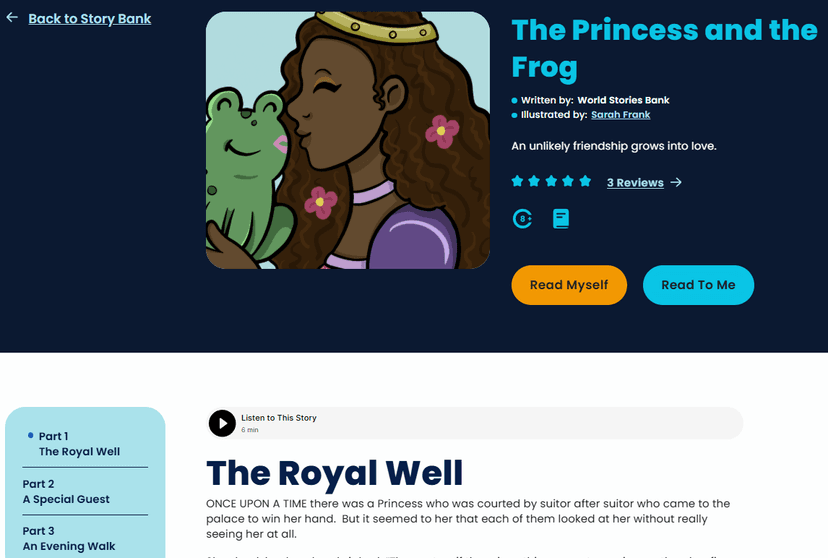
World Stories Bank relies on direct text exposure and narrative-based learning rather than structured, interactive instruction. Users navigate a digital library of multicultural folktales categorized by themes, ethics, and origins. Your child selects a story and reads it in a simple, text-heavy interface without gamified interruptions. The platform focuses on delivering traditional stories that model positive social behaviors and ethics. Because there are no interactive scaffolding tools, the cognitive lifting is entirely up to the reader. The site supports offline learning by allowing educators and parents to print the stories. This feature enables traditional reading strategies like highlighting, underlining, and margin notes. Some stories are available in multiple languages, providing dual-language exposure for bilingual students. The mechanics are entirely passive, meaning the platform delivers the content while relying on the user to process, understand, and reflect on the material independently.
Strengths and tradeoffs of World Stories Bank
The biggest strength of World Stories Bank is its ability to build background knowledge through diverse cultural narratives, while its biggest weakness is the complete lack of active retrieval practice. Building background knowledge is a proven pillar of reading comprehension; the more a student knows about the world, the easier it is for them to decode and understand complex texts later on. The platform delivers this through carefully curated folktales that expose students to global cultures and ethical dilemmas. The clean interface is another major asset, as it avoids the extraneous cognitive load often found in highly animated reading apps. Without flashy distractions, students can dedicate their full attention to the text. However, the platform falls short in instructional design. Because it lacks comprehension checks or spaced repetition for vocabulary, there is no system to ensure the student actually learned anything. A student could passively scroll through a story without absorbing the moral or practicing their decoding skills. To bridge this gap, educators and parents must step in and apply instructional strategies manually, such as asking open-ended questions to force active recall.
Who Might Benefit From World Stories Bank?
Best for elementary educators and parents who need a free, diverse reading library to supplement their own guided instruction. The stories target students in kindergarten through sixth grade, making it highly versatile for mixed-age classrooms or family reading time. It is particularly useful for teachers looking to integrate social-emotional learning into their literacy blocks using traditional folktales. Because the platform lacks built-in assessments, it is not ideal for independent use by struggling readers who need constant feedback. It serves best as a shared reading experience where an adult can provide necessary vocabulary scaffolding and prompt critical thinking.
Data Transparency
Does Not Meet Data Transparency Standard
World Stories Bank does not meet our data transparency standard. Its privacy policy does not document basic protections, including a statement that it does not sell data, a commitment against targeted advertising and limits on sharing children's data.
15 of 35 checks passed
Evaluated September 2026
Privacy Policy →Level 1 · Basic protections
Does not sell data or target ads at students, limits sharing, and lets parents see and delete their child's data.
Not documented: a statement that it does not sell data, a commitment against targeted advertising, limits on sharing children's data, contractual limits on service providers
Level 2 · Parent control (meets the standard)
Families can get their data out, know who processes it, and know how long it is kept.
Not documented: data export, a data retention timeline, self-service deletion
Level 3 · Direct data access
Families or schools can pull their own data through an API, in a stated format.
Not documented: an API for retrieving their own data, a named export format
View all 35 checks
Parent Access7/8
Does the policy mention parents specifically?
“how users, parents, and guardians can control the use and disclosure of collected information”
Can parents view their child's data?
“In addition, even after a parent has given his or her permission, we allow parents to review, amend, or delete information their children may provide, and to prohibit further collection.”
Can parents modify their child's data?
“In addition, even after a parent has given his or her permission, we allow parents to review, amend, or delete information their children may provide, and to prohibit further collection.”
Can parents delete their child's account?
“In addition, even after a parent has given his or her permission, we allow parents to review, amend, or delete information their children may provide, and to prohibit further collection.”
Is there a dedicated Children's Privacy section?
“## Our Commitment to Children’s Privacy”
Does it reference COPPA compliance?
“We have privacy protection procedures in place where children under 13 years old are concerned, as provided for and described in the Children’s Online Privacy Protection Act.”
Does it reference FERPA compliance?
The policy does not mention FERPA.
Is parental consent required for child accounts?
“We require parental consent through a permission form before we ask for any personal information from visitors we know who are under 13 years old.”
Data Portability1/5
Can users access their personal data?
“You can access all your personally identifiable information that we collect online and make changes at any time.”
Can users download/export their data?
The policy does not address downloading or exporting data.
Is there a self-service data access tool?
The policy describes access and corrections by request with identity verification, not a self-service tool.
Is a specific data format mentioned for export?
The policy does not mention any export format.
Is there an API for data access?
The policy does not mention an API for data access.
Data Minimization2/6
Is data collection itemized?
“Personal information may be required upon purchase such as your Name, Mailing address, Email address, Phone number, and Credit/Debit Card Information.”
Can the app be used without a real name?
The policy says name is required for registration and purchases.
Can the app be used without an email?
The policy says email address is required for registration and purchases.
Does it state collection is limited to what is necessary?
“Furthermore, unless personal information is necessary for an activity, we do not require that visitors provide such information in order to participate in the activity.”
Is IP address anonymized or truncated?
The policy does not address IP address anonymization.
Is location tracking explicitly excluded?
The policy does not explicitly exclude location tracking.
Third-Party Protection2/7
Does it explicitly state no selling of data?
The policy says personal information is not shared with third parties but never explicitly says the vendor does not sell data.
Are third-party providers named?
“WSB’s server for the Site is provided by DreamHost.”
Are providers contractually restricted?
The policy does not describe contractual restrictions on providers.
No-targeted-advertising commitment?
The policy says third-party ad companies such as Google may use visit information to show ads about goods and services that may interest users.
Is AI/ML data sharing addressed?
The policy does not address AI or machine learning.
Child-specific sharing restriction?
The policy covers parental consent and control over children's data collection but has no sharing restriction specific to children.
Cookies/tracking limited or opt-out?
“If you do not want us to use cookies to collect this information, most browsers allow you to disable the cookie feature.”
Deletion & Retention2/5
Can users delete their account?
“In addition, if you request, we will use commercially reasonable efforts to remove your name and personal information from our database.”
Self-service deletion mechanism?
The policy says deletion is done by emailing a request, not through a self-service tool.
Specific data retention timeline?
The policy gives no specific retention timeline.
Auto-deletion of inactive accounts?
The policy does not address auto-deleting inactive accounts.
Post-deletion handling described?
“Please understand, however, that it may be impossible to remove this information completely, due to backups and records of deletions.”
Advertising1/4
Advertising model explicitly disclosed?
“We may use third-party advertising companies, such as Google, to serve or track ads on our web site and other web site.”
Free from third-party advertisements?
The policy says third-party advertising companies such as Google may serve ads on the site.
Children excluded from ad targeting?
The policy does not exclude children from ad targeting.
Ad-free option available?
The policy describes third-party ads on the site and offers no ad-free option.
What This Means
The policy review did not meet our data transparency standard. The checks above show the documented findings and unknowns. A missing statement does not establish how the app handles data in practice.
About this evaluation: Based on automated analysis of Privacy Policy against 35 policy-disclosure questions, including questions adapted from the Common Sense Privacy Program's published evaluation questions. TLS is not affiliated with Common Sense Media, and this is not a Common Sense rating. Quoted text is copied from the policy; unquoted notes are our summary. Results describe what the policy documents, not the company's actual practices. Privacy policies can change: this review reflects the version we analyzed and does not determine legal compliance.
Sources and review method
TLS combines product information and editorial analysis to explain how World Stories Bank works, its tradeoffs, and the questions to ask before choosing it. Product features, an instructional rationale and evidence of learning outcomes are different kinds of information.
Formal Learning Standard assessment: not yet completed. Data Transparency findings are reported separately and do not establish learning effectiveness. Read our methodology.
Frequently Asked Questions About World Stories Bank
Is World Stories Bank free?
Yes, World Stories Bank is entirely free for both classroom and home use. There are no paywalls or subscription fees required to access the library of folktales. Because it is an open-access platform, you do not need to worry about entering credit card information or managing trial periods. This makes it an exceptionally accessible tool for educators operating on tight school budgets and for parents looking for high-quality reading materials without adding another monthly software expense to their household.
Is World Stories Bank good for kindergarteners?
Partially. While the ethical themes and folktales are appropriate for young children, kindergarteners will need a parent or teacher to read the stories aloud, as the text complexity exceeds early decoding skills. The platform lacks read-aloud audio narration or clickable vocabulary words, meaning emergent readers cannot navigate the text independently. If used as a shared reading experience where an adult actively guides the story and pauses for discussion, it is a highly valuable tool for early childhood development.
What does World Stories Bank teach?
The platform teaches reading comprehension, global cultural awareness, and social-emotional skills. It uses traditional folktales to model positive human ethics like honesty, bravery, and kindness. By exposing your child to narratives from different countries and traditions, it actively builds their background knowledge. Cognitive science proves that robust background knowledge is one of the most critical components for long-term reading comprehension success. The stories prompt students to think critically about character choices, ethical dilemmas, and diverse cultural perspectives.
How does World Stories Bank compare to Epic!?
Epic! is a massive, subscription-based library with heavy gamification, built-in audiobooks, and end-of-book quizzes designed for independent reading. In contrast, World Stories Bank is a completely free, highly curated collection of folktales that deliberately lacks interactive features. While Epic! leverages extrinsic motivation through badges and points to encourage reading volume, World Stories Bank relies on intrinsic motivation and adult facilitation. It offers a distraction-free, print-friendly reading experience ideal for shared classroom instruction rather than independent tablet time.
Has The Learning Standard evaluated World Stories Bank?
TLS has not yet completed a Learning Standard evaluation of how well World Stories Bank teaches. Its privacy policy has been reviewed for Data Transparency and does not yet document the basic protections (Level 1).
Is World Stories Bank COPPA compliant?
The reviewed privacy policy references COPPA. A policy reference alone does not establish COPPA compliance. Policy review note: The policy references COPPA-based procedures.
Is World Stories Bank FERPA compliant?
A FERPA reference was not found in the reviewed privacy policy. This does not determine whether the app complies with FERPA. Policy review note: The policy does not mention FERPA.
Does World Stories Bank have a children's privacy policy?
The reviewed policy includes a dedicated children's privacy section. Policy review note: The policy has a section with its own heading on children's privacy.
Does World Stories Bank sell student data?
A statement ruling out data selling was not found in the reviewed policy. This does not establish that the app sells student data. Policy review note: The policy says personal information is not shared with third parties but never explicitly says the vendor does not sell data.
Can you delete your data from World Stories Bank?
The reviewed privacy policy describes account deletion. We have not tested the deletion process. Policy review note: Users can ask to have their personal information removed.
Follow TLS Research
Subscribe to future TLS research updates: app reviews, findings, and what the evidence shows.
Screenshots
Take Action
For World Stories Bank
If you represent Stories to Grow By and have a correction or new evidence, send the relevant source so we can review and update this page.
Submit a correctionDetails
- Pricing
- Free for classroom and home use
- Platforms
- Web Browser
- Grade Levels
- Kindergarten, 1st Grade, 2nd Grade, 3rd Grade, 4th Grade, 5th Grade, 6th Grade
- Website
- Visit site