
Wordela
Product by eReflect Inc
Facts checked: Not yet checked
Our take (not a Learning Standard rating). This label applies to learning-science judgments throughout this overview.
Our take (not a Learning Standard rating)
While Wordela relies on proven learning science principles like spaced repetition and retrieval practice to build vocabulary, The Learning Standard has not yet independently evaluated its execution. It offers vast word lists and customizable flashcards, but gamified features sometimes distract from deeper contextual understanding.
Pros
- Employs spaced repetition to improve long-term vocabulary retention.
- Allows educators and parents to customize word lists for targeted classroom or homework alignment.
- Uses retrieval practice through interactive flashcards to strengthen memory recall.
Cons
- Lacks independent efficacy data to confirm the accuracy of its adaptive algorithms.
- Gamification elements may incentivize task completion over genuine vocabulary mastery.
- Does not consistently provide rich contextual examples for complex academic vocabulary.
What Do We Know About Wordela?
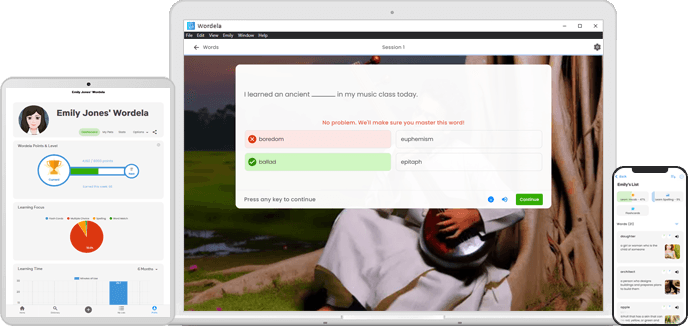
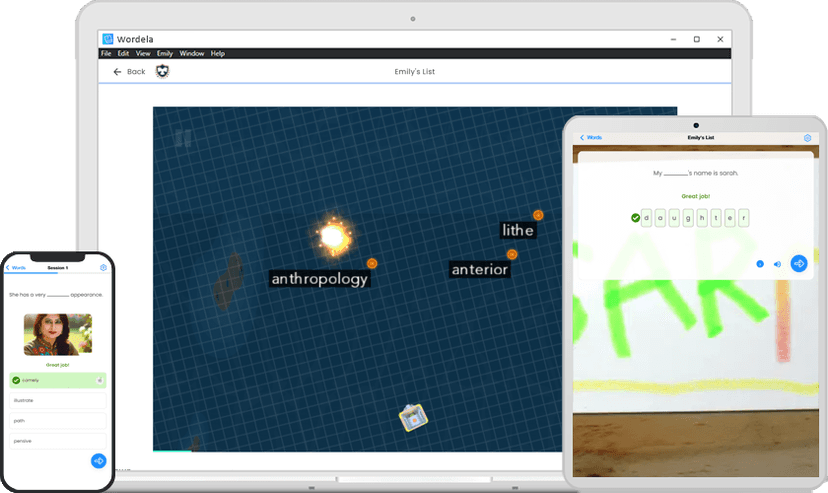
Partially effective for rote vocabulary building, Wordela relies on digital flashcards and spaced repetition to help your child memorize new words. The core engine is built around a massive database of terms ranging from kindergarten sight words to graduate-level academic vocabulary. When your child uses the platform, they interact with targeted lists through drills and games designed to test recall. Learning science supports this type of retrieval practice for basic memorization. However, you should not rely on this tool alone for reading comprehension. Memorizing a definition is only the first step in vocabulary acquisition. Your child must also encounter these words in authentic reading contexts to understand nuance and usage. The app allows you to create custom spelling and vocabulary lists, making it a highly practical tool for weekly homework practice. Since The Learning Standard has not yet formally evaluated Wordela, we cannot confirm whether its adaptive algorithms accurately adjust difficulty to optimize your child's learning pace. Treat it as a robust digital flashcard system rather than a comprehensive literacy curriculum.
How Does Wordela Work?
Wordela uses mastery-based progression combined with spaced repetition to drive vocabulary acquisition. Users begin by selecting or creating specific word lists tailored to their current grade level or learning goals. The platform then presents these words through digital flashcards and brief gamified quizzes. As users answer correctly or incorrectly, the underlying algorithm adjusts the frequency of each word's appearance. Words that are missed appear more often, forcing retrieval practice exactly when the learner is about to forget them. Once a learner demonstrates consistent correct recall over multiple sessions, the system marks the word as mastered and introduces new vocabulary. The interface includes auditory pronunciations, definitions, and spelling exercises. Educators and parents can monitor progress through dashboards that track accuracy and time on task, ensuring that students actually complete the required cycles of repetition necessary for long-term memory encoding.
Strengths and tradeoffs of Wordela
Wordela's biggest strength is its systematic use of spaced repetition, while its biggest weakness is the potential lack of deep contextual reading practice. Spaced repetition is a heavily validated concept in learning science, proving that spacing out review sessions over time drastically improves long-term retention compared to cramming. By automating this spacing, Wordela ensures learners practice words just as the memory begins to decay. Retrieval practice is also well-implemented, forcing users to actively recall definitions rather than passively reading them. However, isolated vocabulary drills have limitations. Contextual learning is critical for actual literacy development. A student might perfectly recall a dictionary definition during a flashcard game but fail to understand that same word when it appears in a complex historical text. Furthermore, the inclusion of gamification can sometimes misdirect learner attention. Point systems and fast-paced games often reward quick guessing rather than deliberate cognitive effort. Since The Learning Standard has not yet evaluated the exact implementation of these features, educators should pair Wordela's rote drills with extensive, high-quality reading assignments to ensure true comprehension.
Who Might Benefit From Wordela?
Best for students and independent learners who need targeted, repetitive practice to memorize specific vocabulary lists or spelling words. Because the content spans from early childhood to post-graduate levels, it works effectively for a second grader learning weekly sight words or a high schooler preparing for the SAT. It is highly useful for educators who want to digitize vocabulary homework and track completion. However, it is not ideal for students struggling with broader reading comprehension issues, as the platform focuses heavily on isolated word-level mastery rather than connected text analysis.
Data Transparency
Does Not Meet Data Transparency Standard
Wordela reaches Level 1 of 3 (Basic protections), below our data transparency standard. Reaching Level 2 needs the policy to document data export, a data retention timeline and self-service deletion.
18 of 35 checks passed
Evaluated September 2026
Wordela Privacy →Level 1 · Basic protections
Does not sell data or target ads at students, limits sharing, and lets parents see and delete their child's data.
Level 2 · Parent control (meets the standard)
Families can get their data out, know who processes it, and know how long it is kept.
Not documented: data export, a data retention timeline, self-service deletion
Level 3 · Direct data access
Families or schools can pull their own data through an API, in a stated format.
Not documented: an API for retrieving their own data, a named export format
View all 35 checks
Parent Access7/8
Does the policy mention parents specifically?
“Upon request from a parent or legal guardian, we will provide a description of the personal information we collect, give parents the opportunity to review their child’s personal information or have their child’s personal information deleted.”
Can parents view their child's data?
“Upon request from a parent or legal guardian, we will provide a description of the personal information we collect, give parents the opportunity to review their child’s personal information or have their child’s personal information deleted.”
Can parents modify their child's data?
The policy gives parents the right to review or delete their child's information, but not to correct or change it.
Can parents delete their child's account?
“Upon request from a parent or legal guardian, we will provide a description of the personal information we collect, give parents the opportunity to review their child’s personal information or have their child’s personal information deleted.”
Is there a dedicated Children's Privacy section?
“## V. Children’s Information”
Does it reference COPPA compliance?
“If a teacher or school official has consented to our collection of information from children who are students in a manner consistent with COPPA, we will collect and use such personal information solely for the use and benefit of the school and for no other commercial purpose.”
Does it reference FERPA compliance?
“Children may use Wordela EDU provided the school has complied with its responsibilities under the Family Educational Rights and Privacy Act ("FERPA") and Children's Online Privacy Protection Act (“COPPA”).”
Is parental consent required for child accounts?
“A school or district must obtain the consent of a parent or legal guardian before providing Wordela with any child’s personal information.”
Data Portability1/5
Can users access their personal data?
“You can submit a request to review, update or delete any personal information that eReflect stores about you by emailing helpdesk@ereflect.com”
Can users download/export their data?
The policy does not address downloading or exporting data.
Is there a self-service data access tool?
The policy says access requests are made by email and does not describe a self-service tool.
Is a specific data format mentioned for export?
The policy does not mention any export format.
Is there an API for data access?
The policy does not mention an API for data access.
Data Minimization2/6
Is data collection itemized?
“We may need certain information, such as name, email address, billing address, type of computer or credit card number in order to provide that service or product.”
Can the app be used without a real name?
The policy says users must give their name when they register.
Can the app be used without an email?
The policy says users must give their email address when they register.
Does it state collection is limited to what is necessary?
“Wordela collects, retains and uses only the information about our Clients that is required by law to administer Wordela business and provide high-level services to our Clients.”
Is IP address anonymized or truncated?
The policy says IP addresses are not linked to personal information but does not say they are anonymized or truncated.
Is location tracking explicitly excluded?
The policy does not explicitly rule out location tracking.
Third-Party Protection5/7
Does it explicitly state no selling of data?
The policy says it does not disclose information to outside companies but never explicitly says it does not sell data.
Are third-party providers named?
“We share this information with Braintree, payment processing software, to process payments from our users.”
Are providers contractually restricted?
“But sometimes it is necessary to provide personally identifiable Client information to a third party. If so, Wordela shall insist that the third party adheres to similar privacy principles that are provided for keeping such information confidential and Client authorisation should be requested.”
No-targeted-advertising commitment?
“Client information will not be used for any target ads or advertising profiles.”
Is AI/ML data sharing addressed?
The policy does not address AI or machine learning.
Child-specific sharing restriction?
“If a teacher or school official has consented to our collection of information from children who are students in a manner consistent with COPPA, we will collect and use such personal information solely for the use and benefit of the school and for no other commercial purpose.”
Cookies/tracking limited or opt-out?
“If a Client rejects the cookie, they may still use the site, but the Client will be limited in some areas of the site.”
Deletion & Retention2/5
Can users delete their account?
“Upon receiving a request from a user to delete their data, we will ensure that all such data is deleted within 5 business days.”
Self-service deletion mechanism?
The policy says deletion requires a request by email and does not describe a self-service tool.
Specific data retention timeline?
The policy says data is kept no longer than necessary but gives no specific retention period.
Auto-deletion of inactive accounts?
The policy does not address automatic deletion of inactive accounts.
Post-deletion handling described?
“This includes all personal data, as well as any data that has been generated as a result of the user's interaction with our services. Please note that once your data has been deleted, it cannot be recovered.”
Advertising1/4
Advertising model explicitly disclosed?
The policy rules out targeted ads but does not explain whether the product shows ads or how it uses advertising.
Free from third-party advertisements?
The policy does not say whether the product shows third-party ads.
Children excluded from ad targeting?
“Client information will not be used for any target ads or advertising profiles.”
Ad-free option available?
The policy does not say the product is ad-free or offer an ad-free option.
What This Means
The policy review did not meet our data transparency standard. The checks above show the documented findings and unknowns. A missing statement does not establish how the app handles data in practice.
About this evaluation: Based on automated analysis of Wordela Privacy against 35 policy-disclosure questions, including questions adapted from the Common Sense Privacy Program's published evaluation questions. TLS is not affiliated with Common Sense Media, and this is not a Common Sense rating. Quoted text is copied from the policy; unquoted notes are our summary. Results describe what the policy documents, not the company's actual practices. Privacy policies can change: this review reflects the version we analyzed and does not determine legal compliance.
Sources and review method
TLS combines product information and editorial analysis to explain how Wordela works, its tradeoffs, and the questions to ask before choosing it. Product features, an instructional rationale and evidence of learning outcomes are different kinds of information.
Formal Learning Standard assessment: not yet completed. Data Transparency findings are reported separately and do not establish learning effectiveness. Read our methodology.
Frequently Asked Questions About Wordela
Is Wordela free?
Wordela uses a tiered pricing model and is not entirely free. While there may be basic access or trial periods for new users, full features like advanced algorithmic tracking, comprehensive academic lists, and detailed educator dashboards require a paid subscription. You will need to evaluate the pricing tiers on their official website to determine which package fits your specific classroom or household budget.
Is Wordela good for elementary students?
Yes, Wordela provides customized word lists suitable for elementary students. Parents and teachers can input specific weekly spelling or sight words, allowing younger children to use the flashcards and games for targeted homework practice. The interface is straightforward enough for early readers to navigate independently, and auditory features help reinforce phonics and pronunciation for kindergarten through fifth-grade learners.
What does Wordela teach?
Wordela teaches spelling and vocabulary acquisition across all grade levels. It focuses heavily on helping learners memorize textbook definitions, correct spelling patterns, and basic word recognition through digital drills. By utilizing interactive repetition, it builds rote memorization skills for foundational literacy. However, it does not explicitly teach broader reading comprehension, narrative analysis, or complex grammar structures, meaning it should supplement a core English curriculum.
How does Wordela compare to Quizlet?
Both platforms use digital flashcards and spaced repetition to build memory recall. Quizlet is a broad, generalized tool used for any subject, relying heavily on user-generated content that can sometimes contain errors. Wordela is specifically dedicated to vocabulary and spelling, offering a massive pre-built dictionary alongside its custom list features. This makes Wordela more specialized for language arts, while Quizlet remains a versatile study aid for general subjects.
Has The Learning Standard evaluated Wordela?
TLS has not yet completed a Learning Standard evaluation of how well Wordela teaches. Its privacy policy has been reviewed for Data Transparency and reaches Level 1, Basic protections.
Is Wordela COPPA compliant?
The reviewed privacy policy references COPPA. A policy reference alone does not establish COPPA compliance. Policy review note: The policy says it collects children's information in a manner consistent with COPPA.
Is Wordela FERPA compliant?
The reviewed privacy policy references FERPA. A policy reference alone does not establish FERPA compliance. Policy review note: The policy refers to FERPA compliance for Wordela EDU.
Does Wordela have a children's privacy policy?
The reviewed policy includes a dedicated children's privacy section. Policy review note: The policy has its own section on children's information.
Does Wordela sell student data?
A statement ruling out data selling was not found in the reviewed policy. This does not establish that the app sells student data. Policy review note: The policy says it does not disclose information to outside companies but never explicitly says it does not sell data.
Can you delete your data from Wordela?
The reviewed privacy policy describes account deletion. We have not tested the deletion process. Policy review note: Users can ask to have all their data deleted.
Follow TLS Research
Subscribe to future TLS research updates: app reviews, findings, and what the evidence shows.
Screenshots

Take Action
For Wordela
If you represent eReflect Inc and have a correction or new evidence, send the relevant source so we can review and update this page.
Submit a correctionDetails
- Pricing
- Tiered Pricing
- Platforms
- Web Browser, iOS (Apple mobile), iPadOS (Apple tablet), Android (Google mobile), macOS (Apple), Chrome OS (Google)
- Grade Levels
- Kindergarten, 1st Grade, 2nd Grade, 3rd Grade, 4th Grade, 5th Grade, 6th Grade, 7th Grade, 8th Grade, 9th Grade, 10th Grade, 11th Grade, 12th Grade, Bachelor's degree, Post-baccalaureate certificate, Master's Degree
- Website
- Visit site