
Walkabouts
Product by ActivEd Inc.
Facts checked: Not yet checked
Our take (not a Learning Standard rating). This label applies to learning-science judgments throughout this overview.
Our take (not a Learning Standard rating)
Walkabouts integrates physical movement with early math and literacy concepts, effectively engaging the embodied cognition of young learners. While kinesthetic activities successfully boost attention and encode memory for foundational skills, the app currently lacks the adaptive difficulty and retrieval practice mechanics necessary for independent, long-term mastery.
Pros
- Incorporates embodied cognition by linking physical movements directly to vocabulary and math concepts.
- Reduces cognitive load for early learners by breaking lessons into short, active segments.
- Aligns activities directly with state standards to ensure relevance to classroom instruction.
Cons
- Lacks adaptive difficulty algorithms to scaffold instruction based on student performance.
- Provides minimal feedback on incorrect answers beyond moving to the next prompt.
- Fails to utilize spaced repetition scheduling for long-term retention of learned concepts.
What Do We Know About Walkabouts?
Walkabouts is a moderately effective supplementary tool that uses physical movement to teach foundational math and literacy to early elementary students. Rather than sitting passively, your child stands up and performs specific physical actions, like hopping or reaching, to answer questions or demonstrate understanding. This approach leverages embodied cognition, a learning science principle showing that physical movement can strengthen memory encoding and increase attention spans in young children. The platform acts primarily as an active drill-and-practice system. It breaks up sedentary screen time, making it highly useful for burning off energy while reviewing sight words or basic addition. However, parents should understand its limitations as a standalone curriculum. Walkabouts does not feature adaptive learning paths; it presents fixed sequences of content regardless of your child's accuracy. It also lacks robust retrieval practice mechanisms designed to revisit struggling concepts over time. Therefore, it works best as an active supplement to traditional instruction rather than a primary teaching tool. Pending formal evaluation by The Learning Standard, it offers a strong method for behavioral engagement but lacks the deep pedagogical scaffolding required for independent mastery.
How Does Walkabouts Work?
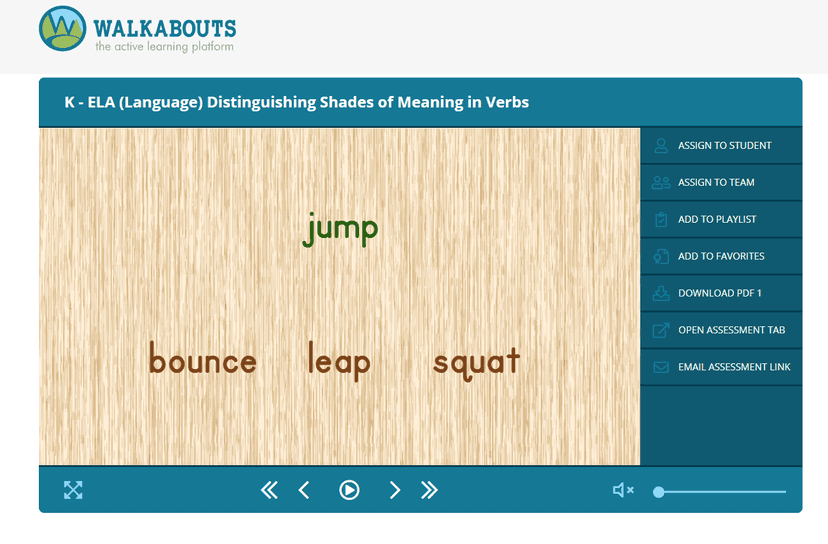
Walkabouts uses kinesthetic drill-and-practice to reinforce foundational literacy and math skills through guided physical movement. When your child begins an activity, an on-screen instructor prompts them to perform specific actions (like marching in place, reaching up high, or touching their toes) associated with academic concepts. For example, a math lesson might require jumping a specific number of times to solve an addition problem, or a literacy lesson might ask students to crouch when they hear a specific vowel sound. The lessons are heavily structured and linear. Students follow along with the video prompts, receiving immediate auditory and visual cues to guide their movements. The platform provides companion Walksheets to transition the active learning into traditional written practice, reinforcing the concepts introduced during the movement phase. Because the software does not track individual user accuracy or adapt in real-time, the progression relies entirely on the parent or teacher selecting appropriate lessons aligned with the student's current classroom instruction.
Strengths and tradeoffs of Walkabouts
Walkabouts' biggest strength is its use of embodied cognition to increase engagement, while its biggest weakness is the absence of adaptive difficulty to scaffold independent learning. Strengths: By forcing students out of their seats, the platform actively combats the attention decay common in traditional digital learning. Connecting physical gestures to academic concepts leverages dual-coding theory, where visual, auditory, and kinesthetic inputs work together to create stronger memory traces. This is particularly effective for Pre-K through 2nd-grade students who naturally learn through play and movement. Weaknesses: The platform functions essentially as a linear video player with prompts, completely lacking the adaptive learning algorithms found in top-tier educational software. If your child struggles with a specific phonics rule or math operation, the system does not recognize the failure or adjust the instruction. Furthermore, it does not employ spaced repetition or retrieval practice to ensure long-term retention. Without these cognitive science pillars, Walkabouts remains a supplementary engagement tool rather than a comprehensive platform for building deep, durable academic mastery.
Who Might Benefit From Walkabouts?
Best for energetic Pre-K through 2nd-grade students who struggle to sit still during traditional math and reading drills. It is an ideal supplementary tool for both classroom teachers looking for productive brain breaks and homeschooling parents needing to inject physical activity into daily academic routines. Because the content does not adapt dynamically, it requires a parent or educator to actively select the correct lessons based on the child's current learning goals. It serves effectively as a brief, active review mechanism rather than a primary instructional curriculum.
Sources and review method
TLS combines product information and editorial analysis to explain how Walkabouts works, its tradeoffs, and the questions to ask before choosing it. Product features, an instructional rationale and evidence of learning outcomes are different kinds of information.
Formal Learning Standard assessment: not yet completed. Data Transparency findings are reported separately and do not establish learning effectiveness. Read our methodology.
Frequently Asked Questions About Walkabouts
Is Walkabouts free?
No, Walkabouts is a subscription-based service. The Individual or Family Home Use license costs $29 per year. The platform also offers higher-tier annual licenses for single classrooms, daycares, and entire schools.
Is Walkabouts good for kindergarteners?
Yes, Walkabouts is specifically designed for early childhood education, targeting Pre-K through 2nd grade. The movement-based lessons are developmentally appropriate for kindergarteners, helping them burn energy while reinforcing basic foundational skills without requiring them to sit passively at a desk.
What does Walkabouts teach?
Walkabouts covers early math, language arts, and reading concepts. Lessons focus on foundational skills like counting, addition, sight words, phonics, and basic grammar. All content is directly aligned with state and national early learning standards.
How does Walkabouts compare to GoNoodle?
While both platforms use physical movement, GoNoodle primarily focuses on general mindfulness, dancing, and brain breaks. Walkabouts explicitly integrates state-standard academic curriculum, like specific phonics or math drills, directly into the physical movements, making it more academically targeted than GoNoodle's general activity videos.
Has The Learning Standard evaluated Walkabouts?
TLS has not yet completed a Learning Standard evaluation of how well Walkabouts teaches. TLS has not published a Data Transparency result for its privacy policy.
Follow TLS Research
Subscribe to future TLS research updates: app reviews, findings, and what the evidence shows.
Screenshots

Take Action
For Walkabouts
If you represent ActivEd Inc. and have a correction or new evidence, send the relevant source so we can review and update this page.
Submit a correctionDetails
- Pricing
- Choose from 4 types of Walkabouts subscriptions that make moving and learning fun, are proven in university studies, and include access to all Walksheets. The Individual or Family Home Use license is $29/yr., is ideal for home use, is used in hundreds of classrooms, and is aligned to state and national standards. The Single Classroom license is $99/yr. and is perfect for class and remote use, is aligned to state and national standards, and setup takes minutes. The Daycare/ Pre-K- Multi-Class/Multi-Group license is $799/yr. and is great for stations or groups, effective in person and virtual, and is standards-based (Head Start & NAEYC). The Entire School Pre-K to 2nd license is $999/yr. and is great for multi-class, multi-teacher setup, ideal for in-person and remote learning, and is aligned to standards.
- Platforms
- Web Browser, iOS (Apple mobile), iPadOS (Apple tablet), Android (Google mobile), Tizen (Samsung mobile), Windows (Microsoft), macOS (Apple), Chrome OS (Google)
- Grade Levels
- Prekindergarten, Transitional Kindergarten, Kindergarten, 1st Grade, 2nd Grade
- Website
- Visit site