
VariQuest® Visual and Kinesthetic Learning Suite
Product by VariQuest
Facts checked: Not yet checked
Our take (not a Learning Standard rating). This label applies to learning-science judgments throughout this overview.
Our take (not a Learning Standard rating)
VariQuest does not directly teach students; rather, it is a production suite for educators to create visual and tactile learning aids. While grounded in dual coding theory through the creation of anchor charts and flashcards, its effectiveness depends entirely on how teachers implement the resulting materials in the classroom.
Pros
- Supports dual coding theory by allowing teachers to easily pair visual representations with verbal instruction via customized posters and anchor charts.
- Facilitates embodied cognition by producing tactile manipulatives and die-cut materials for kinesthetic learning activities.
- Reduces teacher preparation time for creating evidence-based environmental supports like classroom schedules and safety reminders.
- Provides an extensive library of customizable templates that can be tailored to align with specific curriculum goals and student needs.
Cons
- Offers no direct instruction, feedback, or interactive digital practice for students.
- Requires significant upfront school funding and dedicated physical space for the hardware suite.
- Effectiveness relies completely on the pedagogical skill of the teacher designing and deploying the materials.
- Lacks built-in mechanisms to measure student mastery or track individual learning progress.
What Do We Know About VariQuest® Visual and Kinesthetic Learning Suite?
VariQuest Visual and Kinesthetic Learning Suite is effective for learning only when educators use it to produce high-quality, scientifically backed classroom materials. Parents should understand that this is not an app or software program your child will use directly. Instead, it is a commercial-grade production system used by schools to print posters, cut out tactile shapes, and create flashcards. When teachers use this suite to create anchor charts, they help reduce your child's cognitive load by keeping key formulas or grammar rules visible during independent practice. When they print custom flashcards, they enable essential retrieval practice. However, simply covering classroom walls with colorful posters can actually distract students and decrease focus. The learning value lies entirely in the teacher's ability to select and design materials that support active learning rather than passive decoration. Because The Learning Standard has not yet evaluated this suite, we cannot definitively rate its typical classroom implementation. Ultimately, VariQuest empowers teachers with the tools to build a visually and kinesthetically rich environment, but it does not replace direct instruction or active student practice.
How Does VariQuest® Visual and Kinesthetic Learning Suite Work?
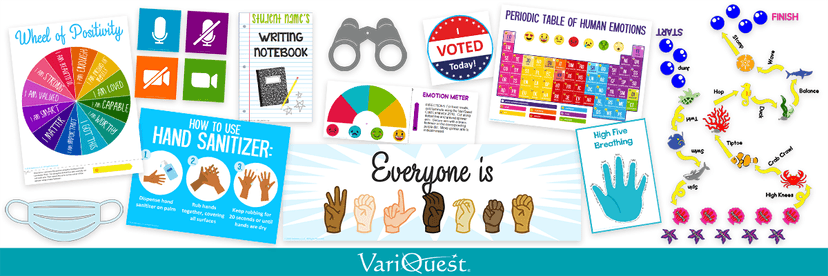
VariQuest uses a teacher-driven, resource-generation approach to support visual and kinesthetic learning environments. Educators log into the VariQuest Design Center software, which houses over 22,000 templates spanning early childhood through high school subjects. From there, they select a template (such as a biology diagram, a set of math manipulatives, or a classroom organization chart) and customize the text and graphics. The software then sends the design to a series of specialized hardware devices. A large-format printer generates posters and anchor charts, a digital die-cut system physically cuts out shapes and letters for bulletin boards or tactile learning, and a specialty printer produces durable labels and flashcards. Students then interact with these physical outputs during lessons. For example, a child might use die-cut fractions to solve math problems cooperatively, engaging in embodied learning. Teachers can also laminate these materials for repeated use across different class periods.
Strengths and tradeoffs of VariQuest® Visual and Kinesthetic Learning Suite
The biggest strength of the VariQuest suite is its ability to facilitate dual coding through customized visual aids, while its biggest weakness is the complete lack of direct student interaction or feedback mechanisms. Visual Support for Cognitive Load: By allowing teachers to easily print anchor charts and visual rubrics, the system helps minimize working memory overload. Students can reference these environmental supports while solving complex problems. Tactile Learning Opportunities: The die-cut system produces physical manipulatives that support embodied cognition, which research shows is particularly effective for early childhood mathematics and spatial reasoning. Dependency on Teacher Execution: Because this is a production tool rather than an instructional platform, it cannot provide worked examples, spaced repetition software, or adaptive pathways on its own. Risk of Extraneous Load: If teachers use the thousands of available templates merely to decorate walls rather than support specific instructional goals, they risk creating visually cluttered environments that distract students and increase extraneous cognitive load. Ultimately, the system is a powerful amplifier of a teacher's existing pedagogical strategies, but it guarantees no learning outcomes by itself.
Who Might Benefit From VariQuest® Visual and Kinesthetic Learning Suite?
Best for school districts and educators who need to produce high-volume, customized visual and tactile learning aids for physical classrooms. Since this requires significant hardware and funding, it is strictly an institutional purchase rather than a tool for individual parents or students. It is highly effective for early childhood and elementary teachers who rely heavily on manipulatives, centers, and cooperative learning. Middle and high school educators in applied sciences or career and technical education can also use the suite to create specialized schematics, safety reminders, and project-based learning displays.
Data Transparency
Does Not Meet Data Transparency Standard
VariQuest® Visual and Kinesthetic Learning Suite does not meet our data transparency standard. Its privacy policy does not document basic protections, including a commitment against targeted advertising, limits on sharing children's data and a COPPA or FERPA commitment.
9 of 35 checks passed
Evaluated September 2026
Privacy Policy →Level 1 · Basic protections
Does not sell data or target ads at students, limits sharing, and lets parents see and delete their child's data.
Not documented: a commitment against targeted advertising, limits on sharing children's data, a COPPA or FERPA commitment, parents' right to see their child's data, parents' right to delete their child's data
Level 2 · Parent control (meets the standard)
Families can get their data out, know who processes it, and know how long it is kept.
Not documented: a data retention timeline, named service providers, self-service deletion
Level 3 · Direct data access
Families or schools can pull their own data through an API, in a stated format.
Not documented: an API for retrieving their own data, a named export format
View all 35 checks
Parent Access1/8
Does the policy mention parents specifically?
The policy does not mention parents; its children's section refers only to "appropriate consent as required by law."
Can parents view their child's data?
The policy does not give parents any right to view their child's data.
Can parents modify their child's data?
The policy does not give parents any right to modify their child's data.
Can parents delete their child's account?
The policy does not give parents a right to delete their child's data; it only says the company will delete children's information it becomes aware of.
Is there a dedicated Children's Privacy section?
“This Site is not intended for children under 13, and we do not knowingly collect personal information from children without appropriate consent as required by law.”
Does it reference COPPA compliance?
The policy does not reference COPPA; it only says consent will be obtained "as required by law."
Does it reference FERPA compliance?
The policy does not reference FERPA.
Is parental consent required for child accounts?
The policy mentions "appropriate consent as required by law" but never says parental consent is required for child accounts.
Data Portability2/5
Can users access their personal data?
“Access the personal information we hold about you”
Can users download/export their data?
“Request a copy of your data (data portability)”
Is there a self-service data access tool?
The policy says users exercise their rights by contacting the company, not through a self-service tool.
Is a specific data format mentioned for export?
The policy does not name a format for data export.
Is there an API for data access?
The policy does not mention an API for data access.
Data Minimization1/6
Is data collection itemized?
“This information may include name, email address, phone number, organization or school name, school location, or any other information you choose to provide.”
Can the app be used without a real name?
The policy says it collects users' names.
Can the app be used without an email?
The policy says it collects email addresses.
Does it state collection is limited to what is necessary?
The policy limits how long data is kept to what is necessary, but does not say collection is limited to what is necessary.
Is IP address anonymized or truncated?
The policy says it collects IP addresses automatically and does not mention anonymizing or truncating them.
Is location tracking explicitly excluded?
The policy does not rule out location tracking and says it collects school location.
Third-Party Protection3/7
Does it explicitly state no selling of data?
“We do not sell personal information.”
Are third-party providers named?
The policy lists only categories of providers (hosting, analytics, email, support) and names none.
Are providers contractually restricted?
“These providers are required to protect your information and use it only for authorized purposes.”
No-targeted-advertising commitment?
The policy makes no commitment against targeted advertising, and the cookie banner says cookies are used to serve personalized ads.
Is AI/ML data sharing addressed?
The policy does not address AI or machine learning.
Child-specific sharing restriction?
The policy has no sharing restriction specific to children.
Cookies/tracking limited or opt-out?
“You may control cookies through your browser settings.”
Deletion & Retention1/5
Can users delete their account?
“Request correction or deletion of your data”
Self-service deletion mechanism?
The policy says deletion requests are made by contacting the company; it offers no self-service deletion.
Specific data retention timeline?
The policy says data is kept only as long as necessary but gives no specific timeline.
Auto-deletion of inactive accounts?
The policy does not address automatic deletion of inactive accounts.
Post-deletion handling described?
The policy says data is deleted or anonymized when no longer needed but does not describe what happens after a deletion request, such as backups.
Advertising1/4
Advertising model explicitly disclosed?
“Advertisement cookies are used to provide visitors with customised advertisements based on the pages you visited previously and to analyse the effectiveness of the ad campaigns.”
Free from third-party advertisements?
The policy does not say the product is free of third-party ads, and the cookie notice mentions advertisement cookies.
Children excluded from ad targeting?
The policy does not exclude children from ad targeting.
Ad-free option available?
The policy does not describe an ad-free option or state that there is no advertising.
What This Means
The policy review did not meet our data transparency standard. The checks above show the documented findings and unknowns. A missing statement does not establish how the app handles data in practice.
About this evaluation: Based on automated analysis of Privacy Policy against 35 policy-disclosure questions, including questions adapted from the Common Sense Privacy Program's published evaluation questions. TLS is not affiliated with Common Sense Media, and this is not a Common Sense rating. Quoted text is copied from the policy; unquoted notes are our summary. Results describe what the policy documents, not the company's actual practices. Privacy policies can change: this review reflects the version we analyzed and does not determine legal compliance.
Sources and review method
TLS combines product information and editorial analysis to explain how VariQuest® Visual and Kinesthetic Learning Suite works, its tradeoffs, and the questions to ask before choosing it. Product features, an instructional rationale and evidence of learning outcomes are different kinds of information.
Formal Learning Standard assessment: not yet completed. Data Transparency findings are reported separately and do not establish learning effectiveness. Read our methodology.
Frequently Asked Questions About VariQuest® Visual and Kinesthetic Learning Suite
Is VariQuest Visual and Kinesthetic Learning Suite free?
No, the VariQuest Visual and Kinesthetic Learning Suite is a significant commercial investment designed for school districts. Purchasing the hardware, software licenses, and ongoing material supplies requires substantial institutional funding. Schools typically purchase the suite using federal grant opportunities such as Title I, IDEA, or COVID Relief funds. There is no free or consumer version available for home use.
Is VariQuest Visual and Kinesthetic Learning Suite good for elementary students?
Yes, elementary students benefit greatly from the physical materials produced by the VariQuest Visual and Kinesthetic Learning Suite. Early childhood and elementary education rely heavily on visual aids and tactile manipulatives to build foundational literacy and numeracy skills. Teachers can print custom flashcards for retrieval practice or die-cut shapes for hands-on math centers, both of which are highly effective for young learners.
What does VariQuest Visual and Kinesthetic Learning Suite teach?
The VariQuest Visual and Kinesthetic Learning Suite does not teach any specific subject directly. Instead, it provides the templates and production hardware for teachers to create instructional materials across all PreK-12 subjects. Educators use it to print complex biology diagrams, historical timelines, math manipulatives, and reading comprehension anchor charts tailored to their specific curriculum and state standards.
Can parents buy the VariQuest Visual and Kinesthetic Learning Suite for home use?
No, parents should not purchase this system for home learning. The suite involves large, commercial-grade hardware designed for high-volume school production rooms. Parents looking to support visual and kinesthetic learning at home should seek out individual educational manipulatives or consumer-grade craft cutting machines rather than investing in a massive, district-level poster and die-cut ecosystem.
Has The Learning Standard evaluated VariQuest® Visual and Kinesthetic Learning Suite?
TLS has not yet completed a Learning Standard evaluation of how well VariQuest® Visual and Kinesthetic Learning Suite teaches. Its privacy policy has been reviewed for Data Transparency and does not yet document the basic protections (Level 1).
Is VariQuest® Visual and Kinesthetic Learning Suite COPPA compliant?
A COPPA reference was not found in the reviewed privacy policy. This does not determine whether the app complies with COPPA. Policy review note: The policy does not reference COPPA; it only says consent will be obtained "as required by law."
Is VariQuest® Visual and Kinesthetic Learning Suite FERPA compliant?
A FERPA reference was not found in the reviewed privacy policy. This does not determine whether the app complies with FERPA. Policy review note: The policy does not reference FERPA.
Does VariQuest® Visual and Kinesthetic Learning Suite have a children's privacy policy?
The reviewed policy includes a dedicated children's privacy section. Policy review note: Section 8 has its own "Children's Privacy" heading.
Does VariQuest® Visual and Kinesthetic Learning Suite sell student data?
The reviewed policy states that the app does not sell data. This is a policy statement; actual data practices were not verified. Policy review note: The policy states the company does not sell personal information.
Can you delete your data from VariQuest® Visual and Kinesthetic Learning Suite?
The reviewed privacy policy describes account deletion. We have not tested the deletion process. Policy review note: Users may request deletion of their data.
Follow TLS Research
Subscribe to future TLS research updates: app reviews, findings, and what the evidence shows.
Screenshots


Take Action
For VariQuest® Visual and Kinesthetic Learning Suite
If you represent VariQuest and have a correction or new evidence, send the relevant source so we can review and update this page.
Submit a correctionDetails
- Pricing
- The VariQuest Visual and Kinesthetic Learning Suite is priced with precious school funding dollars in mind. Our tools and supplies align with most federal grant opportunities including Title I, COVID Relief, IDEA, Carl Perkins, Title IV, and many more – and we help you with verbiage and alignment resources to justify our tools within the funding streams’ guidelines every step of the way. And at the end of the day, the money and time you’ll save having these tools create supports on-demand, and in-house, proves the ROI in the long run – making your purchase something that will continue to give back every time you use it.
- Platforms
- Windows (Microsoft)
- Grade Levels
- Prekindergarten, Kindergarten, 1st Grade, 2nd Grade, 3rd Grade, 4th Grade, 5th Grade, 6th Grade, 7th Grade, 8th Grade, 9th Grade, 10th Grade, 11th Grade, 12th Grade
- Website
- Visit site