
Sustainability Management Simulation: Net Zero
Product by Sim Institute
Facts checked: Not yet checked
Our take (not a Learning Standard rating). This label applies to learning-science judgments throughout this overview.
Our take (not a Learning Standard rating)
While The Learning Standard has not formally evaluated Sustainability Management Simulation: Net Zero, its game-based model effectively utilizes experiential learning principles by forcing learners to navigate complex resource trade-offs. However, without adaptive scaffolding or direct instruction, novices may struggle to connect simulation outcomes to foundational climate science concepts.
Pros
- Implements experiential learning by forcing users to make resource allocation decisions with immediate, visible consequences.
- Uses situational problem-solving to bridge the gap between theoretical climate science and practical corporate application.
- Provides a sandbox environment that encourages exploratory learning and hypothesis testing without real-world financial risk.
- Contextualizes emission reduction data within a realistic business framework to support cognitive integration.
Cons
- Lacks explicit instructional scaffolding to support learners who do not already possess foundational environmental science knowledge.
- Does not utilize spaced repetition to ensure long-term retention of specific sustainability frameworks or terminology.
- Relies heavily on trial-and-error mechanics, which can lead to cognitive overload without adequate worked examples.
What Do We Know About Sustainability Management Simulation: Net Zero?
Sustainability Management Simulation: Net Zero is a potentially effective tool for adult learners and professionals needing practical experience with corporate emissions reduction, though it relies heavily on prior foundational knowledge. Because this app targets professional and technical credentialing, it functions less like a traditional teaching tool and more like an applied practicum. Your learner will step into the role of a program leader at a city-center hotel, making complex operational decisions to reduce carbon footprints. The simulation uses experiential learning to demonstrate the immediate consequences of business choices on both the environment and the corporate bottom line. It does an excellent job of illustrating trade-offs, forcing users to balance budget constraints against sustainability goals. However, educators and organizational trainers should know that this is not a comprehensive introductory course. It lacks the foundational direct instruction needed to teach basic climate science from scratch. Instead, it serves as a robust summative assessment or capstone activity where learners apply what they already know. The Learning Standard has not yet officially evaluated this app, but its design suggests it works best when paired with traditional coursework or corporate training modules that pre-teach the underlying environmental and financial concepts.
How Does Sustainability Management Simulation: Net Zero Work?
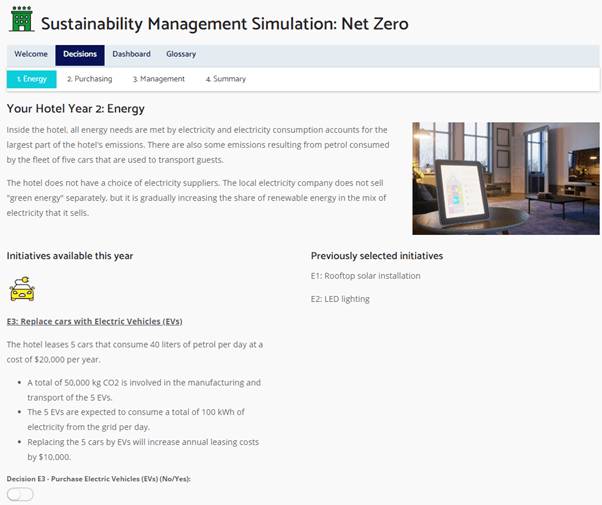
Sustainability Management Simulation: Net Zero uses an experiential, game-based learning approach where participants actively manage an emission reductions program in a simulated corporate environment. Learners are placed in charge of a city-center hotel and must execute a strategic plan to lower the facility's carbon output. The mechanics revolve around resource allocation and decision-making under constraints. Users select various operational upgrades, policy changes, and infrastructure investments, then advance the simulation to see the resulting impact on their emissions targets and financial budget. This cause-and-effect loop provides immediate feedback, allowing learners to adjust their strategies based on the outcomes of previous turns. The platform relies heavily on situational cognition, meaning knowledge is embedded in the specific context in which it will be used. By navigating these practical trade-offs, participants practice applying abstract sustainability concepts to concrete business scenarios. The simulation does not provide traditional lectures or quizzes; instead, progress is measured by the user's ability to achieve the targeted metrics within the game's given operational parameters.
Strengths and tradeoffs of Sustainability Management Simulation: Net Zero
The biggest strength of Sustainability Management Simulation: Net Zero is its use of situated learning to contextualize complex trade-offs, while its biggest weakness is the lack of instructional scaffolding to support novices. By embedding learners in a realistic hotel management scenario, the simulation successfully bridges the gap between theoretical environmental science and applied business strategy. This approach leverages active learning, forcing participants to engage with the material through decision-making rather than passive consumption. When users make an investment in energy efficiency and see the immediate financial and environmental impact, this immediate feedback loop strengthens their understanding of cause and effect. However, the simulation design relies heavily on trial-and-error problem solving, which can quickly lead to cognitive overload if the learner does not already grasp the underlying principles of carbon accounting. There are no worked examples to model successful strategies before the user is expected to perform. Furthermore, the platform does not employ spaced retrieval practice to drill core terminology or regulatory frameworks. It is an application tool rather than an acquisition tool. To maximize its effectiveness, educators must provide the necessary direct instruction beforehand so learners can use the simulation to test hypotheses rather than guess blindly.
Who Might Benefit From Sustainability Management Simulation: Net Zero?
Sustainability Management Simulation: Net Zero is best for adult professionals, corporate trainees, and higher education students who already possess a basic understanding of environmental science and need to practice applying it in a business context. The simulation targets learners seeking technical credentials or career advancement in corporate sustainability. It is an ideal fit for organizational training programs or university capstone courses where the primary goal is demonstrating competence in balancing financial budgets with aggressive emission reduction targets. Because it requires strategic thinking and a firm grasp of business operations, it is not suitable for younger students or beginners needing an introduction to climate change.
Data Transparency
Does Not Meet Data Transparency Standard
Sustainability Management Simulation: Net Zero does not meet our data transparency standard. Its privacy policy does not document basic protections, including a statement that it does not sell data, a commitment against targeted advertising and limits on sharing children's data.
7 of 35 checks passed
Evaluated October 2026
assets-global.website-files.com →Level 1 · Basic protections
Does not sell data or target ads at students, limits sharing, and lets parents see and delete their child's data.
Not documented: a statement that it does not sell data, a commitment against targeted advertising, limits on sharing children's data, contractual limits on service providers, a COPPA or FERPA commitment, parents' right to see their child's data, parents' right to delete their child's data
Level 2 · Parent control (meets the standard)
Families can get their data out, know who processes it, and know how long it is kept.
Not documented: a data retention timeline, self-service deletion
Level 3 · Direct data access
Families or schools can pull their own data through an API, in a stated format.
Not documented: an API for retrieving their own data, a named export format
View all 35 checks
Parent Access0/8
Does the policy mention parents specifically?
The policy does not mention parents.
Can parents view their child's data?
The policy does not give parents any right to view a child's data.
Can parents modify their child's data?
The policy does not give parents any right to modify a child's data.
Can parents delete their child's account?
The policy does not give parents any right to delete a child's data or account.
Is there a dedicated Children's Privacy section?
The policy has no section on children's privacy.
Does it reference COPPA compliance?
The policy does not mention COPPA.
Does it reference FERPA compliance?
The policy does not mention FERPA.
Is parental consent required for child accounts?
The policy does not address parental consent.
Data Portability2/5
Can users access their personal data?
“**The right to access**\- You have the right to request Our Company for copies of your personal data. We may charge you a small fee for this service.”
Can users download/export their data?
“**The right to data portability**\- You have the right to request that Our Company transfer the data that we have collected to another organization, or directly to you, under certain conditions.”
Is there a self-service data access tool?
The policy says rights are exercised by contacting the company, not through a self-service tool.
Is a specific data format mentioned for export?
The policy does not name any export format.
Is there an API for data access?
The policy does not mention an API for data access.
Data Minimization1/6
Is data collection itemized?
“Our Company collects the following data: - Personal identification information (Name, email address)”
Can the app be used without a real name?
The policy says it collects names.
Can the app be used without an email?
The policy says it collects email addresses.
Does it state collection is limited to what is necessary?
The policy does not say collection is limited to what is necessary.
Is IP address anonymized or truncated?
The policy says advertising cookies collect IP addresses and does not mention anonymizing them.
Is location tracking explicitly excluded?
The policy does not rule out location tracking and says cookies may remember a user's location.
Third-Party Protection2/7
Does it explicitly state no selling of data?
The policy does not say data is not sold, and it says data is shared with advertising partners.
Are third-party providers named?
“Our Company securely stores your data at Webflow (for web enquiries), Forio (for simulation users) and Thinkific (for online course participants)”
Are providers contractually restricted?
The policy does not describe any contract limits on providers.
No-targeted-advertising commitment?
The policy says browsing data is used to show users ads based on their browsing patterns.
Is AI/ML data sharing addressed?
The policy does not address AI or machine learning.
Child-specific sharing restriction?
The policy has no sharing limits specific to children.
Cookies/tracking limited or opt-out?
“You can set your browser not to accept cookies, and the above website tells you how to remove cookies from your browser.”
Deletion & Retention1/5
Can users delete their account?
“**The right to erasure**\- You have the right to request that Our Company erase your personal data, under certain conditions.”
Self-service deletion mechanism?
The policy says deletion is by request only, with no self-service option.
Specific data retention timeline?
The policy gives no data retention timeline.
Auto-deletion of inactive accounts?
The policy does not address automatic deletion of inactive accounts.
Post-deletion handling described?
The policy does not describe what happens to data after deletion.
Advertising1/4
Advertising model explicitly disclosed?
“Our Company sometimes shares some limited aspects of this data with third parties for advertising purposes. We may also share online data collected through cookies with our advertising partners.”
Free from third-party advertisements?
The policy describes advertising cookies and advertising partners and does not say the product is ad-free.
Children excluded from ad targeting?
The policy does not exclude children from ad targeting.
Ad-free option available?
The policy offers no ad-free option and describes advertising cookies.
What This Means
The policy review did not meet our data transparency standard. The checks above show the documented findings and unknowns. A missing statement does not establish how the app handles data in practice.
About this evaluation: Based on automated analysis of assets-global.website-files.com against 35 policy-disclosure questions, including questions adapted from the Common Sense Privacy Program's published evaluation questions. TLS is not affiliated with Common Sense Media, and this is not a Common Sense rating. Quoted text is copied from the policy; unquoted notes are our summary. Results describe what the policy documents, not the company's actual practices. Privacy policies can change: this review reflects the version we analyzed and does not determine legal compliance.
Sources and review method
TLS combines product information and editorial analysis to explain how Sustainability Management Simulation: Net Zero works, its tradeoffs, and the questions to ask before choosing it. Product features, an instructional rationale and evidence of learning outcomes are different kinds of information.
Formal Learning Standard assessment: not yet completed. Data Transparency findings are reported separately and do not establish learning effectiveness. Read our methodology.
Frequently Asked Questions About Sustainability Management Simulation: Net Zero
Is Sustainability Management Simulation: Net Zero free?
No, Sustainability Management Simulation: Net Zero is not free. The application costs $47.95 for unlimited use over a six-month period. The developer, Sim Institute, also offers specialized pricing tiers for higher education institutions that want to integrate the simulation into their classroom curriculum.
Is Sustainability Management Simulation: Net Zero good for adult professionals and college students?
Yes, Sustainability Management Simulation: Net Zero is specifically designed for adult professionals and higher education students. It targets learners seeking technical credentials and career skills in corporate sustainability. The complexity of the financial and environmental trade-offs requires the advanced critical thinking skills typical of adult learners.
What does Sustainability Management Simulation: Net Zero teach?
Sustainability Management Simulation: Net Zero teaches applied corporate sustainability, specifically focusing on emission reduction strategies. Learners practice balancing financial budgets with environmental goals by making operational decisions for a simulated city-center hotel. It focuses on the real-world trade-offs, resource allocation, and strategic planning required to hit net-zero targets.
How does Sustainability Management Simulation: Net Zero compare to traditional corporate training modules?
Sustainability Management Simulation: Net Zero offers an active, experiential alternative to traditional passive corporate training modules. While standard modules often rely on video lectures and multiple-choice quizzes, this simulation forces users to apply concepts in real-time. This active decision-making process better prepares learners for actual workplace challenges, though it requires more upfront cognitive effort.
Has The Learning Standard evaluated Sustainability Management Simulation: Net Zero?
TLS has not yet completed a Learning Standard evaluation of how well Sustainability Management Simulation: Net Zero teaches. Its privacy policy has been reviewed for Data Transparency and does not yet document the basic protections (Level 1).
Is Sustainability Management Simulation: Net Zero COPPA compliant?
A COPPA reference was not found in the reviewed privacy policy. This does not determine whether the app complies with COPPA. Policy review note: The policy does not mention COPPA.
Is Sustainability Management Simulation: Net Zero FERPA compliant?
A FERPA reference was not found in the reviewed privacy policy. This does not determine whether the app complies with FERPA. Policy review note: The policy does not mention FERPA.
Does Sustainability Management Simulation: Net Zero have a children's privacy policy?
No dedicated children's privacy section was found in the reviewed policy. Policy review note: The policy has no section on children's privacy.
Does Sustainability Management Simulation: Net Zero sell student data?
A statement ruling out data selling was not found in the reviewed policy. This does not establish that the app sells student data. Policy review note: The policy does not say data is not sold, and it says data is shared with advertising partners.
Can you delete your data from Sustainability Management Simulation: Net Zero?
The reviewed privacy policy describes account deletion. We have not tested the deletion process. Policy review note: Users can ask for their personal data to be erased.
Follow TLS Research
Subscribe to future TLS research updates: app reviews, findings, and what the evidence shows.
Screenshots


Take Action
For Sustainability Management Simulation: Net Zero
If you represent Sim Institute and have a correction or new evidence, send the relevant source so we can review and update this page.
Submit a correctionDetails
- Pricing
- $47.95 for unlimited use for 6 months. Special prices available for use in higher education.
- Platforms
- Web Browser
- Grade Levels
- Professional or Technical Credential
- Website
- Visit site