
ST Math: Early Learning
Product by MIND Education
Facts checked: Not yet checked
Our take (not a Learning Standard rating). This label applies to learning-science judgments throughout this overview.
Our take (not a Learning Standard rating)
While The Learning Standard has not yet formally evaluated ST Math: Early Learning, its visual-based approach removes language barriers to math comprehension. It relies heavily on spatial-temporal reasoning and productive struggle, which are proven to build strong foundational math schemas, though it can frustrate children who expect direct instruction.
Pros
- Uses visual representations rather than text to teach math concepts, eliminating reading barriers for young children.
- Emphasizes productive struggle by requiring children to figure out the puzzle logic rather than providing explicit instructions.
- Offers immediate, visual feedback by animating the exact consequence of the child's input, allowing them to see why an answer is incorrect.
- Progresses through a carefully sequenced mastery path that builds foundational number sense before introducing symbols.
Cons
- Lacks explicit instruction or tutorials, which can lead to prolonged frustration for children who cannot deduce the puzzle logic.
- Does not currently offer a built-in diagnostic tool to place advanced learners, forcing all children to start at the beginning.
- Fails to incorporate distributed practice for older concepts, focusing instead on moving linearly through new modules.
- Provides no targeted interventions or alternative explanations when a child repeatedly fails a level.
What Do We Know About ST Math: Early Learning?
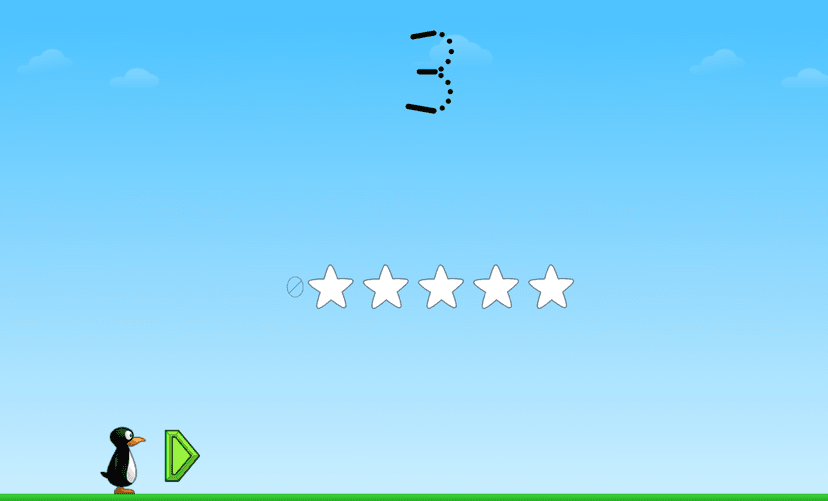
ST Math: Early Learning is a visually driven math platform that effectively builds foundational number sense, though its lack of explicit instruction requires your child to learn through trial and error. The Learning Standard has not yet formally evaluated this app, but its core methodology is built on spatial-temporal reasoning. This means your child will not see numbers, equations, or written instructions initially. Instead, they guide a penguin named JiJi across the screen by solving visual logic puzzles. This approach leverages productive struggle, a learning science principle where learners are challenged to grapple with a problem before being taught the solution. Because there are no verbal or written directions, your child must observe the animations to understand what the puzzle requires. When they make a mistake, the app animates the failure, providing immediate visual feedback so your child can adjust their mental model. While this builds deep conceptual understanding, parents should be prepared to support their children through frustration. The app does not intervene with hints or alternative explanations if your child gets stuck. It is a powerful tool for developing math schemas, but it demands patience and persistence from young learners.
How Does ST Math: Early Learning Work?
ST Math: Early Learning uses a visual-spatial, mastery-based progression system to teach foundational math without relying on language or symbols. When your child logs in, they are presented with a series of animated puzzles that require them to move a penguin character across the screen. To clear the path, they must manipulate visual objects like blocks, balloons, or geometric shapes to balance scales, complete patterns, or represent quantities. Because the interface contains no text or audio instructions, your child must form a hypothesis about how the puzzle works and test it. The learning mechanics center on immediate visual feedback. If your child answers incorrectly, the app plays an animation showing exactly why the mathematical model failed, rather than simply marking a red X. This allows your child to analyze the error and try again. They must master each visual concept before the game introduces traditional mathematical symbols like numerals and operators.
Strengths and tradeoffs of ST Math: Early Learning
The biggest strength of ST Math: Early Learning is its ability to teach complex mathematical concepts entirely without language barriers, while its biggest weakness is the potential for student frustration due to a complete lack of explicit instruction. The app excels at building mental models through spatial-temporal reasoning. By removing text and audio directions, it ensures that a child's reading level or English language proficiency does not bottleneck their math acquisition. The use of immediate visual feedback is another significant strength. When a child makes a mistake, seeing the physical consequence of that error helps them correct their internal schema much more effectively than a generic try again prompt. However, relying exclusively on productive struggle has drawbacks. The app offers no worked examples or hints when a child repeatedly fails. Learning science dictates that while struggle is beneficial, unguided failure without eventual scaffolding can decrease motivation. Additionally, the app lacks a robust system for spaced repetition. Once your child passes a module, they rarely revisit those specific visual puzzles in a structured review, which can limit long-term retention of specific problem-solving strategies.
Who Might Benefit From ST Math: Early Learning?
Best for Pre-K and Transitional Kindergarten students who benefit from visual learning and need to build intuitive number sense without the barrier of written instructions. It is particularly effective for English language learners or children with language processing delays, as the interface relies entirely on spatial manipulation and visual feedback. However, because it requires high tolerance for trial-and-error learning, it is ideal for classrooms or homes where an adult is available to provide emotional support and gentle questioning when the child experiences frustration with the puzzles.
Data Transparency
Does Not Meet Data Transparency Standard
ST Math: Early Learning reaches Level 1 of 3 (Basic protections), below our data transparency standard. Reaching Level 2 needs the policy to document data export, a data retention timeline and self-service deletion.
16 of 35 checks passed
Evaluated September 2026
Privacy Policy →Level 1 · Basic protections
Does not sell data or target ads at students, limits sharing, and lets parents see and delete their child's data.
Level 2 · Parent control (meets the standard)
Families can get their data out, know who processes it, and know how long it is kept.
Not documented: data export, a data retention timeline, self-service deletion
Level 3 · Direct data access
Families or schools can pull their own data through an API, in a stated format.
Not documented: an API for retrieving their own data, a named export format
View all 35 checks
Parent Access6/8
Does the policy mention parents specifically?
“"Users" of our Sites include these Students; authorized representatives of the LEAs, including the Students' teachers ("LEA Representative(s)"); parents / legal guardians of the Students ("Parent(s)"); and other visitors to our websites and mobile applications ("Visitor(s)").”
Can parents view their child's data?
“Parents, legal guardians, and Students aged 13 and above may review the personally identifying information contained in Student Records and may have us correct any erroneous Student Records.”
Can parents modify their child's data?
“Parents, legal guardians, and Students aged 13 and above may review the personally identifying information contained in Student Records and may have us correct any erroneous Student Records.”
Can parents delete their child's account?
“We will terminate use and storage of any personal information contained in Student Records that we have collected for children under 13 following written request from their parent or legal guardian.”
Is there a dedicated Children's Privacy section?
The policy has no separate section headed for children's privacy or COPPA; it mentions COPPA only inside general sections.
Does it reference COPPA compliance?
“The organization is compliant with relevant federal and state legal requirements, including, as a non-limiting example, the federal Family Educational Rights and Privacy Act (20 U.S.C. Sec. 1232g) ("FERPA"), the Children's Online Privacy Protection Act (15 U.S.C. Secs. 6501 – 6506) ("COPPA")”
Does it reference FERPA compliance?
“The organization is compliant with relevant federal and state legal requirements, including, as a non-limiting example, the federal Family Educational Rights and Privacy Act (20 U.S.C. Sec. 1232g) ("FERPA")”
Is parental consent required for child accounts?
The policy says teachers, administrators, or homeschool parents accept the policy on students' behalf, but it does not say parental consent is required to create a child account.
Data Portability1/5
Can users access their personal data?
“Parents, legal guardians, and Students aged 13 and above may review the personally identifying information contained in Student Records and may have us correct any erroneous Student Records.”
Can users download/export their data?
The policy does not offer any way to download or export data.
Is there a self-service data access tool?
The policy has users send access requests by email and mentions only limited account access for updating registration details, not a self-service data access tool.
Is a specific data format mentioned for export?
The policy does not name an export format.
Is there an API for data access?
The policy does not mention an API for data access.
Data Minimization1/6
Is data collection itemized?
“the Student's legal name; name of the Student's teacher; name of the course in which the Software is used, if applicable; the Student's grade in school; the school and school district; the Student's user name and password (in text or and/or pictorial form); date-of-birth; the Student's identifier assigned by the LEA.”
Can the app be used without a real name?
The policy says it receives the student's legal name as part of Student Records.
Can the app be used without an email?
The policy does not explicitly say it collects no student email address.
Does it state collection is limited to what is necessary?
The policy does not say collection is limited to what is necessary.
Is IP address anonymized or truncated?
The policy says IP addresses are logged, with no mention of anonymizing or truncating them.
Is location tracking explicitly excluded?
The policy does not rule out location tracking.
Third-Party Protection6/7
Does it explicitly state no selling of data?
“MIND Education does not provide, sell, trade, or rent personally identifiable information.”
Are third-party providers named?
“Our secure servers, hosted by Amazon Web Services (AWS), are located within North America.”
Are providers contractually restricted?
“MIND Education also contractually requires any of its subcontractors or vendors who are accessing or utilizing such data on its behalf to comply with the requirements of this Privacy Policy pertaining to the use and access of such data.”
No-targeted-advertising commitment?
“MIND/ST Math does not utilize or share any personally identifiable information in student records for the purposes of targeted advertising or other commercial purposes.”
Is AI/ML data sharing addressed?
The policy does not address AI or machine learning.
Child-specific sharing restriction?
“We will not use or share any personal or sensitive information contained in Student Records for commercial purposes unrelated to the operation of the Sites or the services provided to the applicable LEA, Students, parents, or teachers”
Cookies/tracking limited or opt-out?
“Most web browsers automatically accept cookies, but if you prefer, you can set your computer to not accept cookies.”
Deletion & Retention1/5
Can users delete their account?
“We will terminate use and storage of any personal information contained in Student Records that we have collected for children under 13 following written request from their parent or legal guardian.”
Self-service deletion mechanism?
The policy handles deletion only through email or written requests, with no self-service tool.
Specific data retention timeline?
The policy says LEA data is deleted or de-identified within "a reasonable period of time," with no specific timeline.
Auto-deletion of inactive accounts?
The policy does not address automatic deletion of inactive accounts.
Post-deletion handling described?
The policy does not explain how data is handled after deletion, such as in backups; it only says features may stop working once records are removed.
Advertising1/4
Advertising model explicitly disclosed?
The policy only rules out targeted advertising using student records and does not describe the product's advertising model or say it has no ads.
Free from third-party advertisements?
The policy does not say the product is free of third-party advertisements.
Children excluded from ad targeting?
“For the avoidance of doubt, we will not utilize any personally identifiable information in Student Records for the purposes of targeted advertising.”
Ad-free option available?
The policy does not say the product has no ads or offer an ad-free option.
What This Means
The policy review did not meet our data transparency standard. The checks above show the documented findings and unknowns. A missing statement does not establish how the app handles data in practice.
About this evaluation: Based on automated analysis of Privacy Policy against 35 policy-disclosure questions, including questions adapted from the Common Sense Privacy Program's published evaluation questions. TLS is not affiliated with Common Sense Media, and this is not a Common Sense rating. Quoted text is copied from the policy; unquoted notes are our summary. Results describe what the policy documents, not the company's actual practices. Privacy policies can change: this review reflects the version we analyzed and does not determine legal compliance.
Sources and review method
TLS combines product information and editorial analysis to explain how ST Math: Early Learning works, its tradeoffs, and the questions to ask before choosing it. Product features, an instructional rationale and evidence of learning outcomes are different kinds of information.
Formal Learning Standard assessment: not yet completed. Data Transparency findings are reported separately and do not establish learning effectiveness. Read our methodology.
Frequently Asked Questions About ST Math: Early Learning
Is ST Math: Early Learning free?
ST Math: Early Learning is not universally free. Pricing varies, and access is typically purchased by school districts rather than individual parents. You must contact MIND Education directly for specific pricing details. Some families may access it for free if their child's school provides a license.
Is ST Math: Early Learning good for preschoolers?
Yes, it is specifically designed for Pre-K and Transitional Kindergarten. The interface contains no reading or complex verbal instructions, making it highly accessible for early learners who are just developing basic cognitive and motor skills.
What does ST Math: Early Learning teach?
It teaches foundational math concepts including basic counting, subitizing, spatial reasoning, early addition and subtraction concepts, and pattern recognition. It focuses on building visual models of how numbers relate to one another before introducing standard mathematical symbols.
Has ST Math: Early Learning been evaluated by The Learning Standard?
Not yet. This app is currently pending evaluation. The Learning Standard will update this review with quantitative data once experts have formally rated it against educational rubrics. Please refer to The Learning Standard's methodology page to learn how educational effectiveness is evaluated.
ST Math: Early Learning vs Khan Academy Kids: Which is better?
It depends on your child's needs. ST Math focuses exclusively on deep, visual math comprehension through puzzle-solving and productive struggle. Khan Academy Kids is a broader, more traditional app that covers math, reading, and social-emotional learning using direct instruction, voiceovers, and explicit guidance.
Has The Learning Standard evaluated ST Math: Early Learning?
TLS has not yet completed a Learning Standard evaluation of how well ST Math: Early Learning teaches. Its privacy policy has been reviewed for Data Transparency and reaches Level 1, Basic protections.
Is ST Math: Early Learning COPPA compliant?
The reviewed privacy policy references COPPA. A policy reference alone does not establish COPPA compliance. Policy review note: The policy states it complies with COPPA.
Is ST Math: Early Learning FERPA compliant?
The reviewed privacy policy references FERPA. A policy reference alone does not establish FERPA compliance. Policy review note: The policy states it complies with FERPA.
Does ST Math: Early Learning have a children's privacy policy?
No dedicated children's privacy section was found in the reviewed policy. Policy review note: The policy has no separate section headed for children's privacy or COPPA; it mentions COPPA only inside general sections.
Does ST Math: Early Learning sell student data?
The reviewed policy states that the app does not sell data. This is a policy statement; actual data practices were not verified. Policy review note: The vendor states it does not sell personally identifiable information.
Can you delete your data from ST Math: Early Learning?
The reviewed privacy policy describes account deletion. We have not tested the deletion process. Policy review note: A parent's written request ends storage of the child's personal information.
Follow TLS Research
Subscribe to future TLS research updates: app reviews, findings, and what the evidence shows.
Screenshots

Take Action
For ST Math: Early Learning
If you represent MIND Education and have a correction or new evidence, send the relevant source so we can review and update this page.
Submit a correctionDetails
- Pricing
- Pricing varies - contact MIND Education, creators of ST Math for more information
- Platforms
- iOS (Apple mobile), iPadOS (Apple tablet), Windows (Microsoft), macOS (Apple), Chrome OS (Google)
- Grade Levels
- Prekindergarten, Transitional Kindergarten
- Website
- Visit site