
ReadingFluency.app
Product by ReadingFluency.app
Facts checked: Not yet checked
Our take (not a Learning Standard rating). This label applies to learning-science judgments throughout this overview.
Our take (not a Learning Standard rating)
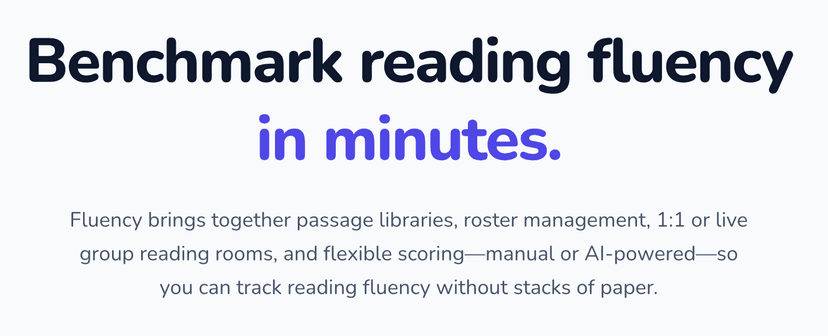
ReadingFluency.app is an assessment tool rather than a direct instructional platform, so it does not teach reading skills independently. However, its immediate AI-powered miscue analysis provides educators with precise, actionable data to target phonics and fluency interventions, supporting a mastery-based approach to literacy development.
Pros
- Provides immediate artificial intelligence-driven miscue analysis to help educators quickly identify specific phonological decoding errors.
- Allows teachers to generate grade-level texts across multiple languages to support diverse learner needs.
- Maintains educator autonomy by allowing teachers to override AI scoring and manually correct fluency data.
- Streamlines MTSS documentation with visual dashboards that track words-per-minute and accuracy progression over time.
Cons
- Functions strictly as an assessment tool and provides no direct instruction or remediation for struggling readers.
- Voice recognition technology frequently struggles with strong regional accents or speech impediments, requiring manual teacher correction.
- Offers no built-in feedback loop for the student to practice specific missed words using spaced repetition.
What Do We Know About ReadingFluency.app?
ReadingFluency.app does not teach your child to read directly, but it acts as a highly effective diagnostic tool for teachers to identify exactly where your child struggles. This platform is designed for classroom educators rather than home use. Instead of offering interactive games or explicit lessons, it simply records your child reading a short passage out loud. The software uses artificial intelligence to calculate words per minute and flag specific pronunciation or decoding errors. Because reading fluency is a critical bridge to reading comprehension, getting this precise data helps teachers personalize your child's instruction. If your child misreads a specific vowel team, the teacher sees exactly what happened and can adjust classroom phonics lessons accordingly. While this app lacks direct instructional features like spaced repetition or phonemic awareness drills, it provides the formative assessment data required for a mastery-based learning progression. Parents should know that any actual learning or improvement will come from the teacher's follow-up instruction, not from interacting with the app itself. The platform simply accelerates the testing process so teachers have more time to focus on targeted intervention.
How Does ReadingFluency.app Work?
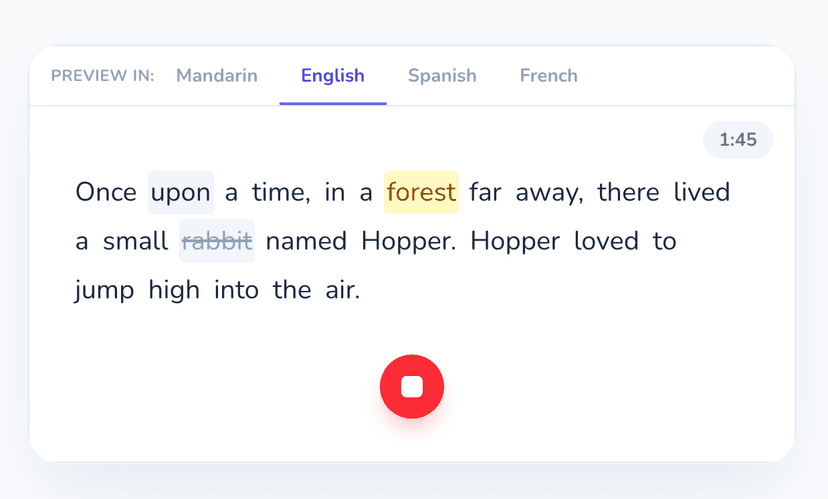
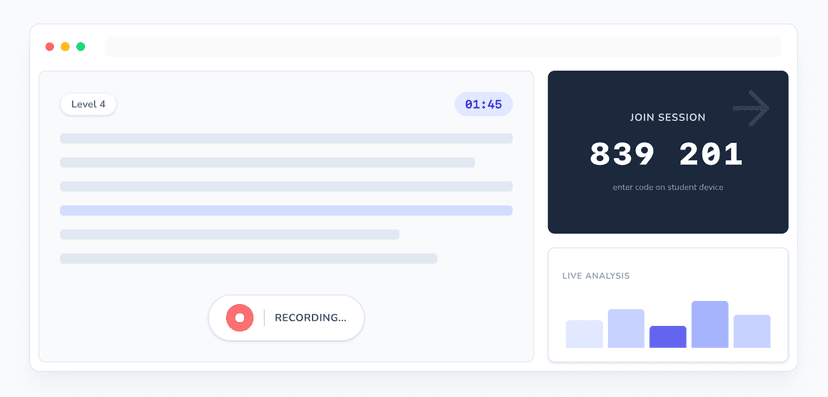
ReadingFluency.app uses a formative assessment model to gather rapid fluency data for personalized learning interventions. Educators generate grade-level reading passages within the platform or use existing texts. Teachers then launch a live or remote session by providing students with a six-digit access code. Students log in on a Chromebook or similar device, read the assigned passage aloud into their microphone, and submit the recording. The platform's AI engine immediately processes the audio. It calculates the student's reading accuracy percentage and words-per-minute rate. More importantly, it performs a word-level miscue analysis, highlighting exactly which words the student skipped, mispronounced, or hesitated on. Teachers review this automated scoring and can override the system if it misinterpreted a student's dialect or background noise. The software then aggregates this data into visual dashboards, allowing schools to track individual and cohort progress over time. This data directly feeds into Multi-Tiered System of Supports documentation, helping educators place students into appropriate instructional tiers based on objective performance metrics.
Strengths and tradeoffs of ReadingFluency.app
The biggest strength of ReadingFluency.app is its instantaneous miscue analysis, while its biggest weakness is the complete lack of student-facing instructional scaffolding. Formative Assessment Acceleration: By automating the time-consuming process of running running records, the app gives teachers immediate, actionable data. Learning science shows that timely, specific feedback is critical for mastery learning. While the app does not give this feedback to the student directly, it arms the teacher with the exact phonetic errors a student makes, allowing for highly targeted classroom retrieval practice. Teacher Autonomy: The platform smartly includes a manual override feature. Artificial intelligence voice recognition often fails to account for regional dialects or speech impediments, so keeping the human educator in the loop ensures data validity. Lack of Direct Remediation: Because the app only tests and does not teach, it misses an opportunity to apply learning science directly to the student experience. There are no worked examples of proper pronunciation, nor is there a spaced repetition system to help students practice the specific words they missed. It is strictly a diagnostic instrument, meaning all pedagogical heavy lifting remains entirely on the teacher's shoulders.
Who Might Benefit From ReadingFluency.app?
ReadingFluency.app is best for K-12 reading interventionists and classroom teachers who need rapid, accurate fluency data to guide MTSS interventions. It is ideal for school districts looking to standardize their oral reading assessments across elementary and middle school grades. While it supports adult education, its most critical use case lies in early elementary grades where phonetic decoding and oral fluency are foundational to future reading comprehension. It is not designed for independent student learning or homeschooling parents seeking a direct phonics tutor.
Data Transparency
Does Not Meet Data Transparency Standard
ReadingFluency.app does not meet our data transparency standard. Its privacy policy does not document basic protections, including a commitment against targeted advertising, contractual limits on service providers and parents' right to see their child's data.
9 of 35 checks passed
Evaluated September 2026
Privacy Policy →Level 1 · Basic protections
Does not sell data or target ads at students, limits sharing, and lets parents see and delete their child's data.
Not documented: a commitment against targeted advertising, contractual limits on service providers, parents' right to see their child's data, parents' right to delete their child's data, account deletion
Level 2 · Parent control (meets the standard)
Families can get their data out, know who processes it, and know how long it is kept.
Not documented: a data retention timeline, named service providers
Level 3 · Direct data access
Families or schools can pull their own data through an API, in a stated format.
Not documented: an API for retrieving their own data, a named export format
View all 35 checks
Parent Access2/8
Does the policy mention parents specifically?
The policy does not mention parents.
Can parents view their child's data?
The policy does not give parents any right to view their child's data.
Can parents modify their child's data?
The policy does not give parents any right to change their child's data.
Can parents delete their child's account?
The policy does not give parents any right to delete their child's data or account.
Is there a dedicated Children's Privacy section?
The policy has only a general "Educational Compliance" section that briefly mentions FERPA and COPPA, and no section about children's privacy.
Does it reference COPPA compliance?
“ReadingFluency.app is designed for use by schools and educators under applicable student privacy requirements, including FERPA and COPPA where those laws apply.”
Does it reference FERPA compliance?
“ReadingFluency.app is designed for use by schools and educators under applicable student privacy requirements, including FERPA and COPPA where those laws apply.”
Is parental consent required for child accounts?
The policy does not address parental consent.
Data Portability3/5
Can users access their personal data?
“You retain control over your classroom data and can add, edit, or delete student records and assessments.”
Can users download/export their data?
“You can export assessment scores and progress monitoring reports where export features are available.”
Is there a self-service data access tool?
“You retain control over your classroom data and can add, edit, or delete student records and assessments.”
Is a specific data format mentioned for export?
The policy mentions exports but does not name a file format.
Is there an API for data access?
The policy does not mention an API for getting data.
Data Minimization1/6
Is data collection itemized?
“**Student roster data:** You may provide student names, grade levels, and language preferences to manage assessment sessions.”
Can the app be used without a real name?
The policy says teachers may provide student names, so real names are collected.
Can the app be used without an email?
The policy does not say that student email addresses are never collected.
Does it state collection is limited to what is necessary?
The policy does not say collection is limited to what is necessary.
Is IP address anonymized or truncated?
The policy says IP addresses are collected but does not say they are anonymized or shortened.
Is location tracking explicitly excluded?
The policy does not address location tracking.
Third-Party Protection2/7
Does it explicitly state no selling of data?
“We do not sell user data to third parties.”
Are third-party providers named?
The policy does not name any third-party providers.
Are providers contractually restricted?
The policy does not describe contract limits on providers.
No-targeted-advertising commitment?
The policy does not address targeted advertising.
Is AI/ML data sharing addressed?
The policy mentions using anonymized, combined data to improve scoring but does not address sharing data with AI or machine-learning providers.
Child-specific sharing restriction?
“Student audio recordings are stored securely and are not shared or exported without your intentional action.”
Cookies/tracking limited or opt-out?
The policy does not address cookies, tracking limits or opting out.
Deletion & Retention1/5
Can users delete their account?
The policy lets users delete student records but does not address deleting the account or all of the user's personal data.
Self-service deletion mechanism?
“You retain control over your classroom data and can add, edit, or delete student records and assessments.”
Specific data retention timeline?
The policy gives no timeline for how long data is kept.
Auto-deletion of inactive accounts?
The policy does not address deleting inactive accounts automatically.
Post-deletion handling described?
The policy does not describe what happens to data after deletion.
Advertising0/4
Advertising model explicitly disclosed?
The policy does not address advertising.
Free from third-party advertisements?
The policy does not address third-party advertising.
Children excluded from ad targeting?
The policy does not address ad targeting of children.
Ad-free option available?
The policy does not address advertising or an ad-free option.
What This Means
The policy review did not meet our data transparency standard. The checks above show the documented findings and unknowns. A missing statement does not establish how the app handles data in practice.
About this evaluation: Based on automated analysis of Privacy Policy against 35 policy-disclosure questions, including questions adapted from the Common Sense Privacy Program's published evaluation questions. TLS is not affiliated with Common Sense Media, and this is not a Common Sense rating. Quoted text is copied from the policy; unquoted notes are our summary. Results describe what the policy documents, not the company's actual practices. Privacy policies can change: this review reflects the version we analyzed and does not determine legal compliance.
Sources and review method
TLS combines product information and editorial analysis to explain how ReadingFluency.app works, its tradeoffs, and the questions to ask before choosing it. Product features, an instructional rationale and evidence of learning outcomes are different kinds of information.
Formal Learning Standard assessment: not yet completed. Data Transparency findings are reported separately and do not establish learning effectiveness. Read our methodology.
Frequently Asked Questions About ReadingFluency.app
Is ReadingFluency.app free?
ReadingFluency.app uses a freemium pricing model. Educators can access basic assessment tools and passage generation at no cost. Advanced features, such as deep district-level MTSS data exporting, long-term data storage, and premium artificial intelligence analysis capabilities, require a paid subscription. Schools should thoroughly evaluate the free tier to see if it meets their basic running record needs before committing district funds to upgrade.
Is ReadingFluency.app good for Kindergarten through 3rd grade?
Yes, it is highly effective for early elementary educators. Kindergarten through third grade represents the critical window for developing oral reading fluency and phonetic decoding skills. The platform allows teachers to generate age-appropriate texts and quickly capture baseline data on early readers. However, very young students may need direct teacher assistance to navigate the six-digit login codes and handle device microphone permissions properly.
What does ReadingFluency.app teach?
ReadingFluency.app does not teach any specific subject directly to students. It functions strictly as an assessment platform designed to measure oral reading fluency, reading accuracy, and words per minute. It identifies phonological and decoding errors by recording a student's voice and analyzing the audio playback. Teachers then use this diagnostic data to inform their own daily humanities and phonics instruction in the classroom setting.
Has The Learning Standard evaluated ReadingFluency.app?
TLS has not yet completed a Learning Standard evaluation of how well ReadingFluency.app teaches. Its privacy policy has been reviewed for Data Transparency and does not yet document the basic protections (Level 1).
Is ReadingFluency.app COPPA compliant?
The reviewed privacy policy references COPPA. A policy reference alone does not establish COPPA compliance. Policy review note: The policy names COPPA as a requirement the product is designed to meet.
Is ReadingFluency.app FERPA compliant?
The reviewed privacy policy references FERPA. A policy reference alone does not establish FERPA compliance. Policy review note: The policy names FERPA as a requirement the product is designed to meet.
Does ReadingFluency.app have a children's privacy policy?
No dedicated children's privacy section was found in the reviewed policy. Policy review note: The policy has only a general "Educational Compliance" section that briefly mentions FERPA and COPPA, and no section about children's privacy.
Does ReadingFluency.app sell student data?
The reviewed policy states that the app does not sell data. This is a policy statement; actual data practices were not verified. Policy review note: The policy states the company does not sell user data.
Can you delete your data from ReadingFluency.app?
Account deletion was not documented in the reviewed privacy policy. This does not establish whether deletion is available. Policy review note: The policy lets users delete student records but does not address deleting the account or all of the user's personal data.
Follow TLS Research
Subscribe to future TLS research updates: app reviews, findings, and what the evidence shows.
Screenshots

Take Action
For ReadingFluency.app
If you represent ReadingFluency.app and have a correction or new evidence, send the relevant source so we can review and update this page.
Submit a correctionDetails
- Pricing
- Freemium
- Platforms
- Web Browser, iOS (Apple mobile), iPadOS (Apple tablet), Android (Google mobile), Windows (Microsoft), macOS (Apple), Chrome OS (Google)
- Grade Levels
- Kindergarten, 1st Grade, 2nd Grade, 3rd Grade, 4th Grade, 5th Grade, 6th Grade, 7th Grade, 8th Grade, 9th Grade, 10th Grade, 11th Grade, 12th Grade, Adult Education
- Website
- Visit site