
Read to Lead
Product by Read to Lead
Facts checked: Not yet checked
Our take (not a Learning Standard rating). This label applies to learning-science judgments throughout this overview.
Our take (not a Learning Standard rating)
While Read to Lead has not yet been formally evaluated by The Learning Standard, its project-based, game-like approach strongly aligns with situated cognition principles. By placing students in workplace scenarios, it effectively anchors literacy and career skills in real-world contexts, though the exact efficacy of its personalized learning mechanics remains pending verification.
Pros
- Places reading comprehension tasks within realistic workplace simulations to leverage situated learning principles.
- Encourages active problem-solving and decision-making rather than passive consumption of disconnected text.
- Integrates career and technical education concepts directly into middle school literacy practice.
- Offers a completely free model that removes access barriers for parents and educators.
Cons
- Lacks explicit phonics or foundational reading instruction for struggling decoders.
- Game-based mechanics may occasionally overshadow the core literacy objectives and distract students from deep reading.
- Detailed effectiveness data regarding long-term skill retention remains unverified by independent reviewers.
What Do We Know About Read to Lead?
Read to Lead appears highly effective for teaching middle school literacy by embedding reading tasks inside virtual workplace simulations, though our formal evaluation is still pending. Your child acts as the "boss" in various career scenarios, making decisions that require them to read, analyze, and synthesize information. This method relies heavily on situated cognition, a learning science principle demonstrating that students retain knowledge better when they learn it in the context where it will be used. Instead of reading disconnected passages and answering multiple-choice questions, your child evaluates staff reports, drafts emails, and solves community problems. This builds authentic reading comprehension and critical thinking skills. Because the platform targets grades 4 through 9, it expects your child to already possess basic decoding abilities. It will not teach a non-reader how to read. Instead, it pushes competent readers to apply their skills to complex, real-world texts. The app also seamlessly introduces career and technical education, exposing your child to fields like applied sciences and humanities. While The Learning Standard has not yet rated this platform, its design avoids the passive scrolling common in many educational apps and forces active cognitive engagement.
How Does Read to Lead Work?
Read to Lead relies on project-based and game-based learning by positioning students as workplace leaders who must read to solve professional challenges. Your child logs into a virtual workplace, such as a medical clinic or a community center, and immediately takes charge. To advance the narrative, they must converse with virtual colleagues, review data reports, and make executive decisions. The mechanics require active reading comprehension. If your child skims or misreads a prompt, their subsequent decisions will negatively impact their virtual business. This forces close reading and text analysis. The platform uses branching narratives, meaning the storyline adapts based on the choices your child makes. This provides immediate, natural consequences for reading errors rather than arbitrary point deductions. By integrating applied science and humanities into these scenarios, the app simultaneously delivers cross-curricular content. The learning engine requires continuous retrieval of information from previously read documents to solve new problems, heavily relying on cognitive load management and active recall.
Strengths and tradeoffs of Read to Lead
The biggest strength of Read to Lead is its use of authentic, scenario-based literacy tasks, while its biggest weakness is the lack of foundational reading support for students who struggle with basic decoding. Situated learning is clearly the app's primary instructional lever. By wrapping text inside career simulations, it gives students a genuine reason to read. This significantly increases engagement and intrinsic motivation for middle schoolers who often resist traditional reading drills. The app also utilizes active retrieval practice. Students cannot simply guess answers; they must pull specific facts from digital memos and reference guides to solve workplace crises. This continuous application of newly acquired information strengthens memory pathways. However, the platform demands a relatively high baseline of reading fluency. Cognitive overload may occur for students reading below a 4th-grade level, as they must simultaneously decode complex vocabulary and navigate the game mechanics. Furthermore, while the branching narratives provide excellent immediate feedback on comprehension failures, they do not offer explicit phonetic or grammatical correction. If a student misunderstands a text, the game shows the negative consequence but does not explicitly teach the missing literacy skill.
Who Might Benefit From Read to Lead?
Read to Lead is best for middle school students in grades 4 through 9 who already possess basic reading skills but need to develop deeper comprehension and critical thinking. It is an excellent tool for parents and educators looking to bridge the gap between traditional literacy instruction and real-world career readiness. Students who are bored by standard reading comprehension worksheets will thrive in this project-based environment. It is particularly useful for classrooms or home-school settings focusing on applied sciences, humanities, or career and technical education.
Sources and review method
TLS combines product information and editorial analysis to explain how Read to Lead works, its tradeoffs, and the questions to ask before choosing it. Product features, an instructional rationale and evidence of learning outcomes are different kinds of information.
Formal Learning Standard assessment: not yet completed. Data Transparency findings are reported separately and do not establish learning effectiveness. Read our methodology.
Frequently Asked Questions About Read to Lead
Is Read to Lead free?
Yes, Read to Lead is completely free for all users. The platform completely removes financial barriers, allowing parents and educators to access its full suite of career-based literacy games without a subscription, hidden fees, or in-app purchases. This makes it an incredibly accessible resource for schools with tight budgets or families looking for high-quality, supplementary educational tools at no cost.
Is Read to Lead good for elementary students?
Read to Lead is highly effective for upper elementary students, specifically those in 4th and 5th grade, but it is entirely inappropriate for early readers. The platform specifically targets grades 4 through 9 and explicitly requires students to already have established decoding and foundational reading skills. Because the gameplay revolves around reading complex workplace memos and making executive decisions, younger students or struggling readers will likely experience cognitive overload rather than meaningful learning.
What does Read to Lead teach?
Read to Lead primarily teaches advanced reading comprehension, critical thinking, and essential career readiness skills. By placing students directly into virtual workplace scenarios as the boss, the app covers diverse subjects like applied science, humanities, and technical education. Crucially, it forces students to continuously synthesize written information, analyze data reports, and make executive decisions that have immediate consequences within the game, thereby reinforcing reading skills through applied practice.
Read to Lead vs. standard reading worksheets: which is better?
Read to Lead is generally far better for building critical thinking and maintaining student engagement than standard reading comprehension worksheets. Traditional worksheets often rely heavily on passive recall and isolated fact-checking, which can quickly demotivate students. In contrast, Read to Lead uses dynamic project-based learning and branching narratives. This approach forces students to actively apply what they just read to solve realistic problems, demonstrating the immediate, real-world utility of literacy skills.
Has The Learning Standard evaluated Read to Lead?
TLS has not yet completed a Learning Standard evaluation of how well Read to Lead teaches. TLS has not published a Data Transparency result for its privacy policy.
Follow TLS Research
Subscribe to future TLS research updates: app reviews, findings, and what the evidence shows.
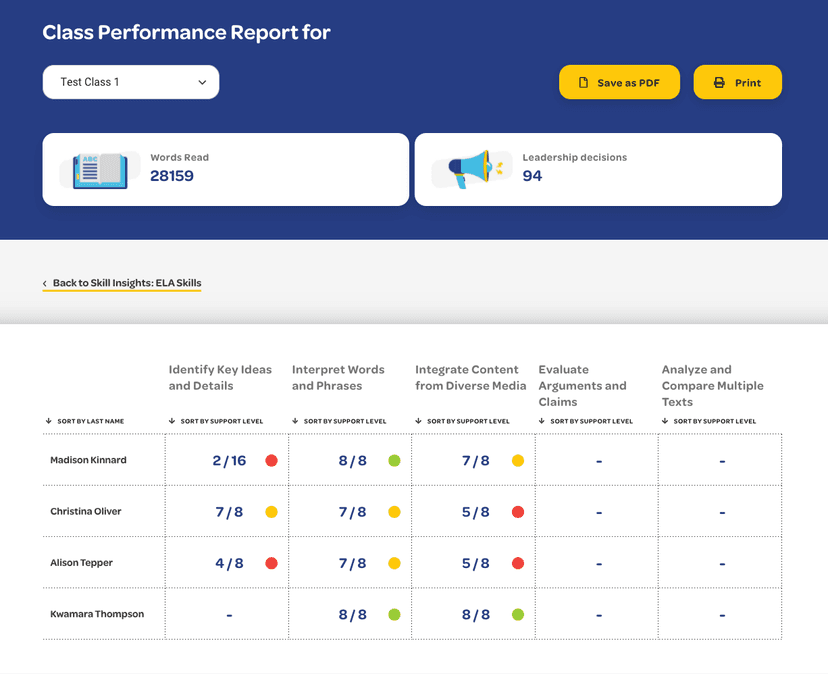
Screenshots

Take Action
For Read to Lead
If you represent Read to Lead and have a correction or new evidence, send the relevant source so we can review and update this page.
Submit a correctionDetails
- Pricing
- Free
- Platforms
- Web Browser
- Grade Levels
- 4th Grade, 5th Grade, 6th Grade, 7th Grade, 8th Grade, 9th Grade
- Website
- Visit site