Persona Life Skills
Product by Persona Education Ltd
Facts checked: Not yet checked
Our take (not a Learning Standard rating). This label applies to learning-science judgments throughout this overview.
Our take (not a Learning Standard rating)
Persona Life Skills provides a structured approach to Social-Emotional Learning by grounding reflection in a personality insights framework. While it utilizes personalized learning to build self-awareness, independent efficacy remains unclear pending full evaluation by The Learning Standard. Its reliance on self-reported assessments limits objective skill mastery verification.
Pros
- Leverages personalized personality profiles to provide contextualized, highly relevant social-emotional learning scenarios.
- Maps curriculum directly to CASEL standards to ensure comprehensive coverage of essential life skills.
- Combines teacher-facilitated discussion modules with self-directed lessons to reinforce concepts across multiple learning environments.
- Utilizes adaptability assessments to measure baseline student capabilities and track perceptual growth over time.
Cons
- Relies heavily on self-reported personality and adaptability assessments which consistently introduce subjective bias.
- Lacks clear evidence of utilizing spaced repetition to ensure long-term retention of behavioral strategies.
- Requires substantial teacher facilitation to maximize impact, making it less effective as a purely independent tool.
- Lacks objective mechanisms for retrieval practice or concrete skill verification beyond self-reflection.
What Do We Know About Persona Life Skills?
Persona Life Skills is an effective supplemental tool for developing your child's social-emotional awareness, though its true impact relies heavily on active discussion rather than independent screen time. The platform revolves around a personality insights framework that helps adolescents understand their own behavioral tendencies and those of their peers. By mapping its lessons to the widely recognized CASEL standards, the program ensures your child encounters structured scenarios related to social, learning, and work-life challenges. Instead of passively absorbing information, your child takes an adaptability assessment and receives a personality profile, which contextualizes the subsequent self-directed and teacher-facilitated modules. From a learning science perspective, this personalization increases relevance and cognitive engagement, making abstract concepts like empathy and resilience more concrete. However, parents should note that self-reported personality assessments are inherently subjective. Your child may answer based on how they wish to be perceived rather than their actual behavior. Furthermore, because it emphasizes cognitive reframing over rote memorization, success cannot be measured by simple right or wrong answers. While The Learning Standard has not yet evaluated its ultimate efficacy in changing long-term behavior, the platform offers a solid, CASEL-aligned starting point for vital conversations about mental wellbeing and employability skills.
How Does Persona Life Skills Work?
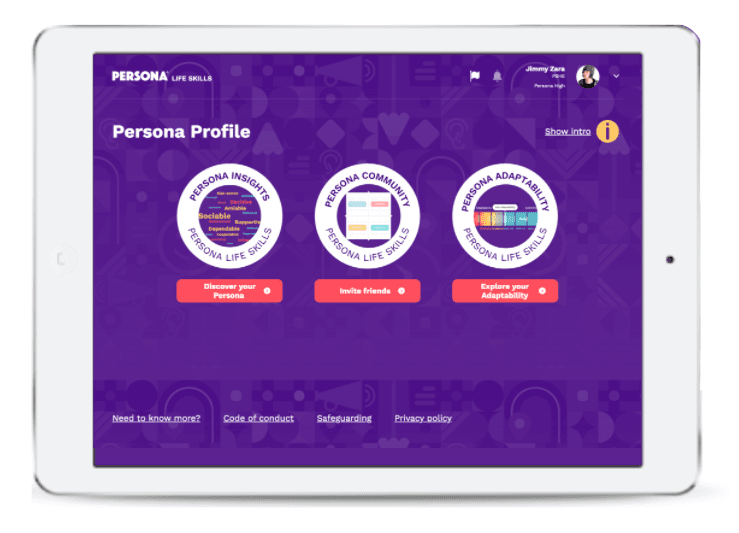
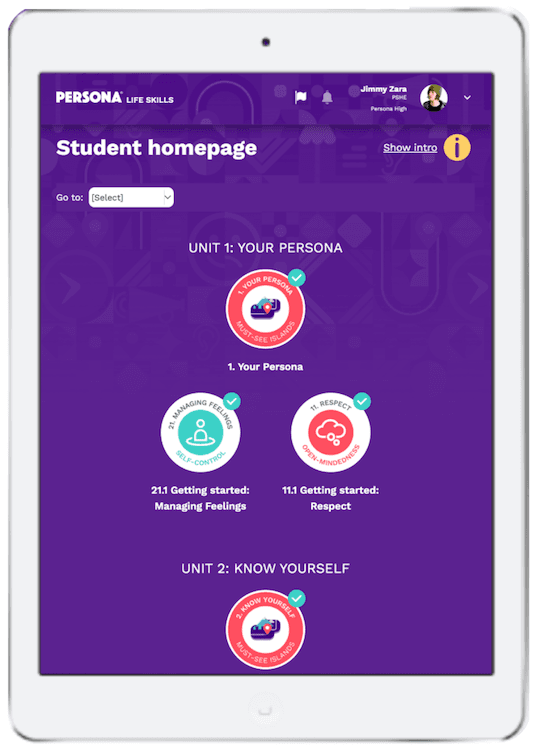
Persona Life Skills uses a blended, personalized learning approach that anchors social-emotional instruction in individual personality profiles. The mechanics begin with an initial adaptability assessment and personality quiz, which generates a unique profile for each student. This profile serves as the cognitive schema through which all subsequent learning is filtered. Students then navigate a combination of teacher-led and self-directed modules designed around specific life challenges, such as handling academic stress or preparing for future careers. The curriculum employs scenario-based learning, asking students to apply their understanding of their own personality traits to hypothetical social conflicts and decision-making exercises. Progress monitoring tools allow educators and parents to track module completion and shifts in the student's self-assessed adaptability over time. By combining direct instruction in the classroom with independent, self-paced reflection, the platform aims to create multiple touchpoints for emotional skill development. While it lacks traditional drill-based mechanics, this framework relies on constructivist learning, encouraging students to actively build their own understanding of emotional intelligence through structured reflection and peer interaction.
Strengths and tradeoffs of Persona Life Skills
The biggest strength of Persona Life Skills is its highly personalized, CASEL-aligned framework, while its biggest weakness is the inherent subjectivity of its self-reported assessment model. On the positive side, utilizing a personality profile as the foundation for learning taps into the schema theory of cognitive science. By connecting new social-emotional concepts to a student's existing understanding of themselves, the platform significantly lowers cognitive load and increases personal relevance. The inclusion of both self-directed modules and teacher-facilitated sessions supports dual-mode instruction, allowing students to process information independently before applying it in social, collaborative settings. However, there are notable pedagogical gaps. Because the platform relies heavily on self-reflection, it lacks objective mechanisms for retrieval practice or concrete skill verification. Students are assessing their own adaptability, which is prone to self-reporting bias and does not guarantee that internal insights will translate to observable behavioral changes. Additionally, there is no evidence of spaced repetition built into the curriculum to ensure that strategies for stress management or conflict resolution are revisited at optimal intervals for long-term memory retention. Ultimately, while it provides excellent worked examples of social scenarios, its efficacy depends heavily on the quality of adult facilitation.
Who Might Benefit From Persona Life Skills?
Persona Life Skills is best for middle and high school students who need structured social-emotional guidance combined with active teacher or parent facilitation. It is specifically designed for adolescents aged 11 to 19 who are navigating the complex social dynamics of secondary education or preparing for early career transitions. Because the curriculum relies on abstract thinking and self-reflection, it requires a baseline level of maturity to yield meaningful results. It is an ideal fit for schools or homeschool groups seeking a formal, CASEL-aligned framework to spark conversations about mental wellbeing, interpersonal conflict, and personal growth.
Data Transparency
Does Not Meet Data Transparency Standard
Persona Life Skills does not meet our data transparency standard. Its privacy policy does not document basic protections, including a statement that it does not sell data, a commitment against targeted advertising and limits on sharing children's data.
10 of 35 checks passed
Evaluated September 2026
Privacy Policy →Level 1 · Basic protections
Does not sell data or target ads at students, limits sharing, and lets parents see and delete their child's data.
Not documented: a statement that it does not sell data, a commitment against targeted advertising, limits on sharing children's data, contractual limits on service providers
Level 2 · Parent control (meets the standard)
Families can get their data out, know who processes it, and know how long it is kept.
Not documented: a data retention timeline, self-service deletion
Level 3 · Direct data access
Families or schools can pull their own data through an API, in a stated format.
Not documented: an API for retrieving their own data, a named export format
View all 35 checks
Parent Access5/8
Does the policy mention parents specifically?
“You have the right to request access to your personal information and receive a copy of the data we hold about you, if you are 13 or older. If you are under 13, your parent/guardian has the same right on your behalf.”
Can parents view their child's data?
“You have the right to request access to your personal information and receive a copy of the data we hold about you, if you are 13 or older. If you are under 13, your parent/guardian has the same right on your behalf.”
Can parents modify their child's data?
“Request correction of the personal information that we hold about you. This enables you to have any incomplete or inaccurate information we hold about you corrected.”
Can parents delete their child's account?
“Request your personal information to be erased. This enables you to ask us to delete or remove personal information where there is no good reason for us continuing to process it.”
Is there a dedicated Children's Privacy section?
The policy has no section with its own heading on children's privacy; COPPA appears only in the introductory compliance statement.
Does it reference COPPA compliance?
“the [US Children's Online Privacy Protection Rule](https://www.ecfr.gov/current/title-16/chapter-I/subchapter-C/part-312)implementing the Children's Online Privacy Protection Act of 1998 (COPPA).”
Does it reference FERPA compliance?
The policy does not mention FERPA.
Is parental consent required for child accounts?
The policy mentions verifying age but does not say parental consent is required for child accounts.
Data Portability2/5
Can users access their personal data?
“You have the right to request access to your personal information and receive a copy of the data we hold about you, if you are 13 or older.”
Can users download/export their data?
“You have the right to request access to your personal information and receive a copy of the data we hold about you, if you are 13 or older.”
Is there a self-service data access tool?
The policy describes access only by request, with no self-service tool.
Is a specific data format mentioned for export?
The policy does not name any export format.
Is there an API for data access?
The policy mentions API Licensing partners but no API that lets users retrieve their own data.
Data Minimization1/6
Is data collection itemized?
“Identity Data: First name, last name, email address(es), date of birth, your school/college, school/college year or grade, gender, and country of residence.”
Can the app be used without a real name?
The policy says it collects first and last name.
Can the app be used without an email?
The policy says it collects email addresses.
Does it state collection is limited to what is necessary?
The policy says data is relevant to its stated purposes and kept only as long as necessary, but does not say collection is limited to what is necessary.
Is IP address anonymized or truncated?
The policy says it collects IP addresses and does not mention anonymizing them.
Is location tracking explicitly excluded?
The policy lists time zone setting and location as collected Technical Data.
Third-Party Protection1/7
Does it explicitly state no selling of data?
The policy does not state that the company does not sell data.
Are third-party providers named?
“Your personal information is stored in the UK, on the Google Cloud Platform (GCP).”
Are providers contractually restricted?
The policy does not describe any contractual limits on providers or partners.
No-targeted-advertising commitment?
The policy does not address targeted advertising.
Is AI/ML data sharing addressed?
The policy does not address sharing data for AI or machine learning.
Child-specific sharing restriction?
The policy has no sharing restrictions specific to children.
Cookies/tracking limited or opt-out?
The policy does not address cookies, tracking limits, or opt-outs.
Deletion & Retention1/5
Can users delete their account?
“Request your personal information to be erased. This enables you to ask us to delete or remove personal information where there is no good reason for us continuing to process it.”
Self-service deletion mechanism?
The policy describes deletion only by request, with no self-service mechanism.
Specific data retention timeline?
The policy says data is kept only as long as necessary but gives no specific timeline.
Auto-deletion of inactive accounts?
The policy does not address automatic deletion of inactive accounts.
Post-deletion handling described?
The policy does not describe what happens to data after deletion.
Advertising0/4
Advertising model explicitly disclosed?
The policy does not address advertising.
Free from third-party advertisements?
The policy does not address third-party advertising.
Children excluded from ad targeting?
The policy does not address ad targeting of children.
Ad-free option available?
The policy does not address advertising or an ad-free option.
What This Means
The policy review did not meet our data transparency standard. The checks above show the documented findings and unknowns. A missing statement does not establish how the app handles data in practice.
About this evaluation: Based on automated analysis of Privacy Policy against 35 policy-disclosure questions, including questions adapted from the Common Sense Privacy Program's published evaluation questions. TLS is not affiliated with Common Sense Media, and this is not a Common Sense rating. Quoted text is copied from the policy; unquoted notes are our summary. Results describe what the policy documents, not the company's actual practices. Privacy policies can change: this review reflects the version we analyzed and does not determine legal compliance.
Sources and review method
TLS combines product information and editorial analysis to explain how Persona Life Skills works, its tradeoffs, and the questions to ask before choosing it. Product features, an instructional rationale and evidence of learning outcomes are different kinds of information.
Formal Learning Standard assessment: not yet completed. Data Transparency findings are reported separately and do not establish learning effectiveness. Read our methodology.
Frequently Asked Questions About Persona Life Skills
Is Persona Life Skills free?
No, Persona Life Skills is not free. It requires a paid annual subscription, offering specific packages for schools, groups, and homeschool environments. The dedicated homeschool package covers two parent or tutor accounts alongside three student accounts for a flat yearly fee. School pricing scales dynamically based on student enrollment numbers, providing access to dozens of teacher-facilitated and self-directed modules.
Is Persona Life Skills good for high school students?
Yes, the platform is highly effective and explicitly designed for adolescents aged 11 to 19. The scenarios, language, and challenges are carefully calibrated to be age-appropriate for middle school, high school, and early college students. The curriculum focuses heavily on mature, real-world themes like future employability, academic stress management, and complex social dynamics that younger children would not yet understand.
What does Persona Life Skills teach?
Persona Life Skills teaches core Social-Emotional Learning competencies strictly aligned with the recognized CASEL framework. It focuses on developing vital interpersonal and intrapersonal skills including self-awareness, self-management, social awareness, relationship skills, and responsible decision-making. The platform approaches these subjects through the unique lens of a personality insights framework, helping adolescents understand their own behavioral tendencies when facing real-world challenges.
Persona Life Skills vs. Everyday Speech: Which is better?
Persona Life Skills and Everyday Speech serve completely different pedagogical needs. Everyday Speech relies heavily on direct video modeling and targeted social skills practice, making it highly effective for neurodivergent learners who need concrete behavioral examples. Conversely, Persona Life Skills uses abstract personality profiling and self-reflection geared toward a broader general education audience. Choose Persona for broad self-discovery, and Everyday Speech for explicit behavioral modeling.
Has The Learning Standard evaluated Persona Life Skills?
TLS has not yet completed a Learning Standard evaluation of how well Persona Life Skills teaches. Its privacy policy has been reviewed for Data Transparency and does not yet document the basic protections (Level 1).
Is Persona Life Skills COPPA compliant?
The reviewed privacy policy references COPPA. A policy reference alone does not establish COPPA compliance. Policy review note: The policy claims compliance with COPPA.
Is Persona Life Skills FERPA compliant?
A FERPA reference was not found in the reviewed privacy policy. This does not determine whether the app complies with FERPA. Policy review note: The policy does not mention FERPA.
Does Persona Life Skills have a children's privacy policy?
No dedicated children's privacy section was found in the reviewed policy. Policy review note: The policy has no section with its own heading on children's privacy; COPPA appears only in the introductory compliance statement.
Does Persona Life Skills sell student data?
A statement ruling out data selling was not found in the reviewed policy. This does not establish that the app sells student data. Policy review note: The policy does not state that the company does not sell data.
Can you delete your data from Persona Life Skills?
The reviewed privacy policy describes account deletion. We have not tested the deletion process. Policy review note: Users can request erasure of their personal information.
Follow TLS Research
Subscribe to future TLS research updates: app reviews, findings, and what the evidence shows.
Screenshots

Take Action
For Persona Life Skills
If you represent Persona Education Ltd and have a correction or new evidence, send the relevant source so we can review and update this page.
Submit a correctionDetails
- Pricing
- Group package for 1 teacher and up to 30 students: USD237 per year. Wellbeing, Academic support or Careers theme. 10 teacher-facilitated modules. 66 self-directed modules. Personality profile. Adaptability assessment. Student progress monitoring. Teacher training module. School subscription: From USD2,381 per year for 100 students. Priced by number of students, discounted by up to 67% as number of students increases. Unlimited free Teacher accounts. 21 teacher-facilitated modules. 66 self-directed modules. Personality profile. Adaptability assessment. Community map. Progress monitoring and reporting. Teacher training module. Additional discounts up to 25% for a two or three year contract. Home School package for 2 parents/tutors and 3 students: USD149 per year. 20 life challenge modules. 66 life skills modules. Personality profile. Adaptability assessment. Student progress monitoring. Parent/Tutor introduction module.
- Platforms
- Web Browser
- Grade Levels
- 6th Grade, 7th Grade, 8th Grade, 9th Grade, 10th Grade, 11th Grade, 12th Grade, Associate's degree
- Website
- Visit site