MLC Number Line
Product by The Math Learning Center
Facts checked: Not yet checked
Our take (not a Learning Standard rating). This label applies to learning-science judgments throughout this overview.
Our take (not a Learning Standard rating)
MLC Number Line operates as a digital manipulative rather than an instructional platform. It effectively supports spatial representation of mathematics, a core component of cognitive learning theory, but provides no direct instruction, structured practice, or feedback. Its effectiveness depends entirely on the educator or parent guiding the lesson.
Pros
- Provides interactive visual models that bridge the gap between concrete manipulatives and abstract mathematical concepts.
- Allows customization of intervals, including fractions and decimals, supporting advanced number sense development.
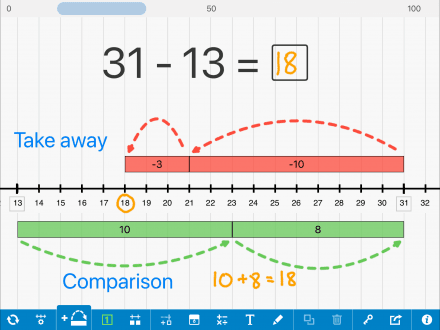
- Features jump drawing tools that visually represent the cognitive steps of addition, subtraction, multiplication, and division.
- Offers a distraction-free interface with no gamification or extrinsic rewards to derail working memory.
Cons
- Lacks any built-in curriculum, direct instruction, or guided practice sets.
- Provides zero corrective feedback on student errors, requiring a human instructor to monitor accuracy.
- Does not utilize spaced repetition, retrieval practice, or any automated tracking of student mastery.
What Do We Know About MLC Number Line?
MLC Number Line is only effective for learning when actively guided by a parent or teacher, as it is an open-ended digital whiteboard rather than a teaching program. Unlike math apps that provide structured lessons and independent practice, this tool offers no curriculum, questions, or automated feedback. Your child cannot simply open the app and learn math independently. Instead, it serves as a powerful visual aid for spatial representation. Cognitive science shows that visualizing mathematical intervals helps reduce working memory load when learning complex operations like adding fractions or calculating with negative numbers. You will need to provide the math problems and guide your child on how to map those problems onto the number line. For example, if your child struggles with subtraction, you can use the app to visually draw jumps backward on the line, making the abstract concept of taking away highly visible. Because The Learning Standard has not yet formally evaluated this app, we cannot provide quantitative data on its learning outcomes. However, its value lies entirely in how you utilize it to supplement traditional homework or direct instruction.
How Does MLC Number Line Work?
MLC Number Line uses a concrete-representational-abstract instructional approach by providing an open digital sandbox for visualizing number sequences. The app functions as a blank, highly customizable digital manipulative. Users select a base number line choosing from whole numbers, fractions, decimals, or negative numbers and adjust the spacing and tick marks to suit the specific math problem at hand. The core mechanic involves drawing customizable jumps above or below the line to represent mathematical operations. A forward jump of five visually demonstrates addition, while repeated jumps of three illustrate multiplication. Users can label these jumps with values or hide the labels to quiz themselves. There are no levels to beat, points to earn, or algorithms adapting to user input. Instead, the interface provides text, drawing, and equation tools to annotate the workspace. This design forces the user to actively construct their own mathematical models, a process that relies heavily on educator direction to ensure accurate representation of the target concepts.
Strengths and tradeoffs of MLC Number Line
The biggest strength of MLC Number Line is its highly adaptable visual interface for modeling abstract math concepts, while its biggest weakness is the complete absence of independent instructional scaffolding. Spatial Representation: The app excels at translating abstract algorithms into visual formats. By allowing students to manually manipulate intervals and draw jumps across fractions or negative numbers, it effectively supports the dual-coding theory of learning, which suggests that combining verbal or written math with visual models enhances retention. Lack of Retrieval Practice: Because it is an open-ended tool, the app contains no built-in problem sets. It cannot test a student's knowledge, meaning it does not facilitate retrieval practice or spaced repetition, which are two of the most effective methods for long-term knowledge retention. Absence of Feedback Loops: The tool will not correct a student who draws an inaccurate jump or mislabels a fraction. Without immediate, corrective feedback, students working independently risk reinforcing misconceptions. Cognitive Load: The interface is clean and entirely free of gamified distractions. This minimal design effectively protects a student's working memory, keeping all cognitive resources focused strictly on the mathematical task at hand.
Who Might Benefit From MLC Number Line?
MLC Number Line is best for educators and highly involved parents who need a robust visual modeling tool to explain math concepts during active instruction. It is appropriate for students of all ages, from early elementary students learning basic addition to middle schoolers graphing negative numbers and complex fractions. It serves as an excellent companion tool for classroom whiteboards or one-on-one tutoring sessions. However, it is not recommended for parents seeking an app to independently occupy and teach their child, as it requires constant adult facilitation to be instructionally useful.
Data Transparency
Does Not Meet Data Transparency Standard
MLC Number Line does not meet our data transparency standard. Its privacy policy does not document basic protections, including limits on sharing children's data, a COPPA or FERPA commitment and parents' right to see their child's data.
13 of 35 checks passed
Evaluated September 2026
Apps Privacy Statement →Level 1 · Basic protections
Does not sell data or target ads at students, limits sharing, and lets parents see and delete their child's data.
Not documented: limits on sharing children's data, a COPPA or FERPA commitment, parents' right to see their child's data, parents' right to delete their child's data
Level 2 · Parent control (meets the standard)
Families can get their data out, know who processes it, and know how long it is kept.
Not documented: self-service deletion
Level 3 · Direct data access
Families or schools can pull their own data through an API, in a stated format.
Not documented: an API for retrieving their own data, a named export format
View all 35 checks
Parent Access0/8
Does the policy mention parents specifically?
The policy does not mention parents.
Can parents view their child's data?
The policy does not give parents any right to view their child's data.
Can parents modify their child's data?
The policy does not give parents any right to modify their child's data.
Can parents delete their child's account?
The policy does not give parents any right to delete their child's data or account.
Is there a dedicated Children's Privacy section?
The policy has no section about children's privacy or COPPA.
Does it reference COPPA compliance?
The policy does not mention COPPA.
Does it reference FERPA compliance?
The policy does not mention FERPA.
Is parental consent required for child accounts?
The policy does not address parental consent for child accounts.
Data Portability2/5
Can users access their personal data?
“If you wish to access, correct, update, or request deletion of your personal information, you can do so at any time as described in the “Updating & Correcting Personal Information” heading below.”
Can users download/export their data?
“In addition, you can object to processing of your personal information, ask us to restrict processing of your personal information, or request portability of your personal information. You can exercise these rights by contacting us at MLCinfo@mathlearningcenter.org.”
Is there a self-service data access tool?
The policy handles data access requests by email and describes no self-service access tool.
Is a specific data format mentioned for export?
The policy names no export format.
Is there an API for data access?
The policy does not describe an API for data access.
Data Minimization3/6
Is data collection itemized?
“some of the specific information we may collect automatically when you visit the Website includes usage data, such as the date and time of visit, duration of visit, type of web browser used, operating system/platform used, your IP address or mobile device ID, the websites from which you linked to the Website, and your CPU speed.”
Can the app be used without a real name?
“We will never ask you to provide us with your or someone else’s personal information in order to access, or while you are using, the Apps.”
Can the app be used without an email?
“We will never ask you to provide us with your or someone else’s personal information in order to access, or while you are using, the Apps.”
Does it state collection is limited to what is necessary?
The policy lists legal bases for processing but does not say collection is limited to what is necessary.
Is IP address anonymized or truncated?
The policy says IP addresses are collected and does not say they are anonymized or truncated.
Is location tracking explicitly excluded?
The policy says aggregated regional location data of App users is collected.
Third-Party Protection5/7
Does it explicitly state no selling of data?
“Except in the limited circumstances stated in this Privacy Statement, we do not share, sell, or otherwise transfer or disclose your personal information to any third party.”
Are third-party providers named?
“Google Analytics™: We use Google Analytics™ on our Website to gather usage data from our Website, including our Web Apps.”
Are providers contractually restricted?
“These third parties are required to keep the information confidential and are not authorized to process your personal information or Automatically Collected Information for any other purpose other than as instructed by us.”
No-targeted-advertising commitment?
“We do not use any advertising, targeting, or marketing cookies on our Website or Apps.”
Is AI/ML data sharing addressed?
The policy does not address AI or machine learning.
Child-specific sharing restriction?
The policy has no sharing restriction specific to children.
Cookies/tracking limited or opt-out?
“Most browsers allow you to refuse to accept cookies and to delete cookies, though the methods for doing so may vary from browser to browser.”
Deletion & Retention3/5
Can users delete their account?
“If you wish to access, correct, update, or request deletion of your personal information, you can do so at any time as described in the “Updating & Correcting Personal Information” heading below.”
Self-service deletion mechanism?
The policy handles deletion by email request and describes no self-service deletion tool.
Specific data retention timeline?
“Currently, Save States are set to automatically delete after two years from their last date of access.”
Auto-deletion of inactive accounts?
The policy auto-deletes only inactive Save States, not inactive accounts.
Post-deletion handling described?
“When we have no ongoing legitimate business need to process your personal information, we will either delete it or anonymize it, or, if this is not possible (for example, because your personal information has been stored in backup archives), then we will securely store your personal information and isolate it from any further processing until deletion is possible.”
Advertising0/4
Advertising model explicitly disclosed?
The policy says it uses no advertising cookies but does not explicitly say the product has no advertising.
Free from third-party advertisements?
The policy says it uses no advertising cookies but does not explicitly say the product has no third-party ads.
Children excluded from ad targeting?
The policy does not say anything specific about excluding children from ad targeting.
Ad-free option available?
The policy does not explicitly say the product has no advertising or offer an ad-free option.
What This Means
The policy review did not meet our data transparency standard. The checks above show the documented findings and unknowns. A missing statement does not establish how the app handles data in practice.
About this evaluation: Based on automated analysis of Apps Privacy Statement against 35 policy-disclosure questions, including questions adapted from the Common Sense Privacy Program's published evaluation questions. TLS is not affiliated with Common Sense Media, and this is not a Common Sense rating. Quoted text is copied from the policy; unquoted notes are our summary. Results describe what the policy documents, not the company's actual practices. Privacy policies can change: this review reflects the version we analyzed and does not determine legal compliance.
Sources and review method
TLS combines product information and editorial analysis to explain how MLC Number Line works, its tradeoffs, and the questions to ask before choosing it. Product features, an instructional rationale and evidence of learning outcomes are different kinds of information.
Formal Learning Standard assessment: not yet completed. Data Transparency findings are reported separately and do not establish learning effectiveness. Read our methodology.
Frequently Asked Questions About MLC Number Line
Is MLC Number Line free?
Yes, MLC Number Line is completely free. The Math Learning Center provides it as a complimentary digital manipulative without in-app purchases, subscription fees, or third-party advertisements.
Is MLC Number Line good for elementary students?
MLC Number Line is highly effective for elementary students when used alongside adult instruction. It helps young learners transition from counting physical objects to understanding abstract numbers by visually mapping out addition, subtraction, and basic fractions.
What does MLC Number Line teach?
MLC Number Line does not independently teach any curriculum. Instead, it provides a digital environment to illustrate mathematical operations like counting, comparing, adding, subtracting, multiplying, and dividing across whole numbers, fractions, decimals, and negative numbers.
Does MLC Number Line provide feedback on incorrect answers?
No, MLC Number Line provides zero automated feedback. It is an open-ended digital whiteboard. If your child models a math problem incorrectly, the app will not flag the error, requiring a parent or teacher to check the work for accuracy.
Has The Learning Standard evaluated MLC Number Line?
TLS has not yet completed a Learning Standard evaluation of how well MLC Number Line teaches. Its privacy policy has been reviewed for Data Transparency and does not yet document the basic protections (Level 1).
Is MLC Number Line COPPA compliant?
A COPPA reference was not found in the reviewed privacy policy. This does not determine whether the app complies with COPPA. Policy review note: The policy does not mention COPPA.
Is MLC Number Line FERPA compliant?
A FERPA reference was not found in the reviewed privacy policy. This does not determine whether the app complies with FERPA. Policy review note: The policy does not mention FERPA.
Does MLC Number Line have a children's privacy policy?
No dedicated children's privacy section was found in the reviewed policy. Policy review note: The policy has no section about children's privacy or COPPA.
Does MLC Number Line sell student data?
The reviewed policy states that the app does not sell data. This is a policy statement; actual data practices were not verified. Policy review note: The policy states MLC does not sell personal information.
Can you delete your data from MLC Number Line?
The reviewed privacy policy describes account deletion. We have not tested the deletion process. Policy review note: Users can ask for their personal information to be deleted.
Follow TLS Research
Subscribe to future TLS research updates: app reviews, findings, and what the evidence shows.
Screenshots
Take Action
For MLC Number Line
If you represent The Math Learning Center and have a correction or new evidence, send the relevant source so we can review and update this page.
Submit a correction