
MathFactLab
Product by MathFactLab
Facts checked: Not yet checked
Our take (not a Learning Standard rating). This label applies to learning-science judgments throughout this overview.
Our take (not a Learning Standard rating)
While The Learning Standard has not yet formally evaluated MathFactLab, its core design aligns with established learning science principles. By utilizing visual models like ten frames and area models instead of mere rote memorization, it helps students build mathematical fluency through cognitive scaffolding and mastery-based progression.
Pros
- Uses visual scaffolding such as area models and ten frames to build conceptual understanding before moving to abstract recall.
- Employs mastery-based progression to ensure foundational facts are learned before introducing complex variations.
- Connects new mathematical facts to previously mastered concepts, reducing cognitive load during learning.
Cons
- Currently restricted to school or district purchasing, making it inaccessible for individual parents or homeschoolers.
- Focuses exclusively on basic fact fluency rather than comprehensive grade-level mathematics instruction.
- Visual strategy tools may feel elementary or patronizing to older students in high school grades.
What Do We Know About MathFactLab?
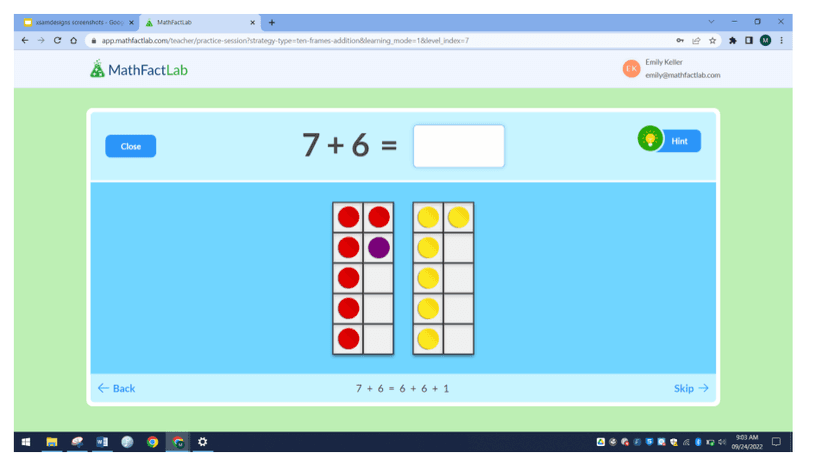
MathFactLab is an effective tool for building foundational math fluency, but it is currently only available through school or district licenses. Your child will not be drilling isolated flashcards in this program. Instead, the software emphasizes strategy-based practice, relying heavily on visual aids like bar diagrams, dice, and ten frames to build a conceptual understanding of numbers. This approach aligns well with cognitive science, specifically schema building, where new knowledge is anchored to previously mastered facts. For example, rather than simply memorizing 6x7, your child learns how to derive it from 5x7 plus one more group of 7. Because it is a mastery-based system, your child must demonstrate consistent success before the app introduces more difficult problem sets. This prevents students from rushing through material without truly absorbing it. However, because it is an enterprise-only application requiring a minimum purchase of fifty licenses, parents cannot buy a standalone subscription for home use. You will only see this app if your child's teacher adopts it for classroom practice. While it lists compatibility up to 12th grade, the heavy reliance on elementary visual manipulatives may limit engagement for older adolescents.
How Does MathFactLab Work?
MathFactLab uses mastery-based progression combined with visual scaffolding to teach basic arithmetic facts. The app replaces traditional rote memorization with strategy-based practice sessions. When your child logs in, they are presented with visual representations of math problems using tools like area models, ten frames, and bar diagrams. These manipulatives force the student to visualize the mathematical relationship rather than just guessing the answer. As your child demonstrates mastery of specific number families, the app gradually fades the visual supports, requiring independent retrieval practice. New facts are introduced by explicitly connecting them to facts the student has already mastered. For instance, addition strategies might build upon known doubles facts. This deliberate scaffolding reduces cognitive load and strengthens neural pathways for long-term retention. Students progress at their own pace, and the system dynamically adjusts the practice sets based on their demonstrated competency.
Strengths and tradeoffs of MathFactLab
MathFactLab's biggest strength is its use of visual conceptual models to build mathematical fluency, while its biggest weakness is its lack of consumer availability for individual families. The emphasis on visual scaffolding is highly supported by learning science. By requiring students to interact with area models and ten frames, the app moves beyond simple rote memorization and encourages deep cognitive processing. This helps students build mental schemas that make future math concepts easier to grasp. The mastery-based learning model ensures that students engage in adequate retrieval practice before moving forward, which is essential for long-term retention. However, the platform is strictly designed for institutional use. With a minimum purchase of 50 licenses, it shuts out parents looking for a supplementary tool to use at home. Additionally, the visual design and mechanics lean heavily toward elementary education. While the developer lists support through 12th grade, older students requiring remediation may find the interface and manipulatives overly juvenile, potentially impacting their motivation to engage with the practice sets.
Who Might Benefit From MathFactLab?
MathFactLab is best for elementary and middle school classrooms that need a structured, conceptual approach to teaching arithmetic fluency. Because it requires a school-wide or district-wide implementation, it serves as a supplementary tool for teachers rather than a standalone curriculum for parents. It is particularly effective for students in grades 2 through 6 who struggle with traditional flashcard memorization and benefit from visual manipulatives like bar diagrams and area models. While the content scales to high school, the core mechanics are most appropriate for younger learners building foundational number sense or special education students requiring concrete visual supports to grasp abstract mathematical relationships.
Data Transparency
Does Not Meet Data Transparency Standard
MathFactLab reaches Level 1 of 3 (Basic protections), below our data transparency standard. Reaching Level 2 needs the policy to document data export, named service providers and self-service deletion.
23 of 35 checks passed
Evaluated September 2026
Privacy Policy →Level 1 · Basic protections
Does not sell data or target ads at students, limits sharing, and lets parents see and delete their child's data.
Level 2 · Parent control (meets the standard)
Families can get their data out, know who processes it, and know how long it is kept.
Not documented: data export, named service providers, self-service deletion
Level 3 · Direct data access
Families or schools can pull their own data through an API, in a stated format.
Not documented: an API for retrieving their own data, a named export format
View all 35 checks
Parent Access8/8
Does the policy mention parents specifically?
“This Privacy Policy addresses how we collect, process and use personal information related to our website visitors, our customers, and our platform users(including students, teachers, and parents).”
Can parents view their child's data?
“To access or delete a Child User’s account, please contact us as provided in the “Contact Us” section below. Please note that you will need the Child User’s username, and we may take steps to authenticate your identity before we respond to your request.”
Can parents modify their child's data?
“HOW TO ACCESS, MODIFY, AND DELETE CHILD USER ACCOUNTS.”
Can parents delete their child's account?
“If you are a Parent and discover that your child under the age of 13 has an account with MathLabFact without consent, please contact us as provided in the “Contact Us” section and request that we delete that child’s personal information from our systems.”
Is there a dedicated Children's Privacy section?
“CHILDREN’S PRIVACY NOTICE”
Does it reference COPPA compliance?
“The Children’s Online Privacy Protection Act (COPPA) is a federal law designed to protect the privacy of individuals under 13 years old (“child” or “children”). MathFactLab’s Site complies with COPPA.”
Does it reference FERPA compliance?
“Consequently, before a school/district enters, uploads, or accesses any data concerning a minor student, the school/district must confirm that it has (1) obtained appropriate consent from the parent or guardian of that student, or (2) determined that one of the limited exceptions to the consent requirement applies.”
Is parental consent required for child accounts?
“The Parent must provide Parental consent for the Child User to use the Site when creating the Child User’s account.”
Data Portability1/5
Can users access their personal data?
“Right to access personal information we have about you;”
Can users download/export their data?
The policy does not offer any way to download or export data.
Is there a self-service data access tool?
The policy says rights are exercised by email or post and describes no self-service tool.
Is a specific data format mentioned for export?
The policy does not name any export format.
Is there an API for data access?
The policy does not mention an API for data access.
Data Minimization2/6
Is data collection itemized?
“Student Activity and Usage Information: When a student registers and interacts with our platform, we collect information such as the classes they participate in, class codes, assigned grades, usage data, fluency rates, responses to questions, and the number of incorrect answers.”
Can the app be used without a real name?
The policy says schools may enter students' full names in the record for each user.
Can the app be used without an email?
The policy says it may collect parent or school-related email addresses when child accounts are created.
Does it state collection is limited to what is necessary?
“We do not ask for more information than is necessary to provide the Site to the Child User.”
Is IP address anonymized or truncated?
The policy says it collects IP addresses and does not mention anonymizing or truncating them.
Is location tracking explicitly excluded?
The policy says it collects geo-location on a country/city basis.
Third-Party Protection5/7
Does it explicitly state no selling of data?
“We do not sell your personal information to third parties.”
Are third-party providers named?
The policy describes service providers only by category, such as analytics and payment, without naming them.
Are providers contractually restricted?
“When we use third-party service providers as described above, we enter into Service agreements and data processing agreements with these third parties.”
No-targeted-advertising commitment?
“We do not collect or use your personal information for personalized advertising.”
Is AI/ML data sharing addressed?
The policy does not address AI or machine learning.
Child-specific sharing restriction?
“MathFactLab does not sell or disclose Child User Personal Information for sale, direct marketing purposes, or targeted advertising purposes.”
Cookies/tracking limited or opt-out?
“Most web browsers accept cookies by default. However, you may be able to set your browser to remove or reject cookies.”
Deletion & Retention3/5
Can users delete their account?
“Right to ask for deletion of your personal information;”
Self-service deletion mechanism?
The policy only offers deletion by contacting the vendor or the school.
Specific data retention timeline?
“Log Information: We retain your log information for 14 months.”
Auto-deletion of inactive accounts?
The policy ties retention to active use or ended access, with no automatic deletion of inactive accounts.
Post-deletion handling described?
“Please note that after your information is deleted, backup copies may linger for some time before they are deleted, and we may retain certain data for a longer period of time if we are required to do so for legal reasons.”
Advertising4/4
Advertising model explicitly disclosed?
“We do not have third-party advertising on the Site.”
Free from third-party advertisements?
“We do not have third-party advertising on the Site.”
Children excluded from ad targeting?
“We do not disclose Child User Personal Information for direct marketing purposes or for targeted advertising purposes.”
Ad-free option available?
“We do not have third-party advertising on the Site.”
What This Means
The policy review did not meet our data transparency standard. The checks above show the documented findings and unknowns. A missing statement does not establish how the app handles data in practice.
About this evaluation: Based on automated analysis of Privacy Policy against 35 policy-disclosure questions, including questions adapted from the Common Sense Privacy Program's published evaluation questions. TLS is not affiliated with Common Sense Media, and this is not a Common Sense rating. Quoted text is copied from the policy; unquoted notes are our summary. Results describe what the policy documents, not the company's actual practices. Privacy policies can change: this review reflects the version we analyzed and does not determine legal compliance.
Sources and review method
TLS combines product information and editorial analysis to explain how MathFactLab works, its tradeoffs, and the questions to ask before choosing it. Product features, an instructional rationale and evidence of learning outcomes are different kinds of information.
Formal Learning Standard assessment: not yet completed. Data Transparency findings are reported separately and do not establish learning effectiveness. Read our methodology.
Frequently Asked Questions About MathFactLab
Is MathFactLab free?
No, MathFactLab is not free. It is a paid enterprise platform designed for schools and districts, costing $3 per student with a strict minimum purchase requirement of 50 student licenses.
Is MathFactLab good for elementary students?
Yes, MathFactLab is highly appropriate for elementary students. The visual manipulatives like dice, ten frames, and area models are standard tools used in early elementary math education to help young learners conceptualize number relationships.
What does MathFactLab teach?
MathFactLab teaches basic mathematical fact fluency. It focuses on helping students master addition, subtraction, multiplication, and division facts through strategy-based practice and visual modeling rather than standard rote memorization.
Can parents buy MathFactLab for home use?
No, individual parents cannot purchase MathFactLab. The pricing structure requires a minimum purchase of 50 licenses, making it exclusively accessible through school or district implementations.
How does MathFactLab compare to traditional flashcards?
MathFactLab is significantly more effective than traditional flashcards for initial learning. Instead of demanding isolated recall, it uses visual scaffolding to help students understand the underlying math concepts behind an arithmetic fact, only moving to rapid retrieval practice once the concept is mastered.
Has The Learning Standard evaluated MathFactLab?
TLS has not yet completed a Learning Standard evaluation of how well MathFactLab teaches. Its privacy policy has been reviewed for Data Transparency and reaches Level 1, Basic protections.
Is MathFactLab COPPA compliant?
The reviewed privacy policy references COPPA. A policy reference alone does not establish COPPA compliance. Policy review note: The policy states the site complies with COPPA.
Is MathFactLab FERPA compliant?
The reviewed privacy policy references FERPA. A policy reference alone does not establish FERPA compliance. Policy review note: The policy explains how FERPA consent requirements apply to school-created accounts.
Does MathFactLab have a children's privacy policy?
The reviewed policy includes a dedicated children's privacy section. Policy review note: The policy has a section with its own heading on children's privacy.
Does MathFactLab sell student data?
The reviewed policy states that the app does not sell data. This is a policy statement; actual data practices were not verified. Policy review note: The policy states the vendor does not sell personal information.
Can you delete your data from MathFactLab?
The reviewed privacy policy describes account deletion. We have not tested the deletion process. Policy review note: Users can ask for their personal information to be deleted.
Follow TLS Research
Subscribe to future TLS research updates: app reviews, findings, and what the evidence shows.
Screenshots

Take Action
For MathFactLab
If you represent MathFactLab and have a correction or new evidence, send the relevant source so we can review and update this page.
Submit a correctionDetails
- Pricing
- School/District accounts are $3 per student, with a minimum purchase of 50 student licences.
- Platforms
- Web Browser, iOS (Apple mobile), iPadOS (Apple tablet), Chrome OS (Google)
- Grade Levels
- 2nd Grade, 3rd Grade, 4th Grade, 5th Grade, 6th Grade, 7th Grade, 8th Grade, 9th Grade, 10th Grade, 11th Grade, 12th Grade
- Website
- Visit site