
Mastery Coding Curriculum
Product by Mastery Coding, Inc.
Facts checked: Not yet checked
Our take (not a Learning Standard rating). This label applies to learning-science judgments throughout this overview.
Our take (not a Learning Standard rating)
While not yet evaluated by The Learning Standard, Mastery Coding Curriculum effectively leverages project-based learning to teach computer science and math. By situating abstract concepts within familiar video game contexts, it builds relevance. However, without independent data, the depth of its mastery-based progression and retrieval practice remains unverified.
Pros
- Integrates math instruction with existing video games to provide contextualized, real-world application of abstract concepts.
- Uses project-based learning to build core coding skills leading to industry-recognized Unity certifications.
- Provides structured pathways that allow students to progress toward competency without requiring prior coding experience.
- Aligns with Career and Technical Education standards to ensure instruction matches current software development demands.
Cons
- Lacks independent evaluation data confirming the effectiveness of its mastery-based progression and feedback mechanisms.
- Requires integration into formal school environments, limiting independent access for individual at-home learners.
- Fails to provide transparent public pricing for educators and parents without direct vendor contact.
What Do We Know About Mastery Coding Curriculum?
Mastery Coding Curriculum is a promising but unverified tool for teaching math and computer science through video game design. Your child will use familiar gaming environments to solve math problems and build actual software applications. This contextualized approach taps into situated learning theory, which suggests students retain knowledge better when they learn it in the environment where they will apply it. Instead of solving isolated equations, your child applies mathematical reasoning to game mechanics. The platform also guides students through structured coding pathways, ultimately preparing them for industry certifications in Unity software. However, The Learning Standard has not yet evaluated this curriculum to confirm if it provides adequate spaced repetition or corrective feedback when students struggle. Because it relies heavily on project-based learning, your child's success will depend significantly on how well their classroom teacher facilitates the projects. Parents should know that this is an institutional curriculum rather than a standalone app you can download at home, meaning it requires school implementation to function properly.
How Does Mastery Coding Curriculum Work?
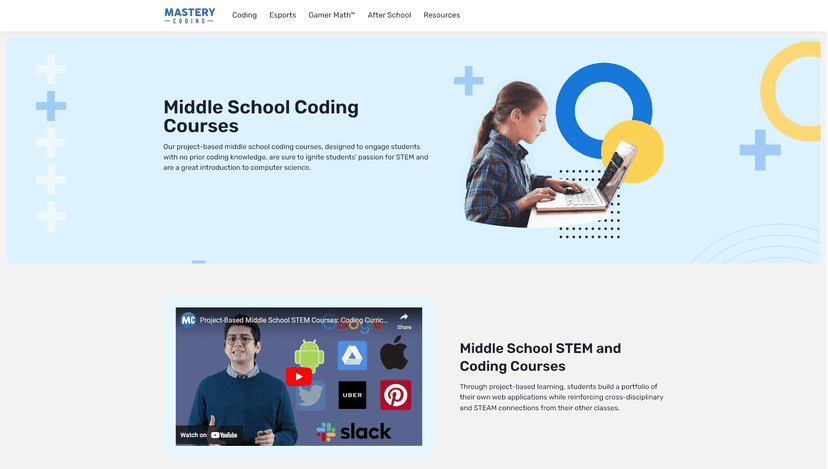
Mastery Coding Curriculum uses project-based learning and competency-based progression to teach coding and applied mathematics. Students begin by entering pathways tailored to their current skill levels, ranging from foundational concepts to advanced game and app development. In the GamerMath module, students analyze popular video games to uncover and solve the embedded mathematical rules governing gameplay. This method requires learners to actively construct knowledge rather than passively consume information. In the coding pathways, students build original projects using professional tools like Unity. They must demonstrate mastery of specific coding syntax and logical structures before moving on to more complex software development tasks. The curriculum attempts to scaffold instruction so that even teachers without a computer science background can guide students through the material. By building tangible products, students engage in experiential learning, applying computational thinking to solve cross-disciplinary problems aligned with career standards.
Strengths and tradeoffs of Mastery Coding Curriculum
The biggest strength of Mastery Coding Curriculum is its use of contextualized, project-based learning, while its biggest weakness is the lack of independent efficacy data regarding its instructional mechanics. Contextualized Learning: By integrating math and coding into the mechanics of popular video games, the curriculum reduces cognitive load and increases relevance. Students anchor new, abstract computational concepts to familiar gaming frameworks. Project-Based Assessment: The curriculum emphasizes creating functional games and apps over taking multiple-choice tests. This requires students to engage in higher-order thinking and synthesis, which strengthens long-term retention. Career Alignment: The direct path to Unity certifications ensures that the skills practiced map directly to real-world technical requirements. Unknown Feedback Loops: Because The Learning Standard has not yet evaluated the platform, we cannot verify how the software handles student errors. Effective mastery learning requires immediate, corrective feedback and targeted retrieval practice when a student fails a concept. Implementation Dependency: As a turn-key curriculum, its success relies heavily on teacher facilitation rather than adaptive algorithms, meaning instructional quality may vary widely between classrooms.
Who Might Benefit From Mastery Coding Curriculum?
Mastery Coding Curriculum is best for middle and high school students who need high-engagement, project-based computer science instruction within a traditional classroom. The platform targets grades three through ten, but its strongest application lies with older students pursuing Career and Technical Education pathways or industry certifications in game design. It serves learners who struggle with abstract math instruction by providing concrete, game-based applications for those concepts. It is specifically for educators seeking a structured, ready-to-teach STEM curriculum that requires no prior computer science expertise.
Data Transparency
Does Not Meet Data Transparency Standard
Mastery Coding Curriculum reaches Level 1 of 3 (Basic protections), below our data transparency standard. Reaching Level 2 needs the policy to document named service providers and self-service deletion.
24 of 35 checks passed
Evaluated October 2026
Mastery Coding's Privacy Policy →Level 1 · Basic protections
Does not sell data or target ads at students, limits sharing, and lets parents see and delete their child's data.
Level 2 · Parent control (meets the standard)
Families can get their data out, know who processes it, and know how long it is kept.
Not documented: named service providers, self-service deletion
Level 3 · Direct data access
Families or schools can pull their own data through an API, in a stated format.
Not documented: an API for retrieving their own data, a named export format
View all 35 checks
Parent Access8/8
Does the policy mention parents specifically?
“Parents and eligible students seeking access to, correction of, or deletion of student records maintained on behalf of an educational institution should direct such requests to the applicable educational institution.”
Can parents view their child's data?
“Parents and eligible students seeking access to, correction of, or deletion of student records maintained on behalf of an educational institution should direct such requests to the applicable educational institution.”
Can parents modify their child's data?
“Parents and eligible students seeking access to, correction of, or deletion of student records maintained on behalf of an educational institution should direct such requests to the applicable educational institution.”
Can parents delete their child's account?
“Parents and eligible students seeking access to, correction of, or deletion of student records maintained on behalf of an educational institution should direct such requests to the applicable educational institution.”
Is there a dedicated Children's Privacy section?
“Students under the age of 13 may only access the Services through an authorized educational institution. Mastery Coding does not permit children under 13 to independently create accounts or directly register for educational services.”
Does it reference COPPA compliance?
“When providing services to educational institutions, Mastery Coding may rely on the educational institution to provide any required parental consent or authorization under applicable law, including the Children's Online Privacy Protection Act ("COPPA").”
Does it reference FERPA compliance?
“To the extent such information constitutes an education record under FERPA, Mastery Coding treats such information as confidential and uses it solely for authorized educational purposes.”
Is parental consent required for child accounts?
“When providing services to educational institutions, Mastery Coding may rely on the educational institution to provide any required parental consent or authorization under applicable law, including the Children's Online Privacy Protection Act ("COPPA").”
Data Portability2/5
Can users access their personal data?
“The right to access, correct, update, or request deletion of your Data.”
Can users download/export their data?
“The right to request portability of your Data.”
Is there a self-service data access tool?
The policy only describes access by email request to legal@masterycoding.com, with no self-service tool.
Is a specific data format mentioned for export?
The policy does not name a format for exported data.
Is there an API for data access?
The policy mentions APIs only for showing parts of the Services on partner sites, not for users to retrieve their data.
Data Minimization2/6
Is data collection itemized?
“Registration Data consists of the teacher name, teacher email address, student e-mail, student ID name or number as defined by the teacher, and other contact information you provide us using the Services, both when you register your account and thereafter.”
Can the app be used without a real name?
The policy states the vendor may process student names and identifiers.
Can the app be used without an email?
The policy states the vendor collects student e-mail and school-issued email addresses.
Does it state collection is limited to what is necessary?
“Student information is collected, used, maintained, and disclosed only as necessary to provide, maintain, support, improve, and evaluate Mastery Coding’s educational services and programs.”
Is IP address anonymized or truncated?
The policy says IP addresses are collected and does not mention anonymizing or truncating them.
Is location tracking explicitly excluded?
The policy does not explicitly rule out location tracking.
Third-Party Protection5/7
Does it explicitly state no selling of data?
“Further, we do not sell personal information or student information for any purpose.”
Are third-party providers named?
The policy names no providers and says a subprocessor list is available on request.
Are providers contractually restricted?
“All service providers receiving access to personal information or student information are contractually required to maintain confidentiality, implement appropriate security measures, and use such information solely for purposes authorized by Mastery Coding.”
No-targeted-advertising commitment?
“We will not serve you with targeted advertisements based on your personal or profile information, and we do not provide any of this personal or profile information to an advertiser or any third party with the exception of those uses expressly requested by the client.”
Is AI/ML data sharing addressed?
The policy does not address sharing data with AI or machine-learning systems.
Child-specific sharing restriction?
“Student information maintained on behalf of educational institutions is disclosed only as necessary to provide the Services, fulfill contractual obligations, comply with applicable law, or as otherwise authorized by the educational institution.”
Cookies/tracking limited or opt-out?
“You may refuse to accept browser cookies by activating the appropriate setting on your browser.”
Deletion & Retention3/5
Can users delete their account?
“The right to access, correct, update, or request deletion of your Data.”
Self-service deletion mechanism?
The policy describes deletion only by request, with no self-service option.
Specific data retention timeline?
“Personally identifiable student information is deleted or de-identified within sixty (60) days following termination of services.”
Auto-deletion of inactive accounts?
The policy ties deletion to termination of services, not to account inactivity.
Post-deletion handling described?
“Once de-identified, the information can no longer reasonably be linked to an identifiable student and may be retained for internal analytics, research, security, and product improvement purposes.”
Advertising4/4
Advertising model explicitly disclosed?
“We do not allow third-party ad servers or ad networks to display advertisements on the Services and do not allow any third party to place a persistent cookie on your computer or use other similar technologies.”
Free from third-party advertisements?
“We do not allow third-party ad servers or ad networks to display advertisements on the Services and do not allow any third party to place a persistent cookie on your computer or use other similar technologies.”
Children excluded from ad targeting?
“Mastery Coding does not sell student information, engage in targeted advertising using student information, or permit third parties to use student information for unrelated commercial purposes.”
Ad-free option available?
“We do not allow third-party ad servers or ad networks to display advertisements on the Services and do not allow any third party to place a persistent cookie on your computer or use other similar technologies.”
What This Means
The policy review did not meet our data transparency standard. The checks above show the documented findings and unknowns. A missing statement does not establish how the app handles data in practice.
About this evaluation: Based on automated analysis of Mastery Coding's Privacy Policy against 35 policy-disclosure questions, including questions adapted from the Common Sense Privacy Program's published evaluation questions. TLS is not affiliated with Common Sense Media, and this is not a Common Sense rating. Quoted text is copied from the policy; unquoted notes are our summary. Results describe what the policy documents, not the company's actual practices. Privacy policies can change: this review reflects the version we analyzed and does not determine legal compliance.
Sources and review method
TLS combines product information and editorial analysis to explain how Mastery Coding Curriculum works, its tradeoffs, and the questions to ask before choosing it. Product features, an instructional rationale and evidence of learning outcomes are different kinds of information.
Formal Learning Standard assessment: not yet completed. Data Transparency findings are reported separately and do not establish learning effectiveness. Read our methodology.
Frequently Asked Questions About Mastery Coding Curriculum
Is Mastery Coding Curriculum free?
No, Mastery Coding Curriculum is not free. It is an institutional curriculum designed for schools and districts rather than a direct-to-consumer app. The developer does not list public pricing tiers. Educators and school administrators must contact the vendor directly to request a quote based on their specific implementation needs, student headcount, and required professional development. Schools must purchase licenses to access the project-based modules and teacher resources.
Is Mastery Coding Curriculum good for elementary and middle school students?
Mastery Coding Curriculum supports students from third grade through tenth grade. It uses age-appropriate scaffolding to introduce foundational STEM concepts to younger learners while offering rigorous, career-aligned software development pathways for middle and high school students. The effectiveness for any specific age group remains pending evaluation by The Learning Standard. By using familiar video game contexts, it maintains engagement for students who might otherwise lose interest in abstract coding lessons.
What does Mastery Coding Curriculum teach?
Mastery Coding Curriculum teaches computer programming, applied mathematics, and career-readiness skills. The curriculum covers foundational STEM concepts, logical reasoning, computational thinking, and advanced game development using the Unity engine. Additionally, the GamerMath component specifically teaches standards-based math concepts by having students analyze and calculate the hidden mathematical mechanics within popular video games. Students also learn project management and troubleshooting as they build their own functional applications.
How does Mastery Coding Curriculum compare to Code.org?
Both platforms teach computer science, but they take different approaches. Code.org is a free, widely accessible platform that relies heavily on block-based coding and short puzzles to introduce basic concepts. Mastery Coding Curriculum is a paid, institutional program that focuses heavily on deep project-based learning, esports integration, and professional-grade tools like Unity to prepare students for specific industry certifications. While Code.org is excellent for brief introductory lessons, Mastery Coding offers a more intensive, career-oriented pathway for older students.
Has The Learning Standard evaluated Mastery Coding Curriculum?
TLS has not yet completed a Learning Standard evaluation of how well Mastery Coding Curriculum teaches. Its privacy policy has been reviewed for Data Transparency and reaches Level 1, Basic protections.
Is Mastery Coding Curriculum COPPA compliant?
The reviewed privacy policy references COPPA. A policy reference alone does not establish COPPA compliance. Policy review note: The policy cites COPPA consent requirements.
Is Mastery Coding Curriculum FERPA compliant?
The reviewed privacy policy references FERPA. A policy reference alone does not establish FERPA compliance. Policy review note: The policy commits to FERPA treatment of education records.
Does Mastery Coding Curriculum have a children's privacy policy?
The reviewed policy includes a dedicated children's privacy section. Policy review note: A separately headed section on student accounts covers children under 13 and COPPA.
Does Mastery Coding Curriculum sell student data?
The reviewed policy states that the app does not sell data. This is a policy statement; actual data practices were not verified. Policy review note: The vendor states it does not sell data.
Can you delete your data from Mastery Coding Curriculum?
The reviewed privacy policy describes account deletion. We have not tested the deletion process. Policy review note: Users may request deletion of their data.
Follow TLS Research
Subscribe to future TLS research updates: app reviews, findings, and what the evidence shows.
Screenshots


Take Action
For Mastery Coding Curriculum
If you represent Mastery Coding, Inc. and have a correction or new evidence, send the relevant source so we can review and update this page.
Submit a correctionDetails
- Pricing
- Contact vendor for pricing.
- Platforms
- Windows (Microsoft), macOS (Apple), Chrome OS (Google)
- Grade Levels
- 3rd Grade, 4th Grade, 5th Grade, 6th Grade, 7th Grade, 8th Grade, 9th Grade, 10th Grade
- Website
- Visit site