
Kermode Education
Product by Kermode Education
Facts checked: Not yet checked
Our take (not a Learning Standard rating). This label applies to learning-science judgments throughout this overview.
Our take (not a Learning Standard rating)
While The Learning Standard has not yet formally evaluated Kermode Education, its inquiry-based approach to media literacy aligns well with cognitive science principles for critical thinking. It provides structured frameworks for analyzing online content, but effectiveness will depend heavily on teacher implementation rather than isolated student practice.
Pros
- Utilizes inquiry-based learning frameworks to promote active cognitive processing of digital media.
- Supports cross-curricular integration, allowing students to transfer critical thinking skills across different academic subjects.
- Encourages project-based learning, which deepens the retention of digital citizenship concepts through practical application.
Cons
- Relies heavily on teacher facilitation to guide inquiry, making it ineffective for independent, unguided student use.
- Lacks automated, immediate feedback mechanisms to correct student misconceptions during the analysis of web pages.
- Does not feature built-in spaced repetition to ensure the long-term retention of specific media literacy heuristics.
What Do We Know About Kermode Education?
Kermode Education functions as an effective structured tool for building media literacy when guided by an educator, though it is not designed as a standalone app for independent home use. Your child will use this platform to analyze websites, identify bias, and evaluate the credibility of online information. Rather than feeding students facts, it uses inquiry-based learning to prompt active critical thinking. This approach requires high cognitive effort, which learning science shows is necessary for deep understanding. Because the software is designed primarily for classroom environments, it lacks the built-in tutorials or adaptive feedback loops often found in direct-to-consumer educational apps. Instead, it serves as a scaffold for classroom discussion. If your child's school uses Kermode Education, expect them to engage in project-based assignments where they must dissect real-world digital media. Parents should know that while the underlying pedagogical concepts are sound, the actual learning outcomes will depend entirely on how frequently and effectively the teacher integrates these media evaluation exercises into the broader curriculum. Please note that this platform is currently pending formal evaluation by The Learning Standard.
How Does Kermode Education Work?
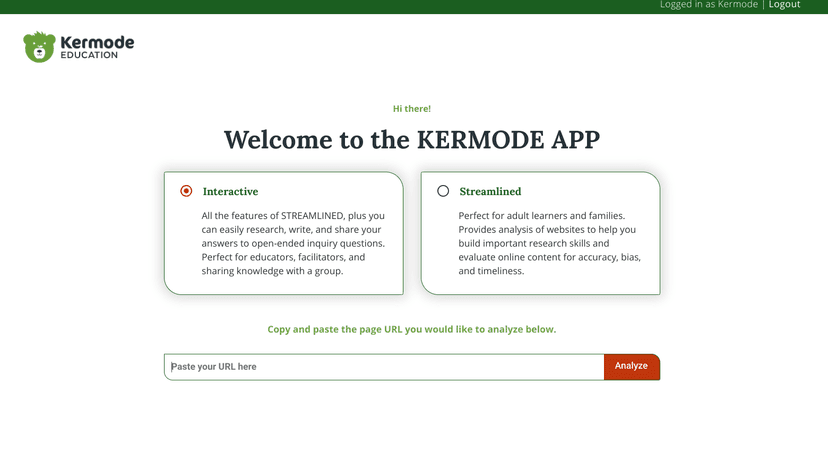
Kermode Education utilizes an inquiry-based learning model focused on the real-time analysis of digital media. Students and teachers input URLs or digital content into the platform, which then generates a structured evaluation framework. Instead of simply labeling a site as credible or biased, the software prompts students to actively investigate authorship, citations, and underlying intent. This process forces the active retrieval and application of digital citizenship principles. The platform integrates cross-curricular tools, meaning a science class can use it to evaluate climate data sources, while a history class can analyze primary documents. By guiding students through specific analytical steps, it provides a cognitive scaffold that reduces the working memory load required to assess complex web pages. Over time, repeated use of these evaluation tools builds automated critical thinking habits. However, it requires a teacher to assign the content and moderate the resulting discussions, as the software does not provide independent mastery-based progression.
Strengths and tradeoffs of Kermode Education
Kermode Education's biggest strength is its use of cognitive scaffolding to teach complex media literacy, while its biggest weakness is a reliance on teacher facilitation that limits independent student practice. Scaffolded inquiry is a proven method for teaching critical thinking, and Kermode Education applies this by breaking down the overwhelming task of website evaluation into manageable, explicit steps. This prevents cognitive overload and helps students focus on one element of credibility at a time, such as author expertise or domain authority. Furthermore, its cross-curricular application supports the transfer of learning, requiring students to apply critical thinking skills across different contexts like science and history. Conversely, the lack of immediate, automated feedback is a notable limitation. Learning science emphasizes the importance of immediate correction during independent practice to prevent the cementing of misconceptions. Because Kermode Education operates primarily as an analytical tool rather than a comprehensive curriculum, students who misinterpret a website's bias may not realize their error unless a teacher manually intervenes. Additionally, without built-in spaced repetition of core digital citizenship concepts, long-term retention relies entirely on how the educator structures their ongoing lesson plans.
Who Might Benefit From Kermode Education?
Kermode Education is best for middle and high school classrooms that need a structured framework to integrate media literacy into existing research projects. Because it spans grades four through twelve, it is highly adaptable, but it strictly requires a classroom setting where an educator can guide the inquiry process. It is ideal for teachers looking to implement project-based learning in humanities, social sciences, or applied sciences. It is not recommended for parents seeking a standalone app for independent home study, as the platform lacks direct instruction and relies heavily on educator facilitation to drive meaningful learning outcomes.
Sources and review method
TLS combines product information and editorial analysis to explain how Kermode Education works, its tradeoffs, and the questions to ask before choosing it. Product features, an instructional rationale and evidence of learning outcomes are different kinds of information.
Formal Learning Standard assessment: not yet completed. Data Transparency findings are reported separately and do not establish learning effectiveness. Read our methodology.
Frequently Asked Questions About Kermode Education
Is Kermode Education free?
No, Kermode Education is not free. It is a paid educational platform that requires an active subscription to access its media literacy evaluation tools. Pricing operates on a standard institutional model, offering individual teacher subscriptions for single classrooms. Additionally, the developer provides discounted bulk licenses for entire schools, academic districts, and larger state or provincial organizations looking to implement critical thinking curriculums at scale.
Is Kermode Education good for middle schoolers?
Yes, Kermode Education is highly appropriate for students in grades six through eight. Middle school is a critical developmental period for establishing strong digital citizenship habits and foundational critical thinking skills. The platform provides the necessary cognitive scaffolding to help early adolescents safely transition from consuming media passively to evaluating it actively. By breaking down complex website analysis into simple steps, it prevents cognitive overload for younger learners.
What does Kermode Education teach?
Kermode Education teaches media literacy, digital citizenship, and foundational critical thinking. Rather than teaching specific subject-area facts or providing direct instruction on historical events, it trains students how to systematically analyze digital content. Students learn to identify hidden bias, verify primary sources, check author credentials, and assess the overall credibility of information they encounter online. These transferable skills can be applied across multiple academic disciplines, including humanities and sciences.
How does Kermode Education compare to NewsGuard?
Kermode Education focuses heavily on teaching students the exact process of how to evaluate sources themselves, whereas NewsGuard primarily provides pre-written, expert-generated credibility ratings for websites. Kermode Education relies on inquiry-based learning to build long-term critical thinking skills and automated analytical habits through repeated practice. In contrast, NewsGuard acts more as an immediate reference tool or browser extension designed to ensure safe, reliable media consumption in the short term.
Has The Learning Standard evaluated Kermode Education?
TLS has not yet completed a Learning Standard evaluation of how well Kermode Education teaches. TLS has not published a Data Transparency result for its privacy policy.
Follow TLS Research
Subscribe to future TLS research updates: app reviews, findings, and what the evidence shows.
Screenshots

Take Action
For Kermode Education
If you represent Kermode Education and have a correction or new evidence, send the relevant source so we can review and update this page.
Submit a correctionDetails
- Pricing
- There are individual teachers subscriptions, as well as discounted bulk subscriptions for schools, districts, state/provincial licenses.
- Platforms
- Web Browser
- Grade Levels
- 4th Grade, 5th Grade, 6th Grade, 7th Grade, 8th Grade, 9th Grade, 10th Grade, 11th Grade, 12th Grade
- Website
- Visit site