
Green Ninja
Product by Green Ninja
Green Ninja review
How it works, strengths, tradeoffs, cost and fit, with the evidence behind each finding.
Our take (not a Learning Standard rating)
While Green Ninja has not yet been formally evaluated by The Learning Standard, its foundation in project-based learning aligns with established science education practices. It effectively structures middle school science around real-world environmental challenges, but its ultimate efficacy depends heavily on teacher implementation rather than standalone digital instruction.
Pros
- Uses inquiry-based learning to connect abstract science concepts to tangible, real-world environmental problems.
- Aligns directly with Next Generation Science Standards to ensure content meets formal educational benchmarks.
- Incorporates project-based assessments that require students to apply knowledge rather than simply recall isolated facts.
- Provides optional physical material kits to support hands-on learning alongside the digital curriculum.
Cons
- Effectiveness relies heavily on the quality of teacher facilitation rather than the digital platform itself.
- Physical materials and printed workbooks require additional purchases beyond the base digital license.
- Group-based project assessments make it difficult to measure individual student mastery of specific concepts.
- Lacks explicit, repetitive drill practice for students who need traditional reinforcement of foundational terminology.
What Do We Know About Green Ninja ?
Green Ninja offers a structurally sound approach to middle school science, though its true effectiveness depends entirely on how your child's teacher implements the curriculum. Rather than relying on rote memorization, the program uses inquiry-based learning to teach scientific concepts through real-world environmental challenges. Your child will spend less time reading textbooks and more time designing solutions to community issues. This project-based learning model is supported by learning science, as applying knowledge to novel situations strengthens cognitive connections and deepens understanding. However, because Green Ninja is a comprehensive curriculum rather than a supplemental practice app, you cannot simply download it for independent study at home. The digital platform serves as a hub for classroom activities, providing materials that guide student groups through complex problems. While the curriculum aligns with Next Generation Science Standards, parents should note that assessing individual progress can be challenging in project-based environments. If your child's school uses Green Ninja, expect to see them working on long-term collaborative projects rather than completing traditional nightly worksheets.
How Does Green Ninja Work?
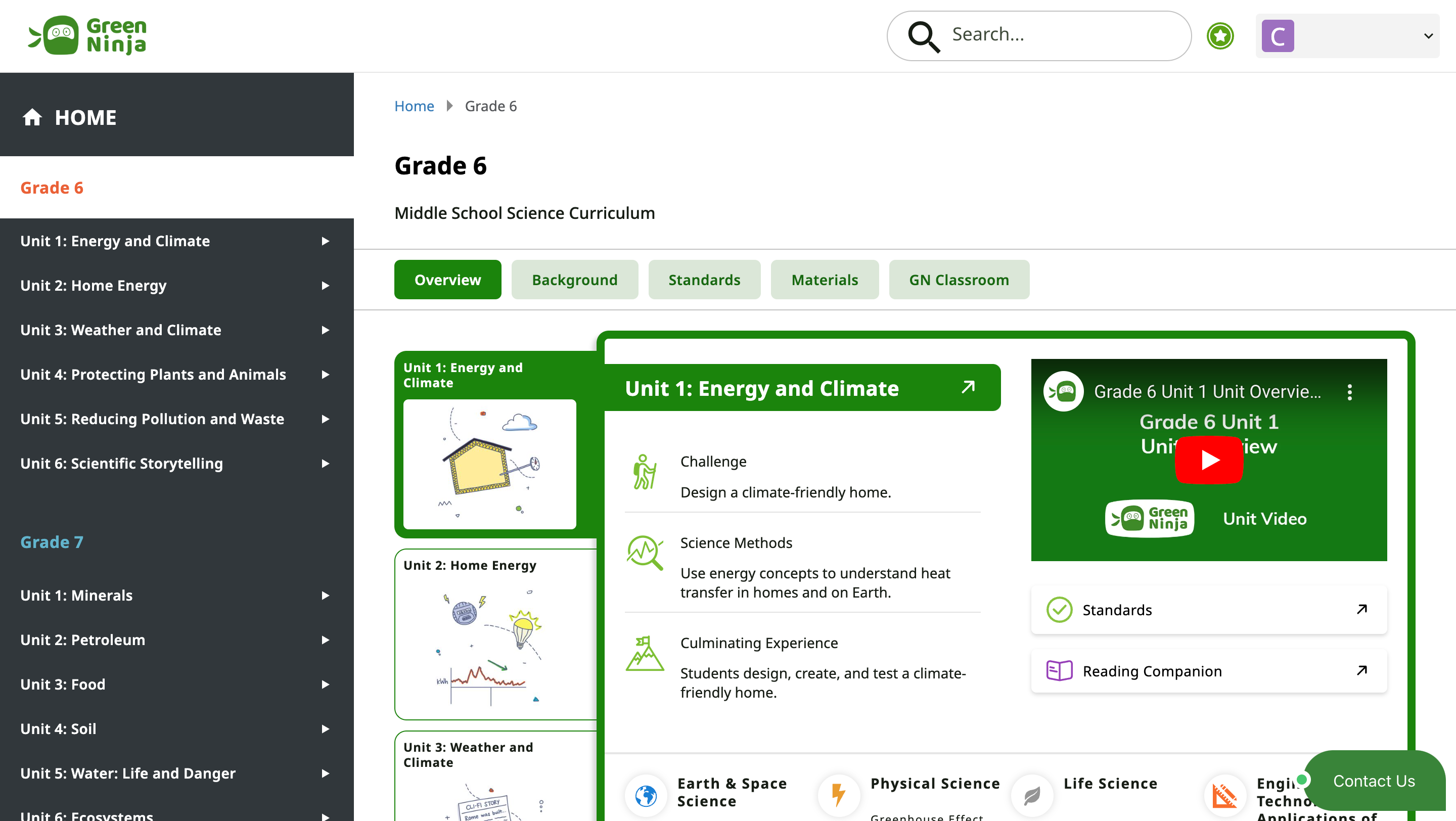
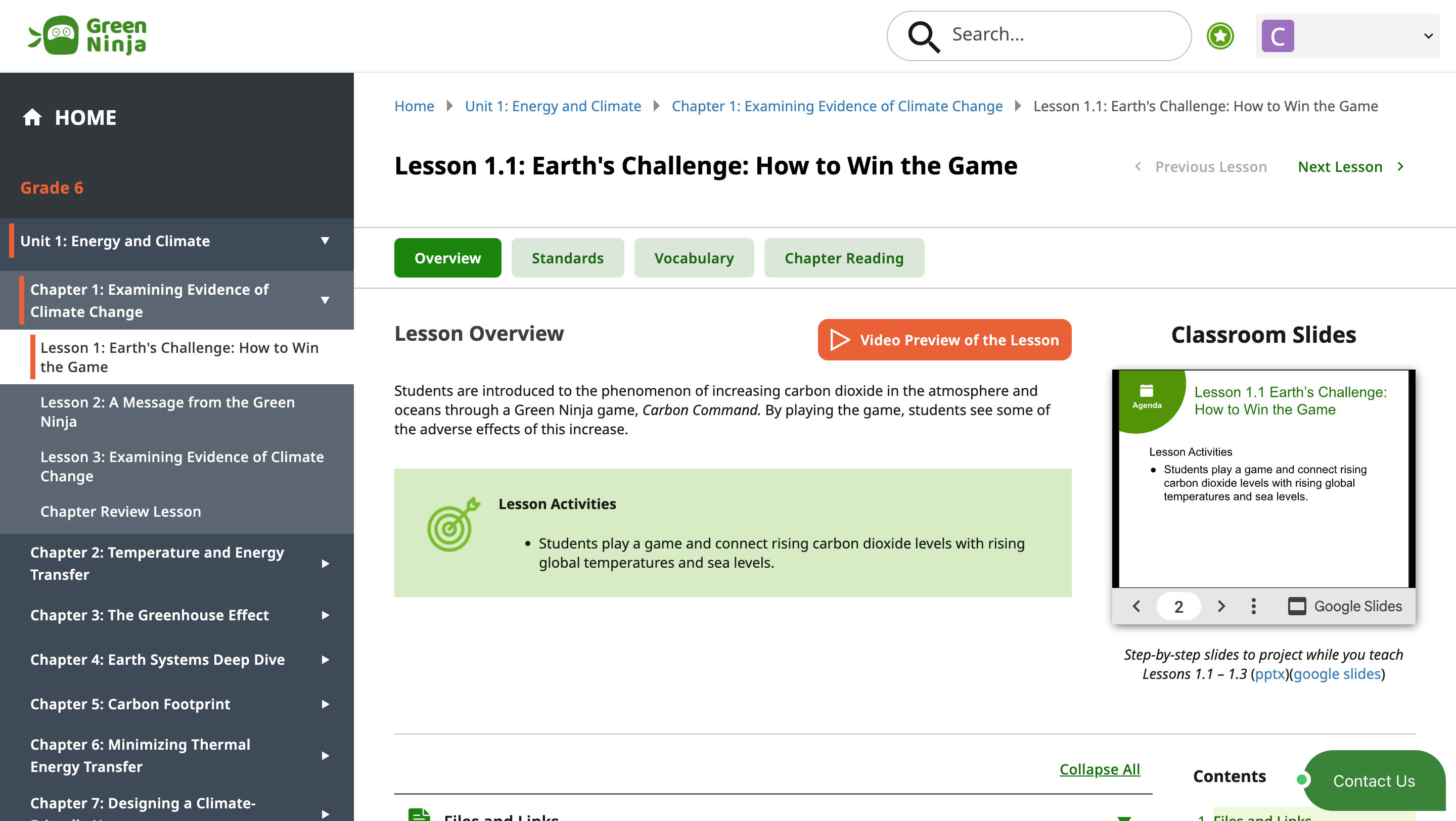
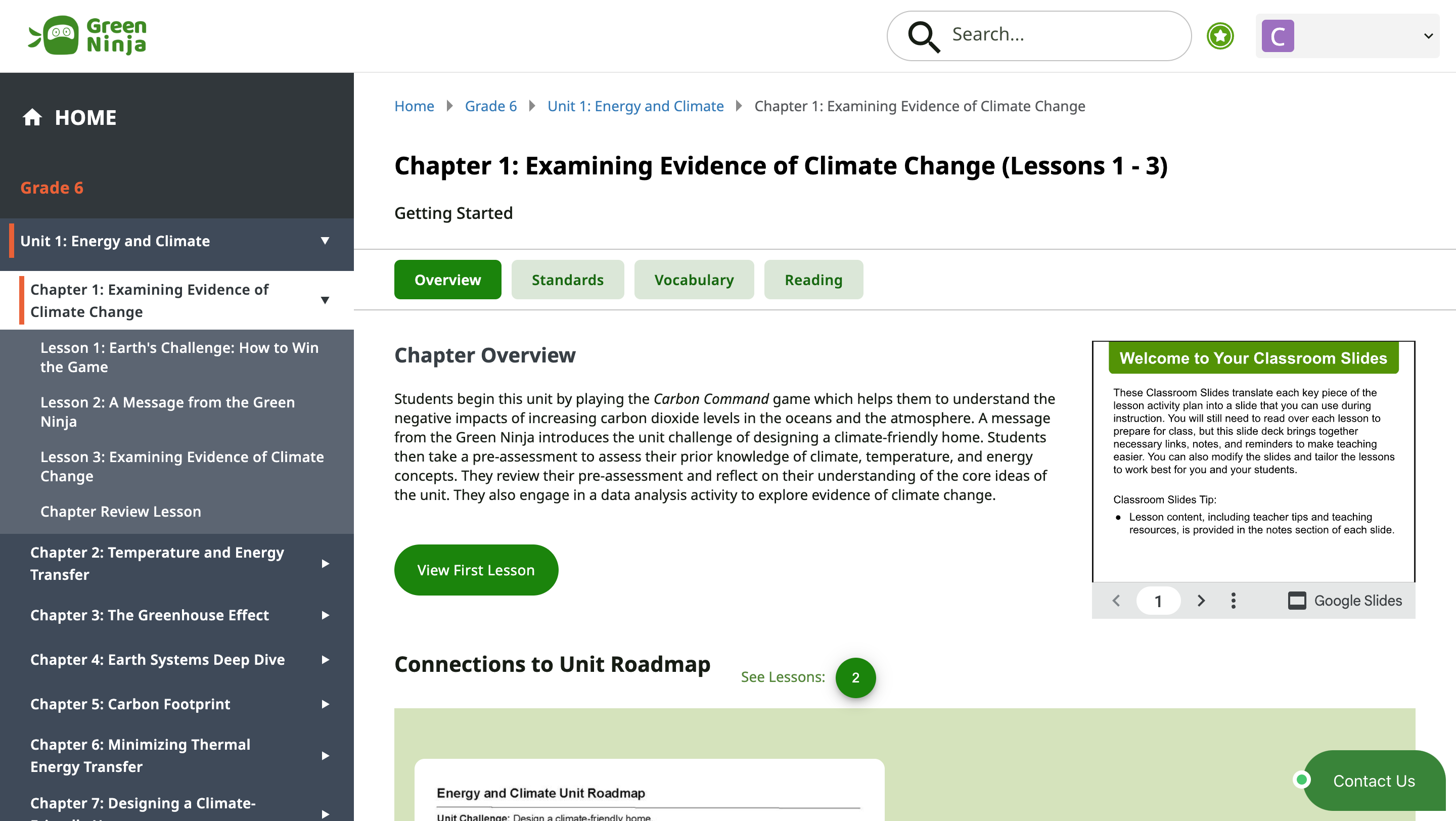
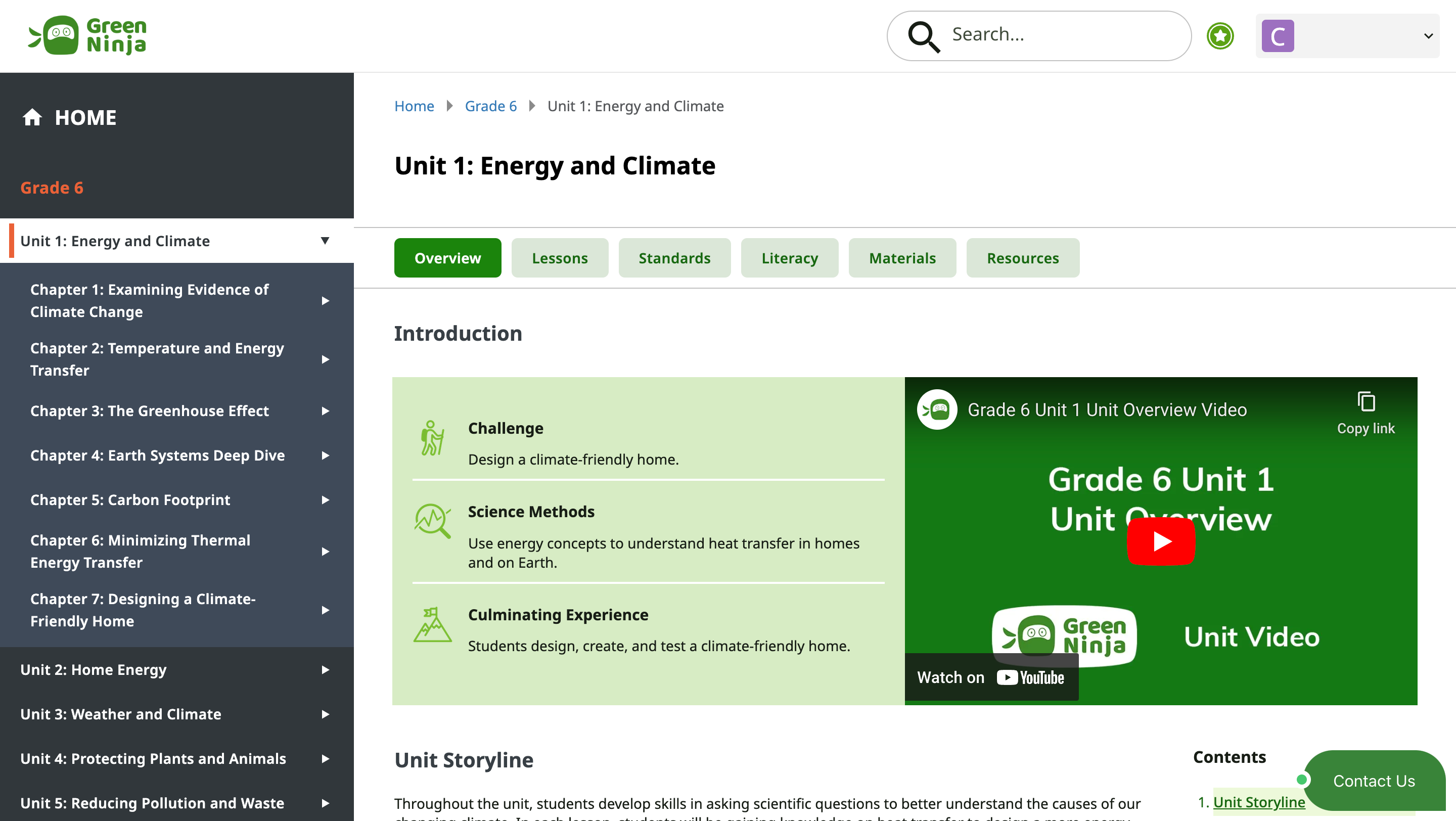
Green Ninja uses a project-based learning architecture where students investigate real-world phenomena to master middle school science standards. The curriculum organizes instruction into thematic units centered around environmental and community challenges. Instead of front-loading information, the platform introduces a complex problem first, prompting students to ask questions and design investigations. Students interact with digital models, analyze data sets, and collaborate with peers to uncover the underlying scientific principles. The digital platform delivers the core instructional materials, interactive simulations, and assessment rubrics directly to students' devices. Teachers act as facilitators, guiding the inquiry process and managing hands-on activities using physical classroom kits. Formative assessments are embedded throughout the investigative process, requiring students to demonstrate their evolving understanding through written explanations and peer discussions. The unit culminates in a capstone project where students present actionable solutions to the initial problem, applying their newly acquired knowledge to a practical scenario.
Strengths and tradeoffs of Green Ninja
Green Ninja's biggest strength is its use of contextualized, problem-based learning to drive engagement, while its biggest weakness is the difficulty of ensuring individual concept mastery within collaborative projects. Project-Based Application: By framing science around real-world environmental issues, the curriculum leverages situated learning. Students learn concepts within the context they will be used, which learning science shows improves knowledge transfer. Constructivist Approach: Rather than passively receiving information, students actively construct knowledge through inquiry. This active processing leads to better long-term retention compared to traditional lecture-based instruction. Heavy Reliance on Facilitation: Because the curriculum is highly open-ended, it lacks the structured scaffolding and worked examples that novice learners often need. Without strong teacher guidance, students may experience cognitive overload when navigating complex, unstructured problems. Individual Assessment Challenges: Collaborative projects make it difficult to measure individual retrieval practice. While the group may produce a successful end-of-unit project, a single student might harbor foundational misconceptions that go unnoticed. The Learning Standard has not yet formally evaluated the platform to see how it mitigates these instructional risks.
Who Might Benefit From Green Ninja ?
Green Ninja is best for middle school science classrooms that want to transition from traditional textbook instruction to hands-on, environmental project-based learning. Specifically designed for 6th, 7th, and 8th-grade students, the curriculum suits schools prioritizing Next Generation Science Standards and community engagement. It is not designed for independent home use, homeschooling parents seeking a standalone app, or students who need focused, repetitive drill practice to master basic concepts. The program works best in collaborative environments where teachers have the time and resources to facilitate complex investigations.
Data Transparency findings
Does Not Meet Data Transparency Standard
Green Ninja does not meet our data transparency standard. Its privacy policy does not document basic protections, including a commitment against targeted advertising, limits on sharing children's data and a COPPA or FERPA commitment.
7 of 35 checks passed
Policy review ·
Privacy Page →These findings describe reviewed policy wording. They do not establish observed data practices or learning effectiveness.
ShowHide all 35 policy findings
Level 1 · Basic protections
Does not sell data or target ads at students, limits sharing, and lets parents see and delete their child's data.
Not documented: a commitment against targeted advertising, limits on sharing children's data, a COPPA or FERPA commitment, parents' right to see their child's data, parents' right to delete their child's data
Level 2 · Parent control (meets the standard)
Families can get their data out, know who processes it, and know how long it is kept.
Not documented: data export, a data retention timeline, named service providers, self-service deletion
Level 3 · Direct data access
Families or schools can pull their own data through an API, in a stated format.
Not documented: an API for retrieving their own data, a named export format
Parent Access0/8
Does the policy mention parents specifically?
The policy only uses "parent" to mean a parent company and never mentions the parents of student users.
Can parents view their child's data?
The policy does not give parents any right to view their child's data.
Can parents modify their child's data?
The policy does not give parents any right to change their child's data.
Can parents delete their child's account?
The policy does not give parents any right to delete their child's data or account.
Is there a dedicated Children's Privacy section?
The policy has no section about children's privacy.
Does it reference COPPA compliance?
The policy does not mention COPPA.
Does it reference FERPA compliance?
The policy does not mention FERPA.
Is parental consent required for child accounts?
The policy does not require parental consent for child accounts.
Data Portability1/5
Can users access their personal data?
Users can ask for access to their personal information.
“Based on the applicable laws of your country, you may have the right to request access to the personal information we collect from you, change that information, or delete it.”Policy document ↗
Can users download/export their data?
The policy does not offer a way to download or export data.
Is there a self-service data access tool?
The policy only offers access through a request form or by contacting the company, not a tool users run themselves.
Is a specific data format mentioned for export?
The policy does not name any export format.
Is there an API for data access?
The policy does not mention an API for getting data.
Data Minimization1/6
Is data collection itemized?
The policy lists the specific types of personal information it collects.
“The personal information we collect may include the following: - names - email addresses - passwords - job titles - usernames”Policy document ↗
Can the app be used without a real name?
The policy says it collects names.
Can the app be used without an email?
The policy says it collects email addresses.
Does it state collection is limited to what is necessary?
The policy limits how long data is kept to what is necessary, but it does not limit collection to what is necessary.
Is IP address anonymized or truncated?
The policy says it collects IP addresses and does not say they are anonymized or truncated.
Is location tracking explicitly excluded?
The policy says it collects location data, which can be precise or imprecise, including through GPS.
Third-Party Protection3/7
Does it explicitly state no selling of data?
The policy states that Green Ninja will not sell personal information.
“Green Ninja has not disclosed or sold any personal information to third parties for a business or commercial purpose in the preceding twelve (12) months. Green Ninjawill not sell personal information in the future belonging to website visitors, users, and other consumers.”Policy document ↗
Are third-party providers named?
The policy refers to service providers in general but does not name any.
Are providers contractually restricted?
Data goes to service providers only under a written contract.
“We may disclose your personal information with our service providers pursuant to a written contract between us and each service provider.”Policy document ↗
No-targeted-advertising commitment?
The policy makes no promise against targeted ads and mentions interest-based advertising by advertisers on its Services.
Is AI/ML data sharing addressed?
The policy does not address AI or machine learning.
Child-specific sharing restriction?
The policy has no sharing limits specific to children.
Cookies/tracking limited or opt-out?
Users can reject or remove cookies through their browser settings.
“Most Web browsers are set to accept cookies by default. If you prefer, you can usually choose to set your browser to remove cookies and to reject cookies.”Policy document ↗
Deletion & Retention2/5
Can users delete their account?
Users can ask to have their account deleted.
“Upon your request to terminate your account, we will deactivate or delete your account and information from our active databases.”Policy document ↗
Self-service deletion mechanism?
The policy only offers deletion by contacting the company or sending a request form.
Specific data retention timeline?
The policy keeps data as long as necessary or while the account exists, with no specific time period.
Auto-deletion of inactive accounts?
The policy does not mention automatically deleting inactive accounts.
Post-deletion handling described?
The policy explains how data is deleted, anonymized, or isolated in backups.
“When we have no ongoing legitimate business need to process your personal information, we will either delete or anonymize such information, or, if this is not possible (for example, because your personal information has been stored in backup archives), then we will securely store your personal information and isolate it from any further processing until deletion is possible.”Policy document ↗
Advertising0/4
Advertising model explicitly disclosed?
The policy only briefly mentions opting out of interest-based advertising by advertisers on its Services and does not explain its advertising model.
Free from third-party advertisements?
The policy does not say the product has no third-party ads and mentions advertisers on its Services.
Children excluded from ad targeting?
The policy does not exclude children from ad targeting.
Ad-free option available?
The policy does not mention an ad-free option or say the product has no ads.
What This Means
The policy review did not meet our data transparency standard. The checks above show the documented findings and unknowns. A missing statement does not establish how the app handles data in practice.
About this evaluation: Based on automated analysis of Privacy Page against 35 policy-disclosure questions, including questions adapted from the Common Sense Privacy Program's published evaluation questions. TLS is not affiliated with Common Sense Media, and this is not a Common Sense rating. Quoted text is copied from the policy; unquoted notes are our summary. Results describe what the policy documents, not the company's actual practices. Privacy policies can change: this review reflects the version we analyzed and does not determine legal compliance.
Frequently Asked Questions About Green Ninja
Is Green Ninja free?
No, Green Ninja is not free. Schools or districts must purchase a per-student digital license to access the curriculum. Additional physical materials, such as student workbooks, teacher editions, and classroom activity kits, require separate, optional purchases.
Is Green Ninja good for middle school students?
Yes, Green Ninja is specifically designed for 6th, 7th, and 8th-grade students. The content is tailored to early adolescent cognitive development, focusing on collaborative problem-solving and social issues that resonate with this age group's growing awareness of the world.
What does Green Ninja teach?
Green Ninja teaches middle school science, applied science, and career and technical education concepts. The curriculum covers earth, life, and physical sciences by exploring real-world environmental issues like climate change, resource management, and local ecological challenges.
Can I use Green Ninja for homeschooling?
No, Green Ninja is generally not suitable for individual homeschooling. The curriculum relies heavily on collaborative group work, large-scale classroom facilitation, and physical kits designed for groups of 32 students. It lacks the independent, self-paced structure needed for solo home learning.
Has The Learning Standard evaluated Green Ninja?
TLS has not yet completed a Learning Standard evaluation of how well Green Ninja teaches. Its privacy policy has been reviewed for Data Transparency and does not yet document the basic protections (Level 1).
Is Green Ninja COPPA compliant?
A COPPA reference was not found in the reviewed privacy policy. This does not determine whether the app complies with COPPA. Policy review note: The policy does not mention COPPA.
Is Green Ninja FERPA compliant?
A FERPA reference was not found in the reviewed privacy policy. This does not determine whether the app complies with FERPA. Policy review note: The policy does not mention FERPA.
Does Green Ninja have a children's privacy policy?
No dedicated children's privacy section was found in the reviewed policy. Policy review note: The policy has no section about children's privacy.
Does Green Ninja sell student data?
The reviewed policy states that the app does not sell data. This is a policy statement; actual data practices were not verified. Policy review note: The policy states that Green Ninja will not sell personal information.
Can you delete your data from Green Ninja ?
The reviewed privacy policy describes account deletion. We have not tested the deletion process. Policy review note: Users can ask to have their account deleted.
Overview sources and freshness
Facts checked: Not yet checked
Overview needs review: linked news reports a product change. Some facts may be out of date.
App details and requirements
Product by Green Ninja
Details
- Pricing model
- Customized, License subscriptions
- Pricing
- Per student license for all digital teaching materials. Separate and optional purchase of unit-level student workbooks, unit classroom material kits for 32 students, and unit -level teacher editions.
- Platforms
- Web Browser
- Grade Levels
- 6th Grade, 7th Grade, 8th Grade
- Website
- Visit site
Teaching Approaches
Screenshots
See inside Green Ninja . Select an image to view it at full size.
Original catalogue image records
Catalogue image sources
Policies
Sources and review method
TLS combines product information and editorial analysis to explain how Green Ninja works, its tradeoffs, and the questions to ask before choosing it. Product features, an instructional rationale and evidence of learning outcomes are different kinds of information.
Formal Learning Standard assessment: not yet completed. Data Transparency findings are reported separately and do not establish learning effectiveness. Read our methodology.
Follow TLS Research
Subscribe to future TLS research updates: app reviews, findings, and what the evidence shows.
Keep exploring.
For Green Ninja
If you represent Green Ninja and have a correction or new evidence, send the relevant source so we can review and update this page.
Submit a correction