Factile
Product by Solis Creative, LLC
Facts checked: Not yet checked
Our take (not a Learning Standard rating). This label applies to learning-science judgments throughout this overview.
Our take (not a Learning Standard rating)
Factile does not introduce new concepts, but it serves as an excellent tool for retrieval practice and active recall. Educators can build Jeopardy-style games to review material before assessments. While it lacks instructional scaffolding or spaced repetition algorithms, it highly engages students in competitive, low-stakes knowledge retrieval.
Pros
- Facilitates active recall and retrieval practice through competitive, low-stakes quizzing.
- Allows educators to customize content completely to align with their specific curriculum and learning objectives.
- Fosters collaborative learning and peer discussion when played in team modes.
- Provides an extensive library of community-generated templates to reduce lesson preparation time.
Cons
- Offers no instructional scaffolding, meaning students cannot learn new concepts without prior exposure.
- Lacks built-in spaced repetition algorithms to optimize long-term memory retention.
- Locks the most engaging interactive features, such as virtual buzzers, behind a paid subscription.
- Relies heavily on multiple-choice or direct short-answer formats that do not measure deeper critical thinking.
What Do We Know About Factile?
Factile is effective for reviewing previously taught material through active recall, but it does not teach your child new concepts from scratch. This application is essentially a digital Jeopardy board generator used primarily by classroom teachers to gamify test preparation. From a learning science perspective, Factile leverages retrieval practice, the act of recalling information from memory, which strengthens neural pathways and improves long-term retention. However, parents should understand that this is an assessment and review tool, not an instructional one. Your child will not find video lessons, worked examples, or adaptive learning paths here. Instead, they will engage in fast-paced, competitive quizzing. If your child's teacher uses Factile, it serves as a highly engaging way to solidify facts, vocabulary, and foundational knowledge before a major exam. For home use, parents can create custom boards to help their children study specific subjects, replacing traditional flashcards with a more dynamic, game-based format. Be aware that the free version is severely limited, restricting users to only three games, and the highly touted buzzer mode requires a paid subscription. While it lacks the sophistication of an adaptive learning platform, it excels at what it is built to do: making rote memorization and factual review competitive and fun.
How Does Factile Work?
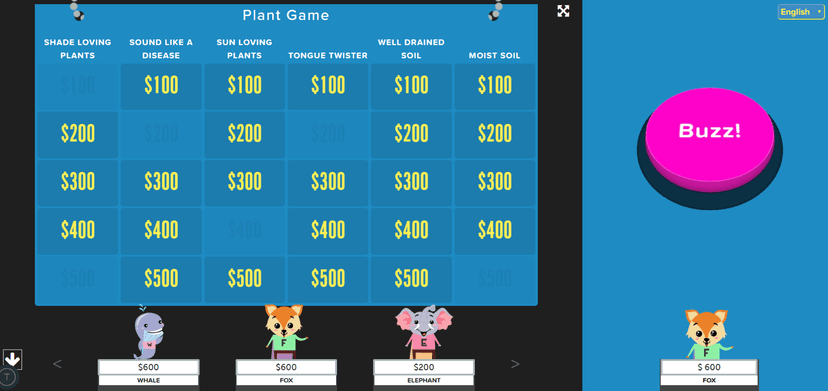
Factile uses a game-based, active recall approach structured entirely around customizable Jeopardy-style trivia boards. Educators or parents input their own categories, questions, and point values to create a grid of escalating difficulty. When playing, the host displays the board on a main screen, and teams or individual students select a category and point value. The host reveals the prompt, and students must retrieve the correct answer from memory. In the paid versions, students can use their personal smartphones, tablets, or Chromebooks as virtual buzzers to chime in, mimicking a live game show environment. The system tracks team scores automatically as the game progresses. Factile does not use algorithmic intelligence; the progression and difficulty are entirely determined by the human creator. Users can either build their boards from scratch or duplicate and modify any of the two million public games created by other educators. The core mechanic relies purely on low-stakes, competitive testing to drive student engagement and enforce knowledge retrieval.
Strengths and tradeoffs of Factile
Factile's biggest strength is its ability to turn mundane retrieval practice into a highly engaging social event, while its biggest weakness is the complete absence of instructional scaffolding or adaptive feedback. On the positive side, learning science heavily supports retrieval practice as a superior method for cementing knowledge compared to passive review. By forcing students to actively recall facts, Factile strengthens memory retention. The platform's customization is another significant asset, allowing teachers to perfectly map the game board to their immediate unit of study. The social and competitive mechanics also drive high levels of student motivation, particularly for middle and high school age groups who might otherwise disengage from test prep. Conversely, the tool is entirely dependent on the quality of the user-generated questions. There are no worked examples, so if a student answers incorrectly, the app provides no explanation to correct the misconception. Furthermore, it lacks any spaced repetition algorithms; once a game is over, the platform does not track individual student mastery or reintroduce missed concepts in future sessions. Finally, the freemium model restrictions mean that educators must pay to access the interactive buzzer features that make the game truly immersive.
Who Might Benefit From Factile?
Factile is best for classroom educators and homeschool parents who need a dynamic, competitive review tool to drill factual knowledge before assessments. It spans an incredibly wide age range, effectively engaging students from third grade all the way through adult education and corporate training. It is ideal for group settings where a teacher can project the game board and moderate the flow of questions. Because it relies heavily on reading comprehension and rapid recall, it works best for students who already possess a baseline understanding of the targeted subject matter and simply need to reinforce their recall speed and accuracy.
Data Transparency
Meets Data Transparency Standard
Factile meets our data transparency standard at Level 2 of 3 (Parent control). Level 3 needs the policy to document an API for retrieving their own data.
25 of 35 checks passed
Level 1 · Basic protections
Does not sell data or target ads at students, limits sharing, and lets parents see and delete their child's data.
Level 2 · Parent control (meets the standard)
Families can get their data out, know who processes it, and know how long it is kept.
Level 3 · Direct data access
Families or schools can pull their own data through an API, in a stated format.
Not documented: an API for retrieving their own data
View all 35 checks
Parent Access8/8
Does the policy mention parents specifically?
“Parents and eligible students have the right to review, update, or delete their educational records.”
Can parents view their child's data?
“Parents and guardians have the right regarding their child’s data to: - Access and review their child’s data.”
Can parents modify their child's data?
“Request corrections or deletions through the school or district, or directly with us by emailing [team@playfactile.com](mailto:team@playfactile.com).”
Can parents delete their child's account?
“Students and parents can delete their data (including **team names, nicknames,** and **scores**) directly from the platform at any time.”
Is there a dedicated Children's Privacy section?
“# COPPA Compliance and Children’s Privacy”
Does it reference COPPA compliance?
“Factile complies with the **Children’s Online Privacy Protection Act (COPPA)** and is committed to protecting the privacy of children under the age of 13.”
Does it reference FERPA compliance?
“Factile complies with the **Family Educational Rights and Privacy Act (FERPA)**, ensuring that **educational records** are protected”
Is parental consent required for child accounts?
“If a child under 13 registers for an individual account, we collect only a username and a parent’s email address for consent purposes.”
Data Portability4/5
Can users access their personal data?
“**User Control:** We empower users to access, modify, and delete their information.”
Can users download/export their data?
“Users can download their game data in CSV format via self-service features.”
Is there a self-service data access tool?
“Users can download their game data in CSV format via self-service features.”
Is a specific data format mentioned for export?
“Users can download their game data in CSV format via self-service features.”
Is there an API for data access?
The policy does not mention an API for users to retrieve their data; it only refers to LMS integrations.
Data Minimization4/6
Is data collection itemized?
“**Account Information:** Email address, password, and payment information (processed securely by third-party providers). Account information is encrypted.”
Can the app be used without a real name?
“This data is retained for as long as required to support **gameplay and educational activities**. We **do not take or retain sensitive personal information** like full names, contact details, or other identifying data.”
Can the app be used without an email?
“This data is retained for as long as required to support **gameplay and educational activities**. We **do not take or retain sensitive personal information** like full names, contact details, or other identifying data.”
Does it state collection is limited to what is necessary?
“**Minimal Data Collection:** We collect only the data necessary to provide our Application Services.”
Is IP address anonymized or truncated?
The policy says it collects IP addresses but does not say they are anonymized or truncated.
Is location tracking explicitly excluded?
The policy does not address location tracking.
Third-Party Protection6/7
Does it explicitly state no selling of data?
“We do not sell or rent your personal information to third parties for marketing or any other purposes.”
Are third-party providers named?
“The payment processor we work with is: Stripe.”
Are providers contractually restricted?
The policy calls its providers "vetted" and says integration sharing is "governed by applicable privacy laws and agreements", but it does not describe contractual limits on providers.
No-targeted-advertising commitment?
“Factile **does not use student information for advertising, marketing, or behavioral profiling**, and student data is never sold.”
Is AI/ML data sharing addressed?
“The Application Service’s AutoGen AI feature uses third-party AI platforms, specifically [OpenAI](https://openai.com/), to generate content based on user-defined inputs.”
Child-specific sharing restriction?
“We do not share students’ game data with third parties, except when required for the **functionality** of the game. We do not share data for marketing or advertising purposes.”
Cookies/tracking limited or opt-out?
“Users can manage their cookie preferences via browser settings.”
Deletion & Retention2/5
Can users delete their account?
“Users can delete accounts and associated data via self-service features or by contacting us at [team@playfactile.com](mailto:team@playfactile.com).”
Self-service deletion mechanism?
“Users can delete accounts and associated data via self-service features or by contacting us at [team@playfactile.com](mailto:team@playfactile.com).”
Specific data retention timeline?
The policy says data is kept only as long as necessary but gives no specific timeline.
Auto-deletion of inactive accounts?
The policy does not address automatic deletion of inactive accounts.
Post-deletion handling described?
The policy does not describe what happens to data after an account is deleted.
Advertising1/4
Advertising model explicitly disclosed?
The policy describes advertising cookies used to measure the vendor's own ads but does not say whether the product shows advertising.
Free from third-party advertisements?
The policy does not state that the product is free of third-party advertisements.
Children excluded from ad targeting?
“Advertising cookies are not used in connection with student gameplay or educational activities.”
Ad-free option available?
The policy does not state that the product has no ads or offer an ad-free option.
Meets Data Transparency Standard
The reviewed policy met our data transparency standard. This result describes the policy disclosures we assessed. Actual practices and legal compliance were not verified.
About this evaluation: Based on automated analysis of Privacy Policy– PlayFactile and COPPA Compliance against 35 policy-disclosure questions, including questions adapted from the Common Sense Privacy Program's published evaluation questions. TLS is not affiliated with Common Sense Media, and this is not a Common Sense rating. Quoted text is copied from the policy; unquoted notes are our summary. Results describe what the policy documents, not the company's actual practices. Privacy policies can change: this review reflects the version we analyzed and does not determine legal compliance.
Sources and review method
TLS combines product information and editorial analysis to explain how Factile works, its tradeoffs, and the questions to ask before choosing it. Product features, an instructional rationale and evidence of learning outcomes are different kinds of information.
Formal Learning Standard assessment: not yet completed. Data Transparency findings are reported separately and do not establish learning effectiveness. Read our methodology.
Frequently Asked Questions About Factile
Is Factile free?
Factile offers a very limited free tier that allows up to three games and five teams without advertisements. To access unlimited games, media integration, question banks, and the interactive buzzer mode, users must upgrade to a Pro plan starting at $5 per month.
Is Factile good for elementary students?
Yes, Factile is appropriate for students from third grade upward. Because the educator completely controls the content and difficulty of the questions, the vocabulary and complexity can be perfectly tailored to match an elementary school curriculum.
What does Factile teach?
Factile does not teach new subjects; rather, it assesses and reviews any subject the creator inputs. Educators use it across all disciplines, including math, science, humanities, and technical education, primarily to drill vocabulary, historical dates, formulas, and foundational facts.
Factile vs Kahoot: Which is better?
Both utilize game-based retrieval practice, but they serve different formats. Factile replicates a traditional Jeopardy board where a host controls the pace and calls on teams. Kahoot pushes multiple-choice questions directly to individual student devices for simultaneous answering, making Kahoot better for whole-class, individual data tracking.
Has The Learning Standard evaluated Factile?
TLS has not yet completed a Learning Standard evaluation of how well Factile teaches. Its privacy policy has been reviewed for Data Transparency and reaches Level 2, Parent control.
Is Factile COPPA compliant?
The reviewed privacy policy references COPPA. A policy reference alone does not establish COPPA compliance. Policy review note: The policy states it complies with COPPA.
Is Factile FERPA compliant?
The reviewed privacy policy references FERPA. A policy reference alone does not establish FERPA compliance. Policy review note: The policy states it complies with FERPA.
Does Factile have a children's privacy policy?
The reviewed policy includes a dedicated children's privacy section. Policy review note: A separate page with its own heading covers children's privacy and COPPA.
Does Factile sell student data?
The reviewed policy states that the app does not sell data. This is a policy statement; actual data practices were not verified. Policy review note: The vendor states it does not sell personal information.
Can you delete your data from Factile?
The reviewed privacy policy describes account deletion. We have not tested the deletion process. Policy review note: Users can delete their accounts.
Follow TLS Research
Subscribe to future TLS research updates: app reviews, findings, and what the evidence shows.
Screenshots

Take Action
For Factile
If you represent Solis Creative, LLC and have a correction or new evidence, send the relevant source so we can review and update this page.
Submit a correctionDetails
- Pricing
- Free (with no ads) for up to 3 games and 5 teams. $5/mo or $48/year for Home/School Basic - unlimited games; images, videos, equations for questions; buzzer mode; and more$7.50/mo or $72/year for Home/School Plus - adds Question Bank; Multi-member buzzer mode teams and more. $9.50/mo or $90/year for Business - adds Logo, private games, training verification. Details at https://www.playfactile.com/plans/
- Platforms
- Web Browser, iOS (Apple mobile), iPadOS (Apple tablet), Android (Google mobile), Tizen (Samsung mobile), Windows (Microsoft), macOS (Apple), Chrome OS (Google)
- Grade Levels
- 3rd Grade, 4th Grade, 5th Grade, 6th Grade, 7th Grade, 8th Grade, 9th Grade, 10th Grade, 11th Grade, 12th Grade, Associate's degree, Bachelor's degree, Post-baccalaureate certificate, Master's Degree, Post-master's certificate, Adult Education, Professional or Technical Credential
- Website
- Visit site