
Elementari
Product by Elementari
Facts checked: Not yet checked
Our take (not a Learning Standard rating). This label applies to learning-science judgments throughout this overview.
Our take (not a Learning Standard rating)
Elementari effectively supports project-based learning by integrating coding with storytelling, which promotes active engagement and cross-curricular synthesis. However, because it relies heavily on open-ended creation rather than structured instruction, its effectiveness depends entirely on how educators scaffold the experience. The Learning Standard has not yet formally evaluated its long-term learning outcomes.
Pros
- Combines coding and narrative writing to encourage cross-curricular synthesis and deeper cognitive processing.
- Utilizes project-based learning mechanics that foster active engagement and student agency.
- Provides professional illustrations and audio assets that reduce extraneous cognitive load, allowing students to focus strictly on logic and story structure.
- Offers real-world publishing features that leverage social learning theory to motivate students through authentic audience feedback.
Cons
- Relies heavily on external teacher scaffolding, as the open-ended platform lacks built-in guided practice or worked examples for complex coding concepts.
- Presents a potentially steep learning curve for younger elementary students who have not yet mastered basic literacy or digital navigation skills.
- Lacks automated feedback mechanisms to correct logical errors in student code in real-time, leaving learners stuck if they cannot self-diagnose the issue.
What Do We Know About Elementari?
Elementari is a highly engaging creative tool that facilitates learning when paired with strong teacher guidance, but it is not a standalone instructional app. Your child will use this platform to write stories and code interactive games, blending literacy with computer science. Rooted in project-based learning, the platform requires students to actively construct knowledge rather than passively consume information. Motivation and Creation: By allowing children to publish their work to a real audience, the app leverages extrinsic and intrinsic motivation. However, parents should understand that open-ended sandbox environments can sometimes lead to cognitive overload if a child does not have clear goals. The Need for Support: Because Elementari does not provide explicit, step-by-step instruction or automated error correction within the coding interface, your child will need support from an educator or parent to troubleshoot problems. The Learning Standard has not yet formally evaluated Elementari, but from an architectural standpoint, it shines as a supplemental creation tool rather than a primary curriculum provider. If your child's school uses it, expect to see impressive interactive projects, but be prepared to help them brainstorm and structure their initial ideas before they start clicking.
How Does Elementari Work?
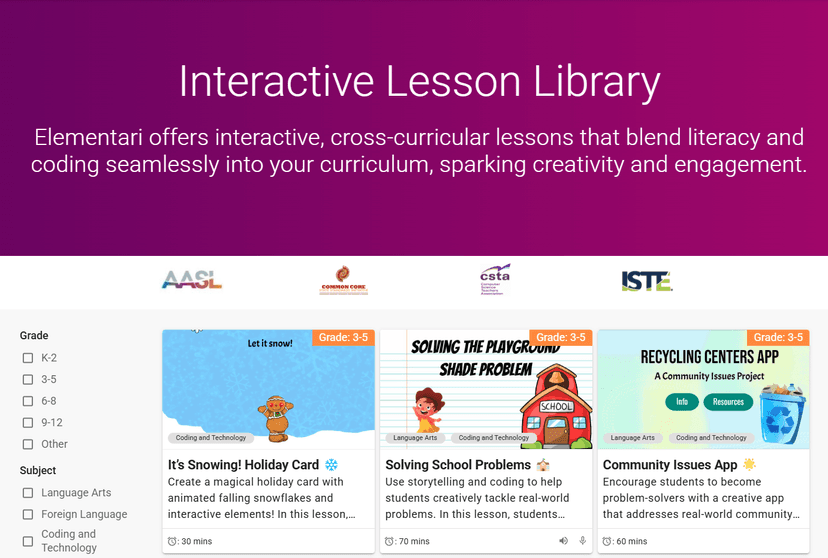
Elementari uses project-based learning and cross-curricular synthesis to teach coding and literacy simultaneously. Students begin by selecting professional illustrations, backgrounds, and sounds to serve as the foundation of their interactive story or game. They then write narrative text and use a visual block-based coding interface to animate characters, trigger sounds, and create interactive elements like clickable buttons or branching storylines. This process requires learners to apply computational thinking alongside traditional storyboarding. Teachers can deploy ready-made lessons to provide structure, assigning specific parameters that constrain the open-ended environment and keep students focused on targeted learning objectives. Once a project is complete, learners can publish it to a secure community, turning a private assignment into a public artifact. The platform itself does not feed students a sequence of increasingly difficult drills; instead, progression is entirely driven by the complexity of the projects the student chooses to build.
Strengths and tradeoffs of Elementari
Elementari's biggest strength is its ability to foster active knowledge construction through interdisciplinary projects, while its biggest weakness is the lack of built-in instructional scaffolding for novice learners. Active knowledge construction is highly effective; by forcing students to articulate a story and build the logical code to execute it, the platform demands deep cognitive processing rather than rote memorization. The inclusion of professional art assets is another major strength, as it minimizes extraneous cognitive load. Students do not waste working memory drawing poorly rendered characters and can instead focus directly on narrative sequencing and coding logic. On the downside, the platform operates as a sandbox. Open-ended learning environments often struggle to support true novices because they lack worked examples and immediate, corrective feedback. If a student's code fails, the platform does not explicitly teach them why. Furthermore, without a teacher enforcing spaced retrieval practice or structured review, students may easily forget the specific coding concepts they utilized in previous projects. Overall, it is a powerful canvas for creation, but it relies entirely on the educator to provide the actual pedagogy.
Who Might Benefit From Elementari?
Elementari is best for middle-grade students and proactive teachers who want a robust, cross-curricular sandbox for project-based learning. While advertised for K-12, the platform's reliance on independent reading, writing, and logical sequencing makes it most effective for upper elementary through middle school students (grades 3-8). It is an excellent fit for classrooms that emphasize computer science integration across the humanities. Parents and educators looking for a structured, step-by-step coding curriculum should look elsewhere, but those who want a highly engaging publishing tool to showcase student creativity will find this platform incredibly valuable.
Data Transparency
Meets Data Transparency Standard
Elementari meets our data transparency standard at Level 2 of 3 (Parent control). Level 3 needs the policy to document an API for retrieving their own data and a named export format.
26 of 35 checks passed
Evaluated September 2026
Privacy Policy →Level 1 · Basic protections
Does not sell data or target ads at students, limits sharing, and lets parents see and delete their child's data.
Level 2 · Parent control (meets the standard)
Families can get their data out, know who processes it, and know how long it is kept.
Level 3 · Direct data access
Families or schools can pull their own data through an API, in a stated format.
Not documented: an API for retrieving their own data, a named export format
View all 35 checks
Parent Access8/8
Does the policy mention parents specifically?
“It applies to everyone who uses Elementari — students, teachers, parents, and guardians.”
Can parents view their child's data?
“teachers and parents can review, correct, or delete a student's information through Account Settings or by emailing”
Can parents modify their child's data?
“teachers and parents can review, correct, or delete a student's information through Account Settings or by emailing”
Can parents delete their child's account?
“teachers and parents can review, correct, or delete a student's information through Account Settings or by emailing”
Is there a dedicated Children's Privacy section?
“for students under 13 we rely on the school (or a parent) for consent, collect as little as possible, and let teachers and parents review or delete that information anytime.”
Does it reference COPPA compliance?
“We've taken the **Student Privacy Pledge** and built our practices around the Children's Online Privacy Protection Act (COPPA), the Family Educational Rights and Privacy Act (FERPA)”
Does it reference FERPA compliance?
“We handle student education data on behalf of schools, governed by this policy, any agreement with the educational agency, and applicable state law.”
Is parental consent required for child accounts?
“We don't collect personal information from children under 13 without consent. In schools, the teacher or school provides that consent on behalf of parents; at home, we email a parent or guardian to confirm before activating the account.”
Data Portability3/5
Can users access their personal data?
“You may request access, correction, restriction, objection, erasure, or portability of your data”
Can users download/export their data?
“You may request access, correction, restriction, objection, erasure, or portability of your data, withdraw consent at any time”
Is there a self-service data access tool?
“teachers and parents can review, correct, or delete a student's information through Account Settings”
Is a specific data format mentioned for export?
The policy does not name a format for exported data.
Is there an API for data access?
The policy does not mention an API for getting data.
Data Minimization3/6
Is data collection itemized?
“**Account.** A username and password. We ask for an email for adult accounts (or a parent/guardian's email for under-18s). **Student accounts need only a username** — no email required.”
Can the app be used without a real name?
The policy says teachers may add a student's first name and last initial, so real names may be collected.
Can the app be used without an email?
“**Student accounts need only a username** — no email required.”
Does it state collection is limited to what is necessary?
“We never require more information than is reasonably needed to use Elementari”
Is IP address anonymized or truncated?
The policy says analytics use approximate location from the IP address and does not say IPs are anonymized or truncated.
Is location tracking explicitly excluded?
The policy says analytics collect approximate location from the IP address.
Third-Party Protection6/7
Does it explicitly state no selling of data?
“**We never sell or rent your information.**”
Are third-party providers named?
“Data is stored on Amazon Web Services in the USA.”
Are providers contractually restricted?
“**with service providers** who help us run Elementari — limited to the minimum needed, and contractually bound to protect it”
No-targeted-advertising commitment?
“We never target ads to students, build advertising profiles, or sell student data.”
Is AI/ML data sharing addressed?
The policy does not say whether data is shared with AI or machine-learning systems.
Child-specific sharing restriction?
“(this does not apply to students, whose work and comments stay within their classroom unless a teacher approves a project for publishing)”
Cookies/tracking limited or opt-out?
“You can decline cookies in your browser settings, though some features may work less smoothly.”
Deletion & Retention4/5
Can users delete their account?
“**Delete.** Delete your account anytime; this permanently removes your personal data, projects, and activity.”
Self-service deletion mechanism?
“delete your account — which permanently removes your data — from Account Settings or by emailing”
Specific data retention timeline?
“Server logs are kept no more than 30 days.”
Auto-deletion of inactive accounts?
The policy does not say inactive accounts are deleted automatically.
Post-deletion handling described?
“Deleting your account removes all associated data from our servers. We may keep de-identified, aggregated data that can't be traced back to you.”
Advertising2/4
Advertising model explicitly disclosed?
“We never sell your data or show ads to students.”
Free from third-party advertisements?
The policy says students are not shown ads but does not say the product has no third-party advertising at all.
Children excluded from ad targeting?
“For students, we do **not** target ads, build advertising profiles, or sell student information.”
Ad-free option available?
The policy says students are not shown ads but does not say the product has no ads or offer an ad-free option.
Meets Data Transparency Standard
The reviewed policy met our data transparency standard. This result describes the policy disclosures we assessed. Actual practices and legal compliance were not verified.
About this evaluation: Based on automated analysis of Privacy Policy against 35 policy-disclosure questions, including questions adapted from the Common Sense Privacy Program's published evaluation questions. TLS is not affiliated with Common Sense Media, and this is not a Common Sense rating. Quoted text is copied from the policy; unquoted notes are our summary. Results describe what the policy documents, not the company's actual practices. Privacy policies can change: this review reflects the version we analyzed and does not determine legal compliance.
Sources and review method
TLS combines product information and editorial analysis to explain how Elementari works, its tradeoffs, and the questions to ask before choosing it. Product features, an instructional rationale and evidence of learning outcomes are different kinds of information.
Formal Learning Standard assessment: not yet completed. Data Transparency findings are reported separately and do not establish learning effectiveness. Read our methodology.
Frequently Asked Questions About Elementari
Is Elementari free?
No, Elementari requires a paid subscription to access its core features. For schools, it costs $2 per student annually, with a minimum purchase of $300. Individual teachers can purchase smaller classroom plans starting at $96 per year for up to 35 students, or opt for a $10 month-to-month subscription. There are no free consumer tiers available for individual families, meaning access must be facilitated through an educator account.
Is Elementari good for elementary students?
Yes, but primarily for older elementary students in grades 3 through 5. Because the platform requires students to write narratives, build logical sequences, and navigate a block-based coding interface, kindergarten through second-grade students may experience cognitive overload without heavy one-on-one adult assistance. Older students with foundational literacy skills will benefit significantly more from the platform's independent project-based approach.
What does Elementari teach?
Elementari teaches block-based coding, computational thinking, and creative writing through cross-curricular project creation. Students learn narrative sequencing, basic programming logic, cause-and-effect relationships, and digital design by building interactive stories and games. Rather than teaching these subjects in isolation, the platform forces learners to synthesize technical coding skills with humanities-based storytelling, providing a holistic educational experience. It also introduces basic UI design concepts when kids create clickable interfaces.
How does Elementari compare to Scratch?
Scratch is a free, purely coding-focused platform built by MIT, whereas Elementari is a paid tool that explicitly merges coding with traditional literacy. While Scratch offers a more expansive open community and deeper technical coding blocks for advanced users, Elementari provides a more structured narrative framework. Elementari also includes professional art assets that specifically support cross-curricular lessons in the humanities, making it easier for teachers to integrate into English classes.
Has The Learning Standard evaluated Elementari?
TLS has not yet completed a Learning Standard evaluation of how well Elementari teaches. Its privacy policy has been reviewed for Data Transparency and reaches Level 2, Parent control.
Is Elementari COPPA compliant?
The reviewed privacy policy references COPPA. A policy reference alone does not establish COPPA compliance. Policy review note: The policy says its practices are built around COPPA.
Is Elementari FERPA compliant?
The reviewed privacy policy references FERPA. A policy reference alone does not establish FERPA compliance. Policy review note: A FERPA section describes how the company handles education records for schools.
Does Elementari have a children's privacy policy?
The reviewed policy includes a dedicated children's privacy section. Policy review note: The policy has a "Children & students" section with a COPPA subsection.
Does Elementari sell student data?
The reviewed policy states that the app does not sell data. This is a policy statement; actual data practices were not verified. Policy review note: The policy says the company never sells data.
Can you delete your data from Elementari?
The reviewed privacy policy describes account deletion. We have not tested the deletion process. Policy review note: Users can delete their account.
Follow TLS Research
Subscribe to future TLS research updates: app reviews, findings, and what the evidence shows.
Screenshots

Take Action
For Elementari
If you represent Elementari and have a correction or new evidence, send the relevant source so we can review and update this page.
Submit a correctionDetails
- Pricing
- Elementari is priced at $2 per student per year, with plans starting at $300 annually. Bulk discounts are available. Individual teachers can purchase as well for $96 annually ($10 for monthly) for 35 students and $300 annually ($29 for monthly) for up to 150 students.
- Platforms
- Web Browser
- Grade Levels
- Kindergarten, 1st Grade, 2nd Grade, 3rd Grade, 4th Grade, 5th Grade, 6th Grade, 7th Grade, 8th Grade, 9th Grade, 10th Grade, 12th Grade
- Website
- Visit site