EdEase
Product by EdEase
Facts checked: Not yet checked
Our take (not a Learning Standard rating). This label applies to learning-science judgments throughout this overview.
Our take (not a Learning Standard rating)
While EdEase offers on-demand AI tutoring aligned with middle and high school curricula, The Learning Standard has not yet evaluated its efficacy. It provides immediate homework help, but rely on it cautiously. AI tutors often struggle to build genuine conceptual understanding without structured scaffolding and verified spaced repetition.
Pros
- Covers a wide breadth of middle and high school subjects including STEM and humanities.
- Provides immediate assistance to help students overcome specific homework roadblocks.
- Offers teachers automated tools to reduce time spent on repetitive administrative tasks.
Cons
- The Learning Standard has not yet evaluated the pedagogical rigor or accuracy of the AI responses.
- Open-ended AI tutors risk providing direct answers rather than guiding students through worked examples.
- Limits student usage to 20 interactions per week before requiring a paid subscription.
What Do We Know About EdEase?
EdEase remains pending evaluation, so we cannot definitively state whether it effectively improves student learning outcomes. This dual-purpose platform acts as both an administrative tool for teachers and an AI chatbot tutor for middle and high school students. For your child, the app offers a way to ask questions about math, science, and humanities concepts when they get stuck on assignments. Because the system relies on artificial intelligence to generate responses, its effectiveness depends heavily on how the AI is prompted. Learning science shows that students benefit most from guided inquiry and worked examples, rather than simply receiving the final answer. You should monitor whether EdEase actually walks your child through the problem-solving steps or merely hands them the solution. While the alignment with standard curricula is a positive feature, AI tools can sometimes hallucinate or bypass the productive struggle necessary for long-term memory retention. Students are limited to 20 free queries per week, which means your child will hit a paywall quickly if they rely on it heavily for daily homework. Until The Learning Standard conducts a full review, use EdEase as a supplementary reference rather than a primary learning tool.
How Does EdEase Work?
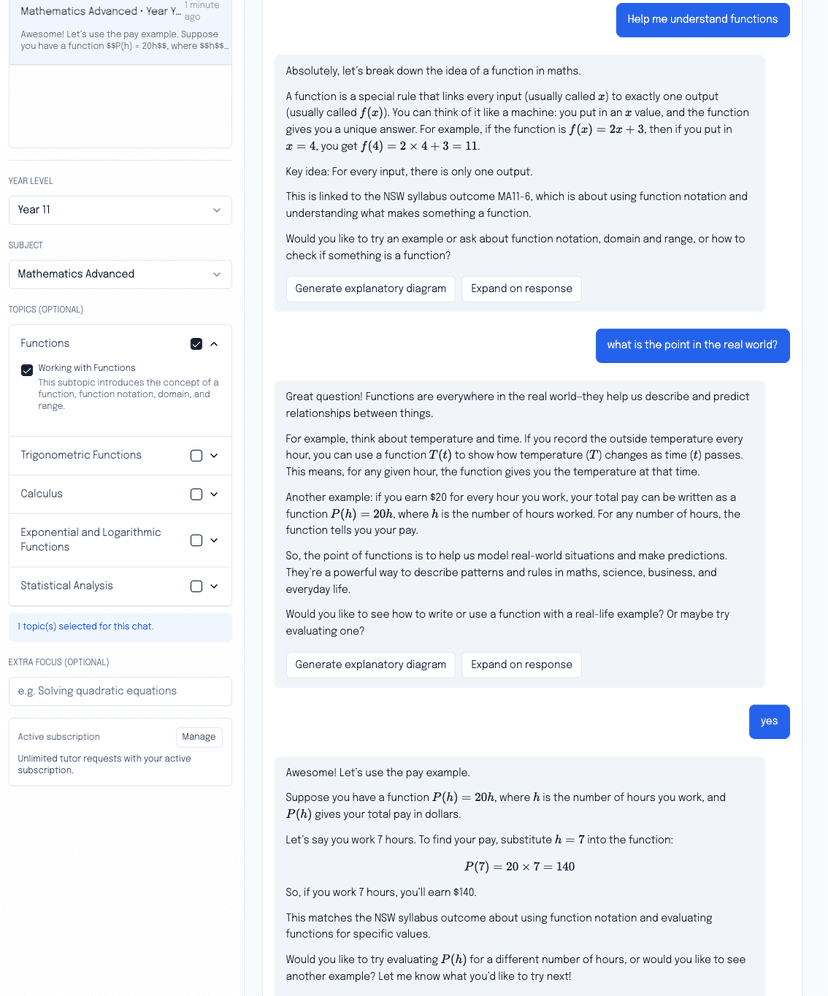
EdEase uses a conversational AI tutoring model to provide on-demand academic assistance across core subjects. Students interact with the platform via a chat interface, typing questions related to their 7th through 12th-grade coursework in math, science, social science, or humanities. The system analyzes the query and generates a text-based response intended to clarify the concept or assist with the homework problem. For educators, the platform functions concurrently as an administrative assistant, using natural language processing to automate repetitive tasks like lesson planning or basic grading. The student-facing side operates without a predetermined curriculum pathway; instead, it relies entirely on student-initiated queries. This means the app does not inherently employ spaced repetition or structured mastery-based progression. Learning is entirely reactive, driven by whatever immediate roadblock your child faces during their independent study time.
Strengths and tradeoffs of EdEase
The biggest strength of EdEase is its broad on-demand subject coverage, while its biggest weakness is the inherent risk of an AI providing answers that bypass productive struggle. Immediate feedback is a proven component of effective learning, and this app delivers instant responses when your child is stuck on a late-night math problem. This prevents frustration from halting the learning process entirely. However, unregulated AI tutors often fail to utilize scaffolding. Instead of breaking a complex physics problem into smaller, manageable steps or providing worked examples, the AI might simply output the final essay structure or math solution. This undermines retrieval practice, as students do not have to recall information from memory. Furthermore, because the app is purely reactive, it lacks a system for interleaved practice or tracking long-term mastery. It relies entirely on the student to know what they do not know. For teachers, the automation of administrative tasks is a clear strength, freeing up time for actual classroom instruction, but the student-facing educational efficacy remains unverified.
Who Might Benefit From EdEase?
EdEase is best for self-directed high school students who need occasional, targeted help to overcome specific homework roadblocks. Because the platform relies on student-prompted AI chat, it requires a user mature enough to ask specific questions rather than just seeking quick answers. It covers 7th through 12th-grade subjects, but younger students may lack the self-regulation needed to use an open-ended AI effectively. It is also highly beneficial for classroom teachers looking to offload basic administrative duties to an AI assistant, provided their school is willing to fund the platform after the trial period.
Data Transparency
Does Not Meet Data Transparency Standard
EdEase does not meet our data transparency standard. Its privacy policy does not document basic protections, including a statement that it does not sell data, a commitment against targeted advertising and limits on sharing children's data.
11 of 35 checks passed
Evaluated September 2026
Privacy Policy →Level 1 · Basic protections
Does not sell data or target ads at students, limits sharing, and lets parents see and delete their child's data.
Not documented: a statement that it does not sell data, a commitment against targeted advertising, limits on sharing children's data, contractual limits on service providers, parents' right to see their child's data, parents' right to delete their child's data
Level 2 · Parent control (meets the standard)
Families can get their data out, know who processes it, and know how long it is kept.
Not documented: a data retention timeline, named service providers, self-service deletion
Level 3 · Direct data access
Families or schools can pull their own data through an API, in a stated format.
Not documented: an API for retrieving their own data, a named export format
View all 35 checks
Parent Access5/8
Does the policy mention parents specifically?
“Educational institutions and teachers are responsible for obtaining verifiable parental consent before providing us with Student Data.”
Can parents view their child's data?
The policy gives access rights only to users ("you") and does not give parents a right to view their child's data.
Can parents modify their child's data?
The policy does not give parents a right to correct or modify their child's data.
Can parents delete their child's account?
The policy does not give parents a right to delete their child's data or account.
Is there a dedicated Children's Privacy section?
“## 9\. Children's Privacy Protecting the privacy of children is especially important.”
Does it reference COPPA compliance?
“We comply with the Children's Online Privacy Protection Act (COPPA) and the Family Educational Rights and Privacy Act (FERPA) in the United States, as well as other applicable laws and regulations.”
Does it reference FERPA compliance?
“We comply with the Children's Online Privacy Protection Act (COPPA) and the Family Educational Rights and Privacy Act (FERPA) in the United States, as well as other applicable laws and regulations.”
Is parental consent required for child accounts?
“Educational institutions and teachers are responsible for obtaining verifiable parental consent before providing us with Student Data.”
Data Portability2/5
Can users access their personal data?
“You have the right to access the Personal Information we hold about you and to request corrections if it is inaccurate or incomplete.”
Can users download/export their data?
“You may request a copy of your Personal Information in a structured, commonly used, and machine-readable format.”
Is there a self-service data access tool?
The policy describes access only by request and mentions no self-service tool.
Is a specific data format mentioned for export?
The policy says only "structured, commonly used, and machine-readable format" and names no specific file format.
Is there an API for data access?
The policy does not mention an API for data access.
Data Minimization1/6
Is data collection itemized?
“Student names and identification numbers. - Academic performance and assessment data. - Attendance records and behavioral data.”
Can the app be used without a real name?
The policy says it collects student names.
Can the app be used without an email?
The policy collects email addresses as Personal Information and does not say students' emails are never collected.
Does it state collection is limited to what is necessary?
The policy limits how long data is kept but does not say collection is limited to what is necessary.
Is IP address anonymized or truncated?
The policy says it collects IP addresses and does not mention anonymizing or truncating them.
Is location tracking explicitly excluded?
The policy does not explicitly rule out location tracking.
Third-Party Protection1/7
Does it explicitly state no selling of data?
The policy does not say the company does not sell data; it only mentions a CCPA right to opt out of sale.
Are third-party providers named?
The policy lists only types of service providers and names none.
Are providers contractually restricted?
The policy does not describe contractual restrictions on service providers.
No-targeted-advertising commitment?
The policy says cookies are used to provide customized advertising and makes no commitment against targeted ads.
Is AI/ML data sharing addressed?
The policy does not address sharing data with AI or machine-learning services.
Child-specific sharing restriction?
The policy has no sharing restrictions specific to children's data.
Cookies/tracking limited or opt-out?
“You can control cookies through your browser settings and other tools. However, disabling cookies may affect the functionality of the Service.”
Deletion & Retention1/5
Can users delete their account?
“You may request that we delete your Personal Information, subject to certain exceptions provided by law.”
Self-service deletion mechanism?
The policy describes deletion only by request and mentions no self-service mechanism.
Specific data retention timeline?
The policy ties retention to the account or contract lasting "for a reasonable period thereafter" and gives no specific timeline.
Auto-deletion of inactive accounts?
The policy does not mention automatic deletion of inactive accounts.
Post-deletion handling described?
The policy does not describe what happens to data after a deletion request, such as removal from backups.
Advertising1/4
Advertising model explicitly disclosed?
“Providing customized content and advertising.”
Free from third-party advertisements?
The policy does not say the product is free of third-party ads and mentions customized advertising.
Children excluded from ad targeting?
The policy does not exclude children from ad targeting.
Ad-free option available?
The policy does not mention an ad-free option or say the product has no advertising.
What This Means
The policy review did not meet our data transparency standard. The checks above show the documented findings and unknowns. A missing statement does not establish how the app handles data in practice.
About this evaluation: Based on automated analysis of Privacy Policy against 35 policy-disclosure questions, including questions adapted from the Common Sense Privacy Program's published evaluation questions. TLS is not affiliated with Common Sense Media, and this is not a Common Sense rating. Quoted text is copied from the policy; unquoted notes are our summary. Results describe what the policy documents, not the company's actual practices. Privacy policies can change: this review reflects the version we analyzed and does not determine legal compliance.
Sources and review method
TLS combines product information and editorial analysis to explain how EdEase works, its tradeoffs, and the questions to ask before choosing it. Product features, an instructional rationale and evidence of learning outcomes are different kinds of information.
Formal Learning Standard assessment: not yet completed. Data Transparency findings are reported separately and do not establish learning effectiveness. Read our methodology.
Frequently Asked Questions About EdEase
Is EdEase free?
EdEase is partially free. Teachers receive a three-month free trial, after which school or department subscriptions are required. Students receive 20 free uses per week. Once your child exhausts those 20 queries, they will hit a paywall and require a paid subscription to continue receiving AI tutoring.
Is EdEase good for middle schoolers?
EdEase can be used by 7th and 8th graders, but it requires strong self-regulation. Open-ended AI tutors are only as good as the questions students ask. Middle schoolers often need more structured scaffolding and explicit instruction than a reactive chat interface naturally provides.
What does EdEase teach?
EdEase covers curriculum-aligned concepts in humanities, social science, science, and math for grades 7 through 12. It does not teach a fixed curriculum from start to finish. Instead, it acts as an on-demand reference to answer specific questions your child brings to the platform.
EdEase vs Khanmigo: Which is better?
Since EdEase is pending evaluation, we cannot make a definitive efficacy comparison. However, Khanmigo is built specifically with safeguards to prevent the AI from giving away direct answers, forcing productive struggle. It is unclear if EdEase employs similar pedagogical guardrails or if it simply functions as a standard AI chatbot.
Has The Learning Standard evaluated EdEase?
TLS has not yet completed a Learning Standard evaluation of how well EdEase teaches. Its privacy policy has been reviewed for Data Transparency and does not yet document the basic protections (Level 1).
Is EdEase COPPA compliant?
The reviewed privacy policy references COPPA. A policy reference alone does not establish COPPA compliance. Policy review note: The policy says it complies with COPPA.
Is EdEase FERPA compliant?
The reviewed privacy policy references FERPA. A policy reference alone does not establish FERPA compliance. Policy review note: The policy says it complies with FERPA.
Does EdEase have a children's privacy policy?
The reviewed policy includes a dedicated children's privacy section. Policy review note: Section 9 is titled "Children's Privacy".
Does EdEase sell student data?
A statement ruling out data selling was not found in the reviewed policy. This does not establish that the app sells student data. Policy review note: The policy does not say the company does not sell data; it only mentions a CCPA right to opt out of sale.
Can you delete your data from EdEase?
The reviewed privacy policy describes account deletion. We have not tested the deletion process. Policy review note: Users can request deletion of their personal information.
Follow TLS Research
Subscribe to future TLS research updates: app reviews, findings, and what the evidence shows.
Screenshots

Take Action
For EdEase
If you represent EdEase and have a correction or new evidence, send the relevant source so we can review and update this page.
Submit a correctionDetails
- Pricing
- Free for teachers for 3 months. School and department plans available afterwards. Students get 20 free uses a week, paid afterwards.
- Platforms
- Web Browser, iOS (Apple mobile), iPadOS (Apple tablet), Android (Google mobile), Tizen (Samsung mobile), Windows (Microsoft), macOS (Apple), Chrome OS (Google)
- Grade Levels
- 7th Grade, 8th Grade, 9th Grade, 10th Grade, 11th Grade, 12th Grade
- Website
- Visit site