
Ed.ai
Product by Ed.ai
Facts checked: Not yet checked
Our take (not a Learning Standard rating). This label applies to learning-science judgments throughout this overview.
Our take (not a Learning Standard rating)
While Ed.ai offers robust automated grading and error pattern analysis for middle school through college math, its ultimate teaching effectiveness remains pending evaluation by The Learning Standard. It succeeds in accelerating teacher workflows and generating personalized practice sets, but relies heavily on student self-regulation to process AI-generated feedback effectively.
Pros
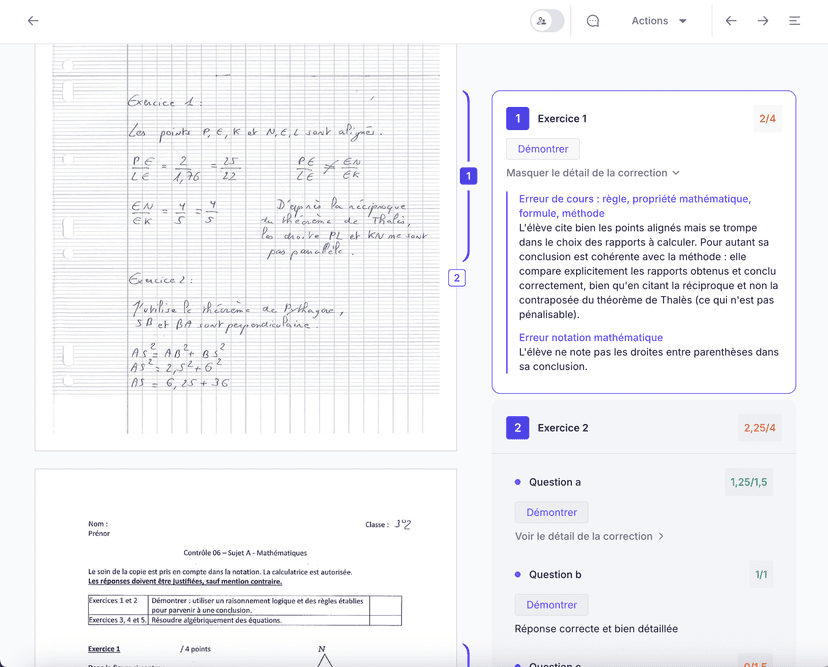
- Identifies specific error patterns in student math work to target underlying misconceptions rather than just marking answers wrong.
- Uses mastery-based progression to ensure students understand foundational math concepts before advancing to complex equations.
- Generates individualized practice paths based on previous mistakes, heavily relying on targeted retrieval practice.
- Provides immediate, detailed feedback on assignments to close the learning loop faster than traditional manual grading.
Cons
- Relies heavily on text-based AI feedback which may overwhelm younger or struggling students who need direct human intervention.
- Focuses exclusively on mathematics, lacking cross-curricular support for science or humanities at this time.
- The effectiveness of its personalized learning paths depends entirely on the initial quality of the teacher's assignment structure.
- Evaluative data regarding long-term knowledge retention using this specific platform remains unavailable.
What Do We Know About Ed.ai?
Ed.ai is a partially effective tool for mathematics that accelerates grading but relies on your child's ability to interpret AI-generated feedback independently. The Learning Standard has not yet formally evaluated this app, but its core mechanics leverage error analysis and personalized learning paths. Instead of waiting days for a teacher to return a math test, your child receives immediate, detailed explanations of their mistakes. This rapid feedback loop is firmly grounded in learning science, as immediate correction prevents students from encoding incorrect mathematical procedures into their long-term memory. However, parents must understand that this is primarily a teacher-facing grading and assignment tool rather than a standalone tutoring app. Your child will interact with Ed.ai through assignments pushed by their school, meaning the quality of the practice depends heavily on how the teacher uses the platform. If your child struggles with reading comprehension, they may find the AI-generated text feedback difficult to parse without a human educator stepping in to model the correct mathematical steps. At $8 per student annually, it is a district-level investment rather than a direct-to-consumer app, meaning your involvement will mostly consist of monitoring the feedback your child brings home.
How Does Ed.ai Work?
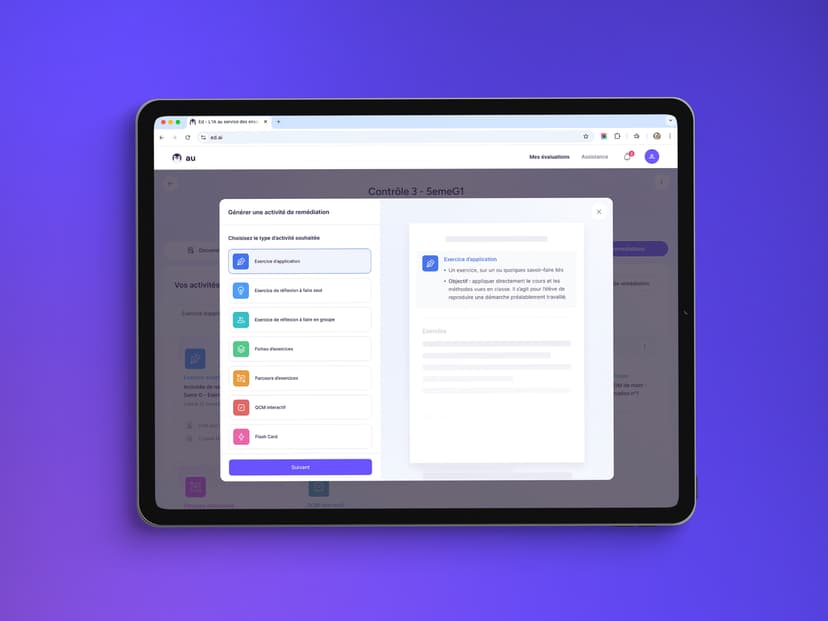
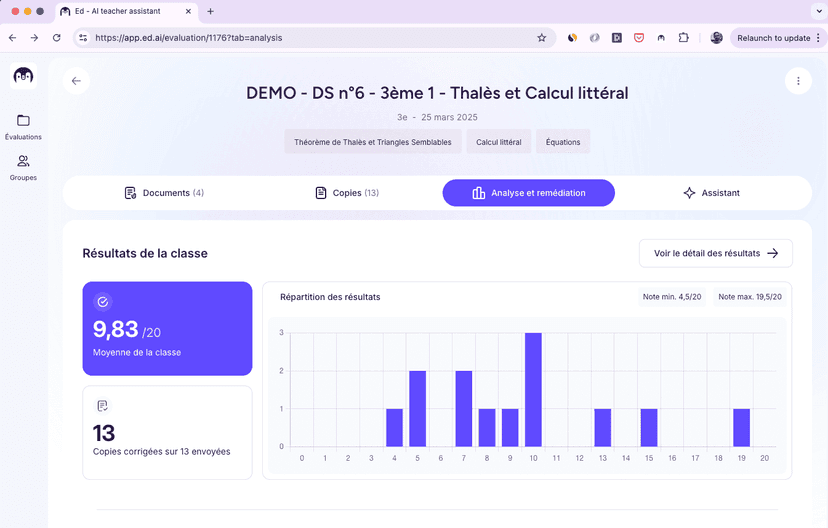
Ed.ai relies on an algorithmic error-analysis approach combined with mastery-based progression to evaluate student math assignments. Teachers upload math assessments or homework into the platform, and the AI grades the submissions by analyzing the specific steps your child took to reach an answer. Instead of a simple pass or fail, the system identifies the exact point where a mathematical procedure broke down. The platform then flags these error patterns and generates a personalized learning path consisting of targeted practice problems designed to correct the specific misconception. This process utilizes dynamic retrieval practice, forcing students to recall and apply the correct formula immediately after receiving feedback. By integrating directly with a school's existing Learning Management System, it centralizes the workflow so students simply log into their regular school portal to see their grades and subsequent personalized assignments. The engine currently processes only mathematics, adapting its feedback complexity from 6th-grade arithmetic up through college-level calculus.
Strengths and tradeoffs of Ed.ai
The biggest strength of Ed.ai is its ability to provide immediate, individualized feedback on complex math problems, while its biggest weakness is the assumption that students possess the metacognitive skills to learn from text-based AI corrections. Immediate feedback is a cornerstone of effective learning science, as it stops students from practicing and cementing errors. By automating the grading process, Ed.ai ensures students do not wait days to find out they misunderstood a core algebraic concept. Furthermore, the platform's error pattern recognition moves beyond binary correct/incorrect scoring to identify the precise procedural mistake, allowing for highly targeted retrieval practice. On the negative side, AI-generated explanations can often lack the nuance of a human teacher's worked examples. If a student lacks foundational reading comprehension or self-regulation, handing them a detailed paragraph about why they factored a polynomial incorrectly will not automatically translate to mastery. Because The Learning Standard has not yet rated this platform, the claim that it tracks true learning remains unverified by independent classroom data. The system currently lacks scaffolding techniques like interactive step-by-step guidance, making it a powerful diagnostic tool that still demands strong teacher oversight.
Who Might Benefit From Ed.ai?
Ed.ai is best for middle school through college-level math students whose teachers need to provide immediate, individualized feedback on complex assignments. Because it relies on text-based AI explanations and automated error tracking, it serves self-directed learners who can process detailed written corrections without constant human hand-holding. It is exclusively an institutional tool, making it ideal for school districts looking to reduce teacher grading workloads while attempting to implement mastery-based progression. It is not suitable for younger elementary students or learners who require extensive, face-to-face modeling to grasp new mathematical concepts.
Data Transparency
Meets Data Transparency Standard
Ed.ai meets our data transparency standard at Level 2 of 3 (Parent control). Level 3 needs the policy to document an API for retrieving their own data and a named export format.
Level 1 · Basic protections
Does not sell data or target ads at students, limits sharing, and lets parents see and delete their child's data.
Level 2 · Parent control (meets the standard)
Families can get their data out, know who processes it, and know how long it is kept.
Level 3 · Direct data access
Families or schools can pull their own data through an API, in a stated format.
Not documented: an API for retrieving their own data, a named export format
View all 35 checks
Parent Access4/8
Does the policy mention parents specifically?
“Les droits relatifs aux données des élèves sont exercés par les représentants légaux (parents/tuteurs) ou par l'enseignant/l'établissement qui a transmis les données, selon le contexte d'utilisation (GAR ou hors GAR).”
Can parents view their child's data?
“Les droits relatifs aux données des élèves sont exercés par les représentants légaux (parents/tuteurs) ou par l'enseignant/l'établissement qui a transmis les données, selon le contexte d'utilisation (GAR ou hors GAR).”
Can parents modify their child's data?
“Les droits relatifs aux données des élèves sont exercés par les représentants légaux (parents/tuteurs) ou par l'enseignant/l'établissement qui a transmis les données, selon le contexte d'utilisation (GAR ou hors GAR).”
Can parents delete their child's account?
“Les droits relatifs aux données des élèves sont exercés par les représentants légaux (parents/tuteurs) ou par l'enseignant/l'établissement qui a transmis les données, selon le contexte d'utilisation (GAR ou hors GAR).”
Is there a dedicated Children's Privacy section?
The policy has a section on student data (3.2) inside its data-collection list, but no dedicated children's privacy or COPPA section.
Does it reference COPPA compliance?
The policy cites the GDPR, the French data protection law and the EU AI Act, but does not mention COPPA.
Does it reference FERPA compliance?
The policy does not mention FERPA.
Is parental consent required for child accounts?
The policy bases student data processing on public interest or legitimate interest, not on parental consent.
Data Portability2/5
Can users access their personal data?
“**Droit d'accès** (art. 15 RGPD) : obtenir confirmation du traitement de vos données et en recevoir une copie.”
Can users download/export their data?
“**Droit à la portabilité** (art. 20 RGPD) : recevoir vos données dans un format structuré et couramment utilisé.”
Is there a self-service data access tool?
The policy says rights are exercised by email or post and that results can be exported, but does not describe a self-service data access tool.
Is a specific data format mentioned for export?
The policy only says a "structured, commonly used format" and names no specific format.
Is there an API for data access?
The policy does not mention an API for data access.
Data Minimization2/6
Is data collection itemized?
“**Exemples :** Nom, prénom, classe (ou identifiant pseudonymisé via le GAR)”
Can the app be used without a real name?
The policy states that student last name, first name and class are collected.
Can the app be used without an email?
The policy does not explicitly state that student email addresses are never collected.
Does it state collection is limited to what is necessary?
“Ed.ai reçoit uniquement les données strictement nécessaires à la fourniture du service, conformément au cadre défini par le Ministère de l'Éducation nationale.”
Is IP address anonymized or truncated?
The policy says IP addresses are collected as connection data but does not say they are anonymized or truncated.
Is location tracking explicitly excluded?
The policy does not address location tracking.
Third-Party Protection7/7
Does it explicitly state no selling of data?
“Ed.ai ne vend, ne loue et ne transmet jamais de données personnelles à des tiers à des fins commerciales, publicitaires ou de prospection.”
Are third-party providers named?
“Tous les fournisseurs de services d'IA (Azure OpenAI, Azure Claude, Azure Mistral) opèrent exclusivement en région UE.”
Are providers contractually restricted?
“**Non-rétention par les fournisseurs :** Nos fournisseurs d'IA s'engagent contractuellement à ne pas conserver les données transmises au-delà du temps strictement nécessaire au traitement de la requête.”
No-targeted-advertising commitment?
“Ed.ai n'utilise aucun cookie publicitaire ni traceur à des fins de ciblage commercial.”
Is AI/ML data sharing addressed?
“**Non-utilisation pour l'entraînement :** Les copies des élèves et les données pédagogiques ne sont jamais utilisées pour entraîner ou améliorer nos modèles d'IA, ni ceux de nos fournisseurs.”
Child-specific sharing restriction?
“Avant toute transmission aux modèles d'IA, les données identifiantes des élèves (noms, prénoms) présentes sur les copies sont systématiquement masquées par un processus automatique de pseudonymisation par pixels blancs.”
Cookies/tracking limited or opt-out?
“Ces cookies ne sont déposés qu'avec votre consentement explicite et peuvent être refusés sans impact sur l'utilisation du service.”
Deletion & Retention4/5
Can users delete their account?
“**Droit à l'effacement** (art. 17 RGPD) : demander la suppression de vos données dans les conditions prévues par la loi.”
Self-service deletion mechanism?
The policy only describes deletion requests by email or post, not a self-service deletion tool.
Specific data retention timeline?
“**Données de connexion / logs** : 12 mois (conformément aux recommandations CNIL)”
Auto-deletion of inactive accounts?
“**Données du compte enseignant** : Durée d'utilisation du service + 12 mois après la dernière connexion”
Post-deletion handling described?
“Après les durées indiquées, les données sont supprimées de manière définitive ou anonymisées de manière irréversible.”
Advertising1/4
Advertising model explicitly disclosed?
The policy rules out advertising cookies and sharing data for advertising, but does not explicitly say whether the product shows advertising.
Free from third-party advertisements?
The policy does not explicitly state that the product is free of third-party advertisements.
Children excluded from ad targeting?
“Ed.ai ne vend, ne loue et ne transmet jamais de données personnelles à des tiers à des fins commerciales, publicitaires ou de prospection.”
Ad-free option available?
The policy does not explicitly state that the product has no advertising or offers an ad-free option.
Meets Data Transparency Standard
The reviewed policy met our data transparency standard. This result describes the policy disclosures we assessed. Actual practices and legal compliance were not verified.
About this evaluation: Based on automated analysis of Ed.ai and Ed.ai against 35 policy-disclosure questions, including questions adapted from the Common Sense Privacy Program's published evaluation questions. TLS is not affiliated with Common Sense Media, and this is not a Common Sense rating. Quoted text is copied from the policy; unquoted notes are our summary. Results describe what the policy documents, not the company's actual practices. Privacy policies can change: this review reflects the version we analyzed and does not determine legal compliance.
Sources and review method
TLS combines product information and editorial analysis to explain how Ed.ai works, its tradeoffs, and the questions to ask before choosing it. Product features, an instructional rationale and evidence of learning outcomes are different kinds of information.
Formal Learning Standard assessment: not yet completed. Data Transparency findings are reported separately and do not establish learning effectiveness. Read our methodology.
Frequently Asked Questions About Ed.ai
Is Ed.ai free?
No, Ed.ai costs $8 per student, per subject, per year. It is sold directly to schools and districts rather than individual parents, so your child will only access it if their school purchases a license.
Is Ed.ai good for middle school students?
Yes, Ed.ai is designed for students in 6th grade through college. Middle school students will benefit from the immediate feedback on math assignments, though those who struggle with reading may need help interpreting the AI's written explanations.
What does Ed.ai teach?
Ed.ai currently evaluates mathematics, ranging from 6th-grade math through undergraduate college courses. The developer states that science and humanities features are currently in development but not yet available.
How does Ed.ai compare to traditional grading?
Ed.ai provides immediate diagnostic feedback, whereas traditional grading often takes days and only provides a final score. This rapid turnaround leverages learning science by correcting misconceptions before your child memorizes the wrong mathematical steps.
Has The Learning Standard evaluated Ed.ai?
TLS has not yet completed a Learning Standard evaluation of how well Ed.ai teaches. Its privacy policy has been reviewed for Data Transparency and reaches Level 2, Parent control.
Is Ed.ai COPPA compliant?
A COPPA reference was not found in the reviewed privacy policy. This does not determine whether the app complies with COPPA. Policy review note: The policy cites the GDPR, the French data protection law and the EU AI Act, but does not mention COPPA.
Is Ed.ai FERPA compliant?
A FERPA reference was not found in the reviewed privacy policy. This does not determine whether the app complies with FERPA. Policy review note: The policy does not mention FERPA.
Does Ed.ai have a children's privacy policy?
No dedicated children's privacy section was found in the reviewed policy. Policy review note: The policy has a section on student data (3.2) inside its data-collection list, but no dedicated children's privacy or COPPA section.
Does Ed.ai sell student data?
The reviewed policy states that the app does not sell data. This is a policy statement; actual data practices were not verified. Policy review note: Ed.ai states it never sells personal data.
Can you delete your data from Ed.ai?
The reviewed privacy policy describes account deletion. We have not tested the deletion process. Policy review note: Users can request deletion of their data.
Follow TLS Research
Subscribe to future TLS research updates: app reviews, findings, and what the evidence shows.
Screenshots

Take Action
For Ed.ai
If you represent Ed.ai and have a correction or new evidence, send the relevant source so we can review and update this page.
Submit a correctionDetails
- Pricing
- $8 per student, per subject, per year Currently available in Mathematics, with Science and Humanities coming soon.
- Platforms
- Web Browser, iOS (Apple mobile), iPadOS (Apple tablet), Android (Google mobile)
- Grade Levels
- 6th Grade, 7th Grade, 8th Grade, 9th Grade, 10th Grade, 11th Grade, 12th Grade, Associate's degree, Bachelor's degree
- Website
- Visit site