
CoolThink@JC
Product by The Education University of Hong Kong
Facts checked: Not yet checked
Our take (not a Learning Standard rating). This label applies to learning-science judgments throughout this overview.
Our take (not a Learning Standard rating)
While CoolThink@JC employs evidence-based approaches like project-based and cooperative learning to build computational thinking skills, its effectiveness remains pending formal evaluation by The Learning Standard. It successfully transitions upper primary students from passive technology consumers to active creators, but rigorous outcome data is required to confirm retention.
Pros
- Uses project-based learning to contextualize computational thinking within real-world problem-solving scenarios.
- Employs cooperative learning structures that encourage peer-to-peer explanation, a proven method for solidifying complex concepts.
- Transitions students from passive screen time to active technology creation through hands-on coding and design tasks.
- Provides structured pedagogical frameworks for educators to ensure classroom implementation aligns with cognitive science principles.
Cons
- Lacks independent verification of learning outcomes by The Learning Standard.
- Requires significant school-level infrastructure and teacher training, making it inaccessible for independent home use.
- Project-based group work can obscure individual knowledge gaps if formative assessments are not rigorously applied.
- Focuses entirely on classroom integration, offering zero tools for parents to monitor individual skill acquisition.
What Do We Know About CoolThink@JC?
CoolThink@JC effectively uses project-based and cooperative learning to teach computational thinking, though formal evaluation by The Learning Standard is pending. Your child will not passively consume content here. Instead, this program forces students to actively engage with digital tools to solve tangible problems. Active learning of this nature requires deeper cognitive processing than traditional lectures or rote memorization. Because the curriculum relies heavily on group work and classroom implementation, your child will practice articulating their thought processes to peers. This peer-to-peer explanation forces learners to retrieve and organize their knowledge, significantly strengthening retention. However, parents must understand that this is an institutional program rather than a standalone consumer app. You cannot simply download it for weekend practice. Its success relies entirely on how well your child's teachers facilitate the cooperative learning modules and manage the project milestones. While the framework provides excellent opportunities for developing logic and coding skills, the lack of a parent-facing dashboard means you will rely entirely on school-provided progress reports to identify any gaps in your child's computational fluency.
How Does CoolThink@JC Work?
CoolThink@JC uses problem-based and cooperative learning models to teach computational thinking and applied science. Students are presented with overarching challenges that require digital solutions, forcing them to break down complex problems into manageable, codable steps. Rather than following isolated tutorials, learners work in teams to design, test, and debug their own technological creations. This iterative process of debugging serves as a practical application of retrieval practice and error analysis, where students must constantly evaluate why a piece of code failed and adjust their mental models accordingly. The program provides structured frameworks for teachers to guide these collaborative sessions, ensuring that group dynamics enhance rather than detract from the learning objectives. By embedding coding exercises within larger, meaningful projects, the curriculum ensures that students understand the utility of the skills they are acquiring, which significantly boosts intrinsic motivation and cognitive engagement.
Strengths and tradeoffs of CoolThink@JC
The biggest strength of CoolThink@JC is its reliance on project-based learning to build functional digital literacy, while its biggest weakness is its complete dependence on institutional execution, limiting independent student access. By structuring lessons around the creation of actual digital products, the program forces students into active cognitive engagement. This approach leverages the generation effect, a learning science principle demonstrating that information is better remembered when it is actively generated rather than passively read. Furthermore, the cooperative learning environment encourages students to verbalize their debugging processes, solidifying their understanding of computational logic. On the downside, the heavy reliance on group work introduces the risk of the free-rider effect, where struggling students might coast on the efforts of stronger peers. Without careful teacher intervention and individual formative assessments, specific gaps in a student's coding vocabulary or logic sequencing will go unnoticed. Additionally, because the program is designed exclusively for school deployment, it lacks the built-in, individualized spaced repetition algorithms found in many direct-to-consumer educational apps, relying entirely on the classroom teacher to revisit and reinforce core concepts over time.
Who Might Benefit From CoolThink@JC?
CoolThink@JC is best for upper primary school students whose educators are fully trained in facilitating project-based, cooperative computational learning. Specifically targeting 4th, 5th, and 6th graders, it serves classrooms aiming to transition students from basic digital literacy to active technology creation. It is highly effective for learners who thrive in collaborative environments and benefit from tackling large, contextualized problems rather than isolated coding drills. However, it is not suitable for parents seeking an independent, self-paced coding application for home use, as the curriculum strictly requires a structured classroom setting, peer collaboration, and active teacher facilitation to function effectively.
Data Transparency
Does Not Meet Data Transparency Standard
CoolThink@JC does not meet our data transparency standard. Its privacy policy does not document basic protections, including a statement that it does not sell data, a commitment against targeted advertising and limits on sharing children's data.
0 of 35 checks passed
Evaluated October 2026
The Hong Kong Jockey Club →Level 1 · Basic protections
Does not sell data or target ads at students, limits sharing, and lets parents see and delete their child's data.
Not documented: a statement that it does not sell data, a commitment against targeted advertising, limits on sharing children's data, contractual limits on service providers, a COPPA or FERPA commitment, parents' right to see their child's data, parents' right to delete their child's data, account deletion
Level 2 · Parent control (meets the standard)
Families can get their data out, know who processes it, and know how long it is kept.
Not documented: users' right to access their data, data export, a data retention timeline, named service providers, self-service deletion
Level 3 · Direct data access
Families or schools can pull their own data through an API, in a stated format.
Not documented: an API for retrieving their own data, a named export format
View all 35 checks
Parent Access0/8
Does the policy mention parents specifically?
The policy does not mention parents.
Can parents view their child's data?
The policy does not address whether parents can view their child's data.
Can parents modify their child's data?
The policy does not address whether parents can modify their child's data.
Can parents delete their child's account?
The policy does not address whether parents can delete their child's data or account.
Is there a dedicated Children's Privacy section?
The policy has no section about children's privacy; its headings cover only general topics such as collection, use, cookies and retention.
Does it reference COPPA compliance?
The policy names only Hong Kong's Personal Data (Privacy) Ordinance and does not mention COPPA.
Does it reference FERPA compliance?
The policy names only Hong Kong's Personal Data (Privacy) Ordinance and does not mention FERPA.
Is parental consent required for child accounts?
The policy does not address parental consent.
Data Portability0/5
Can users access their personal data?
The policy has a heading titled "Access to and Correction of Personal Data" but includes no text describing an access right.
Can users download/export their data?
The policy does not address downloading or exporting data.
Is there a self-service data access tool?
The policy does not describe a self-service data access tool.
Is a specific data format mentioned for export?
The policy does not mention any export format.
Is there an API for data access?
The policy does not mention an API for data access.
Data Minimization0/6
Is data collection itemized?
The policy has a heading titled "Collection of Personal Data" but includes no itemized list of the data collected.
Can the app be used without a real name?
The policy does not say whether the service can be used without a real name.
Can the app be used without an email?
The policy does not say whether the service can be used without an email address.
Does it state collection is limited to what is necessary?
The policy does not say that collection is limited to what is necessary.
Is IP address anonymized or truncated?
The policy does not address anonymizing or truncating IP addresses.
Is location tracking explicitly excluded?
The policy does not exclude location tracking.
Third-Party Protection0/7
Does it explicitly state no selling of data?
The policy does not state that data is not sold.
Are third-party providers named?
The policy does not name any third-party providers.
Are providers contractually restricted?
The policy has a heading titled "Disclosure of Personal Data" but includes no text on contractual restrictions for providers.
No-targeted-advertising commitment?
The policy lists a "Direct Marketing" heading but makes no commitment against targeted advertising.
Is AI/ML data sharing addressed?
The policy does not address sharing data for AI or machine learning.
Child-specific sharing restriction?
The policy has no restrictions on sharing that apply specifically to children.
Cookies/tracking limited or opt-out?
The policy has a heading titled "Use of Cookies" but includes no text on cookie limits or opt-out.
Deletion & Retention0/5
Can users delete their account?
The policy does not address account or data deletion.
Self-service deletion mechanism?
The policy does not describe a self-service deletion mechanism.
Specific data retention timeline?
The policy has a heading titled "Data Retention" but gives no specific retention timeline.
Auto-deletion of inactive accounts?
The policy does not address automatic deletion of inactive accounts.
Post-deletion handling described?
The policy does not describe how data is handled after deletion.
Advertising0/4
Advertising model explicitly disclosed?
The policy lists a "Direct Marketing" heading but does not explicitly disclose an advertising model.
Free from third-party advertisements?
The policy does not state that the product is free of third-party advertisements.
Children excluded from ad targeting?
The policy does not say children are excluded from ad targeting.
Ad-free option available?
The policy does not mention an ad-free option or say the product has no advertising.
What This Means
The policy review did not meet our data transparency standard. The checks above show the documented findings and unknowns. A missing statement does not establish how the app handles data in practice.
About this evaluation: Based on automated analysis of The Hong Kong Jockey Club against 35 policy-disclosure questions, including questions adapted from the Common Sense Privacy Program's published evaluation questions. TLS is not affiliated with Common Sense Media, and this is not a Common Sense rating. Quoted text is copied from the policy; unquoted notes are our summary. Results describe what the policy documents, not the company's actual practices. Privacy policies can change: this review reflects the version we analyzed and does not determine legal compliance.
Sources and review method
TLS combines product information and editorial analysis to explain how CoolThink@JC works, its tradeoffs, and the questions to ask before choosing it. Product features, an instructional rationale and evidence of learning outcomes are different kinds of information.
Formal Learning Standard assessment: not yet completed. Data Transparency findings are reported separately and do not establish learning effectiveness. Read our methodology.
Frequently Asked Questions About CoolThink@JC
Is CoolThink@JC free?
Yes, CoolThink@JC is provided completely free of charge to participating primary schools. The program also includes subsidies for schools to upgrade their facilities and purchase necessary digital devices to ensure equitable access for all students.
Is CoolThink@JC good for 4th graders?
Yes, the curriculum is specifically designed for 4th, 5th, and 6th-grade students. The cognitive demands of the project-based tasks align perfectly with the developmental milestones of upper primary students, introducing abstract computational logic through concrete, collaborative problem-solving.
What does CoolThink@JC teach?
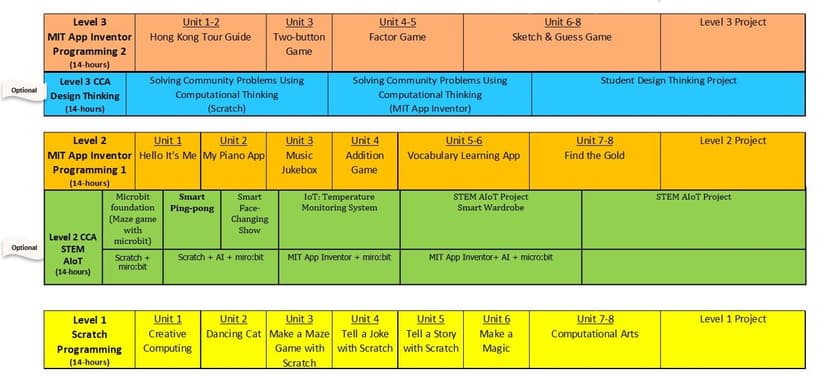
CoolThink@JC teaches computational thinking, applied science, and career and technical education concepts. Students learn how to analyze problems, design logical step-by-step solutions, and utilize coding and digital tools to build actual technology products rather than just consuming them.
How does CoolThink@JC compare to self-paced coding apps like Scratch?
While standalone apps often focus on individual, self-paced coding drills, CoolThink@JC embeds coding within a broader, cooperative classroom framework. It prioritizes collaborative problem-solving and teacher-guided project management over isolated, independent skill acquisition.
Has The Learning Standard evaluated CoolThink@JC?
TLS has not yet completed a Learning Standard evaluation of how well CoolThink@JC teaches. Its privacy policy has been reviewed for Data Transparency and does not yet document the basic protections (Level 1).
Is CoolThink@JC COPPA compliant?
A COPPA reference was not found in the reviewed privacy policy. This does not determine whether the app complies with COPPA. Policy review note: The policy names only Hong Kong's Personal Data (Privacy) Ordinance and does not mention COPPA.
Is CoolThink@JC FERPA compliant?
A FERPA reference was not found in the reviewed privacy policy. This does not determine whether the app complies with FERPA. Policy review note: The policy names only Hong Kong's Personal Data (Privacy) Ordinance and does not mention FERPA.
Does CoolThink@JC have a children's privacy policy?
No dedicated children's privacy section was found in the reviewed policy. Policy review note: The policy has no section about children's privacy; its headings cover only general topics such as collection, use, cookies and retention.
Does CoolThink@JC sell student data?
A statement ruling out data selling was not found in the reviewed policy. This does not establish that the app sells student data. Policy review note: The policy does not state that data is not sold.
Can you delete your data from CoolThink@JC?
Account deletion was not documented in the reviewed privacy policy. This does not establish whether deletion is available. Policy review note: The policy does not address account or data deletion.
Follow TLS Research
Subscribe to future TLS research updates: app reviews, findings, and what the evidence shows.
Screenshots


Take Action
For CoolThink@JC
If you represent The Education University of Hong Kong and have a correction or new evidence, send the relevant source so we can review and update this page.
Submit a correctionDetails
- Pricing
- CoolThink@JC is a free-of-charge programme offering to primary schools. The programme will also provide subsidy to schools for facility upgrade and purchase of new digital devices.
- Platforms
- Web Browser, iOS (Apple mobile), iPadOS (Apple tablet), Android (Google mobile), Tizen (Samsung mobile), Windows (Microsoft), macOS (Apple), Chrome OS (Google)
- Grade Levels
- 4th Grade, 5th Grade, 6th Grade
- Website
- Visit site