CommonLit's Digital Library
Product by CommonLit
Facts checked: Not yet checked
Our take (not a Learning Standard rating). This label applies to learning-science judgments throughout this overview.
Our take (not a Learning Standard rating)
CommonLit delivers highly effective reading comprehension instruction by pairing rigorous texts with targeted retrieval practice. The platform strengthens literacy through immediate formative assessments and guided reading mode, ensuring students actively engage with the material rather than passively scanning. While it lacks adaptive leveling within individual texts, the massive library supports deep background knowledge acquisition.
Pros
- Integrates frequent retrieval practice through embedded comprehension questions to check understanding during reading.
- Builds necessary background knowledge for complex texts through curated pre-reading multimedia resources.
- Reduces cognitive overload for struggling readers via built-in accessibility tools like text-to-speech and translation.
- Encourages active reading strategies with digital annotation tools that allow students to highlight and take notes.
Cons
- Does not dynamically adapt the Lexile level of individual texts based on real-time student performance.
- Requires significant teacher intervention to select appropriate texts and monitor open-ended written responses.
- Locks advanced analytics and district-wide summative assessments behind expensive institutional paywalls.
What Do We Know About CommonLit's Digital Library?
CommonLit is highly effective for building reading comprehension because it requires your child to actively process texts rather than passively consume them. The platform provides a massive library of reading passages across science, history, and literature for grades 3 through 12. Instead of just giving your child a book to read, CommonLit embeds assessment directly into the reading process. Your child will encounter Guided Reading Mode, which blurs out portions of the text until they answer basic comprehension questions. This leverages retrieval practice, forcing your child to recall and secure foundational facts before moving on to higher-order analysis. The platform also excels at building background knowledge, a critical component of reading science. Before your child tackles a complex historical document or scientific article, the app provides related media to anchor their understanding. Furthermore, CommonLit reduces frustration for struggling readers by providing robust scaffolding. Your child can use built-in text-to-speech, translate passages into dozens of languages, and annotate the screen. While the core reading experience is excellent, parents should know this is primarily a teacher-driven tool. You will need to actively assign readings and review your child's written responses, as the system does not automatically generate feedback for open-ended questions.
How Does CommonLit's Digital Library Work?
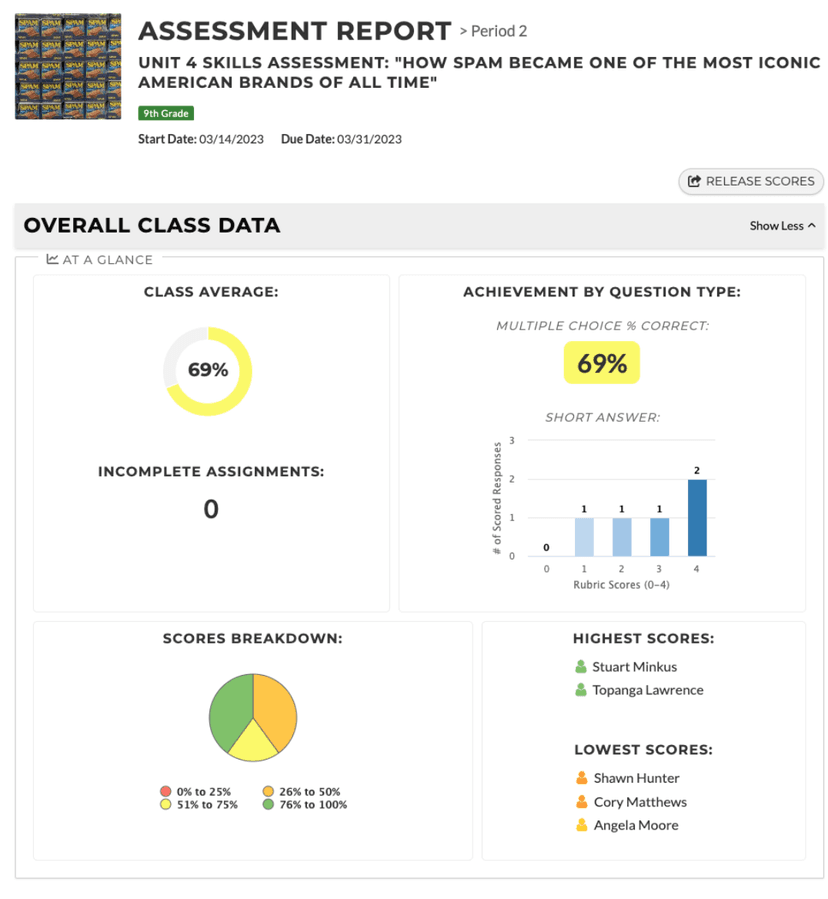
CommonLit uses a blended, competency-based approach combining rigorous text exposure with embedded formative assessment. Teachers or parents assign a text from the 3,000-piece library, filtering by grade level, theme, or literary device. When a student opens an assignment, they read the text alongside a suite of digital tools. They can highlight text, write margin notes, and click on difficult vocabulary words for immediate definitions, which reduces cognitive load. The core learning mechanic relies on Guided Reading Mode. This feature chunks the text into manageable sections and pauses the student to ask a multiple-choice question. The student cannot proceed until they demonstrate basic comprehension of the current section. After finishing the text, students complete a final assessment featuring both multiple-choice and short-answer questions. These questions are aligned to specific reading standards, requiring students to cite textual evidence. The platform provides immediate scoring for multiple-choice items, allowing students to check their understanding, while teachers manually grade the short-answer responses using provided rubrics.
Strengths and tradeoffs of CommonLit's Digital Library
CommonLit's biggest strength is its systematic use of embedded retrieval practice to build comprehension, while its biggest weakness is the lack of automated, immediate feedback for complex writing tasks. Scaffolded Comprehension: By utilizing Guided Reading Mode, the platform prevents students from skimming. Forcing students to answer questions at the end of specific paragraphs leverages the spacing effect and frequent retrieval, ensuring working memory is not overwhelmed before moving to the next concept. Background Knowledge Acquisition: Reading science emphasizes that comprehension relies heavily on domain knowledge. CommonLit addresses this by pairing primary texts with related multimedia, giving students the schema necessary to understand rigorous passages. Accessibility Features: The inclusion of text-to-speech and translation directly within the reading interface acts as an effective worked example of fluent reading and lowers the barrier to entry for English Language learners. Teacher Dependency: The platform is not an autonomous tutoring system. While multiple-choice questions provide immediate automated feedback, the critical short-answer questions require manual teacher grading. Without an adult actively reviewing these responses, students miss out on the corrective feedback necessary to improve their analytical writing.
Who Might Benefit From CommonLit's Digital Library?
Best for educators and homeschooling parents who need structured, rigorous reading comprehension materials for students in grades 3 through 12. CommonLit is an ideal supplement for classroom instruction, offering cross-curricular texts that align with science and social studies units. It works exceptionally well for classrooms with diverse reading abilities, as the built-in accessibility tools allow struggling readers to access grade-level content alongside their peers. However, it is not a standalone learn-to-read app for early elementary students; it requires users to already possess foundational decoding skills and relies on an adult to assign texts and grade written responses.
Data Transparency
Does Not Meet Data Transparency Standard
CommonLit's Digital Library does not meet our data transparency standard. Its privacy policy does not document basic protections, including a statement that it does not sell data and contractual limits on service providers.
19 of 35 checks passed
Evaluated September 2026
Privacy Policy →Level 1 · Basic protections
Does not sell data or target ads at students, limits sharing, and lets parents see and delete their child's data.
Not documented: a statement that it does not sell data, contractual limits on service providers
Level 2 · Parent control (meets the standard)
Families can get their data out, know who processes it, and know how long it is kept.
Not documented: self-service deletion
Level 3 · Direct data access
Families or schools can pull their own data through an API, in a stated format.
Not documented: an API for retrieving their own data, a named export format
View all 35 checks
Parent Access7/8
Does the policy mention parents specifically?
“To review your Child User’s data you must request the information from your child’s teacher.”
Can parents view their child's data?
“To review your Child User’s data you must request the information from your child’s teacher.”
Can parents modify their child's data?
The policy does not give parents a right to change or correct their child's data.
Can parents delete their child's account?
“If you are a parent or guardian (“Parent”) and discover that your child under the age of 13 (or a higher age if required by applicable law) has a registered account with our Services without your consent, please contact your child’s school and alert CommonLit at”
Is there a dedicated Children's Privacy section?
“Protecting the privacy of young children is especially important to CommonLit.”
Does it reference COPPA compliance?
“except through agreements with schools or districts or as otherwise permitted under the Children’s Online Privacy Protection Rule (”
Does it reference FERPA compliance?
“Certain personal information processed on behalf of our customers may be subject to the Family Educational Rights and Privacy Act (”
Is parental consent required for child accounts?
“children under the age of 13 in the U.S. (and a higher age if required by the applicable law in another country) may only use our Service with the express prior consent of a parent or legal guardian”
Data Portability3/5
Can users access their personal data?
“If you have registered for an account with us through the Service, you may review and update certain account information by logging into the account.”
Can users download/export their data?
“Port a machine-readable copy of your personal information to you or a third party of your choice, in certain circumstances.”
Is there a self-service data access tool?
“If you have registered for an account with us through the Service, you may review and update certain account information by logging into the account.”
Is a specific data format mentioned for export?
The policy only says "machine-readable" and does not name a file format.
Is there an API for data access?
The policy does not describe an API for getting data.
Data Minimization1/6
Is data collection itemized?
“Contact data**, such as your first and last name, email address, and organization name.”
Can the app be used without a real name?
The policy says it collects first and last names.
Can the app be used without an email?
The policy says it collects email addresses.
Does it state collection is limited to what is necessary?
The policy does not say collection is limited to what is necessary.
Is IP address anonymized or truncated?
The policy says it collects IP addresses and does not mention anonymizing them.
Is location tracking explicitly excluded?
The policy says it collects general location data and device location when the user authorizes it.
Third-Party Protection4/7
Does it explicitly state no selling of data?
The policy only limits what third parties may do with shared data and never says CommonLit itself does not sell data.
Are third-party providers named?
“Any payment card information you use to make a purchase on the Service is collected and processed directly by our payment processors, such as Stripe.”
Are providers contractually restricted?
The policy does not say service providers are bound by contract, apart from possible transfer safeguards for European data.
No-targeted-advertising commitment?
“Note that we will not use Student data to advertise or market to Students”
Is AI/ML data sharing addressed?
The policy does not address AI or machine learning.
Child-specific sharing restriction?
“No Child User’s profile is made available or visible to the public through CommonLit.”
Cookies/tracking limited or opt-out?
“Most browsers let you remove or reject cookies. To do this, follow the instructions in your browser settings.”
Deletion & Retention3/5
Can users delete their account?
“If you wish to close your account with the Service, please send your request via email by clicking [here](mailto:help@commonlit.org) and we will remove your personal information and account, if applicable, from the active databases for the Service you request.”
Self-service deletion mechanism?
The policy only allows deletion by emailing a request, not through a self-service tool.
Specific data retention timeline?
“Upon termination of your account, CommonLit will take commercially reasonable steps to delete any personal information from its live databases in a reasonable amount of time not to exceed ninety (90) days.”
Auto-deletion of inactive accounts?
The policy does not address deleting inactive accounts.
Post-deletion handling described?
“Even if your account is closed, information may remain in backup or archive records and we may retain certain data relevant to preventing fraud or future abuse or for legitimate business purposes”
Advertising1/4
Advertising model explicitly disclosed?
The policy limits advertising uses of student data but does not state whether the product has advertising.
Free from third-party advertisements?
The policy does not say the product is free of third-party ads.
Children excluded from ad targeting?
“Note that we will not use Student data to advertise or market to Students”
Ad-free option available?
The policy does not mention an ad-free option or say the product has no ads.
What This Means
The policy review did not meet our data transparency standard. The checks above show the documented findings and unknowns. A missing statement does not establish how the app handles data in practice.
About this evaluation: Based on automated analysis of Privacy Policy against 35 policy-disclosure questions, including questions adapted from the Common Sense Privacy Program's published evaluation questions. TLS is not affiliated with Common Sense Media, and this is not a Common Sense rating. Quoted text is copied from the policy; unquoted notes are our summary. Results describe what the policy documents, not the company's actual practices. Privacy policies can change: this review reflects the version we analyzed and does not determine legal compliance.
Sources and review method
TLS combines product information and editorial analysis to explain how CommonLit's Digital Library works, its tradeoffs, and the questions to ask before choosing it. Product features, an instructional rationale and evidence of learning outcomes are different kinds of information.
Formal Learning Standard assessment: not yet completed. Data Transparency findings are reported separately and do not establish learning effectiveness. Read our methodology.
Frequently Asked Questions About CommonLit's Digital Library
Is CommonLit free?
Yes, CommonLit's core digital library is entirely free for teachers and parents. This free tier includes full access to all 3,000+ reading passages, lesson planning resources, and basic comprehension quizzes. The company monetizes the platform through paid school and district-level packages ranging from $2,000 to $5,500 per year. These premium tiers unlock summative assessments, advanced district-wide data tracking, professional development, and seamless integrations with school learning management systems.
Is CommonLit good for elementary students?
Partially. CommonLit is highly effective for upper elementary students in grades 3 through 5 who have already mastered basic phonics and decoding. The app focuses entirely on reading comprehension, building vocabulary, and analytical writing based on rigorous texts. However, it is not designed for kindergarten through second-grade students who are still learning how to read. Younger students require dedicated foundational phonics instruction before transitioning to this platform.
What does CommonLit teach?
CommonLit teaches reading comprehension, literary analysis, and vocabulary across multiple academic subjects. Students read complex texts in humanities, science, and social studies, and then practice citing textual evidence, identifying main ideas, and analyzing authorial intent. This cross-curricular approach is grounded in learning science, helping students build the broad background knowledge required for advanced literacy and critical thinking across different disciplines.
CommonLit vs Newsela: Which is better?
It depends entirely on your instructional goals. CommonLit is better suited for studying traditional literature, poetry, and historical primary source documents with deep analytical questioning. Newsela is superior for providing daily, high-interest news articles that adapt to multiple different Lexile levels for the exact same text. Both platforms effectively utilize embedded comprehension questions to check understanding, but CommonLit leans closer to a traditional English curriculum.
Has The Learning Standard evaluated CommonLit's Digital Library?
TLS has not yet completed a Learning Standard evaluation of how well CommonLit's Digital Library teaches. Its privacy policy has been reviewed for Data Transparency and does not yet document the basic protections (Level 1).
Is CommonLit's Digital Library COPPA compliant?
The reviewed privacy policy references COPPA. A policy reference alone does not establish COPPA compliance. Policy review note: The policy refers to COPPA in its Children section.
Is CommonLit's Digital Library FERPA compliant?
The reviewed privacy policy references FERPA. A policy reference alone does not establish FERPA compliance. Policy review note: The policy includes a Note about FERPA.
Does CommonLit's Digital Library have a children's privacy policy?
The reviewed policy includes a dedicated children's privacy section. Policy review note: The policy has its own "Children" section.
Does CommonLit's Digital Library sell student data?
A statement ruling out data selling was not found in the reviewed policy. This does not establish that the app sells student data. Policy review note: The policy only limits what third parties may do with shared data and never says CommonLit itself does not sell data.
Can you delete your data from CommonLit's Digital Library?
The reviewed privacy policy describes account deletion. We have not tested the deletion process. Policy review note: Users can ask to have their account closed and deleted.
Follow TLS Research
Subscribe to future TLS research updates: app reviews, findings, and what the evidence shows.
Screenshots
Take Action
For CommonLit's Digital Library
If you represent CommonLit and have a correction or new evidence, send the relevant source so we can review and update this page.
Submit a correctionDetails
- Pricing
- Full access to our digital library is free for teachers. Paid packages range from $2,000-$5,500 per building per year and unlock access to summative assessments, school and district-wide data tracking, enhanced professional development, rostering support, and integrations.
- Platforms
- Web Browser
- Grade Levels
- 3rd Grade, 4th Grade, 5th Grade, 6th Grade, 7th Grade, 8th Grade, 10th Grade, 11th Grade, 12th Grade
- Website
- Visit site