
Checkology® Virtual Classroom
Product by The News Literacy Project
Facts checked: Not yet checked
Our take (not a Learning Standard rating). This label applies to learning-science judgments throughout this overview.
Our take (not a Learning Standard rating)
While Checkology offers robust, real-world examples to teach media literacy, its effectiveness relies heavily on teacher facilitation. It utilizes direct instruction and active practice, but lacks built-in spaced repetition to ensure long-term retention of critical thinking skills regarding algorithms, AI, and source credibility.
Pros
- Integrates real-world worked examples of misinformation to build cognitive schema around media credibility.
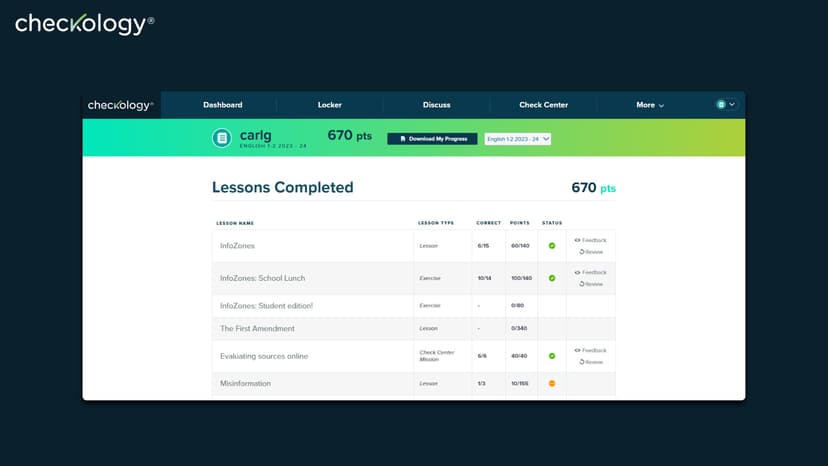
- Provides a comprehensive teacher dashboard for tracking individual student mastery and module completion rates.
- Uses active retrieval practice through interactive quizzes to test immediate comprehension of core concepts.
- Supports blended learning by offering offline materials alongside digital instruction modules.
Cons
- Lacks automated spaced repetition mechanics to reinforce learning and combat the forgetting curve over time.
- Relies heavily on external teacher facilitation rather than adapting dynamically to individual student struggles.
- Provides limited automated scaffolding for students who repeatedly fail to grasp complex topics like algorithmic bias.
What Do We Know About Checkology® Virtual Classroom?
Checkology is an effective tool for teaching your child how to navigate modern media, provided it is supported by active classroom instruction. It teaches middle and high school students to evaluate the credibility of news, understand social media algorithms, and spot generative AI. The platform relies heavily on direct instruction paired with quizzes, meaning your child will watch expert-led videos and then practice identifying bias or misinformation in real-world examples. Because the platform uses worked examples to show the steps of verifying a source before asking the student to do it independently, it successfully reduces cognitive load when introducing complex topics like the First Amendment. However, Checkology does not use adaptive learning algorithms. If your child struggles with a concept, the software will not automatically adjust the difficulty or provide varied practice sets. It functions best as a blended learning curriculum rather than a standalone tutor. Parents should know that while the content is rigorous and highly relevant, long-term retention of these critical thinking skills will require you or their teacher to continually reinforce these concepts outside the app.
How Does Checkology® Virtual Classroom Work?
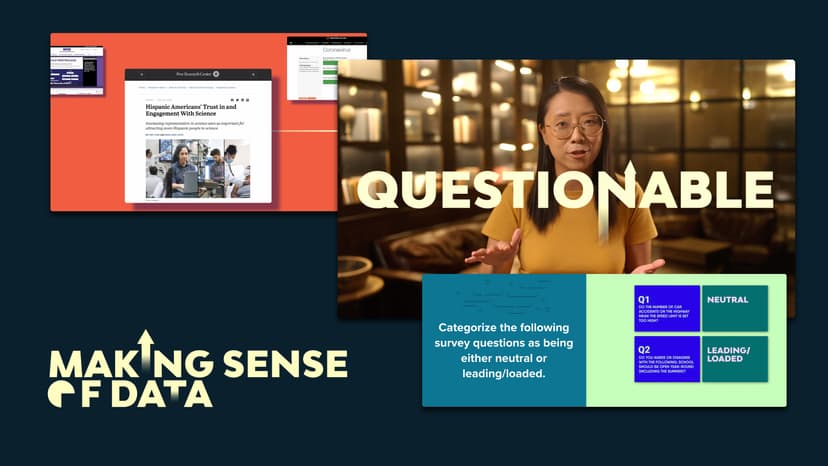
Checkology uses a blended learning approach that combines expert-led direct instruction with interactive retrieval practice. Students log into a virtual classroom where teachers assign specific modules covering topics like algorithmic bias or source verification. The core learning mechanic centers on worked examples where journalists and media experts break down real pieces of news or social media posts, explaining how to analyze them for credibility. After the instructional segment, students complete formative assessments, such as quizzes and interactive categorization tasks, to practice applying these analytical skills. The platform includes a teacher dashboard that captures granular data on student performance, allowing educators to monitor completion rates and quiz scores. While the digital platform handles the primary delivery of content and immediate assessment, it includes supplementary offline materials like lesson plans and classroom slides designed to facilitate deeper, cross-curricular discussions in a traditional classroom setting.
Strengths and tradeoffs of Checkology® Virtual Classroom
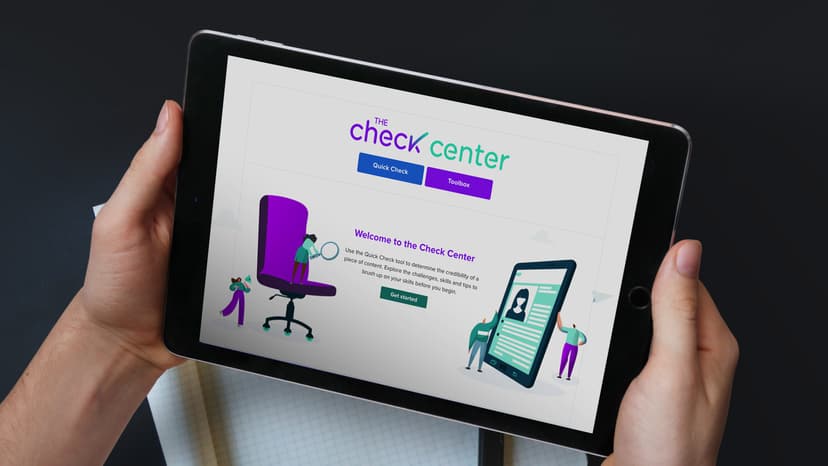
Checkology's biggest strength is its use of authentic, real-world worked examples to teach media literacy, while its biggest weakness is the absence of automated spaced repetition to ensure long-term skill retention. The platform excels at contextualized learning. By using actual social media posts, news articles, and AI-generated images, it builds a robust cognitive schema that helps students transfer their learning directly to the platforms they use daily. The inclusion of formative assessments immediately after direct instruction ensures that students engage in retrieval practice, which strengthens initial comprehension. However, the platform lacks interleaved practice and spaced repetition. Once a student finishes a module on the First Amendment, the system does not systematically re-test that knowledge in later modules to combat the forgetting curve. Furthermore, the platform lacks adaptive scaffolding. If a student consistently fails to identify misinformation in the practice sets, Checkology relies on the teacher to intervene rather than automatically adjusting the difficulty or providing alternative instructional pathways. It is a highly relevant curriculum, but it requires strong educator facilitation to maximize its pedagogical value.
Who Might Benefit From Checkology® Virtual Classroom?
Checkology is best for middle and high school educators who need a structured, interactive curriculum to integrate media literacy into their humanities or social science classes. Designed specifically for grades five through twelve, the platform serves students who are beginning to consume news and social media independently. It is highly effective for classrooms adopting a blended learning model, as it provides a comprehensive suite of digital modules, offline lesson plans, and grading dashboards. It is not ideal as a standalone, unguided app for individual students at home.
Data Transparency
Does Not Meet Data Transparency Standard
Checkology® Virtual Classroom reaches Level 1 of 3 (Basic protections), below our data transparency standard. Reaching Level 2 needs the policy to document data export, named service providers and self-service deletion.
17 of 35 checks passed
Evaluated September 2026
Privacy Policy →Level 1 · Basic protections
Does not sell data or target ads at students, limits sharing, and lets parents see and delete their child's data.
Level 2 · Parent control (meets the standard)
Families can get their data out, know who processes it, and know how long it is kept.
Not documented: data export, named service providers, self-service deletion
Level 3 · Direct data access
Families or schools can pull their own data through an API, in a stated format.
Not documented: an API for retrieving their own data, a named export format
View all 35 checks
Parent Access6/8
Does the policy mention parents specifically?
“Parents have the right to review the personal information that we have collected about their student, to delete it, and to tell us to no longer use such personal information.”
Can parents view their child's data?
“Parents should contact us at [info@newslit.org](mailto:info@newslit.org) to request access to their student’s personal information or deletion of their child’s account.”
Can parents modify their child's data?
The policy lets parents review, delete, or stop the use of their child's data but does not say they can correct or change it.
Can parents delete their child's account?
“Parents should contact us at [info@newslit.org](mailto:info@newslit.org) to request access to their student’s personal information or deletion of their child’s account.”
Is there a dedicated Children's Privacy section?
“How Do We Protect a Child’s Personal Information?”
Does it reference COPPA compliance?
“This Privacy Notice is designed to comply with the Children’s Online Privacy Protection Act (“ **COPPA**”)”
Does it reference FERPA compliance?
The policy does not mention FERPA.
Is parental consent required for child accounts?
“We rely on the teacher and the educational institution to obtain consent from the parents of the students for the collection and use of personal information collected from the students as described in this notice.”
Data Portability1/5
Can users access their personal data?
“Parents should contact us at [info@newslit.org](mailto:info@newslit.org) to request access to their student’s personal information or deletion of their child’s account.”
Can users download/export their data?
The policy does not say users can download or export their data.
Is there a self-service data access tool?
The policy only offers access through an email request, not a self-service tool.
Is a specific data format mentioned for export?
The policy does not name any export format.
Is there an API for data access?
The policy does not mention an API for getting data.
Data Minimization1/6
Is data collection itemized?
“We may automatically collect the following identifiable information about users of the Platform through cookies, web beacons, and other technologies: domain name, browser type, operating system, web pages viewed while logged in, links clicked, the length of time spent on our Site, and the referring URL for the purpose of internal reporting and platform improvement.”
Can the app be used without a real name?
The policy says teachers may provide the student's name and that students may register with their name.
Can the app be used without an email?
The policy says students may register using their email address.
Does it state collection is limited to what is necessary?
The policy does not say collection is limited to what is necessary.
Is IP address anonymized or truncated?
The policy says it may collect IP addresses but does not say they are anonymized or truncated.
Is location tracking explicitly excluded?
The policy does not address location tracking.
Third-Party Protection4/7
Does it explicitly state no selling of data?
“We do not sell personal information about students and we do not use personal information for advertising, including online behavioral advertising or marketing purposes.”
Are third-party providers named?
The policy mentions third-party vendors but does not name any.
Are providers contractually restricted?
“We seek contractual assurances from our vendors that they will maintain the privacy and security of such information and only use it as provided in this notice.”
No-targeted-advertising commitment?
“We do not sell personal information about students and we do not use personal information for advertising, including online behavioral advertising or marketing purposes.”
Is AI/ML data sharing addressed?
The policy does not address AI or machine learning.
Child-specific sharing restriction?
“We do not sell personal information about students and we do not use personal information for advertising, including online behavioral advertising or marketing purposes.”
Cookies/tracking limited or opt-out?
The policy describes cookie collection for internal reporting but offers no opt-out or limit on tracking.
Deletion & Retention4/5
Can users delete their account?
“Parents should contact us at [info@newslit.org](mailto:info@newslit.org) to request access to their student’s personal information or deletion of their child’s account.”
Self-service deletion mechanism?
The policy only allows deletion through an email request, not a self-service tool.
Specific data retention timeline?
“NLP deletes personal information about students who use the Checkology® Platform every twelve (12) months.”
Auto-deletion of inactive accounts?
“NLP deletes personal information about students who use the Checkology® Platform every twelve (12) months.”
Post-deletion handling described?
“Note that, where permitted under applicable law, information may continue to be stored and used if required by law or legal process or to defend ourselves from a legal claim, to enforce our Terms of Use or Platform rules, or to protect the safety and security of our users and our Platform.”
Advertising1/4
Advertising model explicitly disclosed?
The policy says personal information is not used for advertising but does not say whether the product shows ads.
Free from third-party advertisements?
The policy does not say the product is free of third-party ads.
Children excluded from ad targeting?
“We do not sell personal information about students and we do not use personal information for advertising, including online behavioral advertising or marketing purposes.”
Ad-free option available?
The policy does not say the product has no ads or offers an ad-free option.
What This Means
The policy review did not meet our data transparency standard. The checks above show the documented findings and unknowns. A missing statement does not establish how the app handles data in practice.
About this evaluation: Based on automated analysis of Privacy Policy against 35 policy-disclosure questions, including questions adapted from the Common Sense Privacy Program's published evaluation questions. TLS is not affiliated with Common Sense Media, and this is not a Common Sense rating. Quoted text is copied from the policy; unquoted notes are our summary. Results describe what the policy documents, not the company's actual practices. Privacy policies can change: this review reflects the version we analyzed and does not determine legal compliance.
Sources and review method
TLS combines product information and editorial analysis to explain how Checkology® Virtual Classroom works, its tradeoffs, and the questions to ask before choosing it. Product features, an instructional rationale and evidence of learning outcomes are different kinds of information.
Formal Learning Standard assessment: not yet completed. Data Transparency findings are reported separately and do not establish learning effectiveness. Read our methodology.
Frequently Asked Questions About Checkology® Virtual Classroom
Is Checkology® Virtual Classroom free?
Yes, Checkology® Virtual Classroom is entirely free for both educators and students. The News Literacy Project operates as a non-profit and provides full access to the interactive classroom, teacher dashboard, and all supplementary materials like lesson plans and posters without any subscription fees, premium tiers, or hidden paywalls. This makes it a highly accessible and equitable resource for public school districts and independent learners alike.
Is Checkology® Virtual Classroom good for middle school students?
Yes, Checkology® Virtual Classroom is highly appropriate for middle school and high school students in grades five through twelve. It introduces complex concepts like algorithmic bias and the First Amendment using age-appropriate worked examples. However, younger students in fifth or sixth grade will likely require heavy teacher facilitation and direct guidance to fully grasp the more abstract media literacy concepts presented in the modules.
What does Checkology® Virtual Classroom teach?
Checkology® Virtual Classroom teaches critical media and news literacy skills grounded in real-world application. Students learn how to evaluate the credibility of sources, recognize generative AI imagery, understand how social media algorithms filter information, and apply First Amendment principles. The curriculum focuses on building cognitive schemas for identifying misinformation in digital environments, utilizing direct instruction and immediate formative assessments to test student comprehension.
Has Checkology® Virtual Classroom been evaluated by The Learning Standard?
No, Checkology® Virtual Classroom is currently pending evaluation by The Learning Standard. The Learning Standard's research team has not yet conducted a full empirical review of its specific learning outcomes or classroom efficacy. Once evaluated, it will be strictly assessed against our official methodology to determine its exact pedagogical impact, including its use of spaced repetition, cognitive load management, and overall student knowledge retention.
Checkology® Virtual Classroom vs iCivics: Which is better?
Both platforms serve civic education, but they target fundamentally different skill sets. Checkology® Virtual Classroom focuses strictly on media literacy, source verification, and navigating digital information ecosystems using real-world examples. iCivics gamifies broader democratic processes, teaching how government branches function and how laws are formulated through simulation. Educators often use both platforms together to provide a comprehensive, blended learning curriculum covering both civics and media literacy.
Has The Learning Standard evaluated Checkology® Virtual Classroom?
TLS has not yet completed a Learning Standard evaluation of how well Checkology® Virtual Classroom teaches. Its privacy policy has been reviewed for Data Transparency and reaches Level 1, Basic protections.
Is Checkology® Virtual Classroom COPPA compliant?
The reviewed privacy policy references COPPA. A policy reference alone does not establish COPPA compliance. Policy review note: The policy says it is designed to comply with COPPA.
Is Checkology® Virtual Classroom FERPA compliant?
A FERPA reference was not found in the reviewed privacy policy. This does not determine whether the app complies with FERPA. Policy review note: The policy does not mention FERPA.
Does Checkology® Virtual Classroom have a children's privacy policy?
The reviewed policy includes a dedicated children's privacy section. Policy review note: The policy has a section with its own heading about protecting children's personal information.
Does Checkology® Virtual Classroom sell student data?
The reviewed policy states that the app does not sell data. This is a policy statement; actual data practices were not verified. Policy review note: The policy states the company does not sell students' personal information.
Can you delete your data from Checkology® Virtual Classroom?
The reviewed privacy policy describes account deletion. We have not tested the deletion process. Policy review note: Account deletion is available on request.
Follow TLS Research
Subscribe to future TLS research updates: app reviews, findings, and what the evidence shows.
Screenshots

Take Action
For Checkology® Virtual Classroom
If you represent The News Literacy Project and have a correction or new evidence, send the relevant source so we can review and update this page.
Submit a correctionDetails
- Pricing
- Checkology® Virtual Classroom is FREE for educators and students!
- Platforms
- Web Browser
- Grade Levels
- 5th Grade, 6th Grade, 7th Grade, 8th Grade, 9th Grade, 10th Grade, 11th Grade, 12th Grade
- Website
- Visit site