Boxie
Product by Boxie
Facts checked: Not yet checked
Our take (not a Learning Standard rating). This label applies to learning-science judgments throughout this overview.
Our take (not a Learning Standard rating)
Boxie provides a versatile multimedia platform for educators to build interactive video and text lessons, but its effectiveness depends entirely on how the instructor designs the content. While embedding interactive questionnaires within videos supports retrieval practice, the reliance on auto-generated AI assessments requires careful educator oversight to ensure pedagogical alignment.
Pros
- Embeds interactive activities directly into video content to support immediate retrieval practice.
- Offers an AI-powered student video assistant that can provide personalized, just-in-time scaffolding.
- Allows educators to layer multiple modalities, such as text and games, reducing split-attention effects when designed well.
- Automates assessment generation to help teachers quickly implement frequent low-stakes testing.
Cons
- Effectiveness relies completely on the quality of the instructor's content rather than a scientifically backed, built-in curriculum.
- Auto-generated AI assessments often test surface-level recall rather than the deep alignment required for true mastery-based progression.
- The abundance of interactive pins and links risks cognitive overload for younger students.
- Pricing transparency is completely lacking, requiring schools to contact the vendor directly before evaluating cost.
What Do We Know About Boxie?
Boxie acts as an empty vessel that is only as effective for learning as the teacher who creates the lessons within it. You will not find a pre-packaged curriculum here for your child to simply open and play. Instead, your child's school or instructor uses Boxie to transform standard videos and digital books into interactive assignments. When your child watches a video lesson, they will encounter embedded questions, links, and games designed by their teacher. This approach leans heavily on retrieval practice, forcing your child to recall information immediately after learning it rather than passively watching a screen. The platform also uses artificial intelligence to generate quizzes and offer a virtual assistant. While this technology can provide helpful, immediate feedback when your child gets stuck, it also means educators must actively monitor the AI to ensure it aligns with the actual learning goals. Because Boxie relies on schools for content creation, your child's experience will vary wildly depending on how their specific teacher utilizes the interactive features. If the instructor uses the tool to provide frequent, low-stakes testing and clear worked examples, your child will benefit greatly. If used poorly, the extra links and interactive pins may simply cause cognitive overload.
How Does Boxie Work?
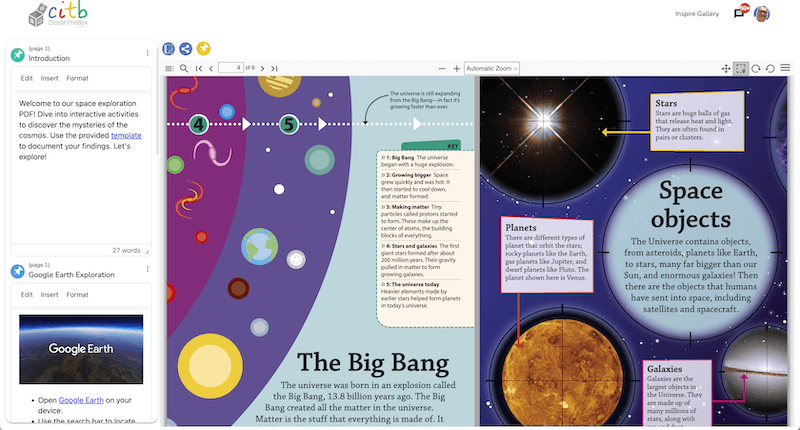
Boxie uses a multimodal instructional delivery approach that relies on educators to construct personalized learning paths through enhanced media. Teachers upload or select video and text content, then use a pinning system to overlay interactive elements directly onto the media. As a student progresses through a digital book or video, the playback pauses to present questionnaires, games, or supplemental text. This forces active engagement and allows for immediate formative assessment. The platform integrates artificial intelligence to assist both teachers and students. For educators, the AI auto-generates assessments based on the uploaded material, reducing the friction of creating frequent practice sets. For students, an AI video assistant provides contextual help during the lesson. This setup supports competency-based learning by allowing students to review embedded worked examples and answer questions at their own pace. However, the system functions strictly as a delivery mechanism and authoring tool, meaning the actual pedagogy relies heavily on the instructor's understanding of learning science to sequence the interactive pins effectively.
Strengths and tradeoffs of Boxie
Boxie's biggest strength is its ability to turn passive video consumption into active retrieval practice, while its biggest weakness is the risk of cognitive overload caused by poorly designed multimedia overlays. Active Engagement: By embedding questionnaires directly into the video timeline, Boxie prevents students from simply zoning out. This method leverages the testing effect, strengthening memory retention by forcing students to recall information in the moment. Multimodal Learning: Educators can combine text, video, and interactive games in a single environment. When used correctly, this supports dual coding theory by presenting information verbally and visually. Cognitive Overload Risks: The platform's extensive pinning system allows teachers to add numerous links, activities, and text boxes to a single screen. Without careful design, these extraneous elements can overwhelm a student's working memory, distracting from the core learning objective. AI Dependency: The reliance on AI for auto-generating assessments and providing a student assistant offers scale but introduces quality control issues. AI-generated questions often test surface-level recall rather than deep conceptual understanding. Educators must heavily curate these auto-generated items to ensure they provide meaningful feedback and accurately measure mastery.
Who Might Benefit From Boxie?
Boxie is best for proactive middle and high school educators who want to build highly interactive, custom multimedia lessons for their classrooms. It serves as a powerful authoring tool for teachers aiming to implement flipped classroom models or personalized learning stations. Because it requires reading comprehension and independent navigation, it is less suitable for early elementary students unless heavily guided. The platform excels in environments where schools want to enhance existing video libraries with embedded formative assessments and AI-driven scaffolding, rather than relying on off-the-shelf curriculum packages.
Sources and review method
TLS combines product information and editorial analysis to explain how Boxie works, its tradeoffs, and the questions to ask before choosing it. Product features, an instructional rationale and evidence of learning outcomes are different kinds of information.
Formal Learning Standard assessment: not yet completed. Data Transparency findings are reported separately and do not establish learning effectiveness. Read our methodology.
Frequently Asked Questions About Boxie
Is Boxie free?
No pricing information is publicly available, as Boxie requires educators or schools to contact the vendor directly for enterprise or classroom licenses.
Is Boxie good for elementary students?
Boxie is better suited for older students who can navigate complex, multi-layered digital environments independently. Younger children may experience cognitive overload from the interactive overlays unless teachers design highly simplified lessons.
What does Boxie teach?
Boxie does not teach specific subjects out of the box. It is a content-agnostic platform that allows educators to build and deliver interactive lessons for any subject across all grade levels.
Can Boxie replace a traditional curriculum?
No. Boxie operates as a delivery mechanism and lesson enhancement tool, meaning schools must still provide the underlying curriculum and subject matter expertise to construct the learning materials.
Has The Learning Standard evaluated Boxie?
TLS has not yet completed a Learning Standard evaluation of how well Boxie teaches. TLS has not published a Data Transparency result for its privacy policy.
Follow TLS Research
Subscribe to future TLS research updates: app reviews, findings, and what the evidence shows.
Screenshots

Take Action
For Boxie
If you represent Boxie and have a correction or new evidence, send the relevant source so we can review and update this page.
Submit a correctionDetails
- Pricing
- Contact vendor for pricing.
- Platforms
- Web Browser
- Website
- Visit site