
Banzai
Product by Banzai Inc
Facts checked: Not yet checked
Our take (not a Learning Standard rating). This label applies to learning-science judgments throughout this overview.
Our take (not a Learning Standard rating)
Banzai leverages scenario-based learning to teach financial literacy, allowing students to experience the consequences of decisions in a safe environment. While its real-world application of math and budgeting principles is strong, The Learning Standard has not yet formally evaluated its long-term impact on financial behavior or core concept retention.
Pros
- Applies situated learning by placing students in realistic financial scenarios that require active decision-making.
- Uses immediate feedback to show the direct consequences of spending and saving choices.
- Integrates cross-curricular skills by requiring students to use basic arithmetic to balance budgets and track expenses.
- Provides supplementary worksheets and calculators to support varied instructional methods and offline practice.
Cons
- Lacks built-in spaced repetition to ensure long-term retention of complex financial terminology.
- Relies heavily on text-based scenarios that present a high cognitive barrier for struggling readers.
- Does not adapt scenario difficulty based on the learner's ongoing performance or mastery level.
What Do We Know About Banzai?
Banzai is an effective tool for introducing financial literacy concepts through experiential learning, though its long-term impact on your child's financial behavior remains unevaluated by The Learning Standard. The platform drops your child into simulated life scenarios, like saving for a goal or managing an unexpected medical expense, where they must make choices and face immediate consequences. This approach relies on situated learning theory, which suggests that learning is most effective when embedded in the realistic context in which it will be used. Rather than simply memorizing terms like interest or overdraft, your child actively navigates them. Parents should be aware that the program requires a strong baseline of reading comprehension, as the scenarios are heavily text-based. Additionally, while the app excels at creating realistic short-term consequences, it does not employ spaced repetition to cement vocabulary or mathematical formulas over time. Because local financial institutions sponsor the platform, it is entirely free, but your child will occasionally see the sponsoring bank's logo. It serves best as a practical application tool to supplement direct instruction on personal finance.
How Does Banzai Work?
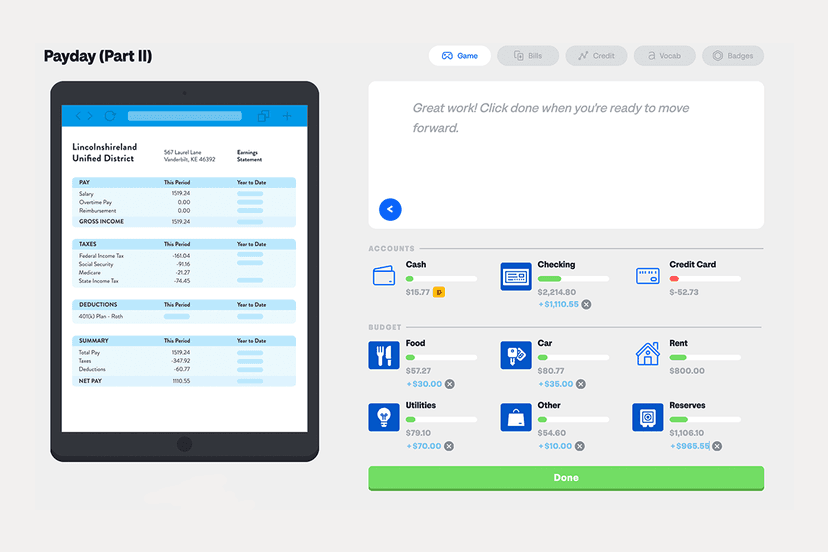
Banzai uses a scenario-based, gamified progression where students navigate branching financial narratives to reach specific monetary goals. When your child begins a course, they are assigned a distinct objective, such as saving for college or buying a car. The platform guides them through a series of simulated life events where they earn income, pay bills, and encounter unexpected expenses. Users must physically allocate digital funds into different categories, practicing the zero-based budgeting method. Every decision triggers immediate feedback; choosing to spend money on a non-essential item might leave them short on rent later in the simulation, directly illustrating opportunity cost. The system tracks their budget in real-time, requiring students to reconcile their accounts and apply basic arithmetic to progress. Supplemental worksheets and calculators reinforce the math required to complete the digital modules.
Strengths and tradeoffs of Banzai
Banzai's greatest strength is its application of situated cognition through realistic financial simulations, while its primary weakness is the lack of adaptive scaffolding for learners who struggle with foundational math or reading concepts. Scenario-Based Application: The app excels at moving beyond rote memorization. By forcing students to make discrete choices, like deciding between cheap, unreliable auto insurance or a comprehensive plan, it utilizes active learning and allows students to experience the pain of unexpected costs in a low-stakes environment. Immediate Feedback: As students mismanage funds, the system provides immediate, logical consequences rather than arbitrary point deductions, which helps correct misconceptions about budgeting. Lack of Adaptive Scaffolding: However, the platform is entirely linear. If a student consistently fails to balance their budget, the system does not dynamically adjust the difficulty or provide worked examples to reteach the underlying arithmetic. High Cognitive Load: The scenarios require simultaneously managing multiple variables, which can overwhelm working memory for younger students or those without prior exposure to basic financial concepts. Missing Retrieval Practice: The app teaches concepts in isolated scenarios but does not utilize spaced retrieval practice to ensure students retain knowledge of financial terminology months later.
Who Might Benefit From Banzai?
Banzai is best for middle and high school students who need practical, risk-free environments to apply foundational personal finance skills. While the developer markets to grades 3 through adult, the text-heavy scenarios and complex variables are most appropriate for learners in 6th grade and above. It is an ideal supplemental resource for educators teaching career and technical education or applied math, and for parents wanting to introduce their children to real-world budgeting, opportunity cost, and financial decision-making before they earn their first actual paycheck.
Data Transparency
Does Not Meet Data Transparency Standard
Banzai does not meet our data transparency standard. Its privacy policy does not document basic protections, including parents' right to see their child's data and parents' right to delete their child's data.
14 of 35 checks passed
Evaluated September 2026
Privacy Policy →Level 1 · Basic protections
Does not sell data or target ads at students, limits sharing, and lets parents see and delete their child's data.
Not documented: parents' right to see their child's data, parents' right to delete their child's data
Level 2 · Parent control (meets the standard)
Families can get their data out, know who processes it, and know how long it is kept.
Not documented: users' right to access their data, data export, self-service deletion
Level 3 · Direct data access
Families or schools can pull their own data through an API, in a stated format.
Not documented: an API for retrieving their own data, a named export format
View all 35 checks
Parent Access3/8
Does the policy mention parents specifically?
“We do not collect, maintain, use, or share Student PII beyond what is needed for authorized educational/school purposes or as authorized by the parent/student.”
Can parents view their child's data?
The policy does not give parents a right to view their child's data.
Can parents modify their child's data?
The policy does not give parents a right to modify their child's data.
Can parents delete their child's account?
The policy lets users and the school district request deletion but does not give parents a deletion right.
Is there a dedicated Children's Privacy section?
“### Children's Online Privacy Protection Act Compliance”
Does it reference COPPA compliance?
“Note that birth dates provided by student users under the age of thirteen as part of our COPPA compliance process will not be used for any other purpose and are deleted from our systems as soon as technically feasible.”
Does it reference FERPA compliance?
The policy does not mention FERPA.
Is parental consent required for child accounts?
The policy says it never knowingly collects personal information from children under 13 and does not describe a parental consent requirement.
Data Portability0/5
Can users access their personal data?
The policy does not give users a right to access their personal data.
Can users download/export their data?
The policy does not address downloading or exporting data.
Is there a self-service data access tool?
The policy does not describe a self-service data access tool.
Is a specific data format mentioned for export?
The policy does not mention an export format.
Is there an API for data access?
The policy does not mention an API for data access.
Data Minimization1/6
Is data collection itemized?
The policy describes collection only in broad categories, such as 'various pieces of information', without listing specific data items.
Can the app be used without a real name?
The policy does not state that the service can be used without the student's real name.
Can the app be used without an email?
The policy blocks email only for students who say they are 12 or younger and otherwise may collect email addresses.
Does it state collection is limited to what is necessary?
“We do not collect, maintain, use, or share Student PII beyond what is needed for authorized educational/school purposes or as authorized by the parent/student.”
Is IP address anonymized or truncated?
The policy says IP addresses may be given to third parties and does not mention anonymizing them.
Is location tracking explicitly excluded?
The policy does not address location tracking.
Third-Party Protection6/7
Does it explicitly state no selling of data?
“We will not sell Student PII.”
Are third-party providers named?
“Banzai uses essential cookies and third-party analytics tools (such as Google Analytics and PostHog) to monitor platform performance and improve services.”
Are providers contractually restricted?
“Authorized personnel at these organizations may be given access to databases containing user information for the sole purpose of performing technical maintenance tasks. In these cases, we will require that vendors follow our commitments to Student PII.”
No-targeted-advertising commitment?
“Banzai does not use or disclose student information collected through our services for behavioral targeting of advertisements to students, nor do we build personal profiles beyond supporting authorized educational purposes.”
Is AI/ML data sharing addressed?
The policy does not address AI or machine learning.
Child-specific sharing restriction?
“our information sharing of student user website data with other non-affiliated third parties is strictly limited to aggregated reporting and contains _no_ personally-identifiable information.”
Cookies/tracking limited or opt-out?
“These cookies are used solely for maintaining your session and ensuring a seamless user experience.”
Deletion & Retention3/5
Can users delete their account?
“If you do not intend to make further use of your Banzai account and would like us to permanently delete your user data send an email with your request to Banzai to privacy@banzai.org.”
Self-service deletion mechanism?
The policy provides deletion only by email request, not through a self-service tool.
Specific data retention timeline?
“Upon written request from the LEA, Banzai will dispose of or securely transfer all Student Data within 90 days, ensuring it is not retained beyond the agreed period unless required by law.”
Auto-deletion of inactive accounts?
The policy says user data may remain on its servers after the user stops using the account and does not describe auto-deletion.
Post-deletion handling described?
“Upon receiving this request, we will delete your user account and all associated data from our active website user database. Note, however, that your data may remain in our database backup files for a period of time.”
Advertising1/4
Advertising model explicitly disclosed?
The policy bars targeted advertising to students but does not describe its advertising model or say the product has no ads.
Free from third-party advertisements?
The policy does not state that the product is free of third-party ads.
Children excluded from ad targeting?
“Banzai does not use or disclose student information collected through our services for behavioral targeting of advertisements to students”
Ad-free option available?
The policy does not state the product has no advertising or offer an ad-free option.
What This Means
The policy review did not meet our data transparency standard. The checks above show the documented findings and unknowns. A missing statement does not establish how the app handles data in practice.
About this evaluation: Based on automated analysis of Privacy Policy against 35 policy-disclosure questions, including questions adapted from the Common Sense Privacy Program's published evaluation questions. TLS is not affiliated with Common Sense Media, and this is not a Common Sense rating. Quoted text is copied from the policy; unquoted notes are our summary. Results describe what the policy documents, not the company's actual practices. Privacy policies can change: this review reflects the version we analyzed and does not determine legal compliance.
Sources and review method
TLS combines product information and editorial analysis to explain how Banzai works, its tradeoffs, and the questions to ask before choosing it. Product features, an instructional rationale and evidence of learning outcomes are different kinds of information.
Formal Learning Standard assessment: not yet completed. Data Transparency findings are reported separately and do not establish learning effectiveness. Read our methodology.
Frequently Asked Questions About Banzai
Is Banzai free?
Yes, Banzai is completely free for all students, parents, and teachers. The platform is funded through a sponsorship model where local community banks and credit unions cover the costs. You will see the sponsoring institution's logo on the platform, but it does not include direct advertising or upselling.
What does Banzai teach?
Banzai teaches personal finance, basic budgeting, and financial decision-making. Students learn concepts like opportunity cost, reconciling bank statements, saving for goals, and managing unexpected expenses. The curriculum requires applied math skills to track income and expenditures across various realistic scenarios.
Is Banzai good for elementary students?
Partially. While Banzai offers a Banzai Junior course aimed at grades 3-5, the heavy reliance on reading comprehension and the cognitive load of managing multiple budget categories can overwhelm younger children. It is highly effective for middle and high school students.
How does Banzai compare to Everfi?
Both Banzai and Everfi offer free, sponsored financial literacy programs, but Banzai focuses more heavily on simulation and gamified budgeting. Everfi uses more traditional module-based learning with instructional videos and quizzes. Banzai is better for experiential, scenario-based learning, while Everfi offers broader coverage of microeconomic concepts.
Has The Learning Standard evaluated Banzai?
TLS has not yet completed a Learning Standard evaluation of how well Banzai teaches. Its privacy policy has been reviewed for Data Transparency and does not yet document the basic protections (Level 1).
Is Banzai COPPA compliant?
The reviewed privacy policy references COPPA. A policy reference alone does not establish COPPA compliance. Policy review note: The policy refers to its COPPA compliance process.
Is Banzai FERPA compliant?
A FERPA reference was not found in the reviewed privacy policy. This does not determine whether the app complies with FERPA. Policy review note: The policy does not mention FERPA.
Does Banzai have a children's privacy policy?
The reviewed policy includes a dedicated children's privacy section. Policy review note: The policy has a section headed for COPPA compliance.
Does Banzai sell student data?
The reviewed policy states that the app does not sell data. This is a policy statement; actual data practices were not verified. Policy review note: The policy states the vendor will not sell Student PII.
Can you delete your data from Banzai?
The reviewed privacy policy describes account deletion. We have not tested the deletion process. Policy review note: Users can request account and data deletion by email.
Follow TLS Research
Subscribe to future TLS research updates: app reviews, findings, and what the evidence shows.
Screenshots



Take Action
For Banzai
If you represent Banzai Inc and have a correction or new evidence, send the relevant source so we can review and update this page.
Submit a correctionDetails
- Pricing
- Banzai is free for all students and teachers because of local community sponsorships in every state.
- Platforms
- iOS (Apple mobile), iPadOS (Apple tablet), Android (Google mobile), Tizen (Samsung mobile), Windows (Microsoft), macOS (Apple), Chrome OS (Google)
- Grade Levels
- 3rd Grade, 4th Grade, 5th Grade, 6th Grade, 7th Grade, 8th Grade, 9th Grade, 10th Grade, 11th Grade, 12th Grade, Adult Education
- Website
- Visit site